Geometric Proofs
Not sure you’re ready?
Take the ~3-minute readiness diagnostic and see where you stand.
A geometric proof is not merely a sequence of statements; it is a weight-bearing architectural structure built from pure logic. In secondary mathematics, students often view geometry as a collection of optical observations—they look at a diagram, see that two lines appear parallel, and assume it to be true. As an educator, your task is to dismantle this optical illusion and replace it with deductive certainty. You are teaching them how to construct an unbreakable chain of reasoning where every conclusion is irrevocably anchored to an established truth.
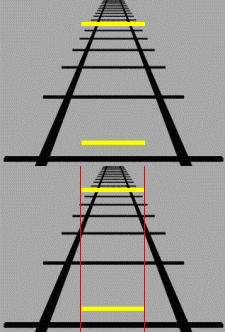
To evaluate or construct a rigorous geometric proof, one must justify every single step with a given premise, definition, postulate, or previously proven theorem. We do not accept assumptions. The bedrock of this system relies on the postulate or axiom, which is a foundational mathematical statement accepted as true without requiring formal proof. From these axioms, we build our theorems.
The mechanics of this construction rely on formal rules of logical inference:
- Modus Ponens: A logical rule stating that if a conditional statement is true and the hypothesis is true, then the conclusion must necessarily be true. (If P→Q, and P is true, then Q is true).
- Modus Tollens: A logical rule stating that if a conditional statement is true and the conclusion is false, then the hypothesis must necessarily be false. (If P→Q, and Q is false, then P is false).
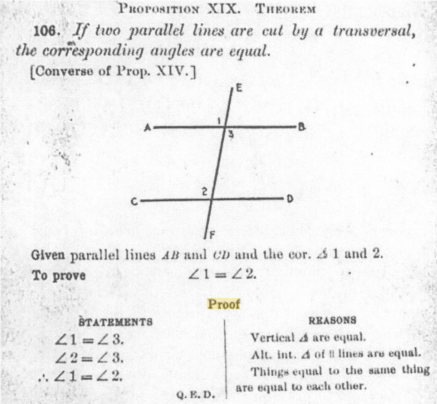
When we prove theorems, we generally employ two distinct methodologies:
- A direct proof logically deduces a conclusion directly from accepted premises, axioms, and previously established theorems. We start at the foundation and build straight up to the roof.
- An indirect proof (proof by contradiction) assumes the negation of the desired conclusion and demonstrates that the negation leads to a logical contradiction. If assuming the conclusion is false breaks the laws of mathematics, the conclusion must be true.
Fallacies and Refutations
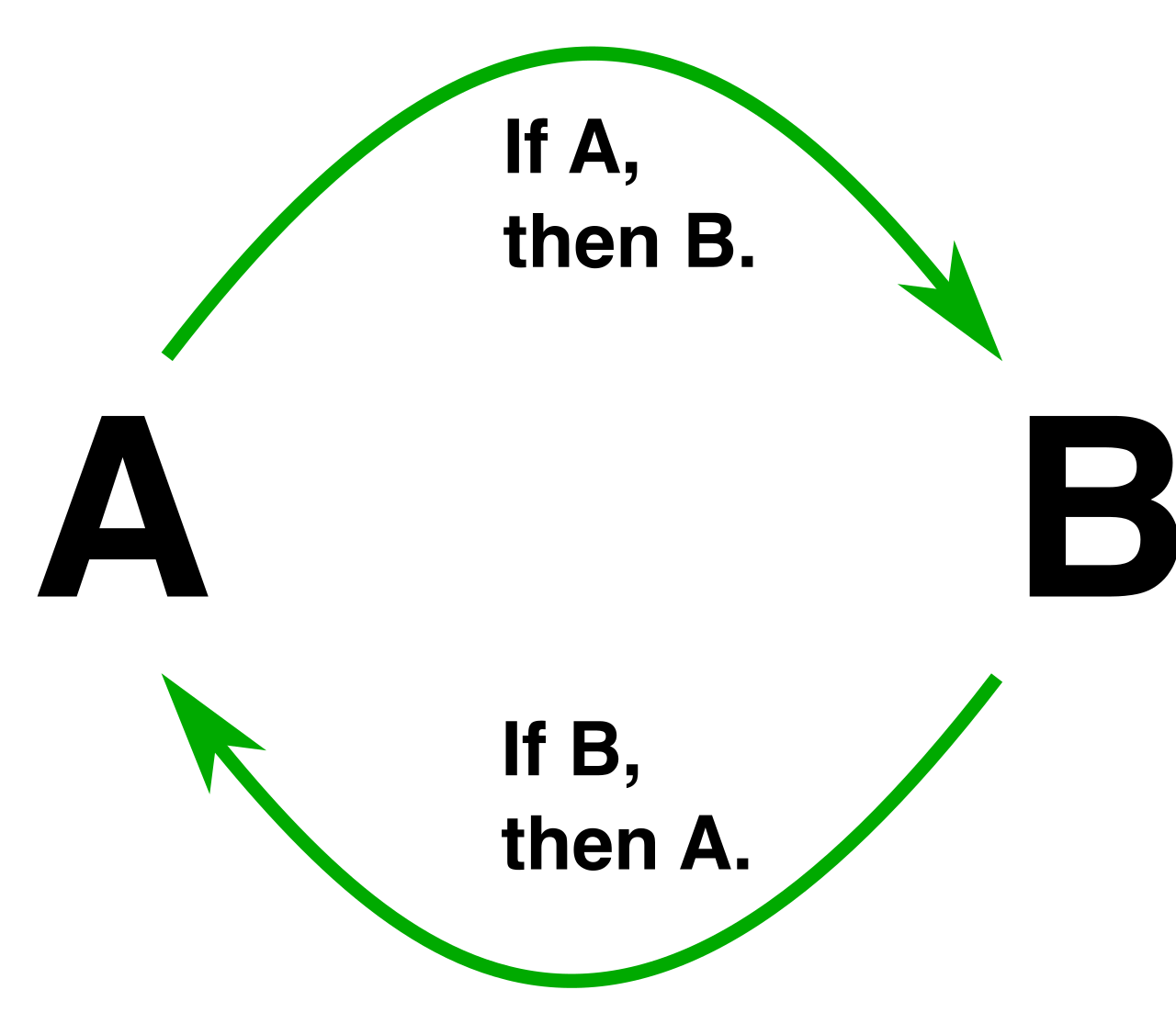
Your students will make logical missteps. Recognizing these is crucial for Praxis 5165 and for your classroom. Watch out for assuming the converse, a logical fallacy where the truth of a conditional statement is incorrectly used to justify the truth of the reversed conditional statement. For example, "If a shape is a square, it has four sides" is true, but its converse, "If a shape has four sides, it is a square," is demonstrably false. Equally dangerous is circular reasoning in a geometric proof, which occurs when the statement being proven is implicitly or explicitly assumed as a starting premise.
When a student presents a flawed universal claim, how do you dismantle it? You use a counterexample, a specific case demonstrating that a general mathematical statement is false. The beauty of mathematics is its strictness: a single valid counterexample is logically sufficient to invalidate a universally quantified geometric statement. You do not need a dozen examples; one shattered condition brings down the entire claim.
Before we can build polygons, we must understand the behavior of intersecting lines.
The Vertical Angles Theorem states that the angles opposite each other when two straight lines intersect are congruent.
This is a beautiful, intuitive direct proof relying on straight lines. Because a straight line measures 180 degrees, adjacent angles on that line are related. The Linear Pair Postulate states that if two angles form a linear pair, the two angles are supplementary. Supplementary angles are precisely defined as two angles whose measures add up to exactly 180 degrees.
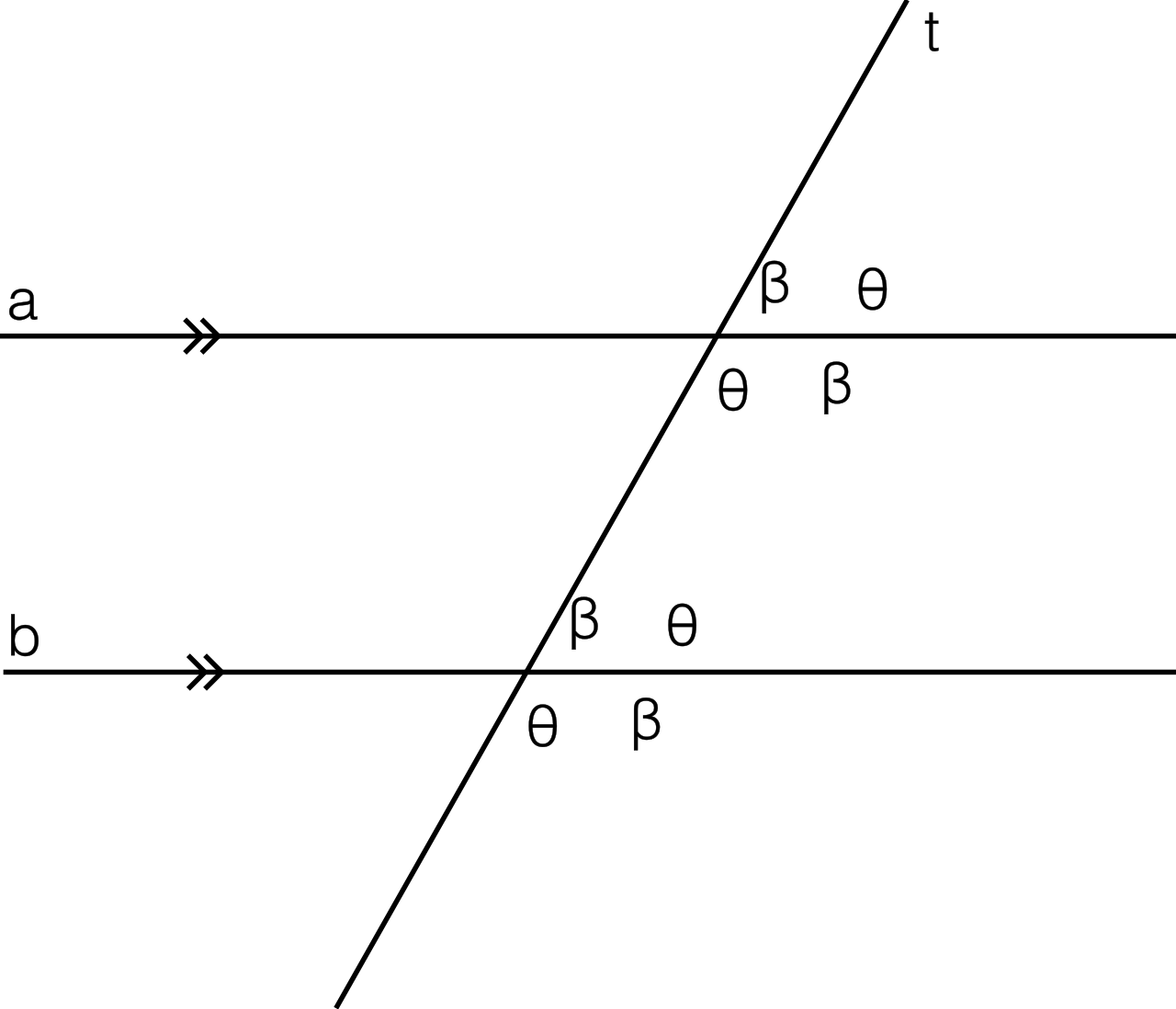
When we introduce a transversal cutting across two parallel lines, the geometry expands. The structural integrity of parallel lines guarantees specific angle relationships:
- The Corresponding Angles Postulate states that if two parallel lines are cut by a transversal, then the pairs of corresponding angles are congruent.
- The Alternate Interior Angles Theorem logically follows, stating that when two parallel lines are cut by a transversal, the alternate interior angles are congruent.
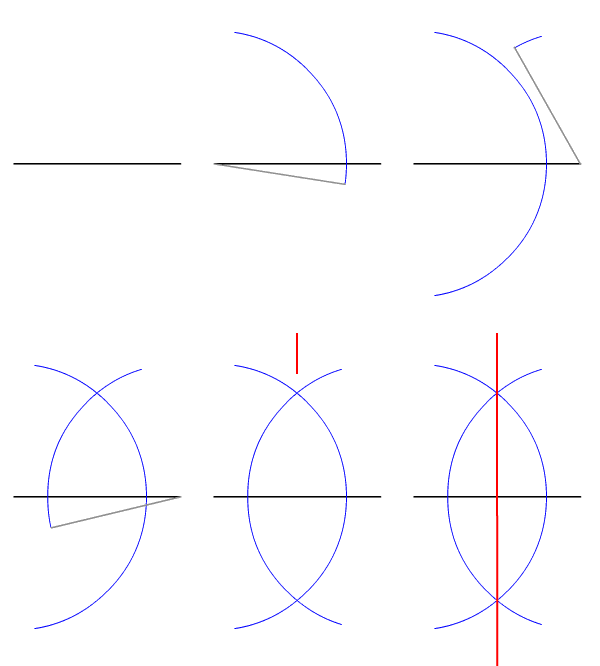
Finally, consider the concept of distance and perpendicularly. Points on a perpendicular bisector of a line segment are exactly equidistant from the endpoints of the line segment. This is why perpendicular bisectors are used in civil engineering to find the exact center point between two transmission towers; the mathematics guarantees perfect balance.
Triangles are the structural minimums of flat space—the simplest polygons, yet they hold the key to complex coordinate geometry and trigonometry.
Angles and Sides
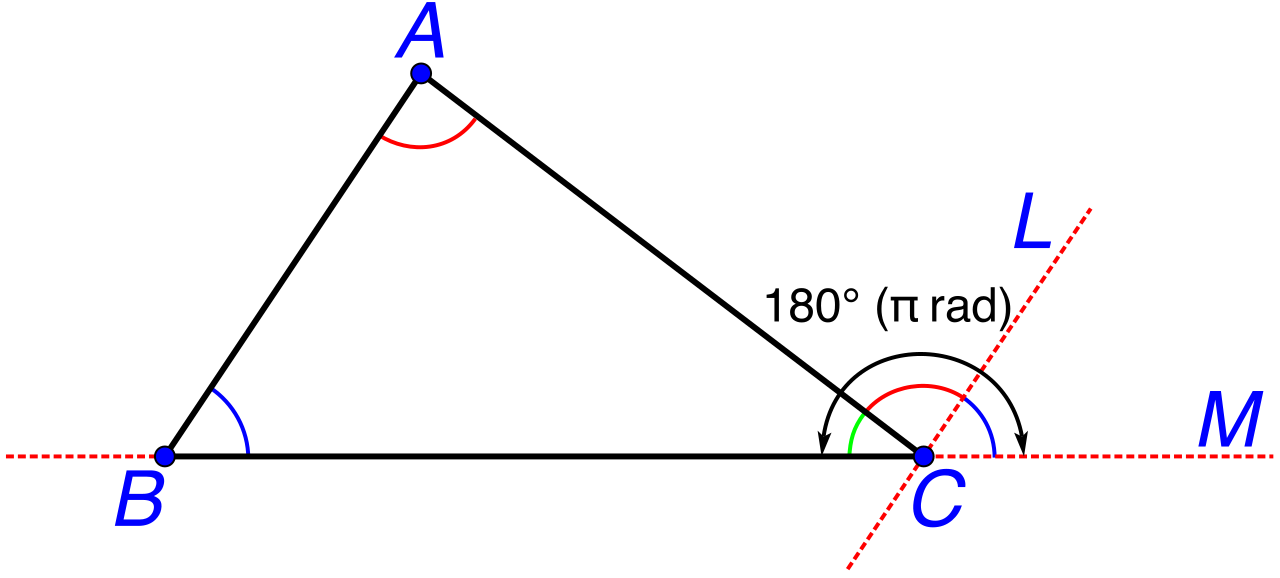
The foundational truth of planar geometry is the Triangle Angle Sum Theorem, which states that the sum of the interior angle measures of any planar triangle is exactly 180 degrees. From this, we derive the Exterior Angle Theorem: the measure of an exterior angle of a triangle is equal to the sum of the measures of the two remote interior angles of the triangle.
When a triangle possesses symmetry, its angles and sides reflect that balance:
- The Base Angles Theorem states that if two sides of a triangle are congruent, the angles opposite those congruent sides are also congruent (the defining trait of isosceles triangles).
- Unlike many geometric statements, its converse is also mathematically valid. The Converse of the Base Angles Theorem states that if two angles of a triangle are congruent, the sides opposite those congruent angles are also congruent.
However, not every three line segments can form a triangle. The Triangle Inequality Theorem dictates a strict physical reality: the sum of the lengths of any two sides of a triangle must be strictly greater than the length of the third side. If a student tries to build a triangle with sides 2, 3, and 8, the mathematical architecture simply collapses.
Medians and Centroids
A median of a triangle is a line segment joining a vertex of the triangle to the midpoint of the opposite side. It represents a line of balancing mass. Remarkably, no matter the shape of the triangle, the three medians of a triangle intersect at a single concurrent point called the centroid.
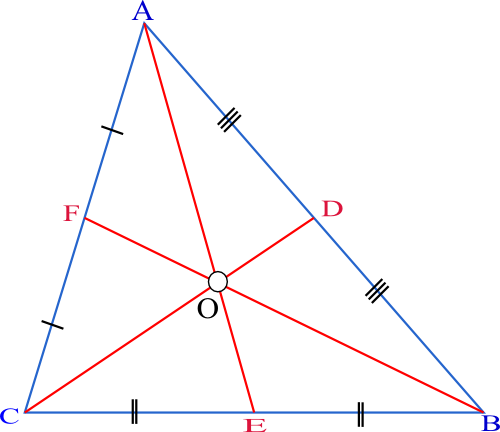
The centroid possesses a unique proportional property: the centroid of a triangle divides each median into two line segments with a length ratio of 2:1. Because of the geometry of the triangle's vertices, the longer segment of a triangle median divided by the centroid connects the centroid to the vertex of the triangle, while the shorter segment connects to the midpoint of the side.
The Right Triangle
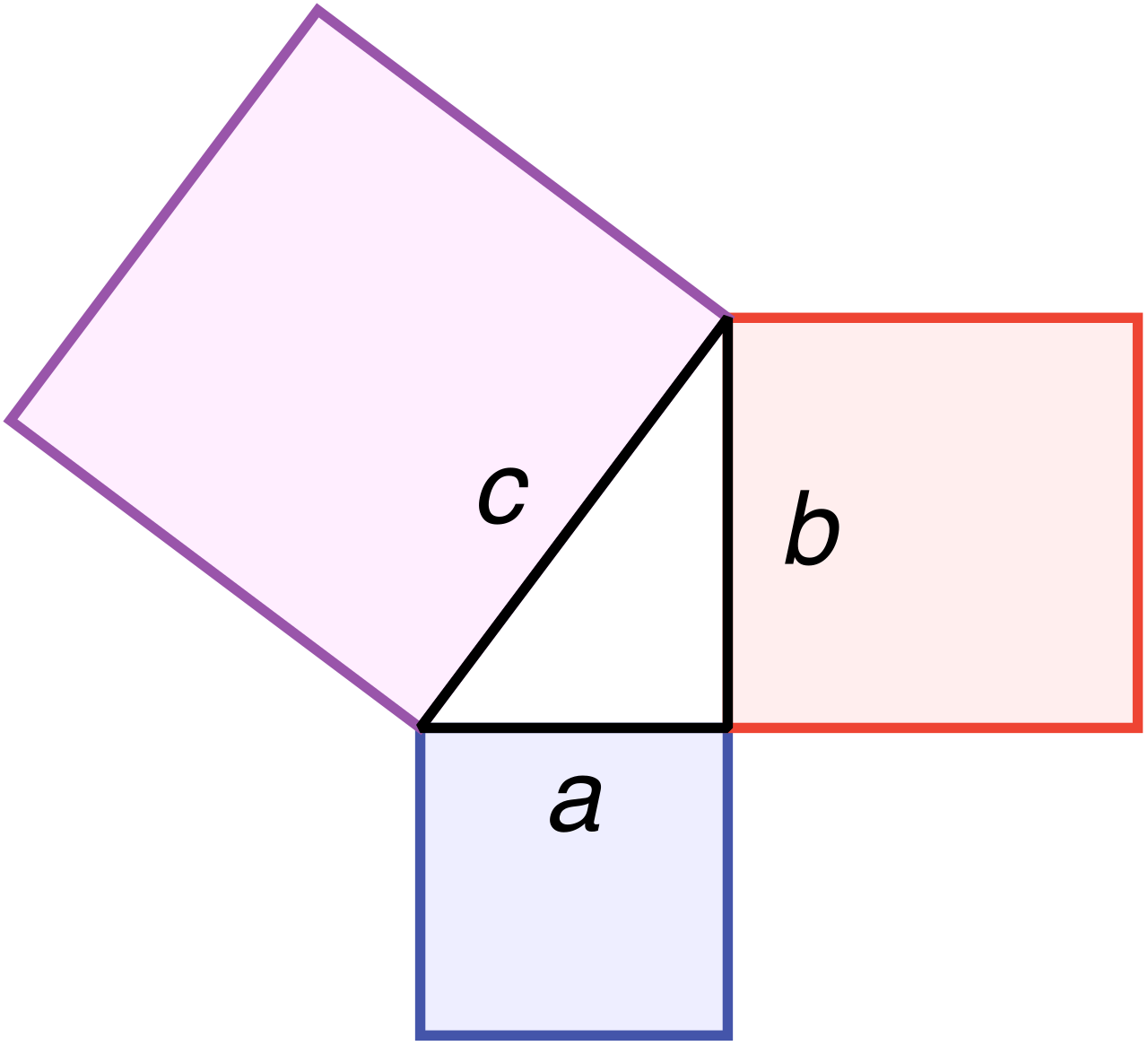
No discussion of triangles is complete without the Pythagorean Theorem, which states that in a right triangle, the square of the hypotenuse length equals the sum of the squares of the lengths of the two legs (a2+b2=c2). Equally important for proof evaluation is the Converse of the Pythagorean Theorem: if the square of one side length equals the sum of the squares of the other two side lengths, the triangle is absolutely guaranteed to be a right triangle.
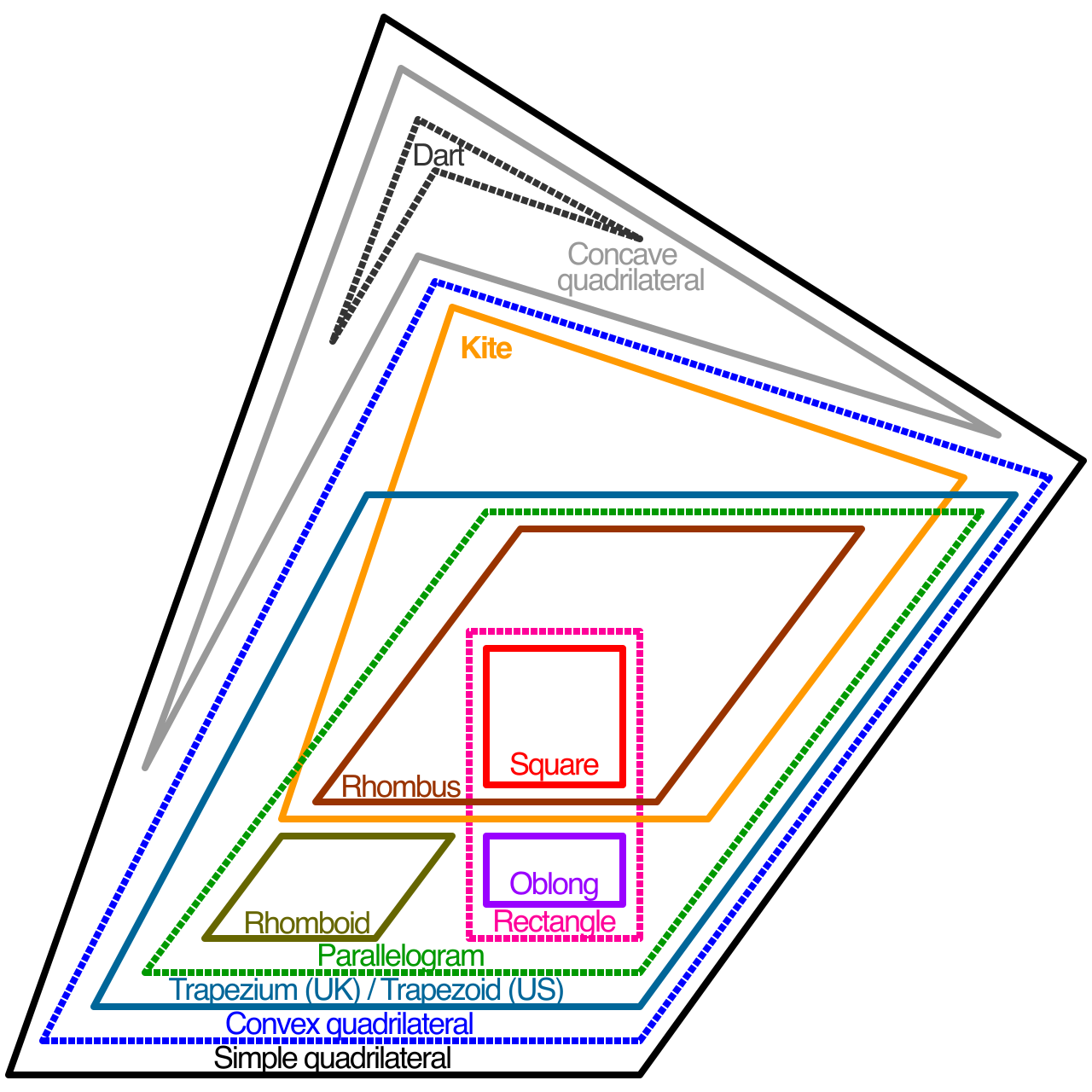
Moving from three sides to four, we encounter quadrilaterals. A parallelogram is defined as a quadrilateral possessing exactly two pairs of parallel opposite sides.
Once a shape is verified as a parallelogram, a cascade of theorems unlocks. In any parallelogram:
- The opposite sides of a parallelogram are congruent in length.
- The opposite angles of a parallelogram are congruent in measure.
- The consecutive interior angles of a parallelogram are supplementary.
- The two diagonals of a parallelogram bisect each other.
How do we prove a generic quadrilateral is a parallelogram without checking every single angle and side? The constraints of geometry offer a shortcut: a quadrilateral is confirmed as a parallelogram if just one pair of opposite sides is proven to be both parallel and congruent. If one pair is locked in parallel and equal length, the endpoints physically force the other two sides to follow suit.
Specialized parallelograms inherit all these traits but add their own strict conditions:
- The diagonals of a rectangle are congruent in length.
- The diagonals of a rhombus are strictly perpendicular to each other.
Historically, geometry was done with compass and straightedge. René Descartes revolutionized this by dropping geometric figures onto an algebraic grid. A coordinate proof uses abstract variables as coordinates (e.g., (0,a), (b,c)) to prove general geometric properties for an entire class of figures, rather than just one specific numerical instance.
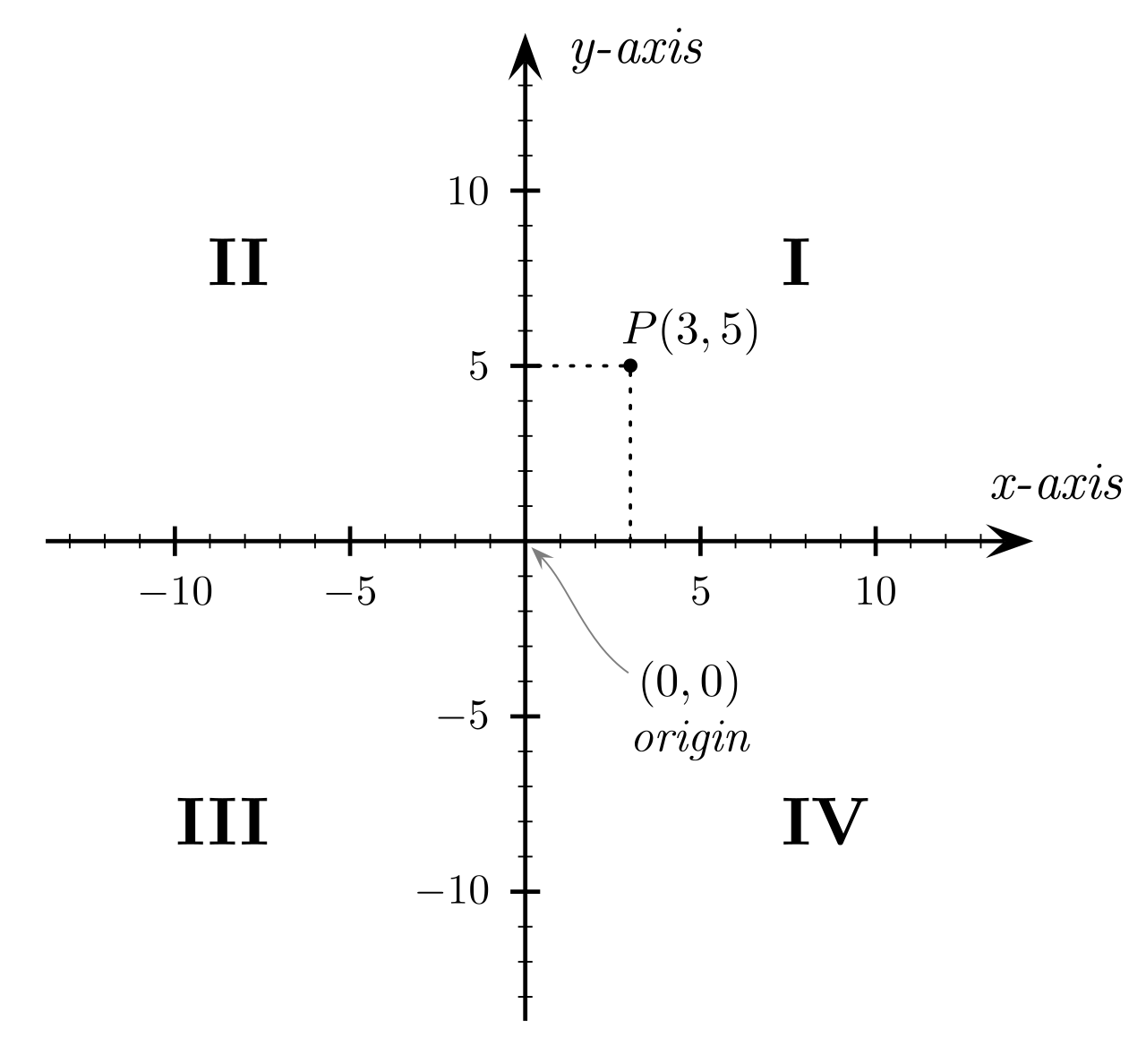
This is highly relevant for students comfortable with graphing calculators. It translates abstract visual arguments into verifiable algebraic computations.
The Toolkit for Coordinate Proofs
| Geometric Goal | Algebraic Tool | Execution |
|---|---|---|
| Prove segments congruent | Distance Formula | Apply the formula to show the lengths of the segments are mathematically equal. |
| Prove lines parallel | Slope Formula | Verify the slopes of the two lines are identical. |
| Prove lines perpendicular | Slope Formula | Verify the product of the two slopes is exactly negative one. |
| Prove a point bisects | Midpoint Formula | Apply the formula to verify the specific point splits the segment into two equal halves. |
Strategic Placement
The beauty of a coordinate proof lies in the fact that space is relative. We can drop our geometric figure anywhere on the Cartesian plane. However, rigorous proof demands efficiency.
Placing the vertex of a geometric figure at the origin in a coordinate proof simplifies the algebraic calculations required for the proof, because zeroes effortlessly eliminate terms in the distance and slope formulas. Furthermore, aligning one side of a polygon with the positive x-axis in a coordinate proof minimizes the number of distinct variable coordinates required.
If you want to prove the diagonals of a generic rectangle are congruent, you don't place its vertices at (x1,y1), (x2,y2), (x3,y3), and (x4,y4). You place the bottom-left vertex at (0,0), align the bottom edge along the x-axis to (a,0), and place the top vertices at (0,b) and (a,b). By defining the rectangle with just variables a and b, the distance formula cleanly proves that both diagonals possess a length of a2+b2.
Teaching the Unseen Structure
When you stand in front of your classroom, remember that geometry is the first time many students are asked to logically defend a claim. They are not just learning that opposite sides of a parallelogram are congruent; they are learning how we know it to be true. By bridging deductive logic, geometric theorems, and coordinate algebra, you provide them with the ultimate toolkit for rational thought.