Trigonometry in Triangles
Not sure you’re ready?
Take the ~3-minute readiness diagnostic and see where you stand.
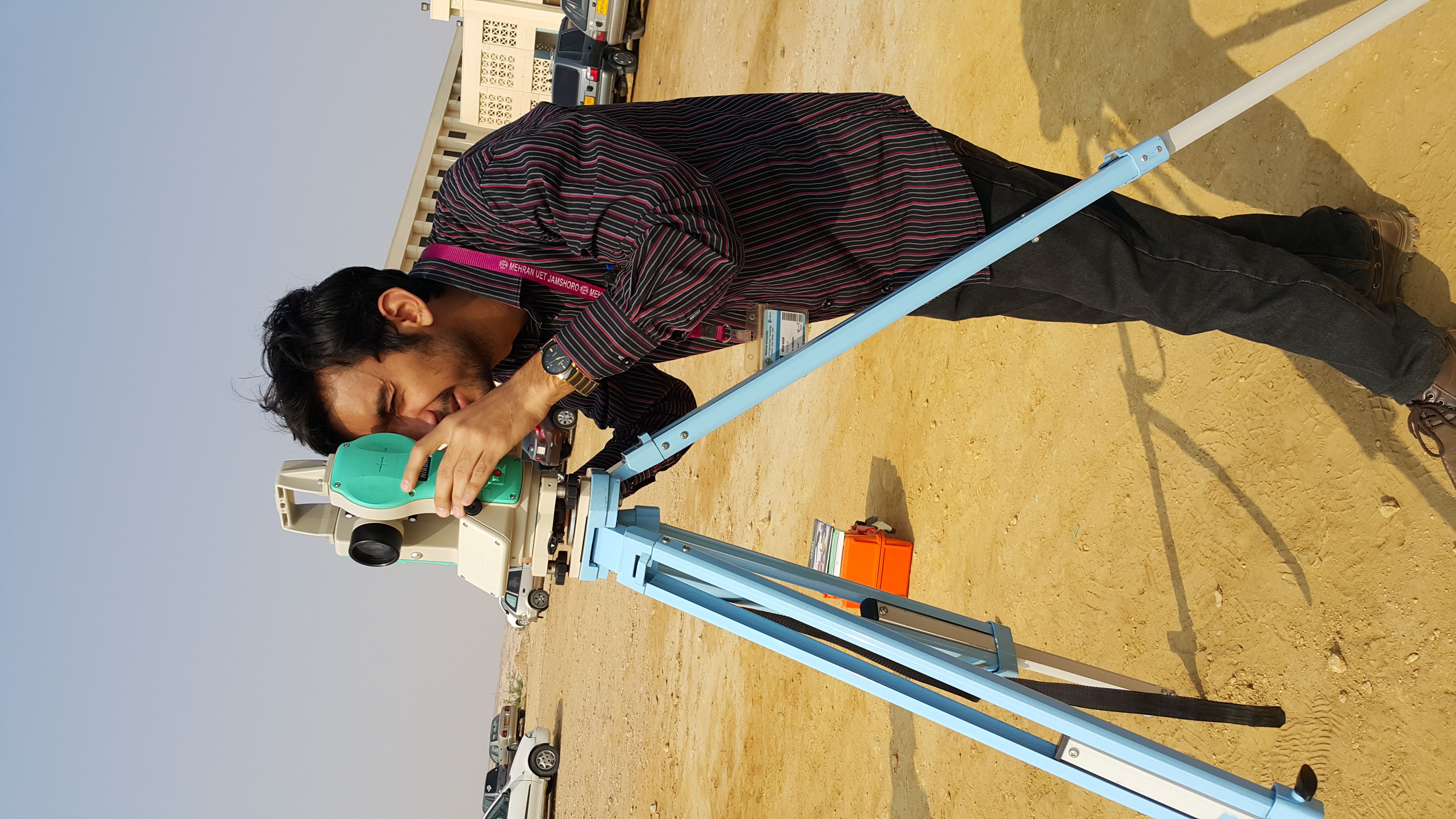
When a civil engineer designs the truss of a bridge, or a surveyor maps the precise boundaries of a plot of land, they rely on a fundamental, unyielding truth of geometry: the moment certain parts of a planar Euclidean triangle are defined, the universe mathematically locks the rest into place. As a future educator preparing for the Praxis (5165): Mathematics exam, you are tasked with revealing this invisible architecture to your students. Trigonometry in triangles is not merely a collection of ratios to be memorized; it is the study of how side lengths and angles constrain one another in perfect, predictable harmony. By understanding how the sine, cosine, and tangent functions dictate these relationships, you empower your students to measure the unreachable—from the height of a redwood tree to the distance across a canyon—using nothing but a transit, a tape measure, and their own mathematical reasoning.
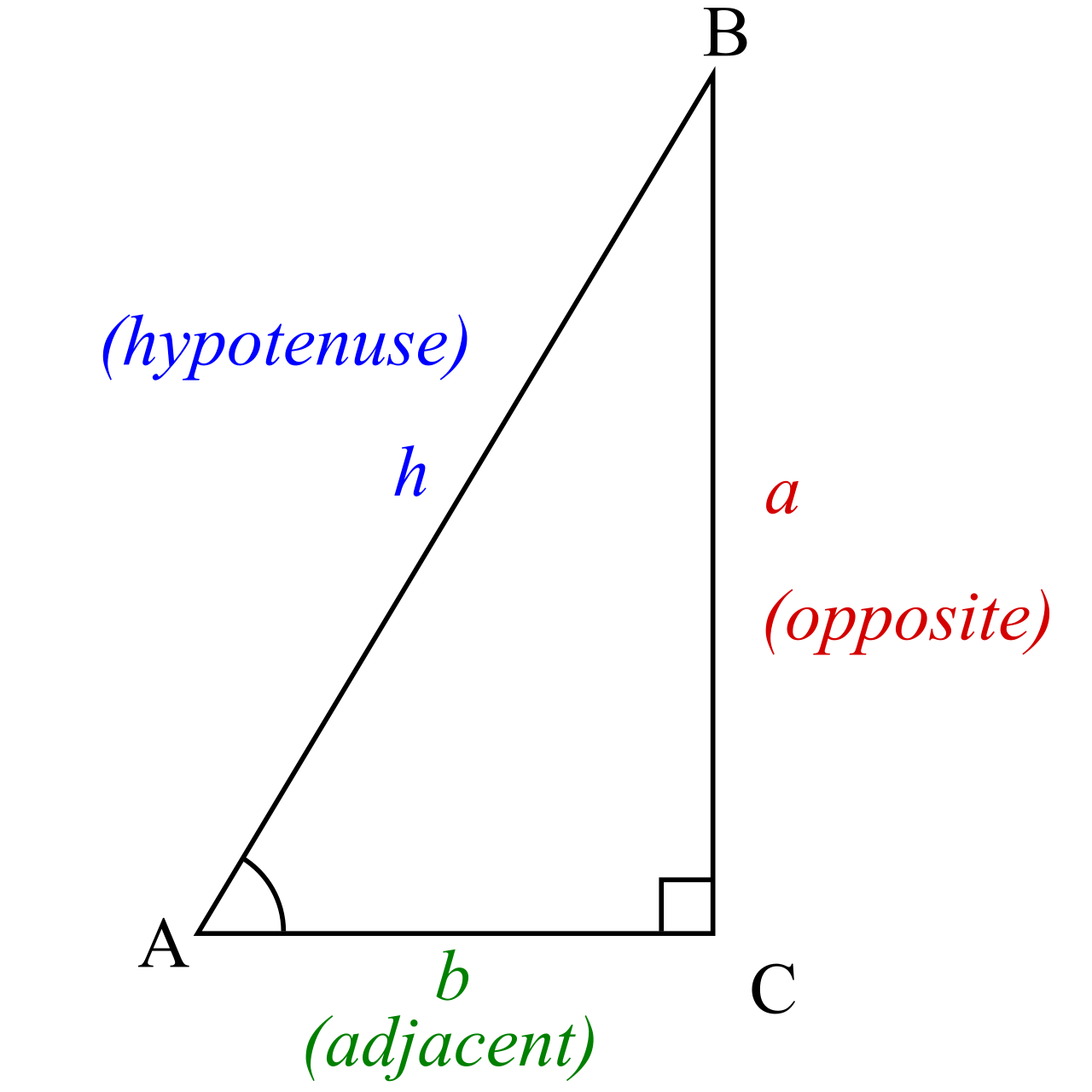
Before we can analyze the irregular shapes of the world, we must master the right triangle. This is the cornerstone of trigonometry.
By definition, the hypotenuse is the longest side of a right triangle, and the hypotenuse of a right triangle is located opposite the right angle. The remaining two sides, the legs, define the geometric relationships for our acute angles.
When you stand at one acute angle of a right triangle and look outward, the ratios of the sides relative to your vantage point define the core trigonometric functions:
- The sine of an acute angle in a right triangle is equal to the ratio of the length of the opposite side to the length of the hypotenuse.
- The cosine of an acute angle in a right triangle is equal to the ratio of the length of the adjacent side to the length of the hypotenuse.
- The tangent of an acute angle in a right triangle is equal to the ratio of the length of the opposite side to the length of the adjacent side.
Imagine you are laying out the foundation of a building. If you know the lengths of the structural beams (the sides), how do you calculate the exact angle to cut the wood? Inverse trigonometric functions are used to calculate the measure of an unknown acute angle in a right triangle given two side lengths. On a graphing calculator, using sin−1, cos−1, or tan−1 translates physical lengths back into rotational degrees.
The Dance of Complementary Angles
In any classroom, a profound mathematical "aha!" moment occurs when students realize that shifting their perspective from one corner of a triangle to the other fundamentally transforms how they label the sides. The "opposite" leg for one angle is the "adjacent" leg for the other.
The sum of the interior angle measures of any planar Euclidean triangle is exactly 180 degrees. Because a right triangle dedicates exactly 90 degrees to its right angle, the remaining two acute angles in any right triangle are complementary. By definition, the sum of the measures of two complementary angles is exactly 90 degrees.
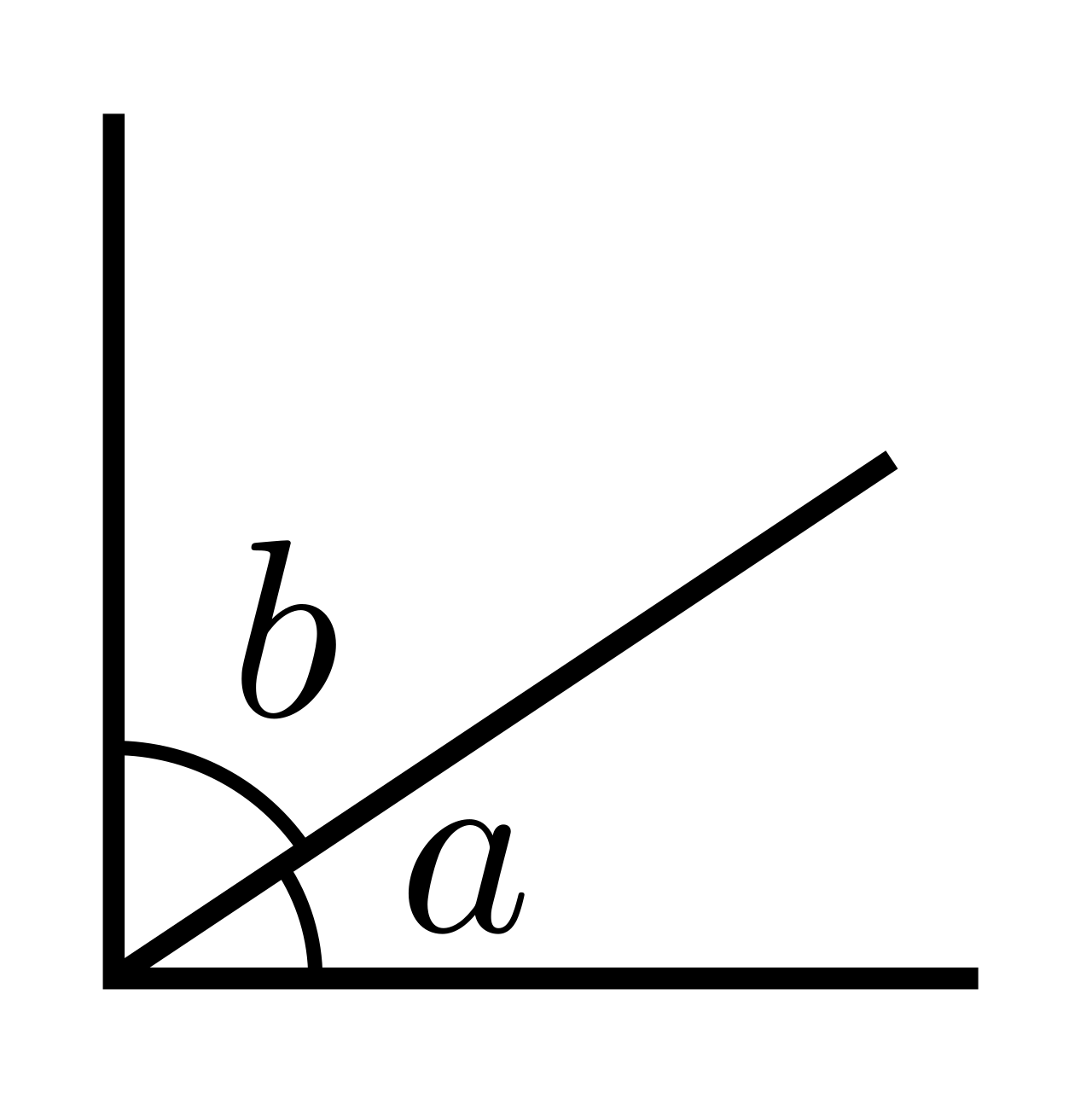
Because of that physical perspective shift from one corner to the other, the sine of any angle is equal to the cosine of the complementary angle. Conversely, the cosine of any angle is equal to the sine of the complementary angle.
We capture this elegant symmetry through the cofunction identities:
The mathematical equation expressing the cofunction identity for sine is sin(θ)=cos(90∘−θ). The mathematical equation expressing the cofunction identity for cosine is cos(θ)=sin(90∘−θ).
This matters immensely for your students. If a student calculates sin(30∘)=0.5, they instantly know that cos(60∘)=0.5. They are describing the exact same physical ratio of beams in the building's foundation, simply viewed from the opposite corner of the room.
The real world is rarely composed of perfect right angles. If a student is surveying a sloped lot to build a fence, they need tools that apply to any triangle.
Enter the Law of Sines. The Law of Sines states that the ratio of a side length to the sine of the opposite angle is constant for all three sides of a triangle.
The algebraic formula for the Law of Sines is sin(A)a=sin(B)b=sin(C)c.
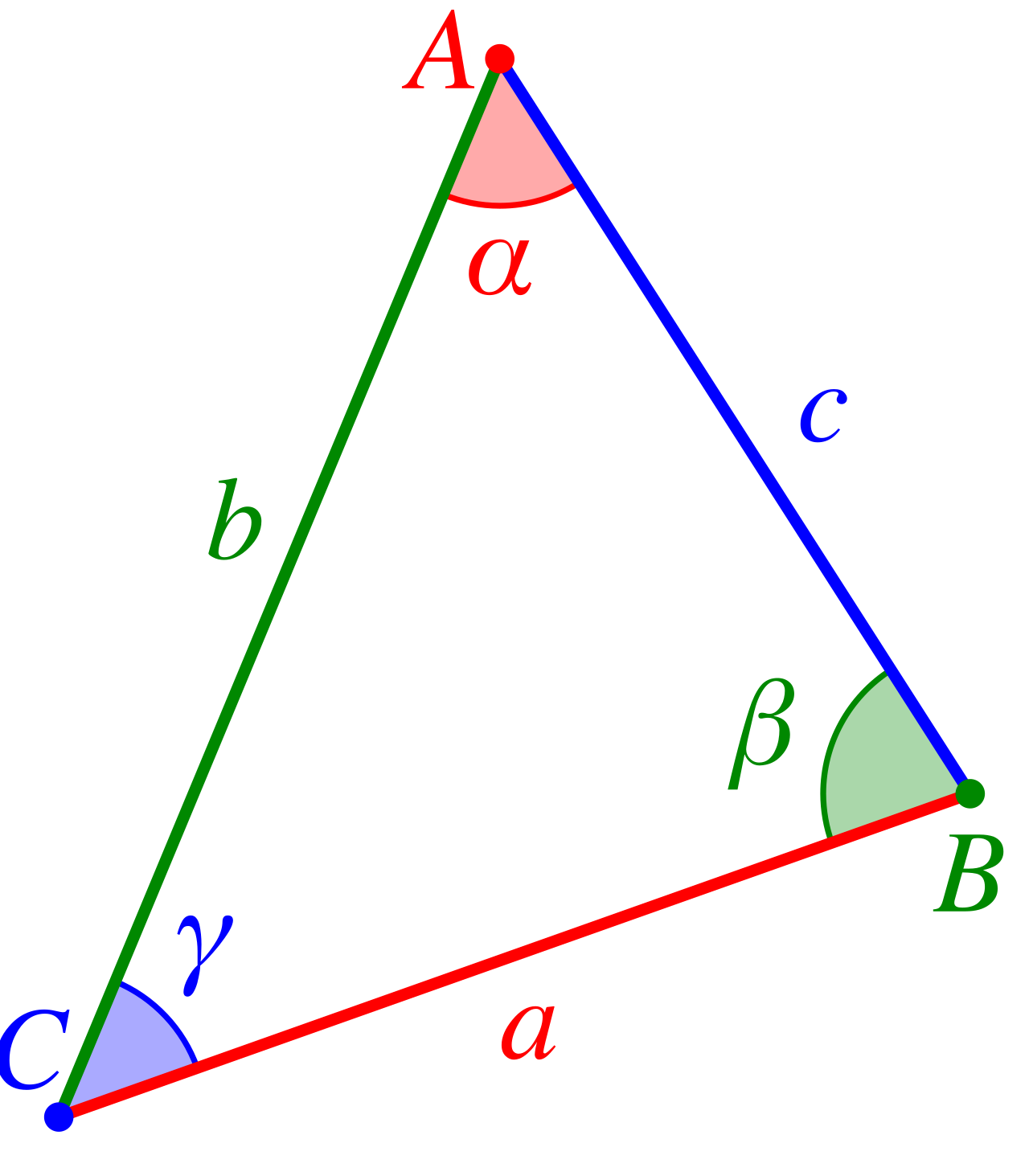
This law provides a direct proportionality. Because of this proportional nature, the longest side of a triangle is always opposite the angle with the largest measure, and the shortest side of a triangle is always opposite the angle with the smallest measure.
From a practical problem-solving perspective, the Law of Sines can be used to find unknown parts of a triangle when given two angles and any side length (AAS or ASA conditions). It is also the tool of choice when given two side lengths and the measure of an angle opposite one of those sides (the SSA condition). However, this latter condition introduces a classic mathematical trap.
The Swinging Pendulum: The Ambiguous Case of SSA
Imagine a student quoting a $15,000 contracting job based on a blueprint that provides two side lengths and a non-included angle. If they assume there is only one way to build that structure, they might make a catastrophic error.
The ambiguous case occurs when solving a triangle using the Law of Sines with given information of two sides and an angle opposite one of those sides (SSA). Because the angle between the two given sides is not locked, the unknown side can act like a swinging door on a hinge. Depending on the length of that swinging side, the ambiguous case of the Law of Sines can result in zero possible triangles, exactly one possible triangle, or exactly two distinct possible triangles.
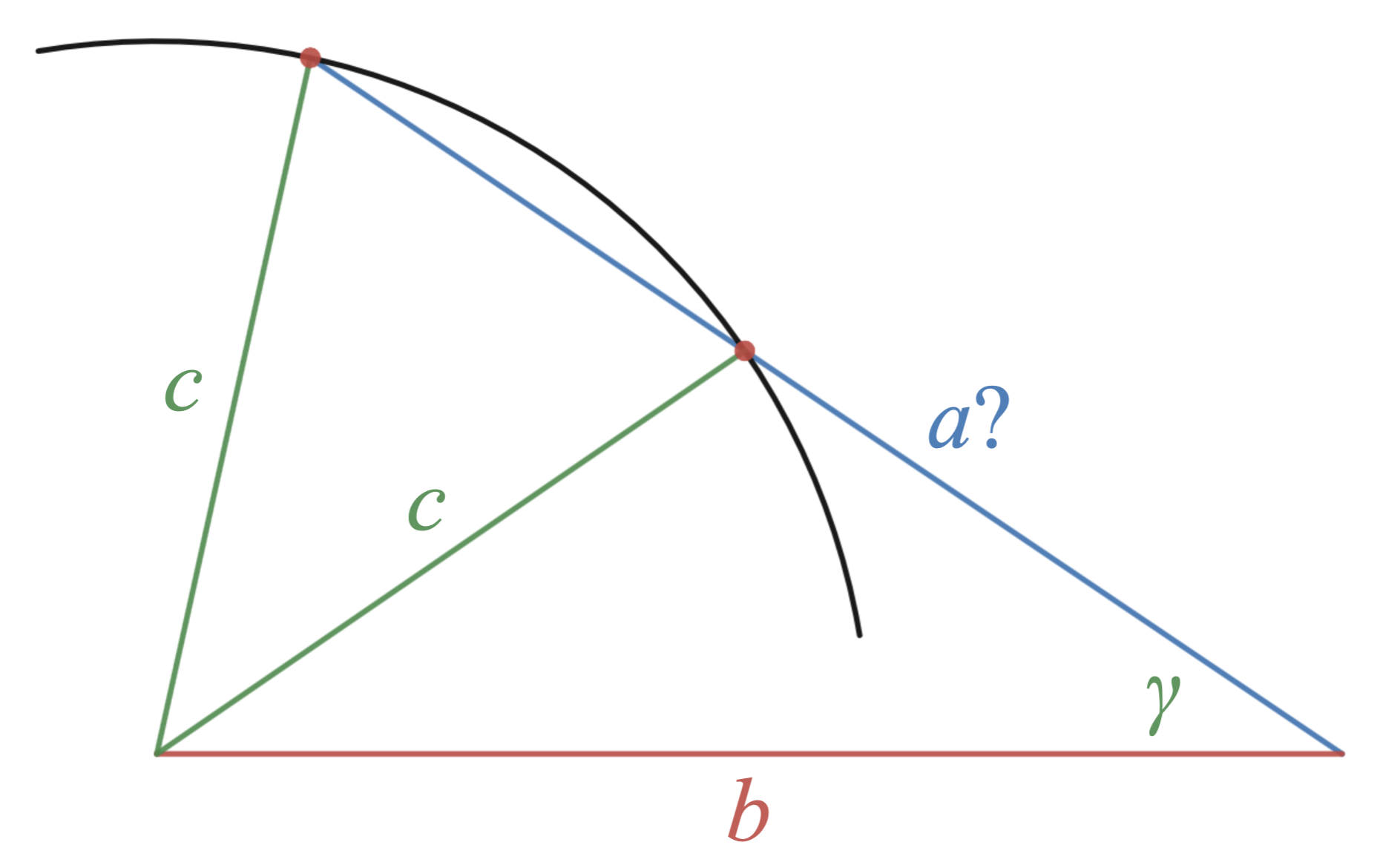
To teach this intuitively, teach your students to drop a perpendicular line to find the height of the triangle. The altitude of a proposed triangle in the Side-Side-Angle condition is calculated by multiplying the adjacent side length by the sine of the given angle (h=b⋅sin(A)).
Once you have the altitude (h), compare the given opposite side (a) to the altitude (h) and the adjacent side (b).
| Condition | Geometric Result | Why It Happens (The "Swinging Door") |
|---|---|---|
| a<h | Zero triangles | In the Side-Side-Angle condition with a given acute angle, no triangle exists if the given opposite side is shorter than the calculated altitude. The swinging side dangles in the air, too short to reach the base. |
| a=h | Exactly one triangle | In the Side-Side-Angle condition with a given acute angle, exactly one right triangle exists if the given opposite side is exactly equal to the altitude. The side perfectly touches the base at a 90-degree angle. |
| h<a<b | Two triangles | In the Side-Side-Angle condition with a given acute angle, two distinct triangles exist if the given opposite side is longer than the altitude and shorter than the adjacent side. The side can swing inward or outward and hit the base in two valid locations. |
| a≥b | Exactly one triangle | In the Side-Side-Angle condition, exactly one triangle exists if the given opposite side is greater than or equal to the adjacent side. The side is so long it can only swing outward to form a triangle. |
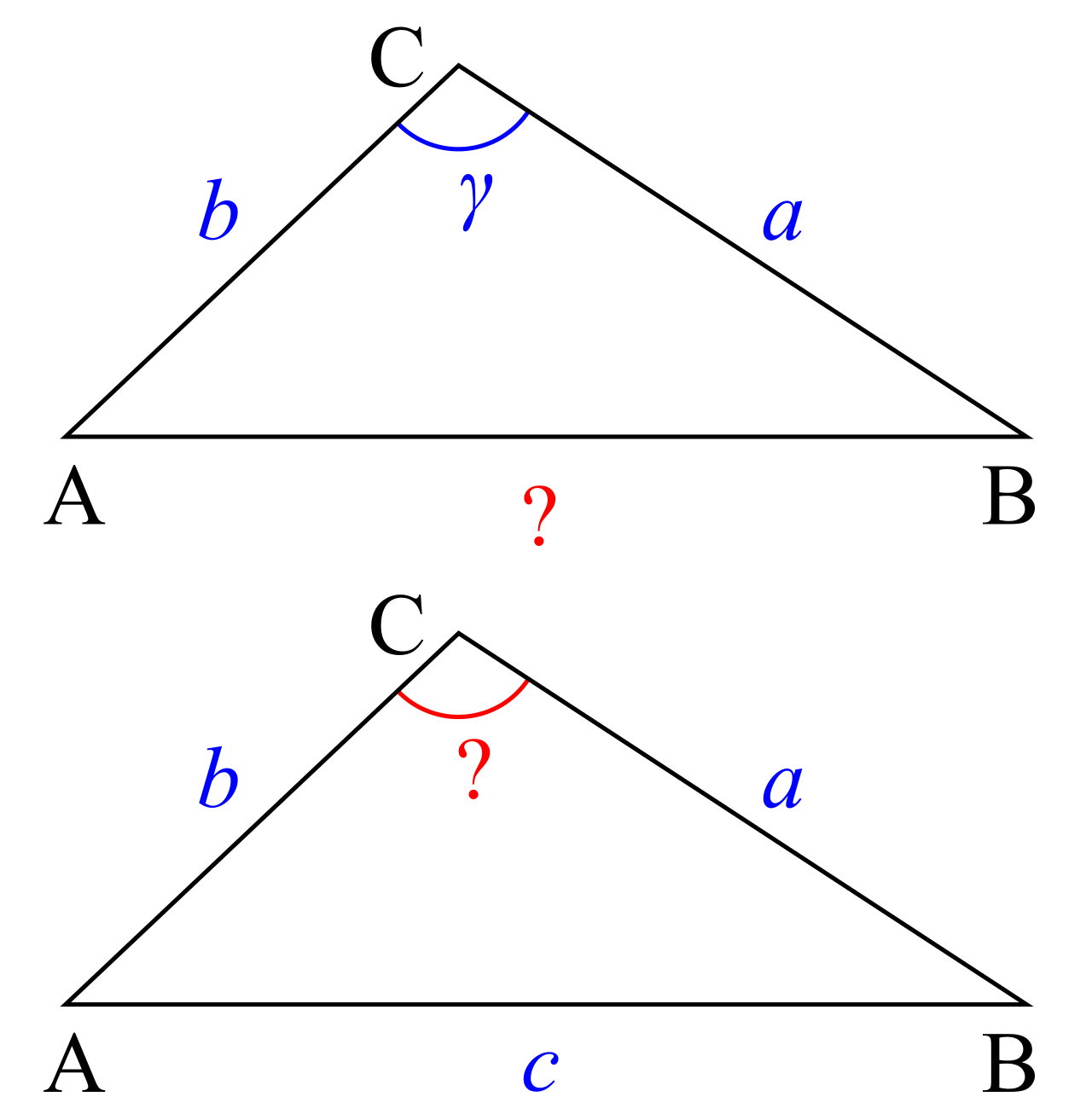
While the Law of Sines requires an opposite side-angle pair, the Law of Cosines is the ultimate generalized tool. It relates the lengths of the three sides of a triangle to the cosine of one specific angle.
The Law of Cosines formula to find a side length is c2=a2+b2−2ab⋅cos(C).
Look closely at this formula. If angle C is exactly 90 degrees, cos(90∘)=0, the entire end term disappears, and we are left with the Pythagorean theorem (c2=a2+b2). The Law of Cosines is simply the Pythagorean theorem with a built-in "adjustment factor" for angles that tilt wider or narrower than 90 degrees.
For curriculum contexts, you will teach students that the Law of Cosines is used to solve a triangle when given the lengths of two sides and the measure of the included angle (SAS). It is also the only starting option when given all three side lengths (SSS).
To find an unknown angle in an SSS scenario, the Law of Cosines formula can be algebraically rearranged to find an angle measure as:
cos(C)=2aba2+b2−c2
The Blind Spot of the Graphing Calculator
Here is where elite mathematical pedagogy sets you apart. When a student enters sin−1(0.5) into a graphing calculator, the machine confidently spits out $30^\circ. But what if the angle in the triangle is actually \150^\circ$?
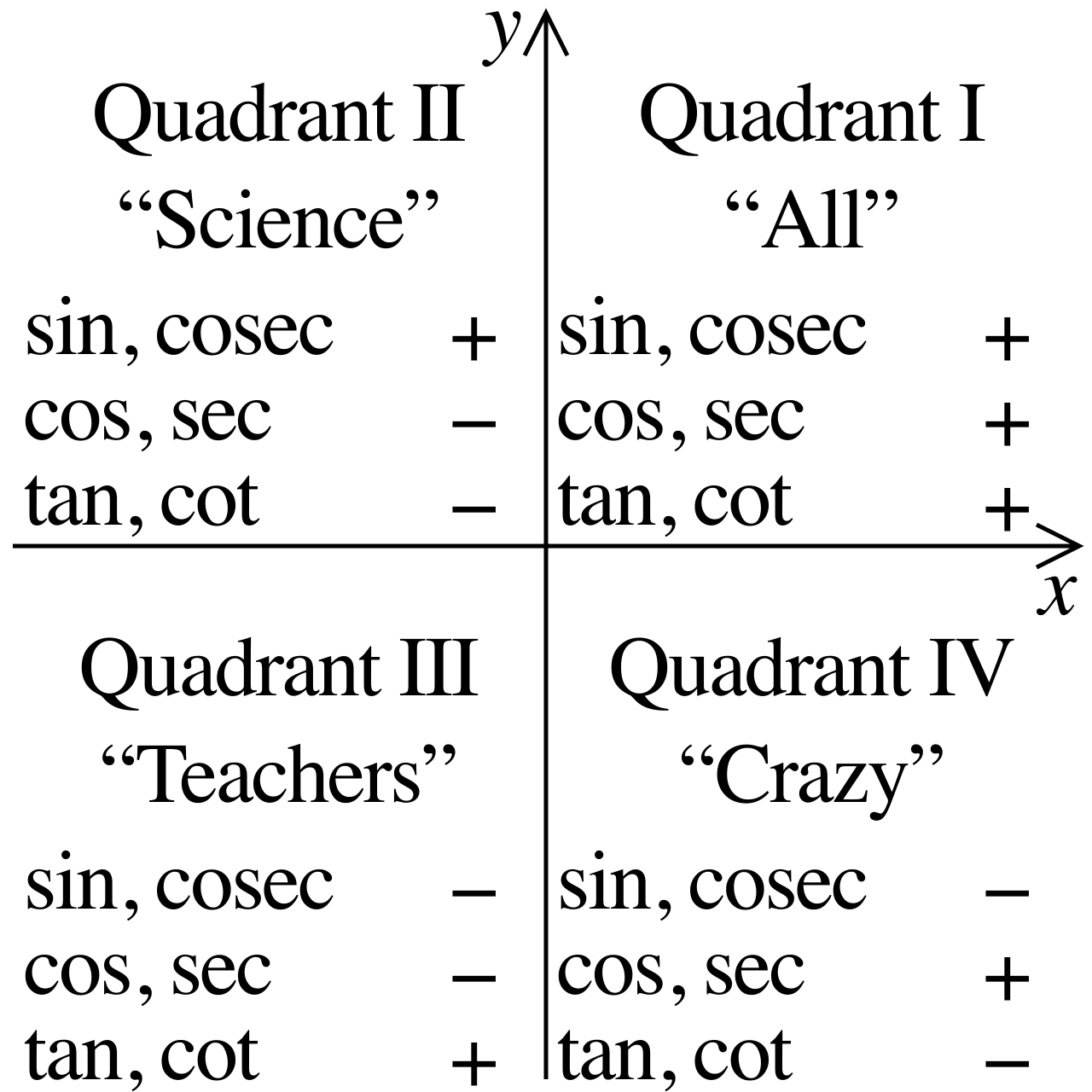
This brings us to a vital geometric reality about supplementary angles. The measure of a supplementary angle is 180 degrees minus the measure of the original angle. Trigonometrically, the sine of an angle is equal to the sine of its supplementary angle. Therefore, the sine of an obtuse angle has a positive value (e.g., sin(150∘)=0.5).
Because both acute and obtuse angles yield a positive sine, the inverse sine function on a calculator can never output an obtuse angle; it defaults strictly to the acute quadrant. This creates massive mathematical ambiguity.
How do we rescue our students from this calculator trap? We use the cosine. Unlike the sine function, the cosine of an obtuse angle has a negative value. A calculator evaluating cos−1(−0.5) will correctly and definitively yield $120^\circ$.
This leads to a golden rule in classroom instruction: The Law of Cosines is used to solve a triangle when given the lengths of all three sides (SSS), and when doing so, finding the largest angle first using the Law of Cosines prevents mathematical ambiguity related to obtuse angles. Because the largest angle is the only one that could be obtuse, using the Law of Cosines to hunt for it immediately identifies whether the triangle has an obtuse angle (the cosine ratio will be negative). Once the largest angle is safely known, the remaining angles must be acute, and the student can safely transition to the quicker Law of Sines without fear of the calculator's blind spot.