Lines and Angles
Not sure you’re ready?
Take the ~3-minute readiness diagnostic and see where you stand.
Consider the structural framework of a suspension bridge, the layout of an urban grid, or the invisible flight paths of aircraft crisscrossing the sky. The physical world organizes itself around intersections, spans, and boundaries. When you prepare to teach geometry—and when you face the Praxis 5165 exam—you are not merely memorizing a dictionary of terms. You are learning the syntax of space itself. To teach your future students how to parse reality, you must guide them from zero-dimensional abstractions to the complex interplay of angles and lines that govern everything from carpentry to computer graphics.
Here, we will dismantle the fundamental architecture of Euclidean geometry, examine the localized relationships of intersecting lines, and translate these concepts into the language of the coordinate plane.
To construct a universe, we must begin with nothingness and slowly add dimensions.
- A point indicates an exact location in space and has no size or dimension. It is pure location—a geometric ZIP code.
- A line extends infinitely in two opposite directions and has exactly one dimension. It possesses length but no width.
- A plane extends infinitely in two dimensions and has no thickness. Imagine an infinitely expansive sheet of glass.
When we place points and lines into this universe, their relationships define their names. Collinear points are points that lie on the same straight line, while coplanar points or lines are those that lie entirely within the same plane.
Lines, in their infinite nature, are unwieldy. We often deal with their fragments:
- A ray is a part of a line that has exactly one endpoint and extends infinitely in one direction. It is a laser beam fired into the void.
- A line segment is a bounded part of a line consisting of two distinct endpoints and all points between the two distinct endpoints. This is the physical ruler on your desk.
Lines in Space
When two lines exist in the same universe, how do they interact?
- Intersecting lines are coplanar lines that cross each other at exactly one point.
- Parallel lines are coplanar lines that never intersect regardless of how far the lines are extended.
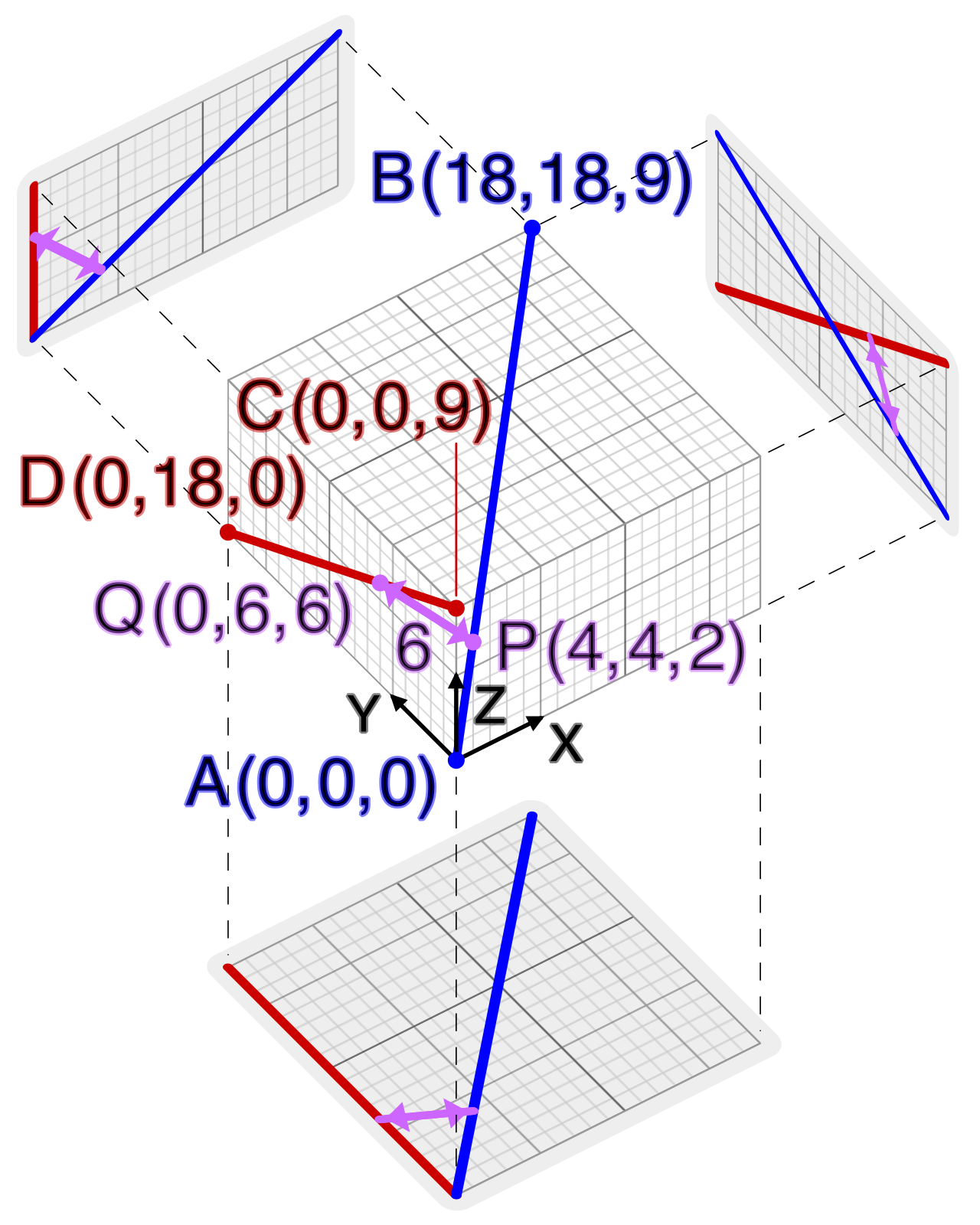
- Skew lines are non-coplanar lines that never intersect.
Teaching Tip for Skew Lines: Students often struggle to visualize skew lines. Point to the ceiling and the floor of your classroom. A line drawn north-to-south on the ceiling and a line drawn east-to-west on the floor will never intersect, but they are not parallel. They are skew—existing in different planes, like airplanes flying at different altitudes.
How do we guarantee parallel lines exist? We rely on Playfair's Axiom, which states that given a line and a point not on the line, exactly one line can be drawn through the point that is parallel to the given line. This single assumption is the bedrock of Euclidean geometry; alter it, and you warp space into a sphere or a saddle.
When two rays collide, geometry becomes interesting. An angle is formed by two rays that share a common endpoint. This common endpoint is called the vertex of the angle.
We classify angles by their degree measure, forming a continuous spectrum from flat lines to full rotations:
| Angle Classification | Definition |
|---|---|
| Acute | Measures strictly greater than 0 degrees and strictly less than 90 degrees. |
| Right | Measures exactly 90 degrees. |
| Obtuse | Measures strictly greater than 90 degrees and strictly less than 180 degrees. |
| Straight | Measures exactly 180 degrees. |
| Reflex | Measures strictly greater than 180 degrees and strictly less than 360 degrees. |
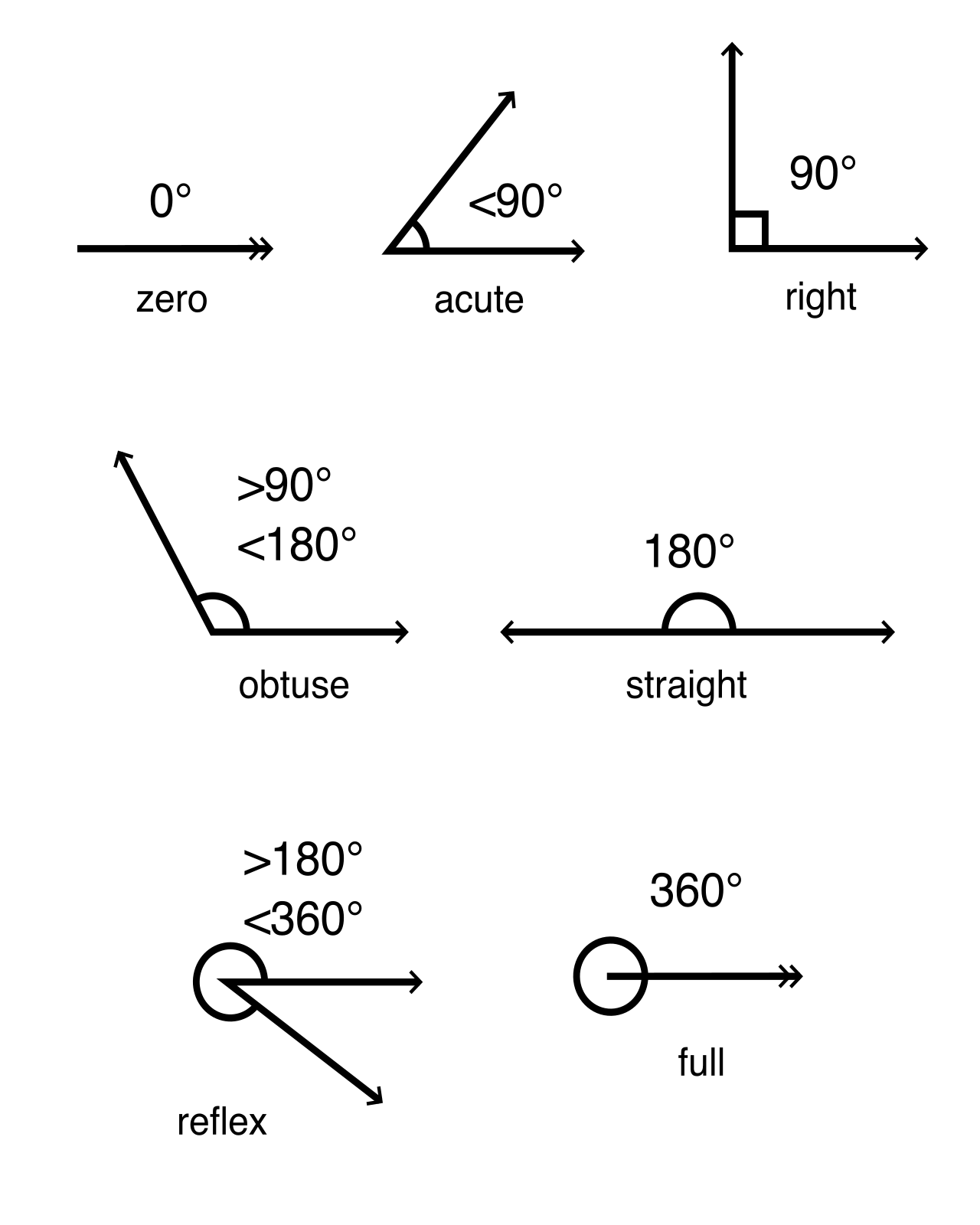
If you were to draw multiple angles originating from a single point, you would eventually close the circle. The sum of the measures of all non-overlapping angles sharing a single common vertex and fully surrounding the common vertex is exactly 360 degrees.
Sometimes, we need to slice an angle precisely in half. An angle bisector is a ray that divides a single angle into two congruent adjacent angles.
Angles rarely exist in isolation. They share vertices, sides, and relationships. Let's clarify the terms your students will invariably mix up.
Adjacent angles are two angles in the same plane that share a common vertex and a common side. Crucially, adjacent angles cannot share any common interior points. They are next-door neighbors sharing a fence; neither neighbor's yard overlaps with the other.
Then we have pairs defined purely by their arithmetic sums:
- Complementary angles are two angles whose measures sum to exactly 90 degrees.
- Supplementary angles are two angles whose measures sum to exactly 180 degrees.
Crucial Distinction: Both complementary and supplementary angles do not need to be adjacent to each other. An angle in New York and an angle in Tokyo can be supplementary as long as their measures add up to 180 degrees.
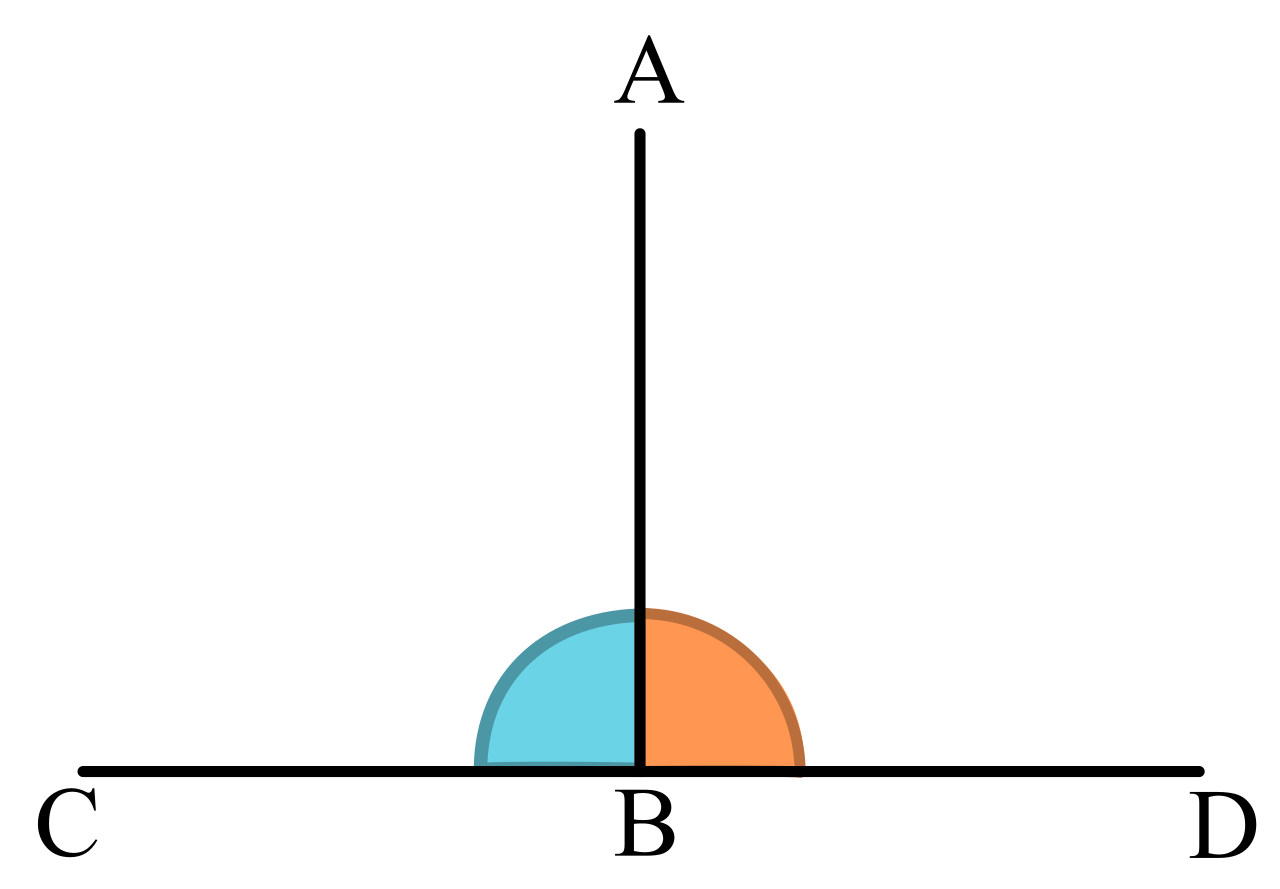
However, when supplementary angles are adjacent, they form something special. A linear pair consists of two adjacent angles whose non-common sides form opposite rays. The formal mathematical guarantee of this relationship is the Linear Pair Postulate, which states that if two angles form a linear pair, then the two angles are supplementary.
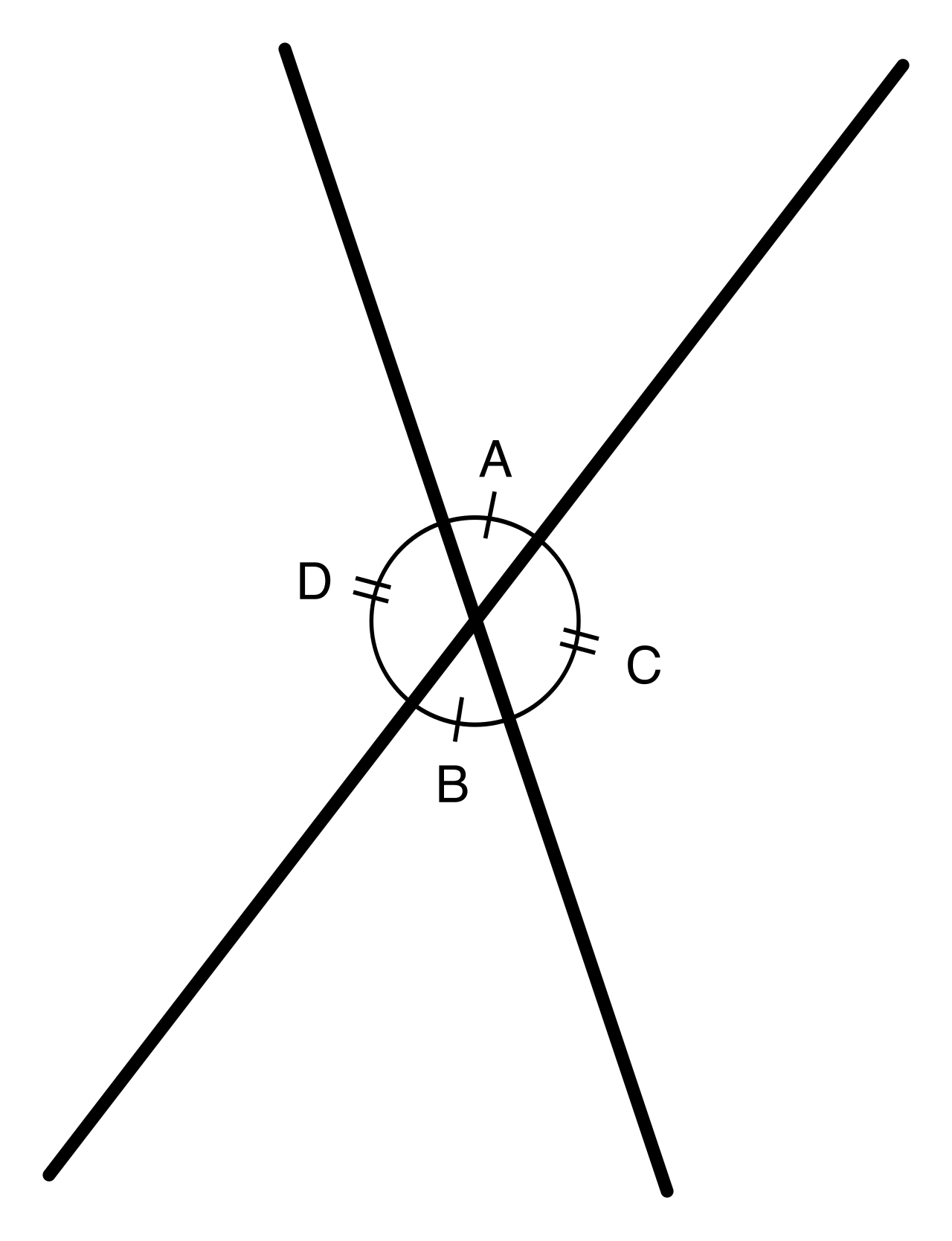
When two straight lines cross, they create four angles. The angles that are next to each other form linear pairs. But the angles directly across from one another are known as vertical angles—the non-adjacent pairs of opposite angles formed by the intersection of two lines.
Why do we care about vertical angles? Because of the absolute, unyielding symmetry of the universe: The Vertical Angles Theorem states that vertical angles are always congruent. If a scissors opens 30 degrees at the blades, the handles open 30 degrees at the back. It is inescapable.
When we drop a line across a set of other lines, we create a powerful analytical tool. A transversal is a line that passes through two or more coplanar lines at distinct points. A transversal cutting across two lines creates eight distinct angles, which we categorize by their geographic position.
The Angle Roster
- Alternate interior angles are positioned on opposite sides of a transversal and between the two intersected lines.
- Alternate exterior angles are positioned on opposite sides of a transversal and outside the two intersected lines.
- Consecutive interior angles (often called same-side interior angles) are positioned on the same side of a transversal and between the two intersected lines.
- Corresponding angles occupy the same relative position at each intersection where a transversal crosses other lines.
The Magic of Parallel Transversals
When the two intersected lines happen to be parallel, these angles lock into predictable, beautiful relationships.
- The Corresponding Angles Postulate: If two parallel lines are cut by a transversal, then corresponding angles are congruent.
- The Alternate Interior Angles Theorem: If two parallel lines are cut by a transversal, then alternate interior angles are congruent.
- The Alternate Exterior Angles Theorem: If two parallel lines are cut by a transversal, then alternate exterior angles are congruent.
- The Consecutive Interior Angles Theorem: If two parallel lines are cut by a transversal, then consecutive interior angles are supplementary.
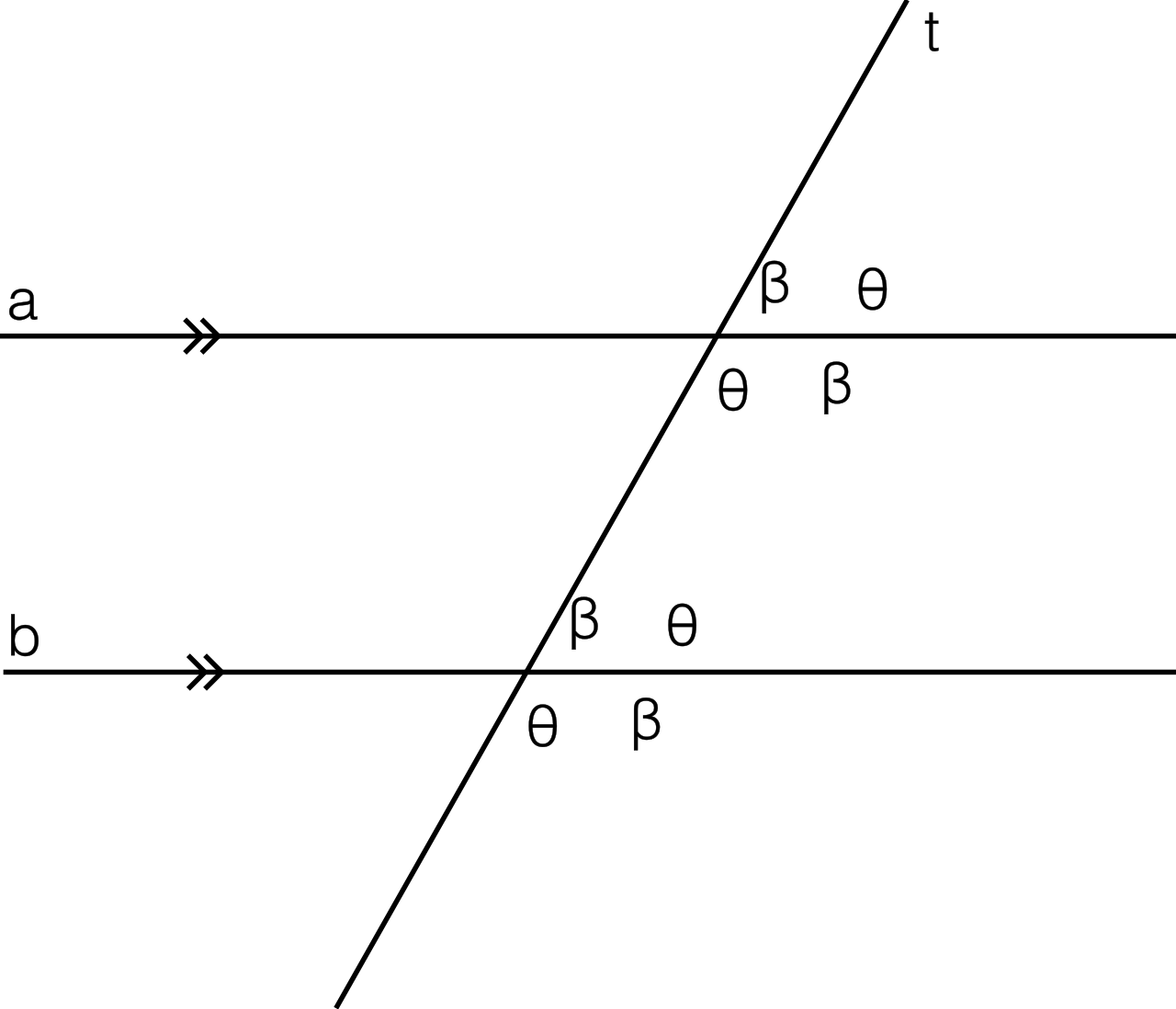
Notice that these are one-way streets: If the lines are parallel, then the angle relationships hold. But mathematics demands rigor in both directions. The converses are equally powerful tools for proving lines are parallel:
- If two coplanar lines are cut by a transversal such that corresponding angles are congruent, then the two coplanar lines are parallel.
- If two coplanar lines are cut by a transversal such that alternate interior angles are congruent, then the two coplanar lines are parallel.
- If two coplanar lines are cut by a transversal such that consecutive interior angles are supplementary, then the two coplanar lines are parallel.
What happens when intersection is perfectly balanced? Perpendicular lines are intersecting lines that meet to form exactly four right angles.
Because perpendicular lines are governed by 90-degree constraints, they act as the rigid joists of geometric proofs. Consider these three transitive and perpendicular theorems:
- If two distinct coplanar lines are both perpendicular to a third line, then the two distinct coplanar lines are parallel to each other. (Think of the upright studs in a wall, all perpendicular to the floorplate).
- If a transversal is perpendicular to one of two parallel lines, then the transversal is also perpendicular to the other parallel line.
- Two distinct lines that are both parallel to a third line must be parallel to each other.
Perpendicularity is also the geometry of efficiency. In space, the shortest distance from a given point to a given line is the length of the perpendicular segment connecting the given point to the given line. If you are standing in a field and want to reach a road as fast as possible, you walk perpendicular to it.
Consequently, the distance between two parallel lines is the perpendicular distance between one of the parallel lines and any arbitrary point on the other parallel line. Because parallel lines never converge or diverge, this perpendicular distance is a constant.
We can apply this to segments as well. A perpendicular bisector is a line, segment, or ray that intersects a given line segment at exactly a 90-degree angle and passes through the midpoint of the given line segment. It perfectly divides and perfectly aligns.
As an aspiring teacher, you know that modern mathematics relies heavily on algebraic translations of geometric principles—this is what happens when you fire up a graphing calculator. In the coordinate plane, the abstract concepts of parallel and perpendicular map directly onto a single numeric value: slope.
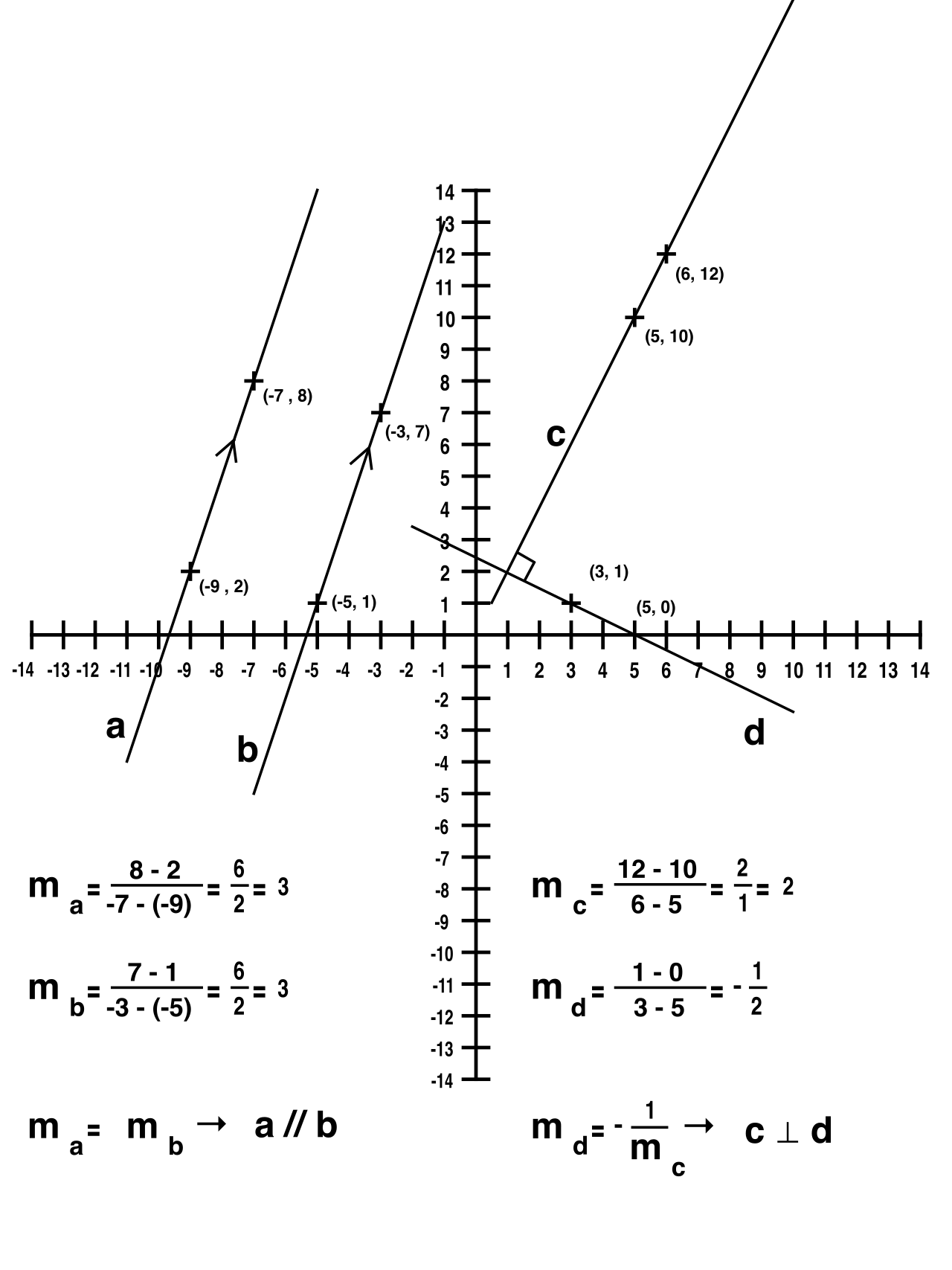
- Parallel Lines: In a coordinate plane, two distinct non-vertical lines are parallel if and only if the two distinct non-vertical lines possess identical slopes.
- Perpendicular Lines: In a coordinate plane, two non-vertical lines are perpendicular if and only if the product of the slopes of the two non-vertical lines is exactly negative one. (We often teach this as "opposite reciprocals.")
Why do we keep specifying "non-vertical"? Because vertical lines break the algebraic machine of y=mx+b.
- Horizontal lines in a coordinate plane have a slope of exactly zero.
- Vertical lines in a coordinate plane have an undefined slope (because you cannot divide by zero).
Despite this algebraic hiccup, the geometric truth remains: Any vertical line in a coordinate plane is perpendicular to any horizontal line in the same coordinate plane. The y-axis and the x-axis are the ultimate proof of this fact.
Bringing It All Together for the Exam
When sitting for the Praxis 5165, you will be asked to toggle seamlessly between the synthetic geometry of axioms (Playfair's, Linear Pair Postulate) and the analytic geometry of the coordinate plane (slopes and distances).
Remember that geometry is simply a game of logical deduction played by very strict rules. A point is nothing; a line is an infinite span. Yet, when we intersect them, measure them, and cross them with transversals, we map out the logic of the entire physical world. Own these definitions, visualize their implications, and you will not only conquer the exam, but you will also become a master architect of your students' understanding.