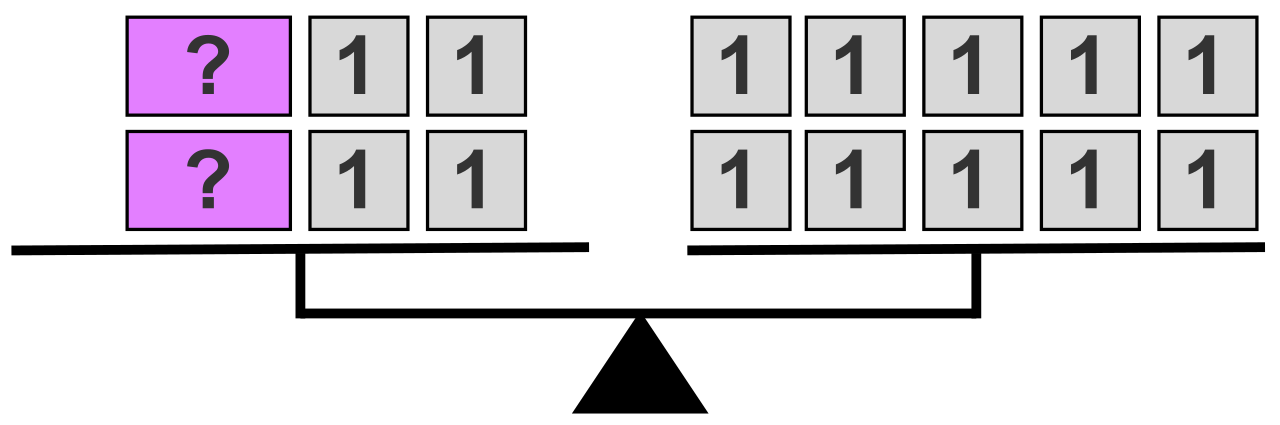
Consider a delicate mechanical scale perfectly balanced with an unknown mass on one side and a collection of standard weights on the other. Every algebraic manipulation you perform on a linear equation is a physical action taken upon this scale. If you add weight to the left, you must add the exact same weight to the right; if you halve the contents of one pan, you must halve the contents of the other. The language of linear equations and inequalities is the mathematical formalization of this equilibrium, providing the essential syntax for modeling constant rates of change in the real world. As a mathematics educator, your objective is not merely to train students to isolate a variable, but to teach them how to read these symbolic statements as living models of predictable behavior, from calculating a school district's projected budget deficit to determining the exact moment a moving vehicle will run out of fuel.
A mechanical balance scale offers a physical visualization of algebraic equilibrium, where every mathematical operation performed on one side must be mirrored on the other to maintain equality.
At its core, a linear equation in one variable can be written in the form ax+b=c, where a, b, and c are real numbers and a is not equal to zero. The restriction that a=0 is structural; without it, the variable vanishes, and we are no longer investigating an unknown.
The first recorded use of the equals sign, published by Robert Recorde in his 1557 text "The Whetstone of Witte." In modern algebraic notation, this foundational equation translates to 14x + 15 = 71.
To solve these equations, we rely on two fundamental axioms that guarantee our logical steps preserve the original truth of the statement:
The addition property of equality states that adding the same real number to both sides of an equation produces an equivalent equation. (This equally applies to subtraction, which is merely the addition of a negative value).
The multiplication property of equality states that multiplying both sides of an equation by the same non-zero real number produces an equivalent equation. (Division is similarly just multiplication by a reciprocal).
When working in the classroom, you will frequently encounter students paralyzed by equations cluttered with fractions or decimals. The multiplication property offers an elegant escape route. Rather than laboring through complex fractional arithmetic, multiplying every term in a linear equation by the least common denominator eliminates all fractions from the equation. If a student is faced with 31x+21=65, multiplying the entire system by the common denominator6 instantly transforms the equation into the highly approachable 2x+3=5.
Similarly, multiplying every term in a linear equation by an appropriate power of ten eliminates decimal coefficients from the equation. An equation like 0.25x+1.5=3.75 can be multiplied universally by 100 (102) to shift the decimal point two places, yielding 25x+150=375.
This same structural manipulation applies to systems where numbers are replaced entirely by letters. Literal equations are solved for a specific target variable by treating all other variables in the equation as constants. When converting the temperature formula F=59C+32 to solve for Celsius, you apply the exact same addition and multiplication properties, simply dragging the "constants" (F and 32) around the target variable C until it is isolated.
Students often assume that every algebraic equation has exactly one definitive numerical answer. This is a limited worldview. When we set out to solve an equation, we are actually running a logical test: Under what conditions is this mathematical statement true?
There are three possible outcomes to this test:
A conditional equation is a mathematical statement that is true for exactly one value of the variable. Most standard classroom problems fall here. The equation 3x−1=8 is only true upon the explicit condition that x=3.
An identity is an equation that is true for all real values of the variable. It represents a fundamental mathematical synonym. For instance, 2(x+3)=2x+6 is true whether x is 5, −12, or 1.4 million. The left and right sides are simply two different ways of writing the exact same thing. What happens when a student tries to solve this? Solving an identity analytically yields a true mathematical statement without variables, such as 0=0.
A contradiction is an equation that has no mathematical solution. It is a fundamentally flawed premise, such as x=x+5. There is no number in the universe that is five units larger than itself. If a student proceeds algebraically, subtracting x from both sides, the variables vanish. Solving a contradiction analytically yields a false mathematical statement without variables, such as 0=5.
Teaching Context: When variables vanish and leave 0=0 or 0=5, students often panic and assume they made an arithmetic error. Teach them to listen to what the math is saying. A result of 0=0 is the equation declaring, "This is always true!" A result of 0=5 is the equation screaming, "This is impossible!"
The real world rarely operates in strict equalities. Elevators have maximum weight limits, speed cameras trigger above a certain threshold, and profit occurs when revenue is simply greater than cost.
Structurally, a linear inequality in one variable contains an inequality symbol instead of an equal sign. They follow nearly all the same structural rules as equations:
Adding or subtracting the same value on both sides of an inequality preserves the direction of the inequality symbol.
Multiplying or dividing both sides of an inequality by a positive number preserves the direction of the inequality symbol.
However, the geometric nature of the number line demands one critical divergence: Multiplying or dividing both sides of an inequality by a negative number reverses the direction of the inequality symbol.
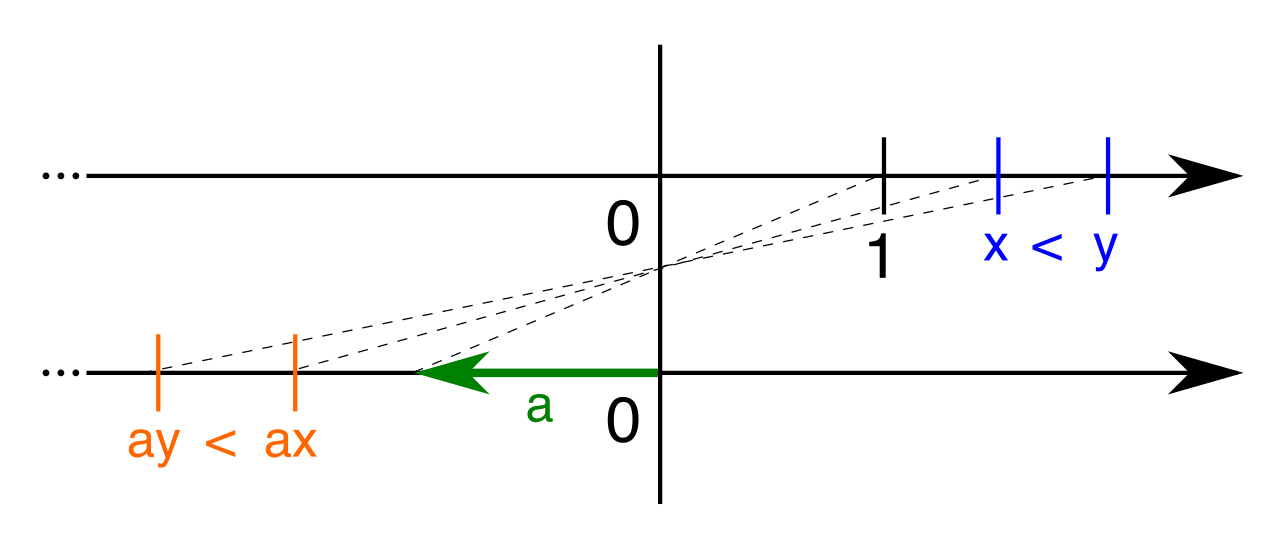
Why? Think of the physical number line. We know that 3>2. If we multiply both sides by −1, we are geometrically reflecting those points across zero. The number 3 lands at −3, and 2 lands at −2. Because −3 is situated further to the left on the number line than −2, it is mathematically smaller. The geometry forces the symbol to flip: −3<−2.
Multiplying an inequality by a negative number geometrically reflects the coordinates across zero on the number line, necessitating a reversal of the inequality symbol to maintain mathematical truth.
A non-strict inequality uses a less than or equal to symbol (≤) or a greater than or equal to symbol (≥).
We translate these boundaries visually and symbolically:
Number Line:On a number line graph, an open circle represents an excluded boundary value for a strict inequality. Conversely, a closed circle represents an included boundary value for a non-strict inequality.
Interval Notation: This highly efficient syntax maps the lower and upper bounds of a solution set. In interval notation, a parenthesis indicates that an endpoint is excluded from the solution set.A square bracket indicates that an endpoint is included in the solution set. Because infinity is not a reachable destination but a direction, the infinity symbol in interval notation is always paired with a parenthesis.
For example, the inequality x≥5 is graphed with a closed circle at 5 with a line extending to the right. In interval notation, this is written as $