Solving Quadratic Equations
Not sure you’re ready?
Take the ~3-minute readiness diagnostic and see where you stand.
Imagine a projectile launched into the air. Its height over time traces a symmetrical arc dictated by gravity. If we want to know precisely when that projectile returns to the earth, we are asking a fundamental mathematical question: at what exact moment does the height equal zero? This physical reality—finding the intersection of a curved trajectory with a baseline—represents the essence of solving quadratic equations. The algebraic techniques we use to find these moments are not arbitrary rules to be memorized; they are logical tools designed to force a sprawling polynomial to reveal its roots. For a secondary mathematics teacher, guiding students through this landscape requires illuminating the geometric meaning and logical necessity behind every algebraic maneuver.
Before manipulating a quadratic, we must establish its structure. The standard form of a quadratic equation is ax2+bx+c=0.
Every term has a role, but the most critical constraint is that in the standard form of a quadratic equation ax2+bx+c=0, the coefficient 'a' must not be equal to zero. If a=0, the x2 term vanishes, the curvature collapses, and the equation degenerates into a linear straight line.
As educators, we must anchor algebra to geometry. When we solve ax2+bx+c=0, we are asking a graphical question. The real solutions of a quadratic equation ax2+bx+c=0 correspond to the x-intercepts of the graph of the function y=ax2+bx+c. Every algebraic solution you find maps directly to a coordinate (x,0) on your student's graphing calculator screen.
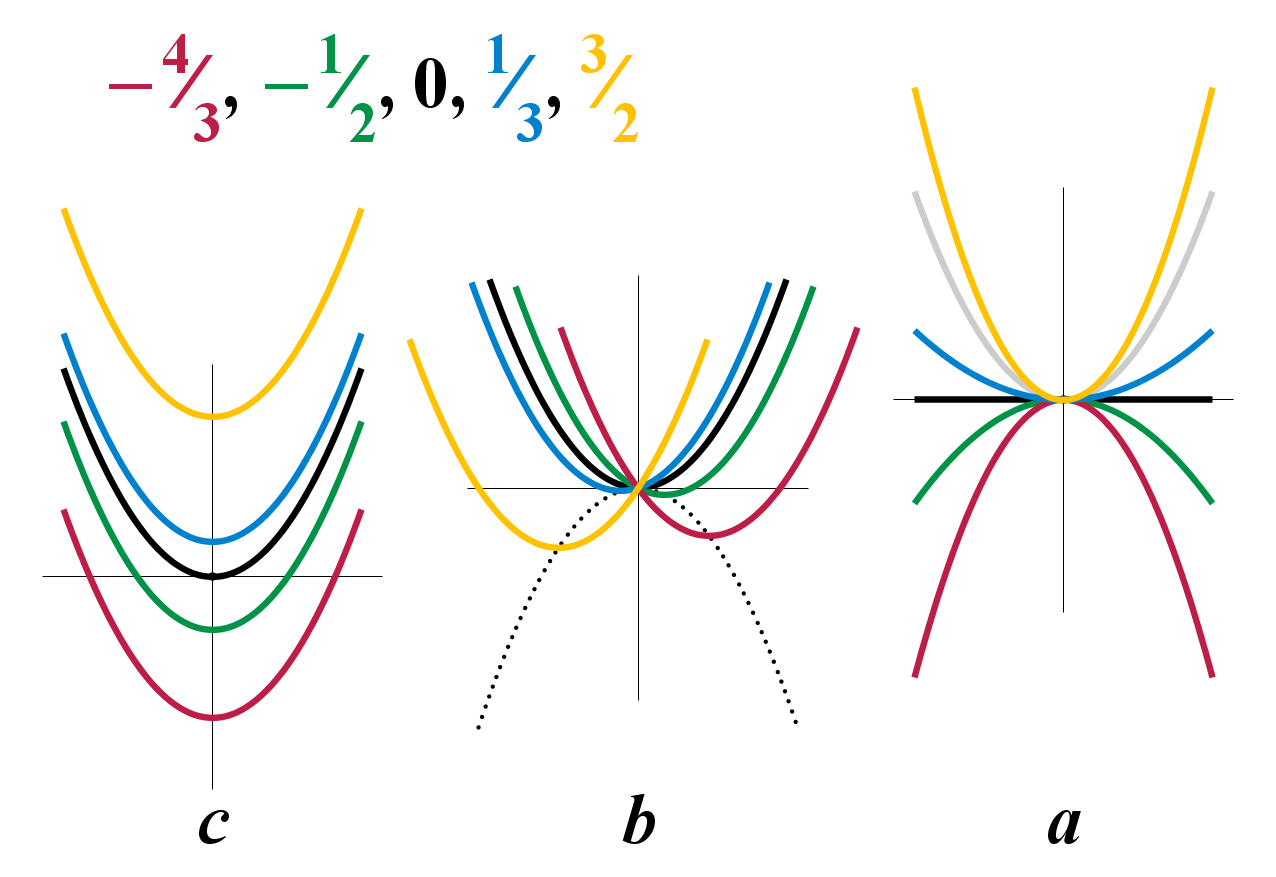
The most elegant way to solve a quadratic is to dismantle it into simpler, linear pieces. Solving a quadratic equation by factoring requires rewriting the equation so that one side is a product of linear factors and the other side is zero.
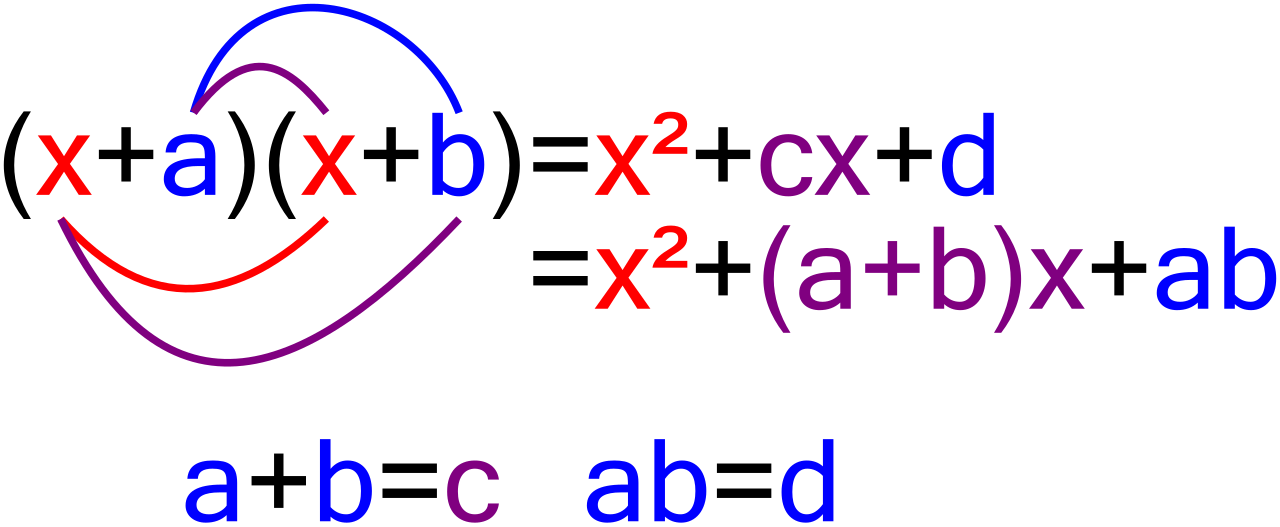
Why must the other side be zero? Because zero possesses a unique mathematical superpower. The Zero Product Property states that if the product of two or more factors is zero, then at least one of the individual factors must equal zero.
If we have an equation factored as (x−3)(x+5)=0, the logical certainty is absolute: either x−3=0 or x+5=0. If the right side were anything other than zero—say, (x−3)(x+5)=12—we would know nothing definitive about the individual factors, as an infinite combination of real numbers multiplies to 12.
This logic works perfectly in reverse, which is a vital tool for curriculum design and testing. A quadratic equation can be reconstructed from two known roots r1 and r2 by multiplying the linear factors (x−r1) and (x−r2) and setting the product to zero. If you want to write an exam question where the answers are x=2 and x=−7, you simply construct (x−2)(x+7)=0 and expand it to x2+5x−14=0.
Not all quadratic expressions factor cleanly. When confronted with an "unfactorable" quadratic, we do not surrender; we reshape the equation by forcing it into a symmetrical form.
A perfect square trinomial is a trinomial that can be factored into the square of a single binomial. For example, x2+6x+9 is a perfect square trinomial because it factors beautifully into (x+3)2.
Notice the relationship between the middle coefficient (b=6) and the constant (c=9). The expression x2+bx+c becomes a perfect square trinomial when the constant term 'c' is equal to the square of half the coefficient 'b'. Mathematically, this is expressed as c=(2b)2.
When an equation lacks this perfect constant, we engineer it. Completing the square is the mathematical process of adding a specific constant to an expression to create a perfect square trinomial.
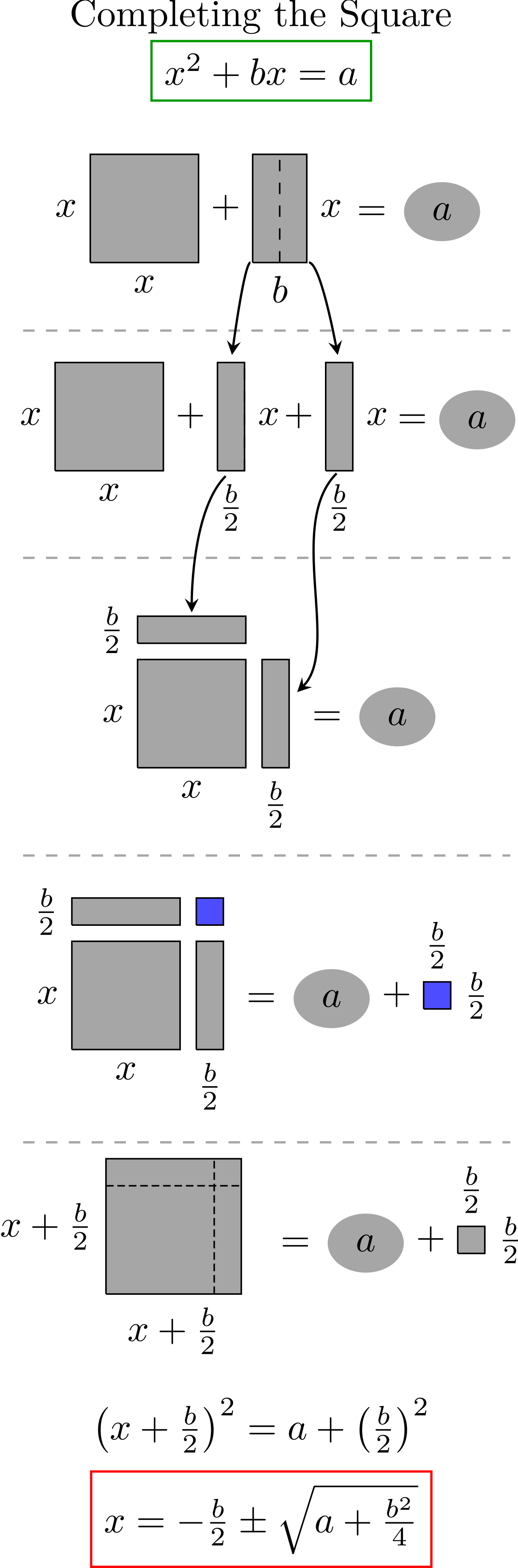
Crucial Teaching Pitfall: A common student error occurs when the leading coefficient is not 1. To complete the square for ax2+bx+c=0, the leading coefficient 'a' must be factored out or divided from the entire equation before adding the completing constant. You cannot apply c=(2b)2 safely to 2x2+8x+5=0 without first dividing the entire equation by 2.
Once the equation is rewritten in the form (x+p)2=k, we unleash our next tool. The Square Root Property states that if x squared equals a constant k, then x is equal to the positive square root of k or the negative square root of k. Taking the square root of both sides leaves us with x+p=±k, easily revealing the solutions.
Completing the square is powerful, but doing it from scratch every time is tedious. Mathematics thrives on generalization. What happens if we apply the completing-the-square algorithm to the abstract standard equation ax2+bx+c=0, without any actual numbers?
We derive a master key. The quadratic formula is derived by applying the process of completing the square to the standard quadratic equation ax2+bx+c=0.
The Quadratic Formula The quadratic formula is x equals negative b plus or minus the square root of the quantity b squared minus 4ac, all divided by 2a. x=2a−b±b2−4ac
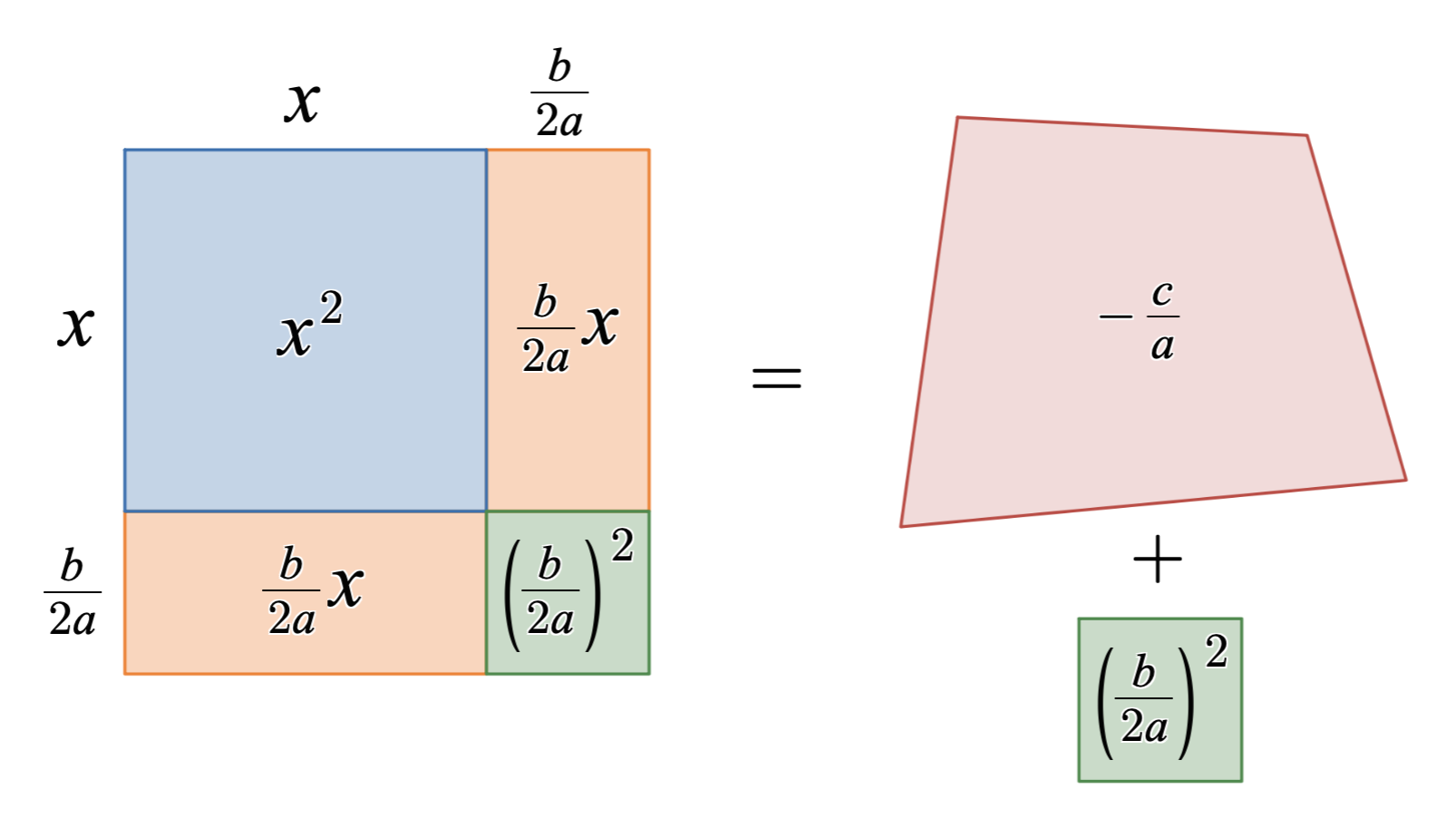
This is not magic; it is simply completing the square pre-packaged. The quadratic formula calculates the exact solutions of any quadratic equation using the coefficients of the quadratic equation. It bypasses the need for intuition or trial-and-error, guaranteeing an answer regardless of how unruly the coefficients are.
Inside the quadratic formula lies the expression b2−4ac, sitting securely beneath the square root. This specific piece of algebraic real estate dictates the fundamental nature of the parabola. The discriminant of a quadratic equation ax2+bx+c=0 is the expression b2−4ac.
Because we must take the square root of this value, its algebraic sign (positive, zero, or negative) acts as an indicator light. The discriminant determines the number and type of solutions for a quadratic equation.
For the secondary math teacher, the discriminant is the bridge between the algebraic formula and the visual graph.
Case 1: The Positive Discriminant (Δ>0)
A positive discriminant indicates that the quadratic equation has exactly two distinct real solutions. Because we are adding and subtracting a real, non-zero square root (±positive), we split into two distinct paths.
- The graph of a quadratic function with two distinct real roots will cross the x-axis exactly twice.
- Rationality Check: If the coefficients are rational, the nature of the roots further depends on the specific positive number. A positive perfect square discriminant indicates that a quadratic equation with rational coefficients has two distinct rational solutions. (e.g., 36=6).
- Conversely, a positive non-perfect square discriminant indicates that a quadratic equation with rational coefficients has two distinct irrational solutions. (e.g., 17 cannot be simplified, leaving an irrational expression).
Case 2: The Zero Discriminant (Δ=0)
A discriminant equal to zero indicates that the quadratic equation has exactly one real solution. If b2−4ac=0, the formula simplifies to x=2a−b±0, yielding a single result.
- A single real solution of a quadratic equation is called a double root. It arises from a perfect square trinomial, such as (x−4)2=0.
- The graph of a quadratic function with exactly one real root will be tangent to the x-axis at the vertex of the parabola. The parabola descends, gently kisses the x-axis at a single coordinate, and sweeps back up.
Case 3: The Negative Discriminant (Δ<0)
A negative discriminant indicates that the quadratic equation has exactly two complex solutions. Taking the square root of a negative number introduces the imaginary unit, i.
- Because the plus-or-minus sign sits in front of the imaginary component, these solutions always arrive as a pair. If a quadratic equation has real coefficients and a negative discriminant, the two complex solutions of the quadratic equation are complex conjugates. (If one root is 3+4i, the other must be 3−4i).
- The graph of a quadratic function with two complex roots will never intersect the x-axis. It floats entirely above or below the axis, a geometric confirmation that no real numbers can satisfy the condition y=0.
| Discriminant (b2−4ac) | Number & Type of Roots | Graphical Behavior |
|---|---|---|
| Positive, Perfect Square | 2 Distinct Rational | Crosses x-axis twice at clean fractions/integers. |
| Positive, Non-Perfect Square | 2 Distinct Irrational | Crosses x-axis twice at irrational values. |
| Zero | 1 Real (Double Root) | Tangent to x-axis at the vertex. |
| Negative | 2 Complex Conjugates | Parabola never intersects the x-axis. |
As a teacher, you will frequently need to verify student work, build equations, or quickly assess if a pair of roots belongs to a specific equation without plugging them in. This is where the elegant relationships discovered by François Viète become indispensable.

There is a profound symmetry hidden within the coefficients a, b, and c.
- Vieta's formulas state that the sum of the roots of the quadratic equation ax2+bx+c=0 is equal to negative b divided by a. (r1+r2=−ab)
- Vieta's formulas state that the product of the roots of the quadratic equation ax2+bx+c=0 is equal to c divided by a. (r1⋅r2=ac)
These formulas matter immensely in the classroom. Suppose a student uses the quadratic formula on 2x2−10x+12=0 and claims the roots are x=2 and x=3. You don't need to check their arithmetic step-by-step. You check Vieta:
- Sum of roots: 2+3=5. Does this equal −ab? −2−10=5. Yes.
- Product of roots: 2×3=6. Does this equal ac? 212=6. Yes.
In seconds, you have confirmed the solution is flawlessly correct by relying on the structural DNA of the quadratic equation itself.
By mastering the transition from factored forms to standard forms, understanding the geometry behind completing the square, and predicting graphing calculator outputs using discriminant analysis, you move from simply calculating roots to genuinely understanding the mathematics of parabolas.