Strengths and Limitations of Collaborative Approaches
Not sure you’re ready?
Take the ~3-minute readiness diagnostic and see where you stand.
When two distinct waves in physics occupy the same space, they either amplify each other through constructive interference or cancel each other out. The inclusive classroom operates on precisely the same principle. Bringing a general education teacher and a special education teacher into the same room is not a simple addition of personnel; it is a complex collision of differing expertise, pedagogical philosophies, and methodologies. If these two professionals align their efforts, they create an instructional environment far more powerful than either could manage alone. If they fail to align, the resulting friction diminishes the effectiveness of the instruction and leaves students navigating contradictory expectations.
Understanding the mechanics of professional collaboration is not merely about learning how to share a whiteboard. It is about understanding how to structurally integrate specialized interventions within the pacing and rigor of the general education curriculum. For the special educator, mastering these models is the difference between being a vital architect of student learning and becoming a ghost in the back of someone else's classroom.
Before we examine the specific mechanisms of co-teaching, we must understand the fundamental problem these models were engineered to solve. Historically, students with disabilities were pulled out of the general education environment to receive specialized instruction. While this provided targeted support, it frequently isolated them from the core curriculum and their peers.
Collaborative approaches mathematically change this equation. Collaborative approaches combine the content knowledge of general educators with the specialized instructional strategy expertise of special educators. The general educator serves as the master of the "what"—the curriculum, the standards, and the core content. The special educator serves as the master of the "how"—the accommodations, the modifications, the behavior interventions, and the diverse pathways to learning.
When successfully executed, collaborative teaching achieves two vital outcomes:
- Curricular Access: Co-teaching allows students with disabilities to access the general education curriculum alongside typically developing peers, ensuring they are exposed to the same rigorous academic standards.
- Stigma Reduction: Collaborative teaching models reduce the stigma associated with receiving special education services by keeping students in the general education classroom rather than pulling them out in full view of their peers.
To provide a structured framework for this partnership, educational researchers Marilyn Friend and Lynne Cook identified six primary models of co-teaching used by special and general educators. These are not strict, mutually exclusive categories to be chosen once at the beginning of the year. Rather, they are tools in a toolkit. A masterful co-teaching pair might transition fluidly between three different models within a single fifty-minute class period, depending on the objective of the lesson.
1. One Teach, One Observe
In this model, one educator delivers the primary academic instruction while the second educator intentionally gathers specific evidence. The One Teach, One Observe co-teaching model involves one educator delivering instruction while the second educator collects specific data on student performance.
Exam Warning: Do not confuse this with a teacher passively watching a lesson. The One Teach, One Observe model requires the educators to determine the specific academic or behavioral data to be collected prior to the lesson.
When to use it: You suspect a student’s disruptive behavior is triggered by transitioning from direct instruction to independent work. The general educator teaches the lesson; you stand with a clipboard mapping the precise antecedents to the student's behavior.
2. One Teach, One Assist
Here, one teacher holds the floor and directs the lesson flow, while the second teacher moves quietly through the room. The One Teach, One Assist co-teaching model features one educator leading the lesson while the second educator circulates the room to provide individual help to students.
While this requires very little joint planning time, it carries a severe institutional danger. A major limitation of the One Teach, One Assist model is the risk of reducing the assisting special educator to the role of a paraprofessional. If the special education teacher is permanently relegated to floating around handing out pencils and whispering hints, their specialized instructional expertise is completely wasted, and the students quickly figure out who the "real" teacher is.
3. Station Teaching
Think of this as an instructional circuit-training routine. Station Teaching involves dividing instructional content into segments presented at separate physical locations in the classroom.
The mechanics are specific: Station Teaching requires both co-teachers to deliver distinct instructional content to small groups of students simultaneously. The groups then rotate. Because there are usually more groups than teachers, Station Teaching frequently incorporates a third independent work station for students to complete tasks without direct teacher supervision.
- Strength: Excellent for breaking up complex, multi-step lessons (e.g., one teacher does vocabulary, one does reading comprehension, the independent station does a writing prompt).
- Limitation: Because two teachers are lecturing simultaneously in the same room, a high noise level is a common limitation of the Station Teaching model. It requires clear physical boundaries and excellent volume control.
4. Parallel Teaching
If you want to maximize student participation, you cut the audience in half. Parallel Teaching involves dividing the class in half to teach the exact same instructional material simultaneously.
By doing this, Parallel Teaching lowers the student-to-teacher ratio to increase student engagement and opportunities to respond. If you ask a question to a group of 30, a student has a 1-in-30 chance of answering. In a group of 15, their accountability doubles.
- Limitation: This model lives or dies by the clock. Parallel Teaching requires both educators to have strong pacing skills to ensure both groups finish the lesson at the same time. If one teacher finishes five minutes early while the other is still lecturing, the entire classroom dynamic collapses into chaos.
5. Alternative Teaching
Sometimes, a small fraction of the class needs something fundamentally different from the rest. Alternative Teaching involves one educator working with a large group of students while the second educator works with a smaller group.
Alternative Teaching allows for targeted pre-teaching, reteaching, or enrichment for specific students. You might pull five students to the back table to pre-teach challenging vocabulary before the general educator introduces the reading passage to the large group.
- Limitation: While highly effective academically, it poses a social risk. A limitation of Alternative Teaching is the risk of stigmatizing students who are repeatedly pulled into the small group for remediation. If the same four students with IEPs are always dragged to the back table, the inclusive illusion is broken. You must rotate group membership to avoid creating a "special ed island" within the general ed room.
6. Team Teaching
This is the apex of collaborative instruction. Team Teaching involves both educators sharing the delivery of the exact same instruction to the whole class at the same time. They finish each other's sentences, chart notes while the other speaks, and seamlessly pass the conversational baton.
Because it operates like a tightly choreographed dance, Team Teaching requires the highest level of mutual trust and instructional coordination between co-teachers. It is difficult to achieve, but when it works, it is brilliant to watch.
Co-Teaching Models Summary Matrix
| Model | Mechanics | Primary Benefit | Primary Limitation |
|---|---|---|---|
| One Teach, One Observe | One instructs; one gathers pre-planned data. | Yields precise behavioral or academic data. | Only one teacher is actively instructing. |
| One Teach, One Assist | One instructs; one circulates to support. | Provides immediate, targeted student help. | Risks reducing SPED teacher to paraprofessional status. |
| Station Teaching | Both teach distinct content simultaneously; students rotate. | High engagement; breaks up complex content. | High noise level in the classroom. |
| Parallel Teaching | Both teach same content to half the class. | Lowers student-teacher ratio; doubles engagement. | Requires perfectly synchronized pacing. |
| Alternative Teaching | One large group; one small group for targeted support. | Allows discrete pre-teaching or reteaching. | Risk of stigmatizing the small group members. |
| Team Teaching | Both share whole-class instruction simultaneously. | Seamless fusion of content and strategy expertise. | Requires massive trust and coordination. |
Not all collaboration involves two teachers standing in the same room. Often, special educators operate behind the scenes, providing the specialized knowledge necessary to keep the system running. Educational consultation is a collaborative process where a special educator assists a general educator in addressing a specific student's needs.
You must recognize the distinction between two primary models of consultation:
1. The Triadic-Dependent Model
Picture a triangle. At the top is the Special Educator (the consultant). At the bottom corners are the General Educator (the consultee) and the Student (the client). In a triadic-dependent consultation model, the special education teacher provides indirect services to the student by advising the general education teacher. Why dependent? The general educator relies on the special educator's specialized knowledge to solve a problem. For example, a general education teacher comes to you asking how to support a student with autism who struggles with sensory overload during assemblies. You design a visual schedule and a sensory diet, which the general education teacher then implements. You never directly intervene with the student; your expertise reaches the student through the general educator.
2. The Collaborative-Interdependent Model
Now picture a round table. There is no single expert handing down advice. The collaborative-interdependent consultation model involves multiple professionals contributing equal expertise to solve complex student problems. When a student has intense, multifaceted needs (e.g., an individual with a traumatic brain injury transitioning back to school), no single person holds the answer. The physical therapist, the speech-language pathologist, the general educator, the parents, and the special educator must synthesize their diverse knowledge bases into a single, cohesive action plan.

If collaboration is so effective, why is it frequently a source of immense stress for educators? Because aligning two adult professionals within an inflexible school system requires overcoming significant structural and interpersonal friction.
Structural and Systemic Barriers
You cannot plan a seamless lesson through a five-minute hallway conversation. Effective co-teaching requires dedicated, mutual planning time built into the master schedules of both educators. Unfortunately, a common limitation of collaborative teaching is a lack of administrative support in scheduling common planning periods. When administrators build the master schedule treating co-teachers merely as "coverage" rather than a synchronized team, the instruction inherently devolves into the "One Teach, One Assist" model.
Furthermore, special educators are rarely assigned to just one classroom. Special education teachers assigned to co-teach in multiple different classrooms often struggle to effectively participate in instructional planning for every subject. If you co-teach 9th-grade algebra, 10th-grade biology, and 11th-grade history, mastering the nuances of all three curricula to be an equal instructional partner is mathematically impossible given standard planning constraints.
Interpersonal and Philosophical Barriers
Even with perfect schedules, bringing two adults into one room creates interpersonal vulnerability.
-
Behavioral Expectations: Differences in classroom management styles between co-teachers can create behavioral inconsistency for students. If the general educator demands absolute silence during independent work, but the special educator allows low-volume peer assistance, students become confused and behaviors escalate.
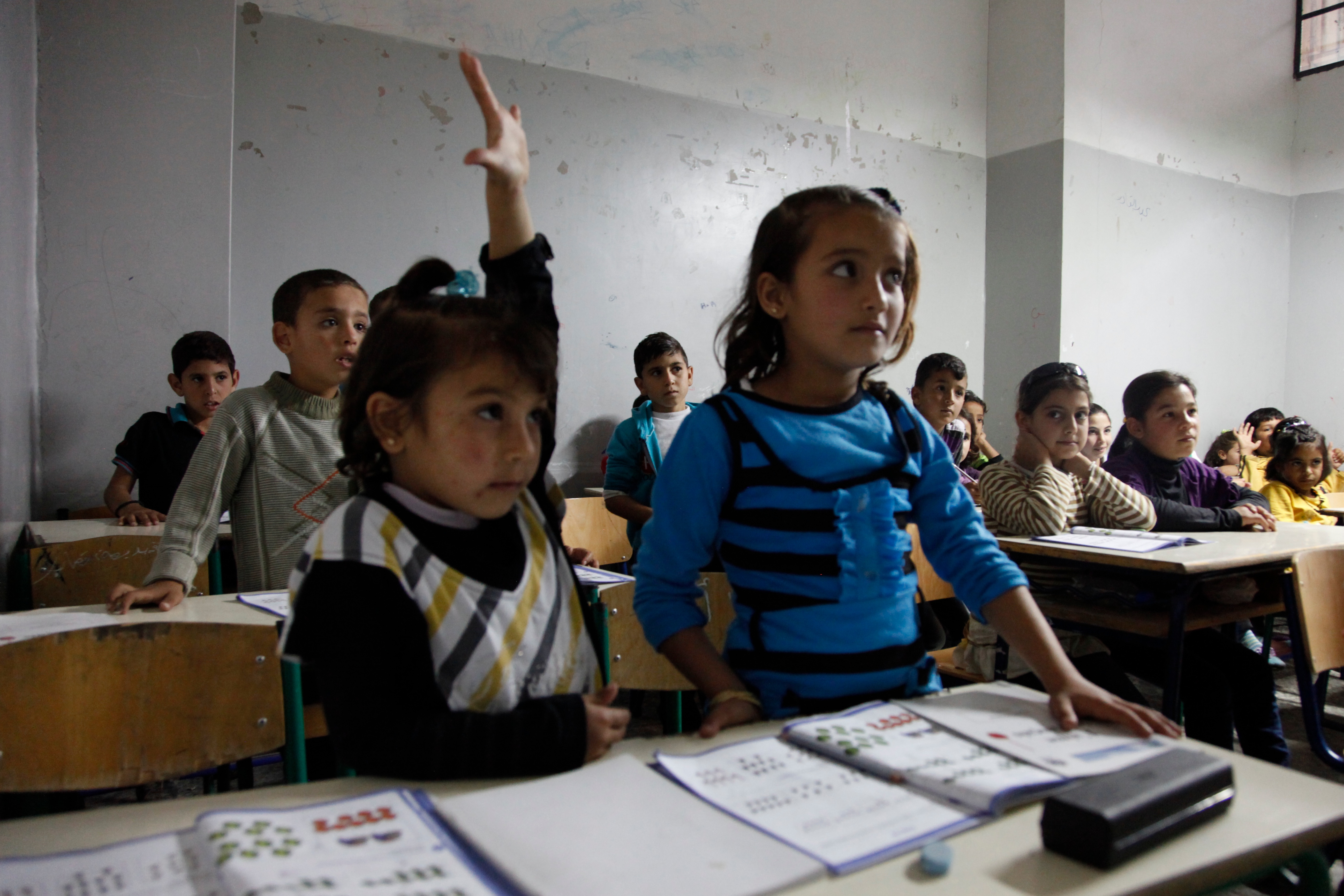
Differing classroom management expectations between co-teachers, such as strict rules for hand-raising versus open dialogue, can lead to student confusion and escalated behaviors. Source: Syrian refugee children in a Lebanese school classroom (15101234827) by DFID - UK Department for International Development, CC BY-SA 2.0. -
Educational Beliefs: Mismatched educational philosophies regarding inclusion or grading standards frequently cause conflict in a co-teaching partnership. If one teacher believes "fair means equal" (everyone takes the exact same test) and the other believes "fair means equitable" (tests should be modified based on IEPs), the partnership will fracture.
-
The Division of Labor: Finally, disagreements over the division of grading and assessment responsibilities hinder the effectiveness of collaborative teaching models. If the general educator refuses to grade modified work, or the special educator is locked out of the digital gradebook, resentment builds rapidly.
A Concluding Thought for the Practitioner
Collaboration is not a soft skill; it is a highly technical competency. As a special educator, you are the ambassador of accessibility. You must be fluent in the content vocabulary of the general educator, precise in your data collection, and highly adaptable in your delivery. By mastering these collaborative frameworks—knowing exactly when to pull a small group, when to split the class in half, and when to act as a silent observer—you transform the general education classroom from a place where students with disabilities merely sit, into a place where they genuinely learn.