Fractions as Numbers and Equivalent Fractions
Not sure you’re ready?
Take the ~3-minute readiness diagnostic and see where you stand.
When a young child first learns to count, numbers represent concrete, unbreakable entities. Three apples. Four blocks. The mathematical universe consists entirely of whole objects. The introduction of fractions shatters this paradigm, demanding a profound cognitive leap: a number is no longer just a count of discrete items, but a relationship. To teach fractions effectively, we must move past the simplistic notion of "pieces of a pie" and guide students to understand fractions as measurable quantities, distinct points on a number line, and ratios.
This guide deconstructs the conceptual architecture of fractions. As an educator, you are not merely teaching children how to manipulate numbers across a bar; you are rewiring their understanding of what a number can be.
Before a student can grasp the numeric value of a fraction, they must understand the physical and cognitive actions that create one. The foundational concept here is equipartitioning, which is the cognitive process of dividing a continuous whole into equal-sized parts.
When we write a fraction to represent this part-whole relationship, we use a specific notation divided by a line. The formal mathematical term for the fraction bar separating the numerator and the denominator is the vinculum.
The Part-Whole Relationship
- The Denominator: In a part-whole fraction relationship, the denominator specifies the total number of equal parts that make up one single whole. It "denominates" or names the size of the piece.
- The Numerator: In a part-whole fraction relationship, the numerator specifies the count of equal parts being referenced. It "enumerates" or counts those pieces.
The Power of the Unit Fraction
To prevent students from seeing a fraction like 3/4 as just "a three over a four," we must build fractions from the ground up using unit fractions.
A unit fraction is a rational number written as a fraction where the numerator is exactly one. Conceptually, a unit fraction represents exactly one equal part of a partitioned whole.
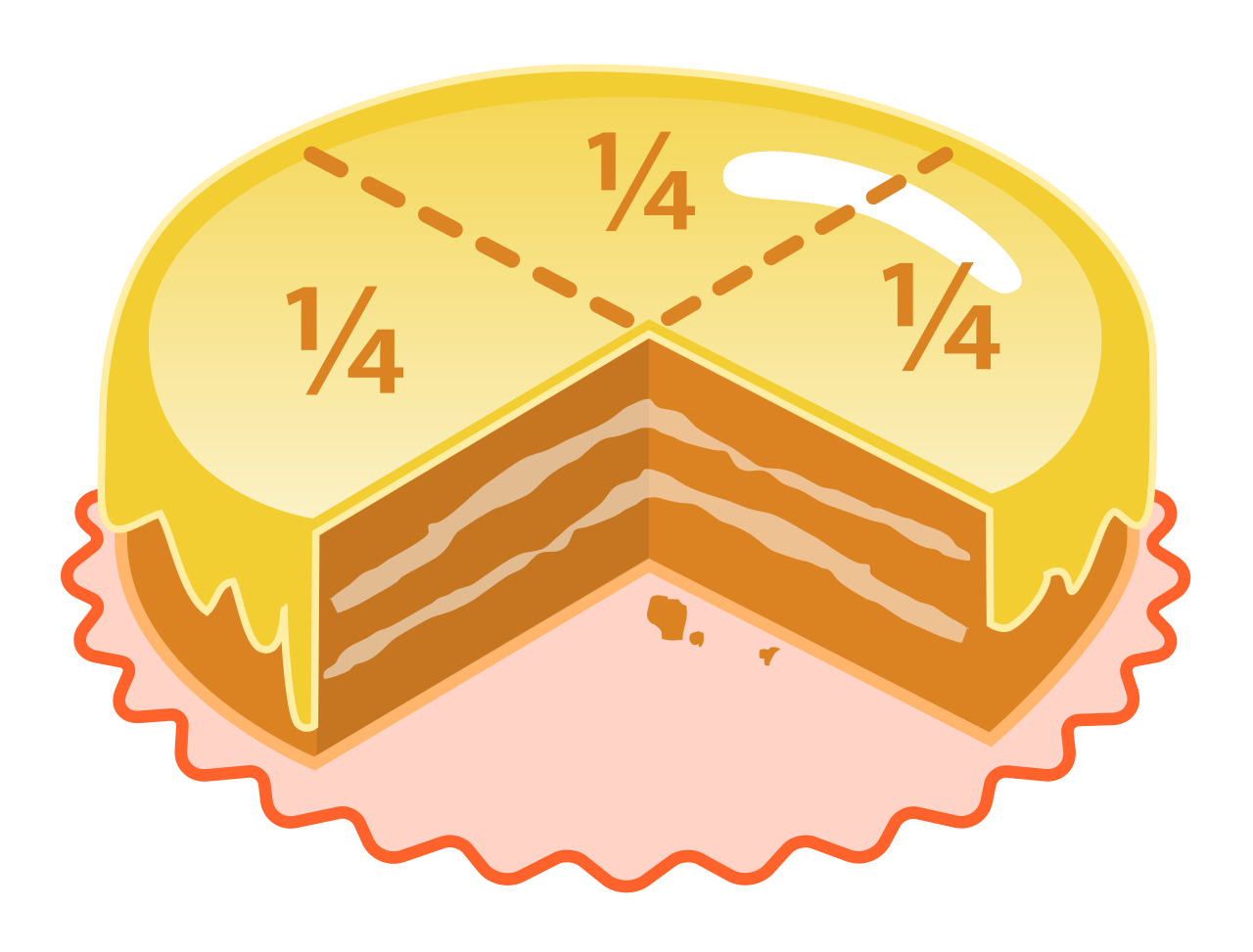
Why is this critical for instruction? Because it establishes a reliable unit of measure. Just as a child counts whole numbers ("one, two, three apples"), they can count unit fractions ("one-fourth, two-fourths, three-fourths"). By teaching that any fraction represented by a/b is composed of a count of individual copies of the unit fraction 1/b, you give students a logical bridge between whole-number counting and fractional reasoning.
To build deep conceptual understanding, students must encounter fractions through multiple visual and physical representations. Relying on a single model creates brittle knowledge that falls apart when the context changes.
| Model Type | Definition & Application | Key Pedagogical Insight |
|---|---|---|
| Visual Area Models | These use partitioned geometric shapes to illustrate fractional quantities. | Equal-sized parts in an equipartitioned area model must possess the same area, but crucially, they do not need to possess identical geometric shapes. A square can be divided into four equal-area parts consisting of two triangles and two rectangles. Students who only look for identical shapes will misinterpret these models. |
| Visual Set Models | These represent fractional quantities as a designated subset within a larger group of discrete objects (e.g., 3 red counters out of 5 total counters). | This challenges students because the "whole" is not a single continuous object, but a collection. It bridges part-whole reasoning with early ratio thinking. |
| Linear Models | These represent fractions as continuous measurable distances along a straight path. | Fraction strips are a type of linear mathematical model used to demonstrate fraction magnitude and equivalence by comparing the length of strips. |
The most vital transition a student makes in elementary mathematics is moving from seeing fractions merely as shaded shapes to understanding them as actual numbers. Fractions function as numerical values possessing distinct and unique locations on a number line.
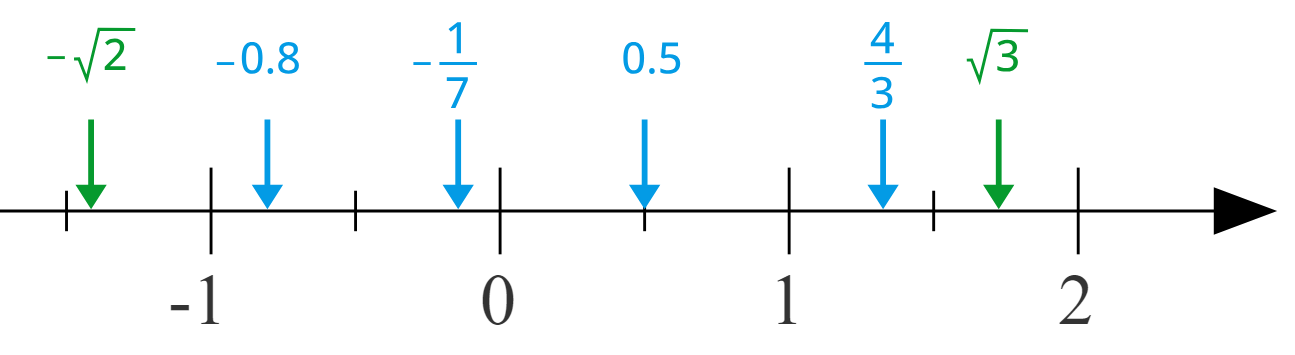
When introducing the number line, the reference points are paramount:
- The distance between the integer zero and the integer one on a standard number line represents exactly one whole.
- Locating a fraction with denominator b on a number line requires dividing the interval between zero and one into b equal length segments.
By physically mapping the distance of unit fractions, students realize that 1/4 is not just "one out of four pieces," but a specific distance—one of four equal jumps required to travel from 0 to 1.
Fractions as Ratios
Beyond part-whole and linear measurements, fractions also serve a distinct comparative function. Fractions can represent a ratio describing a multiplicative comparison between two distinct quantities. For example, if a recipe requires 2 cups of flour for every 3 cups of water, the fraction 2/3 operates as a ratio comparing these distinct physical quantities, expanding the utility of fractional notation beyond single-whole partitioning.
As students iterate unit fractions along a number line, they inevitably pass the integer 1. This necessitates understanding the classifications of fractions based on their magnitude.
- Proper Fraction: A proper fraction has a numerator value strictly less than the denominator value. It resides between 0 and 1 on the positive number line.
- Improper Fraction: An improper fraction has a numerator value equal to or strictly greater than the denominator value. Consequently, an improper fraction represents a quantity equal to or greater than one complete whole.
- Mixed Number: A mixed number consists of an integer component and a proper fraction component combined together (e.g., 241).
A critical mathematical truth for students to internalize is that every mixed number can be rewritten as a mathematically equivalent improper fraction. They are simply two different ways of encoding the exact same magnitude. If a student understands that 1 whole is composed of 4/4, then 241 is intuitively calculated as 4/4+4/4+1/4=9/4.
Equivalence is often taught procedurally ("whatever you do to the top, you do to the bottom"), which bypasses the conceptual meaning. What does it actually mean for two fractions to be equivalent?
- Linear equivalence: Two fractions are equivalent if the two fractions map to the exact same point on a number line.
- Quantitative equivalence: Two fractions are equivalent if the two fractions represent the exact same quantity of identically sized wholes.
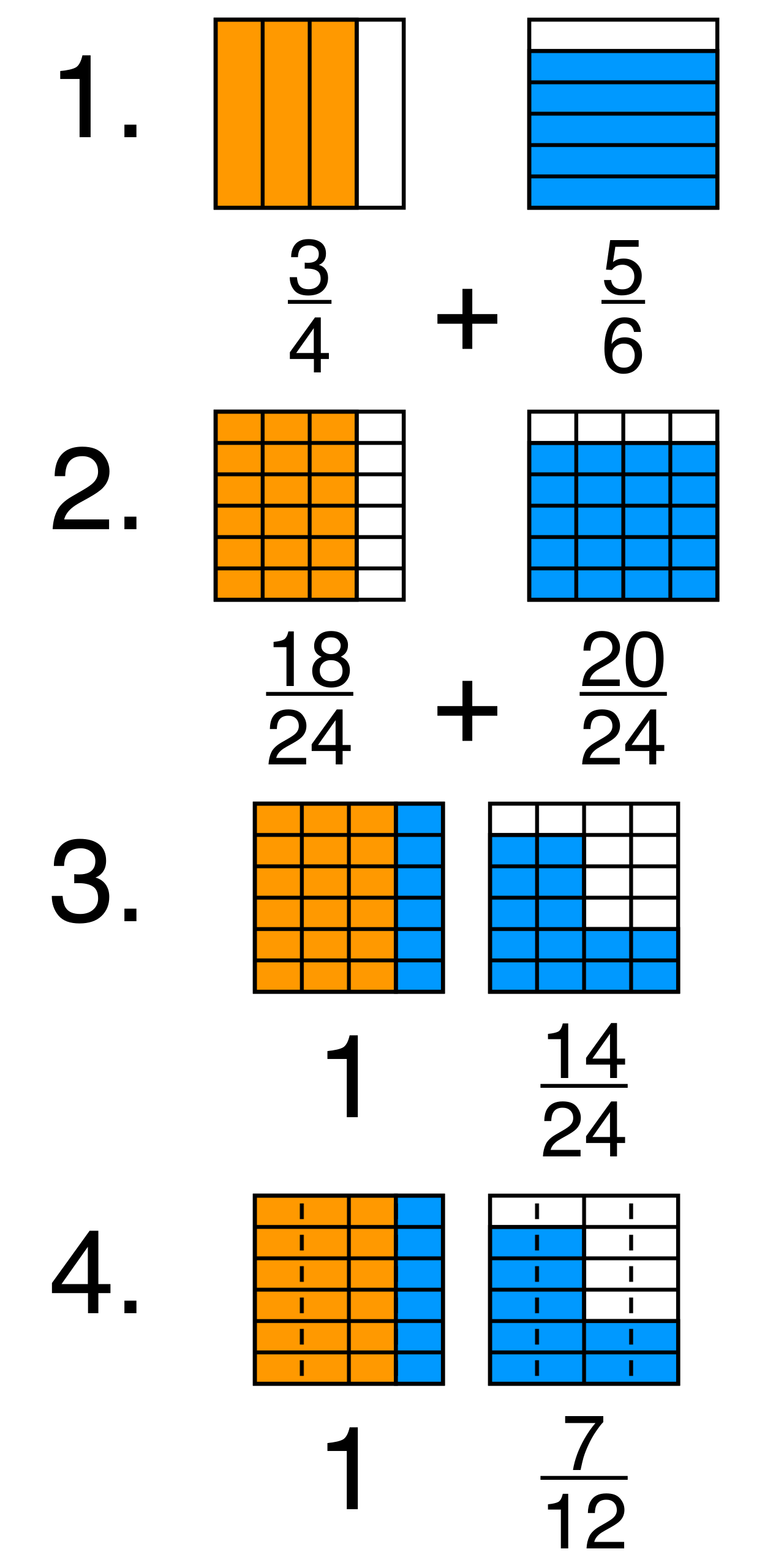
Once students physically see that 1/2 and 2/4 occupy the same point on a number line or cover the same total area of a reference whole, we introduce the arithmetic mechanisms to generate them:
Generating Equivalent Fractions
- Multiplication: Multiplying a fraction's numerator and denominator by the same non-zero integer yields an equivalent fraction. (Conceptually, this represents cutting the existing pieces into smaller, more numerous pieces without changing the total area).
- Division: Dividing a fraction's numerator and denominator by a common factor yields an equivalent fraction. (Conceptually, this represents grouping smaller pieces together into larger, fewer pieces).
Your mastery of content knowledge is measured by your ability to predict, diagnose, and resolve student misconceptions. In the realm of fractions, human intuition often actively betrays the student.
1. The Whole-Number Illusion
Students often incorrectly apply whole-number reasoning to fractions by treating the numerator and denominator as separate, independent integers. A student might look at 3/8 and 4/5, adding them together across the vinculum to get 7/13. They are viewing the digits as isolated counting numbers rather than a single unified magnitude. Instructional countermeasure: Constantly return to the number line to prove that a fraction represents a singular position.
2. The "Larger Denominator = Larger Quantity" Trap
Because 8 is greater than 4, a student's whole-number bias leads to a very common misconception: assuming a fraction with a larger denominator represents a physically larger quantity (e.g., claiming 1/8>1/4). Instructional countermeasure: Reinforce equipartitioning. If you share a single pizza among 8 people, the slices must be smaller than if you share it among 4 people. The denominator represents the number of cuts, not the size of the resulting slice.

3. The Shifting Reference Whole
When exploring equivalence, a student might argue that half of a small pizza is not equivalent to two-fourths of a large pizza. This happens because students frequently misunderstand fraction equivalence by failing to recognize that equivalent fractions must refer to identically sized reference wholes. Instructional countermeasure: Explicitly define the "whole" before making any comparisons. Equivalence is a relationship of proportions; if the initial wholes differ in magnitude, their fractional components cannot be directly equated as absolute numeric values.