Place Value and Decimals
Not sure you’re ready?
Take the ~3-minute readiness diagnostic and see where you stand.
The Hindu-Arabic numeral system is one of the most profound technological leaps in human history, yet its very efficiency disguises its underlying mathematical complexity. When a young child looks at the number 42, they visually process two distinct, adjacent symbols. The monumental leap in early cognition occurs when they begin to understand that the '4' does not simply mean four distinct objects, but rather four groups of ten. Teaching place value is therefore not merely a matter of naming columns on a chalkboard; it is the process of revealing the invisible, positional machinery that governs our entire mathematical universe. To teach it effectively requires an intimate understanding of not just how the machinery works, but exactly where its moving parts catch, grind, and confuse the developing mind.

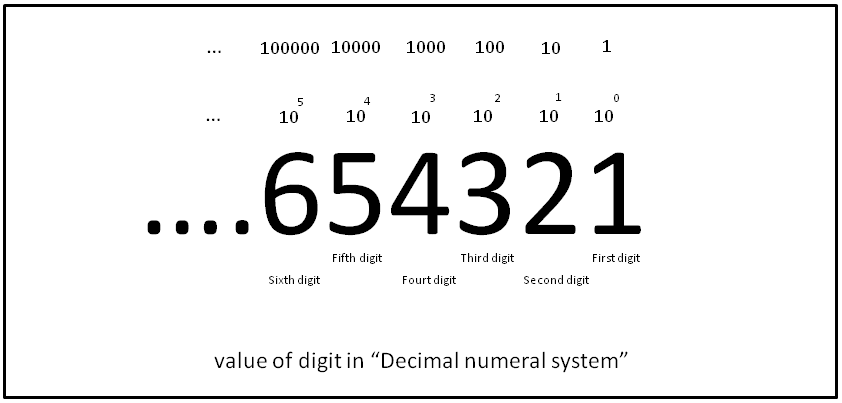
To understand how children learn numbers, we must first look at the mechanics of our counting system. The base-ten number system is a positional numeral system. This means the geographical location of a digit dictates its actual mathematical worth.
In this system, a digit's total value in a number is the product of its face value (the integer itself) and its place value (its location's designated worth). Because our system is anchored to the quantity of ten, a beautiful, repeating geometry governs its layout. Moving horizontally across a number, in a base-ten system, each place value is exactly ten times greater than the place value to its immediate right. Conversely, each place value is exactly one-tenth of the place value to its immediate left.
The Power of Zero To maintain this strict positional discipline, the system requires an architectural strut: the number zero. Zero functions as a placeholder in the base-ten system to maintain the correct positional value of other digits.

Without this placeholder, the entire positional structure collapses. For novice learners, missing placeholders often lead students to incorrectly write numbers. If you ask a student to write "four hundred two," a student omitting a placeholder zero might incorrectly write four hundred two as 42, fundamentally altering the magnitude of the number simply because the structural column of the tens place was left empty.
Because we must communicate these values, we utilize three distinct translations, or forms, of a number:
- Standard form represents a number using only numerical digits. (e.g., 345)
- Word form represents a number using written language instead of numerals. (e.g., "three hundred forty-five")
- Expanded form represents a number as the explicit sum of the values of its individual digits.
Expanded form is not just a vocabulary word; it is the mathematical equivalent of unzipping the number to reveal its constituent parts. For instance, the expanded form of 345 is written as 300 + 40 + 5. This explicitly forces the student to recognize that the '3' is not three ones, but three hundreds.
A deep conceptual understanding requires fluency in taking numbers apart and putting them back together. Usually, numbers can be decomposed into standard base-ten groupings based strictly on place value (as seen in expanded form).
However, mathematical fluency requires flexibility. Numbers can also be decomposed into non-standard base-ten groupings.
Consider the number 53. Its standard decomposition is 5 tens and 3 ones. But decomposing 53 into 4 tens and 13 ones is an example of a non-standard base-ten grouping.
Why do we care about this slightly awkward phrasing? Because non-standard base-ten decompositions are fundamental for understanding subtraction algorithms that require regrouping. When a student attempts to subtract 18 from 53, they cannot subtract 8 ones from 3 ones without dipping into negative numbers. The traditional "borrowing" algorithm is nothing more than teaching the student to quickly translate the standard grouping (5 tens, 3 ones) into a non-standard grouping (4 tens, 13 ones). If they lack this conceptual underpinning, "borrowing" becomes a rote, meaningless trick.
To move students from rote counting to abstract grouping, we employ physical objects. Using physical manipulatives to compose numbers helps students transition from counting by single ones to conceptualizing distinct groups of ten.
The Foundation: Ten-Frames and Subitizing
In early childhood, the magic begins with the number ten. Ten-frames are graphical tools comprising a two-by-five grid. As students place counters into these grids, ten-frames assist early elementary learners in visualizing numbers in relation to the anchor number ten.
Over time, this builds an essential cognitive skill: subitizing. Subitizing is the mathematical ability to instantly recognize the quantity of objects in a small group without manually counting. By recognizing a full row of five and two more in a ten-frame, a student instantly subitizes "seven" without painstakingly touching each counter.
Proportional vs. Non-Proportional Manipulatives
As numbers grow, we need tools that model our positional system. Proportional manipulatives physically reflect the ten-to-one magnitude differences between adjacent place values.
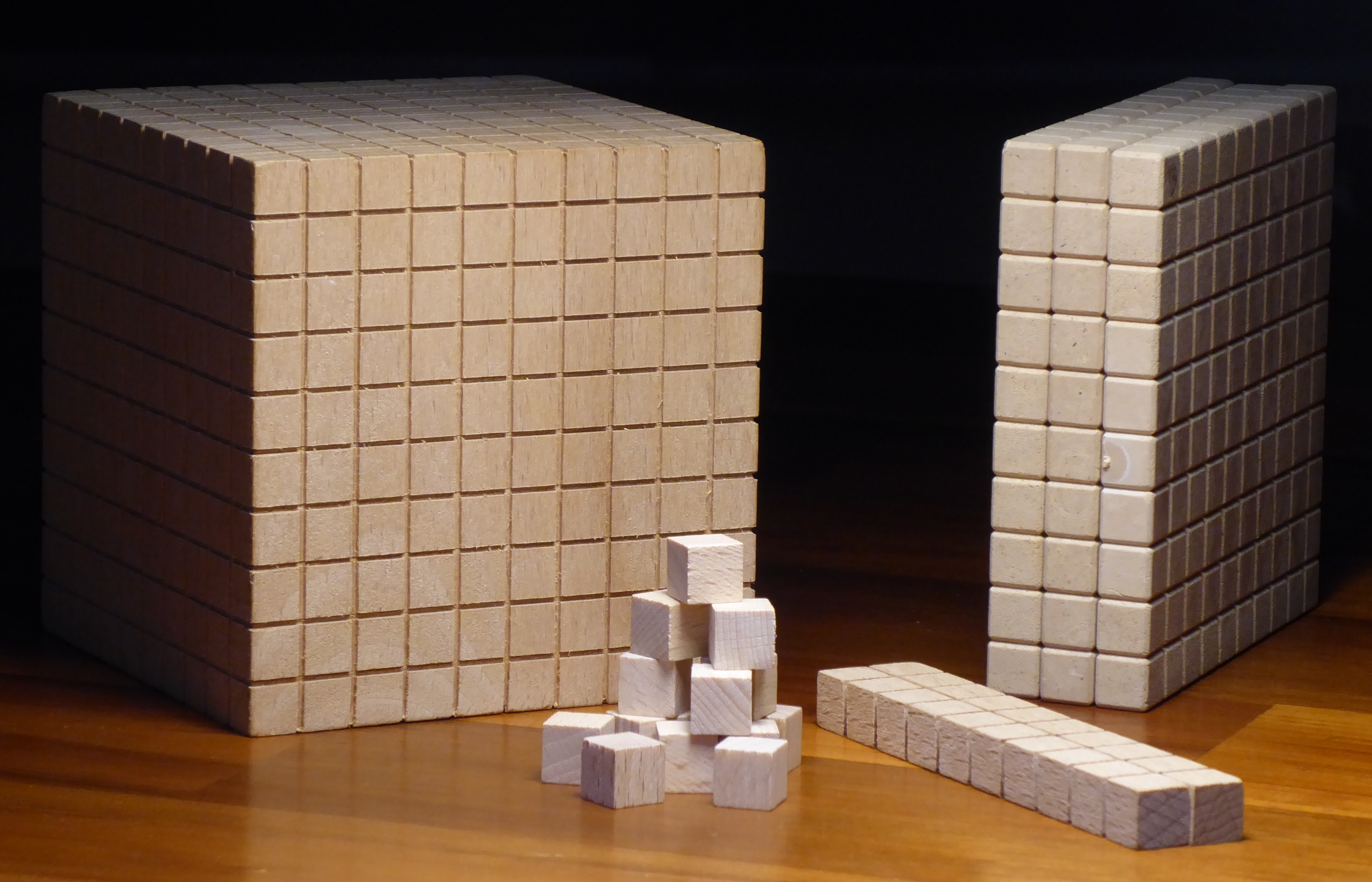
Base-ten blocks are proportional manipulatives, meaning a visual and tactile inspection confirms the mathematical truth. They act as physical or virtual manipulatives used to model the base-ten number system.
- In whole number representations, a base-ten unit cube represents the value of one.
- In whole number representations, a base-ten rod comprises ten unit cubes and represents the value of ten.
- In whole number representations, a base-ten flat comprises ten rods and represents the value of one hundred.
- In whole number representations, a base-ten large cube comprises ten flats and represents the value of one thousand.
However, adults do not carry base-ten blocks in their pockets. We often use non-proportional manipulatives. Non-proportional manipulatives require abstract understanding because physical size does not match numerical magnitude.
Coins and place value disks are non-proportional manipulatives. A dime is physically smaller than a penny, yet it is worth ten times as much. Place value disks are manipulatives that represent value through color and a printed number rather than proportional size. To use them, a student must abandon their reliance on physical volume and trust the abstract numerical system.
Eventually, mathematics demands precision between the whole numbers. Enter the decimal.
The decimal point separates the whole number portion from the fractional portion of a base-ten number. But the decimal point is often profoundly misunderstood. It is essentially punctuation. More accurately, the decimal point explicitly marks the location of the ones place.
When we extend place value to the right of the decimal, fractional decimal place values utilize the standard naming convention of whole number place values combined with a "th" suffix.
- The first positional place to the immediate right of the decimal point is the tenths place.
- The second positional place to the right of the decimal point is the hundredths place.
- The third positional place to the right of the decimal point is the thousandths place.
The Symmetry Misconception
There is a beautiful, mirror-like symmetry to place value nomenclature, but students often misplace the mirror. Place value names are symmetrical around the ones place. (Tens mirror tenths; hundreds mirror hundredths).
However, students often incorrectly identify the decimal point as the center of symmetry for place value names. Because place value names are not symmetrical around the decimal point, this leads to a frantic search for the non-existent "oneths" place. Teaching students that the symmetry pivots on the ones place—and the decimal point simply anchors our eyes to the ones—cures this conceptual headache.
To teach decimals conceptually, we can utilize the same visual tools we used for whole numbers, but we must shift our frame of reference. Base-ten block values can be redefined to represent decimal place values.
If we redefine our standard unit, the physical relationships seamlessly model fractions.
- When modeling decimals, a base-ten flat often represents one whole unit.
- When a base-ten flat represents one whole unit, a base-ten rod represents one-tenth. (Because 10 rods make a flat).
- When a base-ten flat represents one whole unit, a base-ten unit cube represents one-hundredth. (Because 100 cubes make a flat).
By holding a tiny unit cube and realizing it represents a "hundredth" of the large flat, students gain a visceral understanding of how small a hundredth truly is.
Decimals are notoriously difficult for students to grasp because they trigger an intersection of whole-number bias and flawed fraction logic. As an educator, you must actively anticipate these specific cognitive traps.
1. The "Two Separate Numbers" Trap: A common student misconception involves treating the digits to the right of the decimal point as a separate whole number. A student looks at 0.45 and 0.5, separates the fractional part, and compares 45 to 5. Treating the decimal portion as an independent whole number leads students to incorrectly believe that 0.45 is greater than 0.5.
2. The "Longer is Larger" Trap: Because 452 is inherently larger than 45, students often incorrectly assume that a longer decimal representation always has a larger magnitude. They struggle with the mathematical truth that appending zeros to the extreme right end of a decimal fraction does not change the mathematical value of the number. (e.g., 0.5 is exactly equal to 0.500).
3. The "Shorter is Larger" Trap: Conversely, once students are introduced to fractions, they learn that 1/10 is far larger than 1/100. Some students over-apply this valid fraction logic to the length of decimals. Students sometimes mistakenly assume shorter decimals are larger by overgeneralizing fraction concepts regarding tenths and hundredths. They might deduce that 0.2 is larger than 0.85 simply because 0.2 stops at the "larger" tenths place.
To break through these misconceptions, educators must move beyond discrete digits and return to spatial continuous reasoning.
Number lines help students visualize the continuous magnitude and relative positioning of multidigit numbers and decimals. When a student is forced to plot 0.45 and 0.5 on a continuous line between 0 and 1, the spatial reality overrides their whole-number bias. The number line physically demonstrates that 0.5 sits further to the right.

Furthermore, number lines provide a visual pedagogical tool for rounding numbers to a designated place value. Instead of teaching abstract "rounding rhymes" (e.g., "five or more, let it soar"), a number line shows why a number rounds a certain way. If you plot 37 on a number line featuring decades, you can visibly see it is geographically closer to 40 than to 30.
In mathematics, rounding a number replaces the original value with an approximate value based on a specific positional limit. It trades absolute precision for conceptual convenience. Understanding this trade-off is the pinnacle of place value fluency: recognizing that the mathematical structures we impose upon numbers—whether decomposing them for an algorithm, sliding them across a decimal point, or approximating them on a line—are all part of a cohesive, beautifully engineered system.