Applying Basic Number Properties
Not sure you’re ready?
Take the ~3-minute readiness diagnostic and see where you stand.
Consider the mundane act of counting a handful of mixed coins. You do not mechanically add each value in the exact sequence it rests in your palm; you instinctively group the quarters, pair dimes and nickels to create neat multiples of ten, and leave the pennies for the end. This intuitive mental choreography is possible only because arithmetic obeys a set of universal architectural rules. Basic number properties are not arbitrary vocabulary words to be memorized; they are the fundamental permissions that allow us to bend, reorder, and simplify numbers without breaking the mathematical truth of the universe. For an educator preparing for the Praxis Core, mastering these properties means looking past the rote steps of a calculation to see the invisible scaffolding holding the numbers together.

Understanding these properties transforms arithmetic from a rigid set of instructions into a flexible tool. It allows you to recognize how operations are structured, manipulate expressions effortlessly, and teach students to view mathematics as a fluid, logical language rather than a punishing obstacle course.
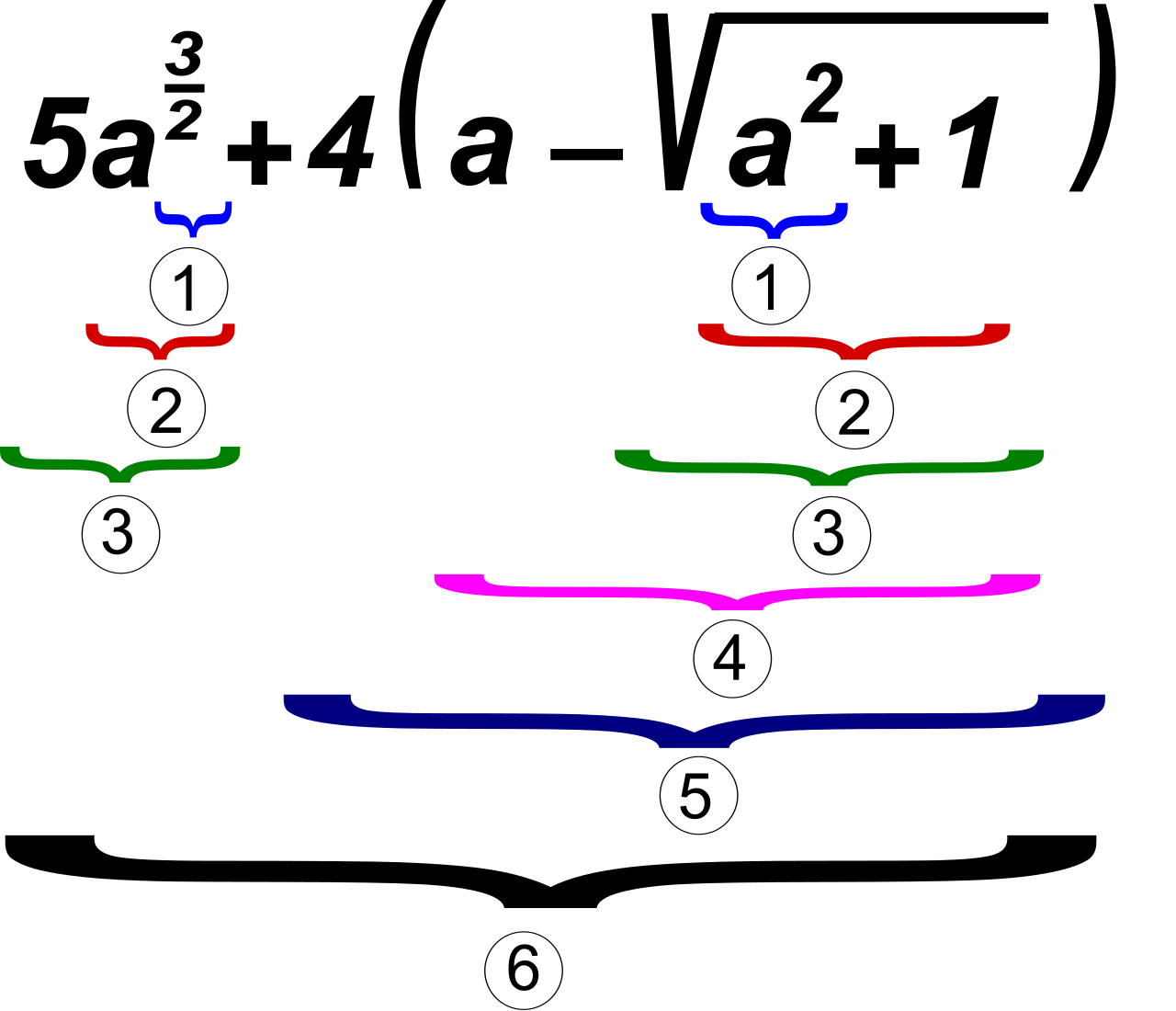
Before we can begin moving numbers around, we must understand how mathematical operations are bundled. Mathematics is read much like a language, but instead of punctuation marks like commas and periods, it utilizes structural brackets.
Grouping symbols such as parentheses dictate which arithmetic operations must be performed first within an algebraic expression. When you encounter an expression like 3×(4+5), the parentheses are an absolute command: evaluate the relationship between 4 and 5 before allowing the multiplication to interact with them. Understanding these boundaries is essential, because the properties we are about to explore are largely tools for either respecting, navigating, or legally circumventing these parentheses.
The word "commute" means to travel or move around. In mathematics, the commutative property governs whether numbers can physically trade places without altering the final reality of the calculation.
Addition and Multiplication
Nature is highly cooperative when we are simply pooling quantities together or scaling them up.
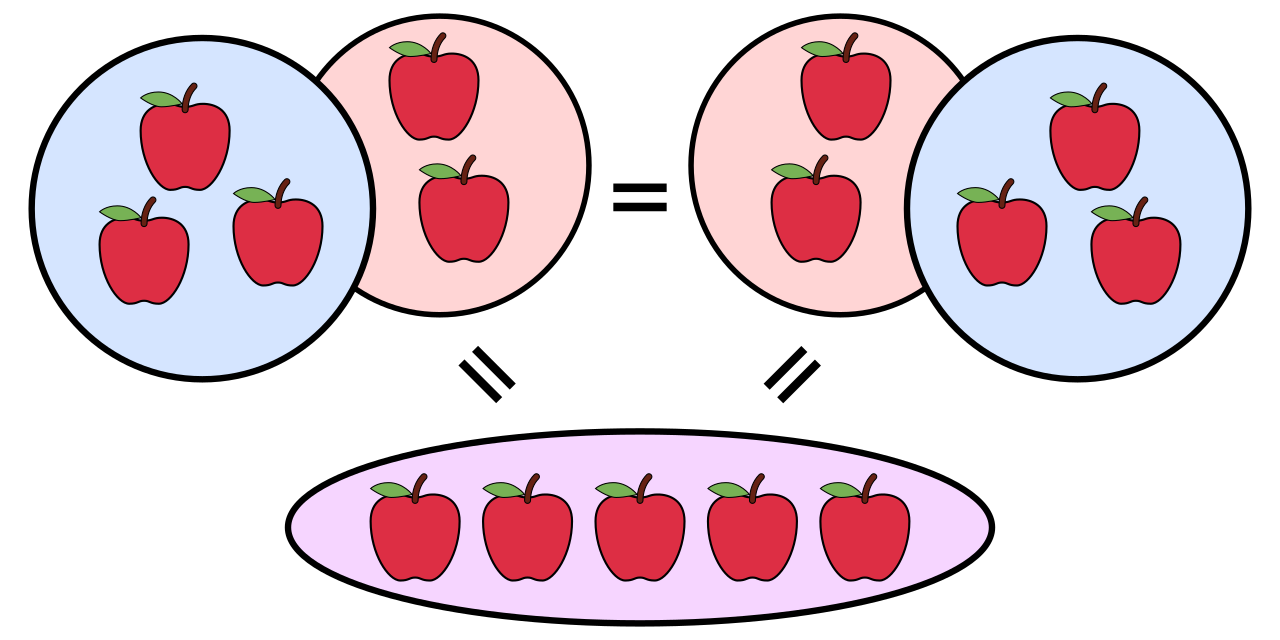
The Commutative Property of Addition states that changing the order of addends does not change the resulting sum. Algebraic Representation: a+b=b+a
If you pour 3 ounces of water into a beaker and then add 5 ounces, you possess 8 ounces. If you pour 5 ounces first and then 3 ounces, you still possess 8 ounces. The commutative property allows numbers in an addition expression to be rearranged to combine compatible numbers that sum to a multiple of ten. For instance, faced with 17+46+13, a clever mathematical mind rearranges the expression to 17+13+46. The 17 and 13 instantly snap together to form 30, turning a tedious calculation into an effortless 30+46=76.
Multiplication shares this exact same spatial freedom.
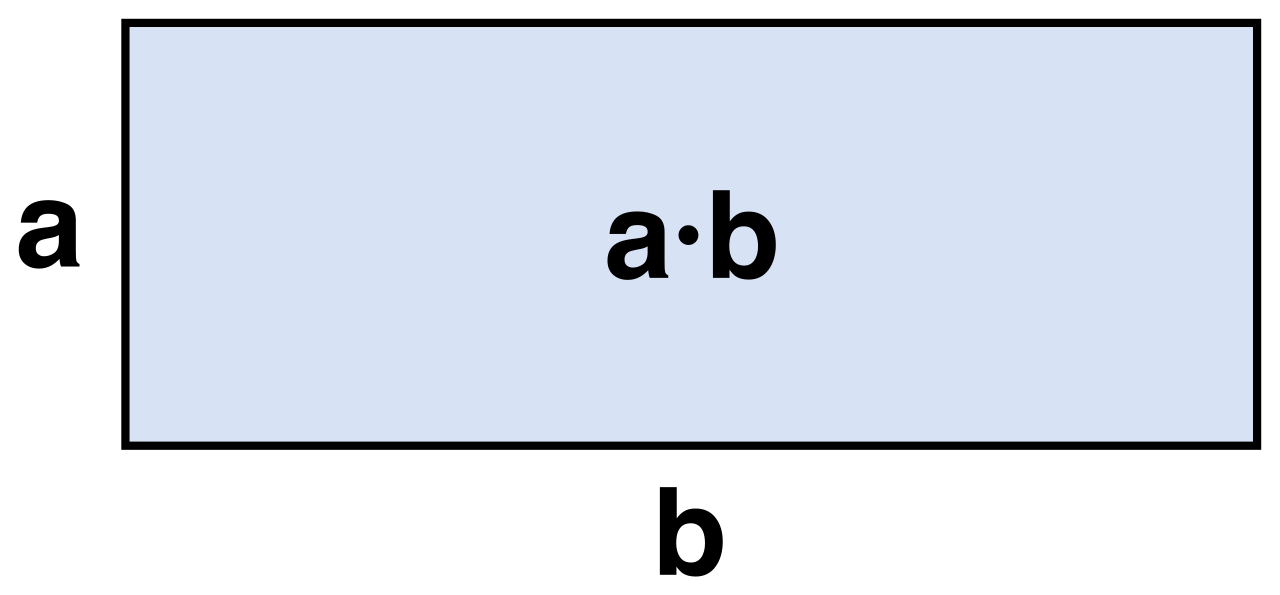
The Commutative Property of Multiplication states that changing the order of factors does not change the resulting product. Algebraic Representation: a×b=b×a
A rectangle that is 4 units wide and 5 units long contains exactly the same 20 square units of area as a rectangle that is 5 units wide and 4 units long. You are merely viewing the same rectangle from a different angle.
The Strict Limits of Subtraction and Division
We must be equally precise about where these freedoms fail. The operation of subtraction does not satisfy the commutative property. If you have $10 in your bank account and write a check for $2, you have $8. If you have $2 and attempt to write a check for $10, you have a financial disaster. Order dictates reality here: $10 - 2 \neq 2 - 10$.
Similarly, the operation of division does not satisfy the commutative property. Sharing 10 pizzas among 2 hungry students yields a joyous 5 pizzas per student ($10 \div 2).Attemptingtoshare2pizzasamong10studentsleaveseveryonewantingmore(2 \div 10 = 0.2$). The roles of the dividend (what is being broken up) and the divisor (how many ways it is being broken) are entirely non-interchangeable.
While the commutative property is about moving numbers, the associative property is about grouping them. The root word "associate" means to join or partner with. If the order of the numbers remains perfectly static, does it matter which two numbers decide to interact first?
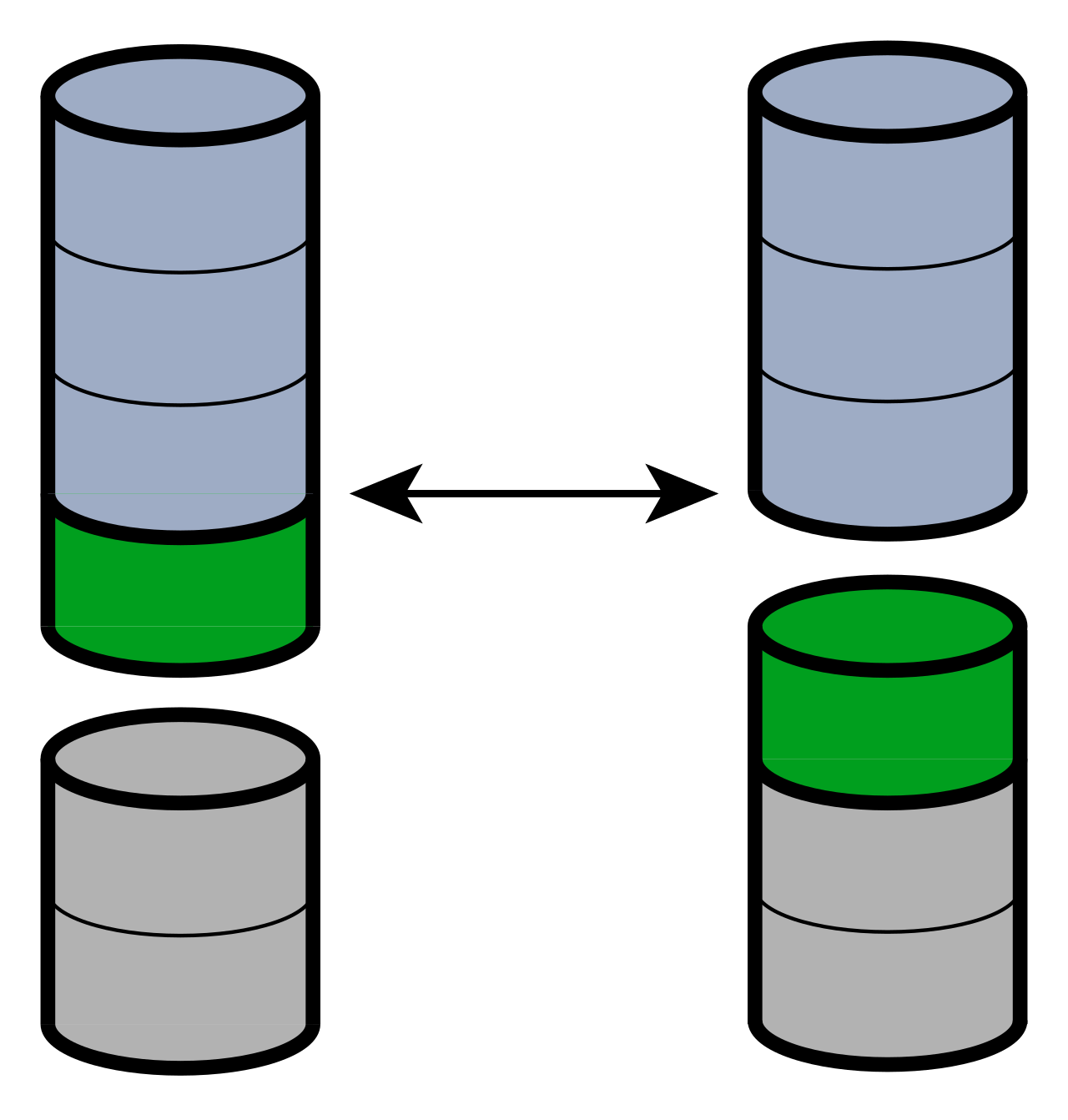
The Associative Property of Addition states that changing the grouping of addends does not change the resulting sum. Algebraic Representation: (a+b)+c=a+(b+c)
Imagine a line of three people holding cash: Person A has $5, Person B has $10, and Person C has $15. If Person A and B combine their money first ($15) and then add Person C's money, the total is $30. If A waits while B and C combine theirs first ($25), and then A hands over their $5, the total is still $30. The brackets shift; the sequence of numbers does not.
This works exactly the same way for scaling factors.
The Associative Property of Multiplication states that changing the grouping of factors does not change the resulting product. Algebraic Representation: (a×b)×c=a×(b×c)
This is an immensely powerful tool for mental arithmetic. The associative property allows a string of multiplication operations to be regrouped to form easier partial products without changing the final result. Consider evaluating $14 \times 5 \times 2.Ifwegroupthefirsttwo:(14 \times 5) \times 2,weareforcedtocalculate70 \times 2 = 140. But if we group the last two: \14 \times (5 \times 2), the calculation becomes \14 \times 10. The answer is instantly identifiable as \140$. We manipulated the parentheses to create a friendly multiple of ten.
Where Association Fails
Just as with the commutative property, directional operations like subtraction and division reject associative freedoms. The operation of subtraction does not satisfy the associative property. Take (10−5)−2. The parentheses tell us to evaluate $10 - 5first,yielding5.Then5 - 2 = 3. Now shift the grouping: \10 - (5 - 2).Here,5 - 2 = 3, and \10 - 3 = 7.Because3 \neq 7$, the associative property utterly fails for subtraction.
Likewise, the operation of division does not satisfy the associative property. Division demands a strict adherence to left-to-right processing precisely because shifting the parentheses wildly distorts the quotient.
The commutative and associative properties deal with one operation at a time—all addition, or all multiplication. But what happens when multiplication and addition are forced to occupy the same space? Enter the distributive property, arguably the most important mechanical lever in all of algebra.
The distributive property of multiplication over addition allows evaluating the product of a value and a sum by first multiplying the value by each addend separately and adding the resulting products.
Algebraic Representation: a×(b+c)=(a×b)+(a×c)
Imagine you are ordering 3 combo meals. Each meal consists of a $5 burger and a $2 soda. You can calculate the cost in two ways:
- Find the total cost of one combo meal first: (5+2)=7. Then multiply by the 3 meals: $3 \times 7 = 21$.
- Multiply the quantity of each item separately: $3 \times 5 = 15 for the burgers, and \3 \times 2 = 6 for the sodas. Combine them: \15 + 6 = 21$.
The multiplier is distributed to every term inside the parentheses.
This property holds true even when subtracting inside the parentheses. The distributive property of multiplication over subtraction allows evaluating the product of a value and a difference by first multiplying the value by each term separately and subtracting the resulting products. a×(b−c)=(a×b)−(a×c)
Applying the distributive property enables mental math calculations by breaking down a difficult multiplication problem into the sum of two easier multiplication problems. If a student encounters $6 \times 98, the traditional [vertical algorithm](https://en.wikipedia.org/wiki/Multiplication_algorithm) takes time and scratch paper. But a mathematician sees \98as(100 - 2)$. By applying the distributive property: 6×(100−2)=(6×100)−(6×2) 600−12=588 The complex operation has been instantly demystified into a simple mental subtraction.
Every mathematical system requires reference points—elements that allow us to step forward without moving at all. These are known as identity elements.
The additive identity property states that the sum of any given number and zero is the original given number. Zero is the mirror of addition; it reflects back exactly what you gave it. (a+0=a).
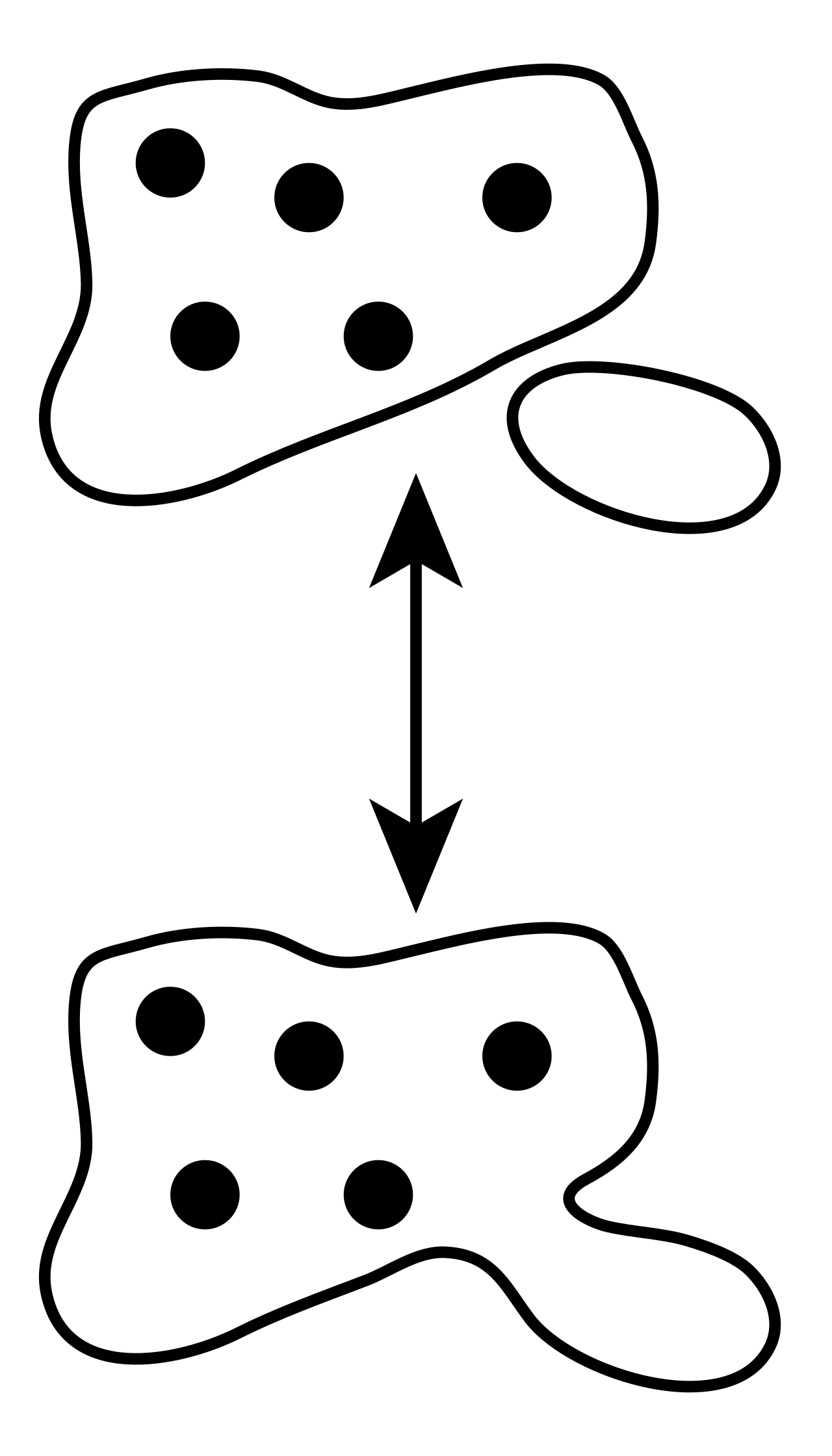
The multiplicative identity property states that the product of any given number and one is the original given number. When you multiply by 1, you are taking "one copy" of a number, which leaves its magnitude entirely unchanged. (a×1=a).
However, zero plays a drastically different role when exposed to multiplication. The multiplicative property of zero states that the product of any number and zero is exactly zero. Think of multiplication as scaling an object. If you take zero copies of an object, no matter how massive that object initially was, it ceases to exist in your inventory. (a×0=0).
In physics, every action has an equal and opposite reaction. In mathematics, this concept is captured by "inverses." An inverse is a mathematical undo button; it is an operation combined with a specific number designed to return you to the identity elements we just discussed.
Additive Inverses
The additive inverse of a given number is the unique number that yields zero when added to the given number. It destroys the original value to return to the additive identity (zero).
The additive inverse of a positive number is the negative counterpart of the identical magnitude. If you walk 5 steps forward (a value of $+5), the only way to return to your starting point of zero is to walk 5 steps backward (a value of \-5$). 5+(−5)=0

Multiplicative Inverses
Multiplication has its own method of returning to baseline. The multiplicative inverse of a given nonzero number is the unique number that yields one when multiplied by the given number. Notice that it returns us to the multiplicative identity (one), not zero.
How do we turn a number like $4 into \1 purely through multiplication? We multiply it by its [fractional](https://en.wikipedia.org/wiki/Fraction) opposite. **The multiplicative inverse of a mathematical fraction is the [reciprocal](https://en.wikipedia.org/wiki/Multiplicative_inverse) of that specific fraction.** To find the reciprocal, we invert the [numerator](https://en.wikipedia.org/wiki/Fraction) and the [denominator](https://en.wikipedia.org/wiki/Fraction). The number \4canbewrittenas\frac{4}{1}.Itsmultiplicativeinverseis\frac{1}{4}. $$4 \times \frac{1}{4} = \frac{4}{4} = 1$$ If you have the fraction \frac{2}{3},itsmultiplicativeinverseis\frac{3}{2},because\frac{2}{3} \times \frac{3}{2} = \frac{6}{6} = 1$.
To synthesize these structural laws, review the table below. Notice how the shape of the expression provides the greatest hint about which mathematical law is in play.
| Property | Addition Example | Multiplication Example | Core Function |
|---|---|---|---|
| Commutative | $4 + 7 = 7 + 4$ | 6×3=3×6 | Reordering. The sequence of numbers physically shifts. |
| Associative | (2+3)+4=2+(3+4) | (2×3)×4=2×(3×4) | Regrouping. Order stays identical; parentheses move. |
| Distributive | N/A | $5(x + 2) = 5x + 10$ | Expanding. A multiplier is applied to all terms in a group. |
| Identity | $8 + 0 = 8$ | 8×1=8 | Maintaining. Value remains totally unchanged. |
| Inverse | 8+(−8)=0 | 8×81=1 | Undoing. Combining values to reach 0 (add) or 1 (multiply). |
By deeply absorbing these properties, you do far more than pass a mathematics exam. You develop an intuitive fluency with numbers. When you recognize that $8 \times 25 is really just \8 \times (20 + 5), or that \12 + 89 + 88ismerely100 + 89$ in disguise, you stop doing arithmetic and start conducting it.