Units of Measurement and Conversions
Not sure you’re ready?
Take the ~3-minute readiness diagnostic and see where you stand.
To measure the physical world is to translate reality into mathematics. Yet, a number in isolation is entirely meaningless. If a physicist reports a distance as "seven," the value contains no information until it is anchored to a standard. Seven millimeters, seven miles, and seven light-years represent fundamentally different realities. The standard that gives the number its physical meaning is the unit of measurement. Understanding how to navigate, manipulate, and convert these units is not merely a matter of rote memorization; it is the grammatical foundation of the scientific and mathematical language. When we convert units, we are not altering the physical reality of the object being measured. We are simply translating its magnitude from one numerical vocabulary to another.
The metric system, formalized during the French Revolution, is an elegant, scientifically derived system built entirely on powers of ten. Because our standard number system is also base-ten, converting between metric units requires no complex arithmetic—only an understanding of decimal place values.
The architecture of the metric system is built upon foundational units that define fundamental physical properties:
- The meter is the base unit of length in the metric system.
- The gram is the base unit of mass in the metric system.
- The liter is the base unit of volume in the metric system.
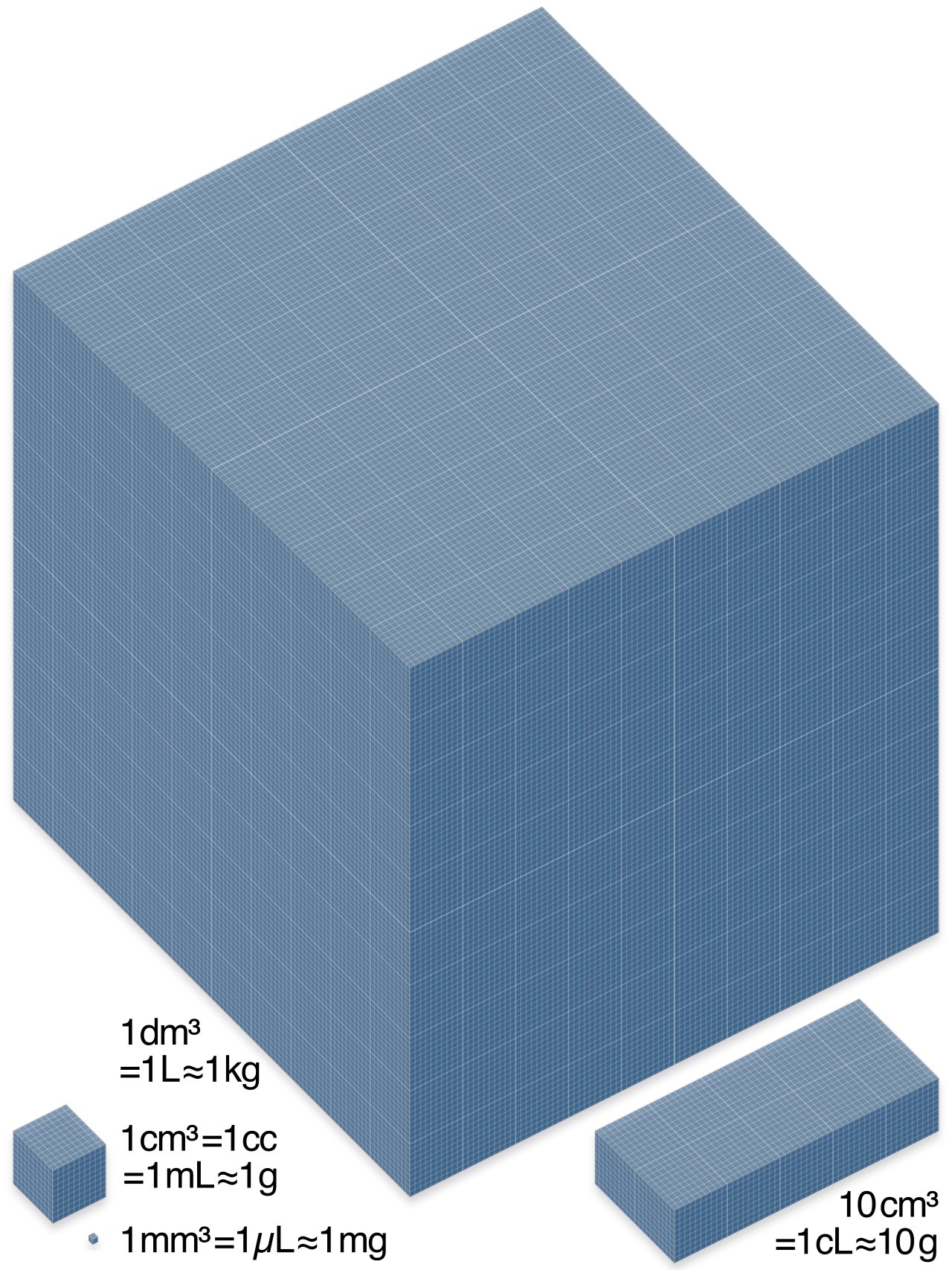
Rather than inventing entirely new words for different magnitudes (as one might do with inches, feet, and miles), the metric system uses a strict set of standardized prefixes attached to these base units. Each prefix represents a specific power of ten.
Metric Prefixes and Magnitudes
To scale up from the base unit:
- The metric prefix kilo- means one thousand times the base unit (1,000×).
- The metric prefix hecto- means one hundred times the base unit (100×).
- The metric prefix deca- means ten times the base unit (10×).
To scale down from the base unit into fractions:
- The metric prefix deci- means one-tenth of the base unit (1/10×).
- The metric prefix centi- means one-hundredth of the base unit (1/100×).
- The metric prefix milli- means one-thousandth of the base unit (1/1,000×).
Navigating the Metric Scale
Because the system mirrors our base-ten counting system, movement between these scales is mechanical and precise.
Converting from a larger metric unit to a smaller metric unit requires multiplying by a power of ten. Multiplying a metric measurement by a power of ten moves the decimal point to the right.
Consider converting 5.4 kilometers to meters. A kilometer is a larger unit than a meter. Because kilo- means one thousand, there are 1,000 meters in one kilometer. We multiply 5.4 by 1,000 (103). Mechanically, we shift the decimal point three places to the right, yielding 5,400 meters.
The inverse rule governs movement up the scale:
Converting from a smaller metric unit to a larger metric unit requires dividing by a power of ten. Dividing a metric measurement by a power of ten moves the decimal point to the left.
If we have 750 milligrams and need to express this in grams, we recognize that we are moving from a smaller unit to a larger one. Since milli- means one-thousandth, it takes 1,000 milligrams to make a single gram. We divide 750 by 1,000, shifting the decimal point three places to the left, arriving at 0.75 grams.
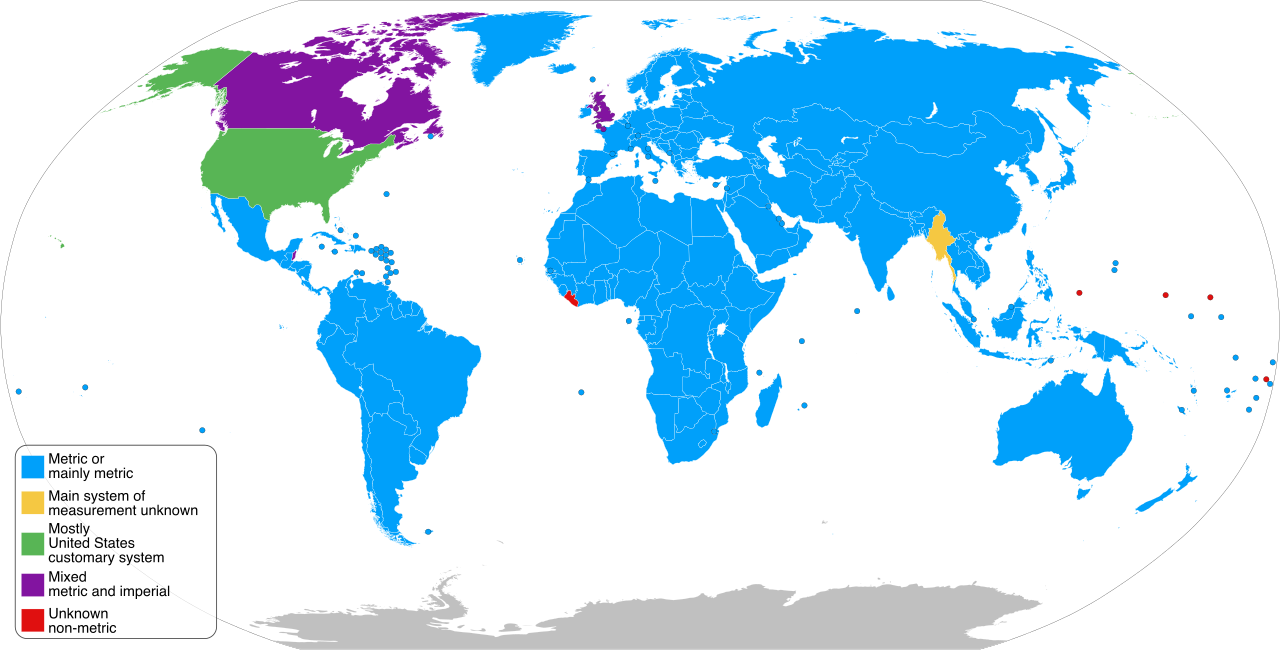
Unlike the metric system, which was designed mathematically from the top down, the U.S. Customary system evolved organically over centuries of human trade, agriculture, and craftsmanship. Its conversion factors are not uniform powers of ten, but rather an assortment of historically derived ratios. Navigating this system requires committing specific constants to memory.
Length and Distance
Distance in the U.S. system scales from the length of a human thumb up to the distance a Roman legion could march in a thousand paces.
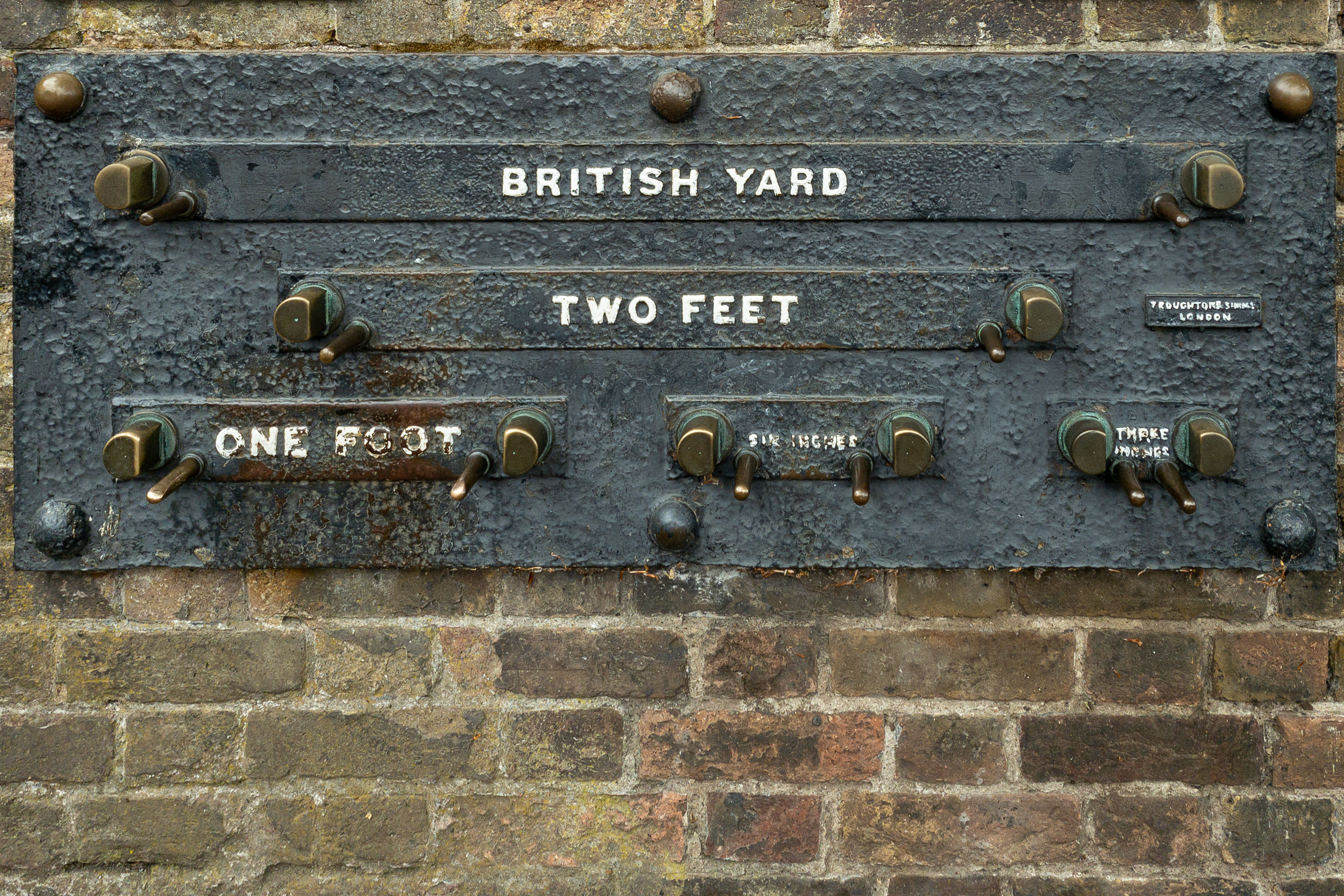
- One foot is equal to 12 inches.
- One yard is equal to 3 feet. Consequently, by multiplication (3×12), one yard is equal to 36 inches.
For geographical distances, the mile is the standard standard of measure:
- One mile is equal to 5,280 feet.
- Because a yard is exactly three feet, dividing 5,280 by 3 reveals that one mile is equal to 1,760 yards.
Mass and Weight
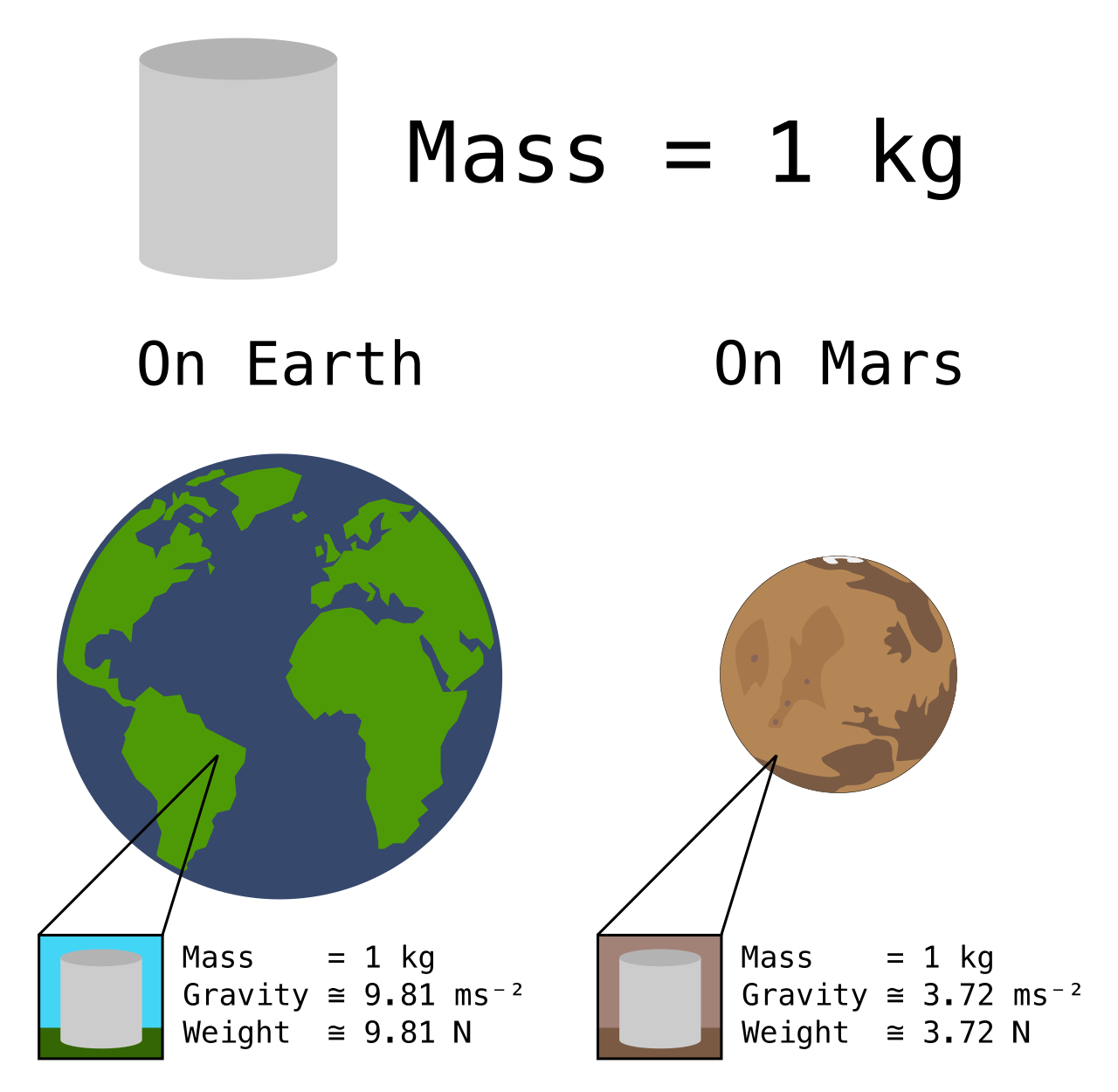
In physics, mass and weight are strictly distinct (mass is invariant matter; weight is the force of gravity upon it). However, in everyday commerce and standard U.S. conversions, we utilize the following benchmarks:
- One pound is equal to 16 ounces.
- For massive quantities, one standard U.S. ton is equal to 2,000 pounds.
(Note: The weight ounce must not be confused with the fluid ounce used for volume. They measure fundamentally different properties—mass versus three-dimensional space.)
Volume and Capacity
The customary system of volume is highly fractional, built largely around successive doublings and halvings. It is critical to grasp this chain of equivalencies:
- One cup is equal to 8 fluid ounces.
- Moving up, one pint is equal to 2 cups. Because each cup holds 8 fluid ounces, it follows that one pint is equal to 16 fluid ounces.
- Continuing upward, one quart is equal to 2 pints.
- Finally, one gallon is equal to 4 quarts.
If we trace the mathematics from a gallon all the way down to fluid ounces (4 quarts×2 pints/quart×2 cups/pint×8 fluid ounces/cup), we derive a vital overarching fact: One gallon is equal to 128 fluid ounces.
The Universal Rhythm of Time
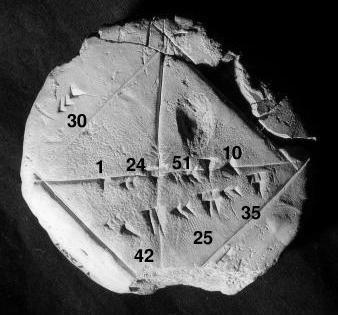
Regardless of whether a nation uses the metric or customary system, the measurement of time is a globally shared standard inherited from ancient Babylonian base-60 mathematics.
- One minute is equal to 60 seconds.
- One hour is equal to 60 minutes.
- Based on planetary rotation, one day is equal to 24 hours.
When we group these days into broader calendar units:
- One standard week is equal to 7 days.
- Based on planetary orbit, one standard year is equal to 365 days.
- Furthermore, one standard year contains 52 full weeks.
Committing facts to memory is only the first step. The true power of mathematics lies in having a rigorous, foolproof methodology for manipulating these facts.
Dimensional analysis is a mathematical method for converting from one unit of measurement to another unit. It treats units of measurement just like algebraic variables (x or y). If you have an x in the numerator and an x in the denominator, they divide out to 1. The exact same logic applies to "gallons," "meters," or "seconds."
The Anatomy of a Conversion Factor
The cornerstone of dimensional analysis is the conversion factor. A conversion factor is a ratio expressing how two different units of measurement are related.
Consider the fact that 1 foot=12 inches. If we divide both sides of this equation by 1 foot, we get: 1 foot12 inches=1
This fraction is a conversion factor. The numerator and denominator of a conversion factor represent the exact same quantity in different units. Because the top and bottom express the exact same physical length, the total value of the fraction is simply 1.
This leads to a profound mathematical truth: Multiplying a value by a valid conversion factor does not change the actual physical quantity of the measurement. By the Identity Property of Multiplication, multiplying anything by 1 leaves its inherent value unchanged. We are merely changing the unit expressing that value.
Executing Dimensional Analysis
To successfully convert a measurement, you must properly align your conversion factors so that unwanted units vanish algebraically. In dimensional analysis, measurement units that appear in both the numerator and the denominator cancel each other out.
This requires adhering to two absolute rules of alignment:
- To cancel an unwanted starting unit using dimensional analysis, the applied conversion factor must place the unwanted unit in the denominator.
- To convert to a new target unit using dimensional analysis, the applied conversion factor must place the target unit in the numerator.
Example 1: Single-Step Conversion
Suppose we wish to convert 4.5 yards into feet.
We begin with our starting value as a fraction: 14.5 yards
We know the equivalency: 1 yard=3 feet. We must construct a conversion factor. To cancel the unwanted unit ("yards"), we must place yards in the denominator. To reach our target unit ("feet"), we must place feet in the numerator.
14.5 yards×1 yard3 feet
Notice what happens mathematically. The "yards" label in the starting numerator and the "yards" label in the conversion factor's denominator cancel each other out completely.
1×14.5×3 feet=13.5 feet
The physical distance has not altered; 4.5 yards and 13.5 feet describe the exact same expanse of space.
Example 2: Multi-Step Conversion
Dimensional analysis reveals its true brilliance when a single conversion factor is not immediately known, requiring us to chain multiple factors together.
Suppose a problem asks: How many fluid ounces are in 2.5 gallons?
If you have forgotten that one gallon equals 128 fluid ounces, but you remember the step-by-step volume progression, you can chain conversion factors together. You must move from gallons → quarts → pints → cups → fluid ounces.
Set up the starting value, and ensure that for every subsequent fraction, the unit of the previous numerator is placed in the denominator to force cancellation:
12.5 gallons×1 gallon4 quarts×1 quart2 pints×1 pint2 cups×1 cup8 fluid ounces
Look at the cascade of cancellations:
- Gallons cancel out.
- Quarts cancel out.
- Pints cancel out.
- Cups cancel out.
The only surviving unit is our target: fluid ounces. We then multiply the remaining numbers straight across the numerators: 2.5×4×2×2×8=320 fluid ounces
By mastering dimensional analysis, you eliminate guesswork. You no longer have to blindly ask, "Do I multiply or divide here?" The algebraic alignment of the units will strictly dictate the arithmetic. If the units cancel correctly to leave only your desired outcome, the mathematical setup is infallibly correct.