Circles: Circumference, Area, and Angles
Not sure you’re ready?
Take the ~3-minute readiness diagnostic and see where you stand.
Imagine driving a single wooden stake into a flat, limitless field, tying a length of taut rope to it, and walking a full rotation. The path your feet trace is the most perfect, fundamental shape in geometry: a circle. Fundamentally, a circle is the set of all points in a two-dimensional plane that are equidistant from a single fixed center point. That simple restriction—perfect, unyielding symmetry—gives birth to a rich mathematical ecosystem. The study of circles is not merely the memorization of disconnected formulas; it is the observation of how distances, boundaries, and internal angles lock together in flawless proportion. For the Praxis Core Mathematics exam, mastering this shape means understanding its physical anatomy, calculating its internal space, and deciphering the elegant, predictable rules governing the angles drawn within it.
To understand a circle, we must first establish the vocabulary of its parts. Every line and segment interacting with a circle has a precise definition and a specific geometric behavior.
The most critical measurement of any circle is its radius. The radius of a circle is the straight-line distance from the center point to any point on the boundary of the circle. It is the taut rope from our field analogy, dictating exactly how large the circle will be.
If we draw a straight line straight across the circle, through the center, we create a diameter. By definition, the diameter of a circle is the length of a straight line segment that passes through the center point and has both endpoints on the circle. Because it is simply two radii glued end-to-end, a strict mathematical relationship exists: the length of the diameter of a circle is exactly twice the length of the radius of that same circle (d=2r). Conversely, the length of the radius of a circle is exactly half the length of the diameter of that same circle (r=2d).
Not all lines crossing a circle pass through the center. A chord is a straight line segment whose endpoints both lie on the boundary of the circle. Think of a chord as a shortcut across a circular park; you start at the edge and end at the edge, but you do not necessarily walk through the dead center. However, if you do walk through the center, you take the longest possible path across the interior space. Therefore, the diameter is the longest possible chord that can be drawn within a circle.
Lines can also interact with circles from the outside or cut completely through them:
- A secant is a straight line that passes through and intersects a circle at exactly two distinct points. While a chord is a finite segment trapped inside the circle, a secant is an infinite line that slices completely through it.
- A tangent to a circle is a straight line that touches the outside boundary of the circle at exactly one single point. If you lay a ruler flat against the side of a perfectly round coin, the ruler is a tangent.
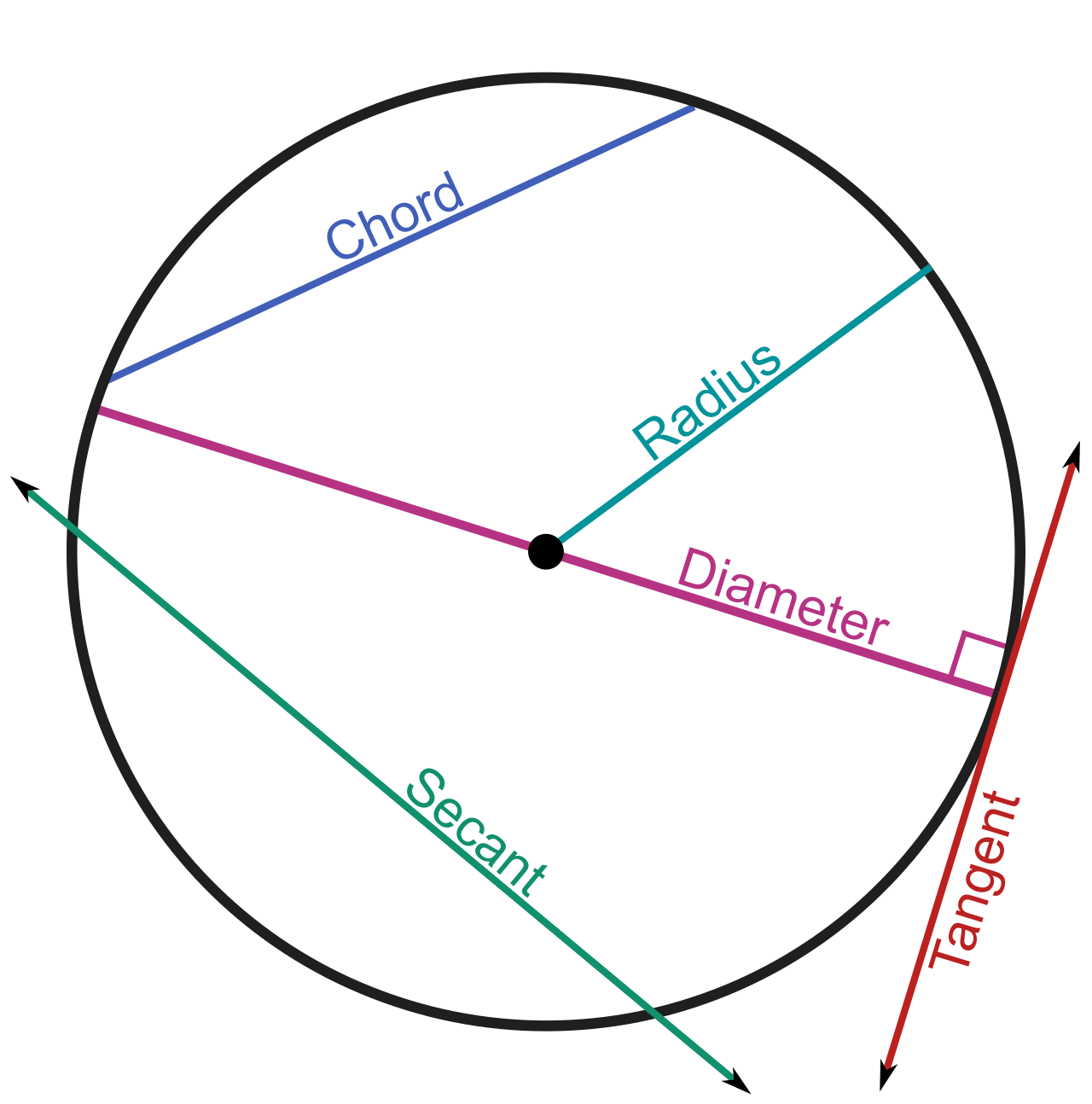
Crucial Geometric Property: A tangent line is always geometrically perpendicular to the radius drawn to the specific point of tangency. If you connect the center of the circle to the exact point where a tangent touches the edge, the angle formed is perfectly 90∘.
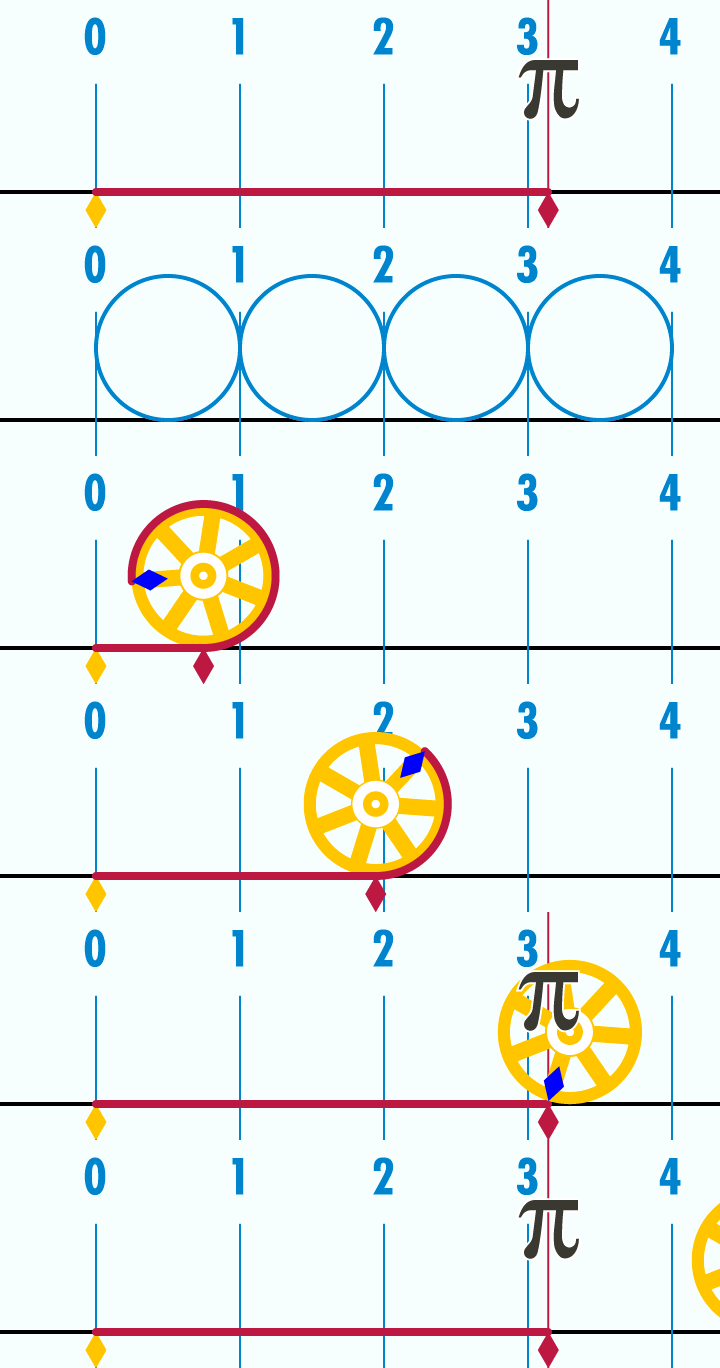
To measure circles, mathematicians historically faced a problem: straight-edge rulers do not naturally bend. However, early geometricians noticed a universal constant. If you take any circle—whether it is the size of a coin or the size of a galaxy—and divide its perimeter by its width across, you yield the exact same irrational number.
The Constant Pi (π)
Pi represents the mathematical constant defined as the ratio of a circle's circumference to the circle's diameter. Because it is an irrational number, its decimal expansion goes on forever without repeating. For the purposes of the Praxis Core exam, two approximations are required:
- The mathematical constant pi is approximately equal to the decimal value 3.14.
- The fraction 722 is commonly used as a working approximation for the mathematical constant pi. (This is particularly useful when calculating dimensions that are multiples of 7).
Circumference
The circumference of a circle is the total linear perimeter or distance around the outside edge of the circle. If you were to snip the circle and lay it out into a straight line, its length is the circumference. Because π=dC, we can easily rearrange this to find the total distance around the shape.
The formula to calculate the circumference of a circle using the diameter is: C=πd
Because the diameter is twice the radius (d=2r), we can substitute to find the formula to calculate the circumference of a circle using the radius: C=2πr
Area
While circumference measures the outer fence, the area of a circle represents the total amount of two-dimensional space enclosed within the boundary of the circle. Think of area as the amount of grass seed required to cover the circular field.
The formula to calculate the area of a circle using the radius is: A=πr2
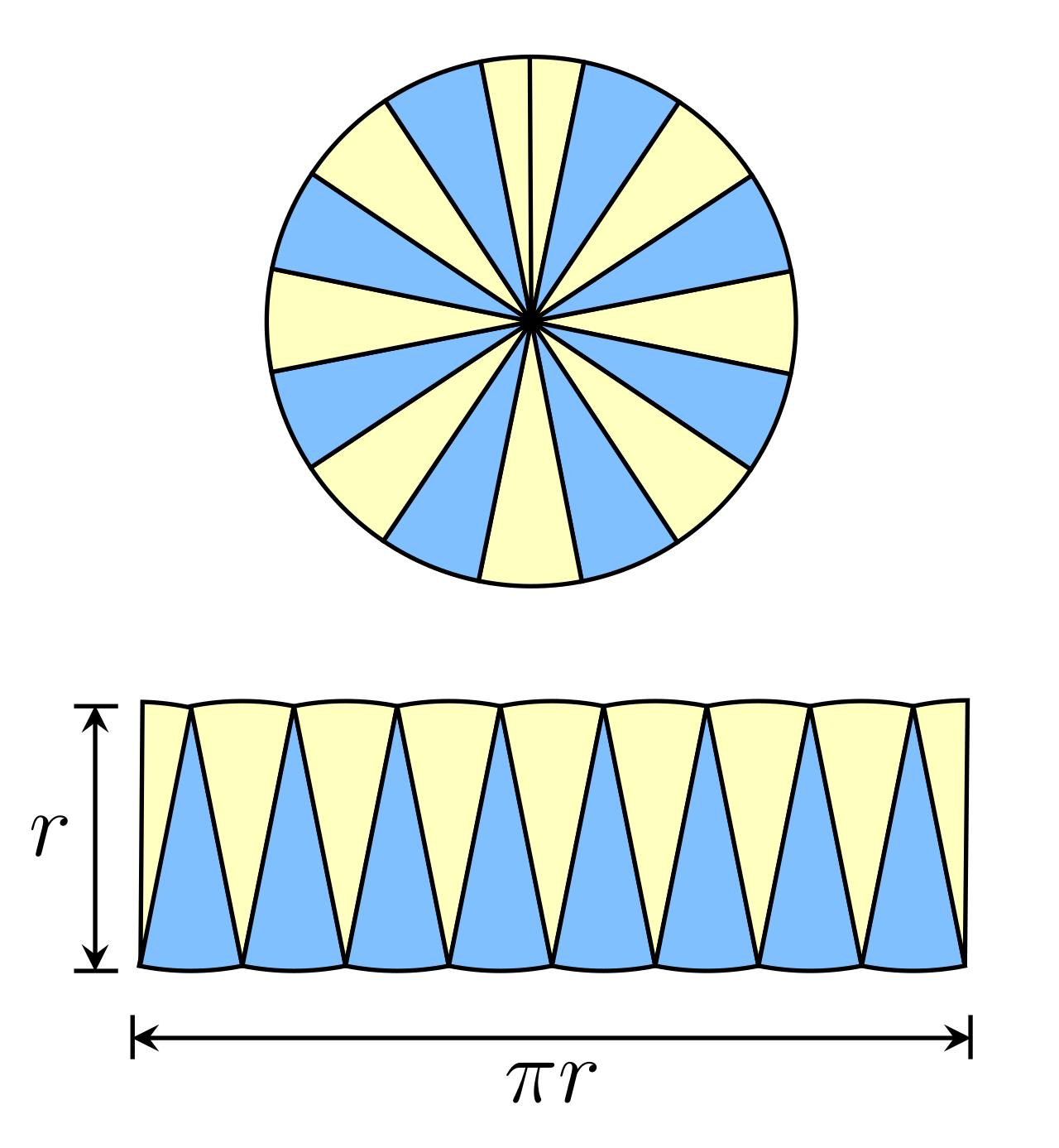
Order of Operations Warning: The radius must be mathematically squared before multiplying by pi when calculating the area of a circle. If a circle has a radius of 3, you must square the 3 to get 9, and then multiply by π to achieve an area of 9π. Squaring πr entirely is a common, fatal error.
When dealing with circles, we must map out rotational space. By mathematical convention, a full circular rotation measures exactly 360 degrees.
If we slice a circle perfectly in half using a diameter, we create a semicircle. A semicircle represents exactly one half of a complete circle.
The edge of any portion of a circle is called an arc. Formally, an arc is a continuous, unbroken portion of the circumference of a circle. Because a full circle is 360∘ and a semicircle is exactly half of that, it follows geometrically that the arc of a semicircle measures exactly 180 degrees.
Central vs. Inscribed Angles
Imagine standing in a circular theater. The stage takes up a certain curved portion of the wall—an arc. The angle at which you view the stage changes drastically depending on where you stand in the room. This concept illustrates the difference between central and inscribed angles.
| Feature | Central Angle | Inscribed Angle |
|---|---|---|
| Definition | An angle whose vertex is located at the exact center point of a circle. | An angle whose vertex lies exactly on the boundary edge of the circle. |
| Composition | Formed by two radii connecting the center to the boundary. | The two sides forming an inscribed angle consist of two intersecting chords of the circle. |
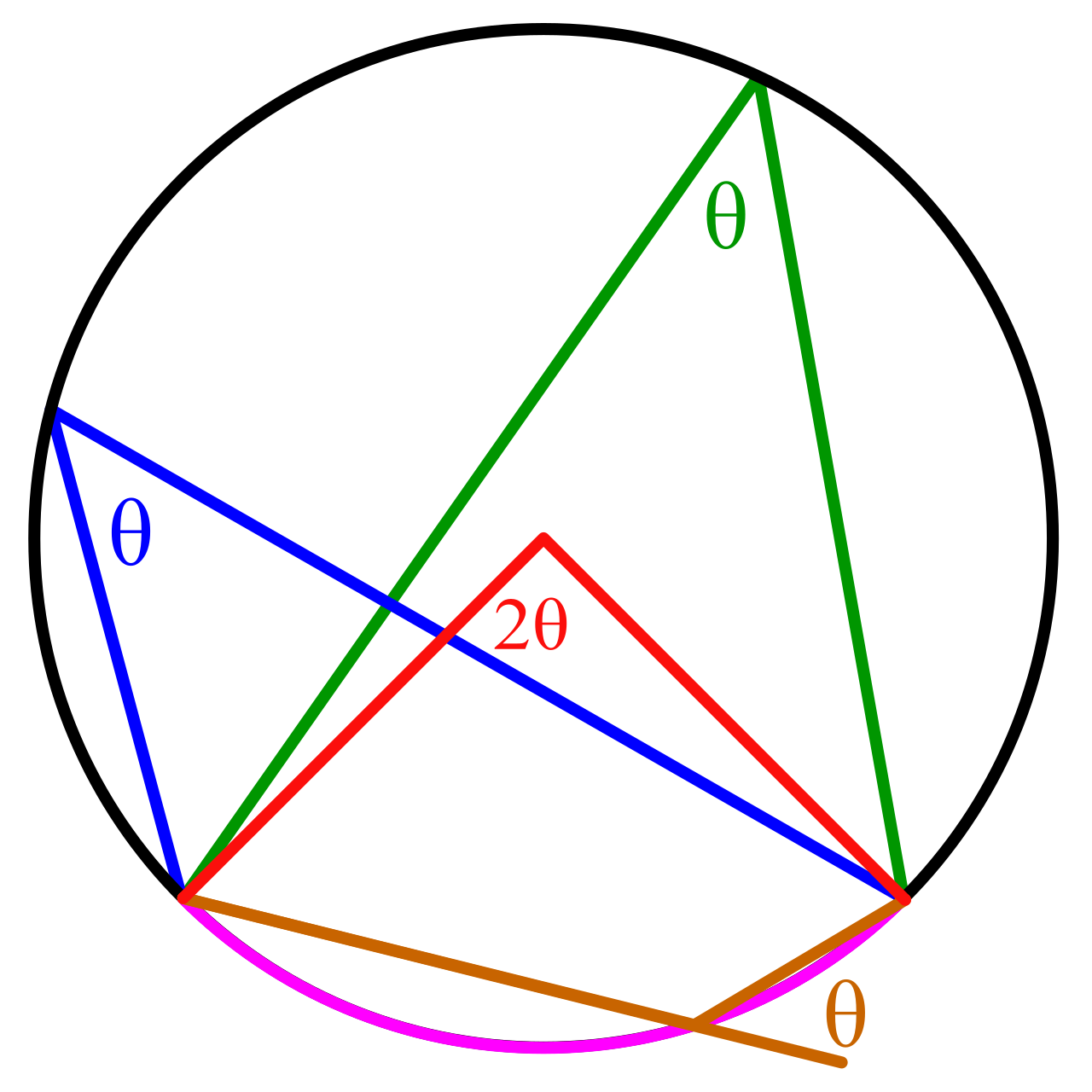
| Mathematical Measure | The degree measure of a central angle is exactly equal to the degree measure of the arc intercepted by that central angle. | The degree measure of an inscribed angle is exactly half the degree measure of the arc intercepted by that inscribed angle. |
The Intuition Behind the Math: If you stand at the exact center of the circular theater (a central angle) and look at a stage that takes up a 60∘ arc of the wall, your field of vision sweeps exactly 60∘.
Now, walk backward until your back hits the opposite wall of the theater. You are now the vertex of an inscribed angle. You are looking at the exact same 60∘ stage. Because you are twice as far away, the stage appears narrower in your field of vision. The mathematics reflect this perfectly: the inscribed angle will measure exactly 30∘, which is half the intercepted arc.
Special Properties of Inscribed Angles
Understanding that an inscribed angle is always half the measure of its intercepted arc leads to two elegant corollaries that frequently appear on exams:
1. The Semicircle Rule (Thales's Theorem) What happens if an inscribed angle opens up to intercept a full semicircle? We know the arc of a semicircle measures exactly 180∘. We also know that a right angle measures exactly 90 degrees. Since the inscribed angle must be exactly half the intercepted arc (180÷2=90), we arrive at an ironclad geometric rule: Any inscribed angle that intercepts a semicircle is always a right angle. No matter where you place the vertex on the boundary, as long as its chords hit the two endpoints of a diameter, a perfect 90∘ angle is formed.
2. The Shared Arc Rule Return to our theater analogy. Suppose two different people are standing against the back wall at different spots, but they are both looking at the exact same stage. Because they are both on the boundary edge, and both intercepting the identical arc, their viewing angles must be identical. Mathematically stated: Two separate inscribed angles that intercept the exact same arc will always have identical degree measures.
By internalizing these relationships—how the radius dictates the diameter, how π bridges straight lines to curves, and how a vertex's position determines an angle's measure—you transform the circle from a collection of rote formulas into a completely logical, predictable system of space.