Properties of Quadrilaterals
Not sure you’re ready?
Take the ~3-minute readiness diagnostic and see where you stand.
Imagine taking four straight, rigid sticks and pinning them together end-to-end so they lie flat on a table. The moment you connect the final stick to the first, closing the shape, you have created a universe bounded by distinct, unyielding mathematical laws. This geometric boundary is a quadrilateral, defined formally as a two-dimensional polygon with exactly four sides. Regardless of how you push, pull, or skew those four connected sticks—whether you stretch the joints into a long, slanted dart or square them up perfectly—one fundamental truth governs the system: the sum of the interior angles of any quadrilateral is exactly 360 degrees.
Understanding quadrilaterals is not an exercise in memorizing a random assortment of shapes. It is a study in symmetry, constraints, and consequences. When we force sides to be parallel, or angles to stand perfectly upright, or side lengths to match, we trigger a cascade of structural guarantees. Let us dissect how imposing these geometric constraints gives rise to the distinct families of quadrilaterals you must master.
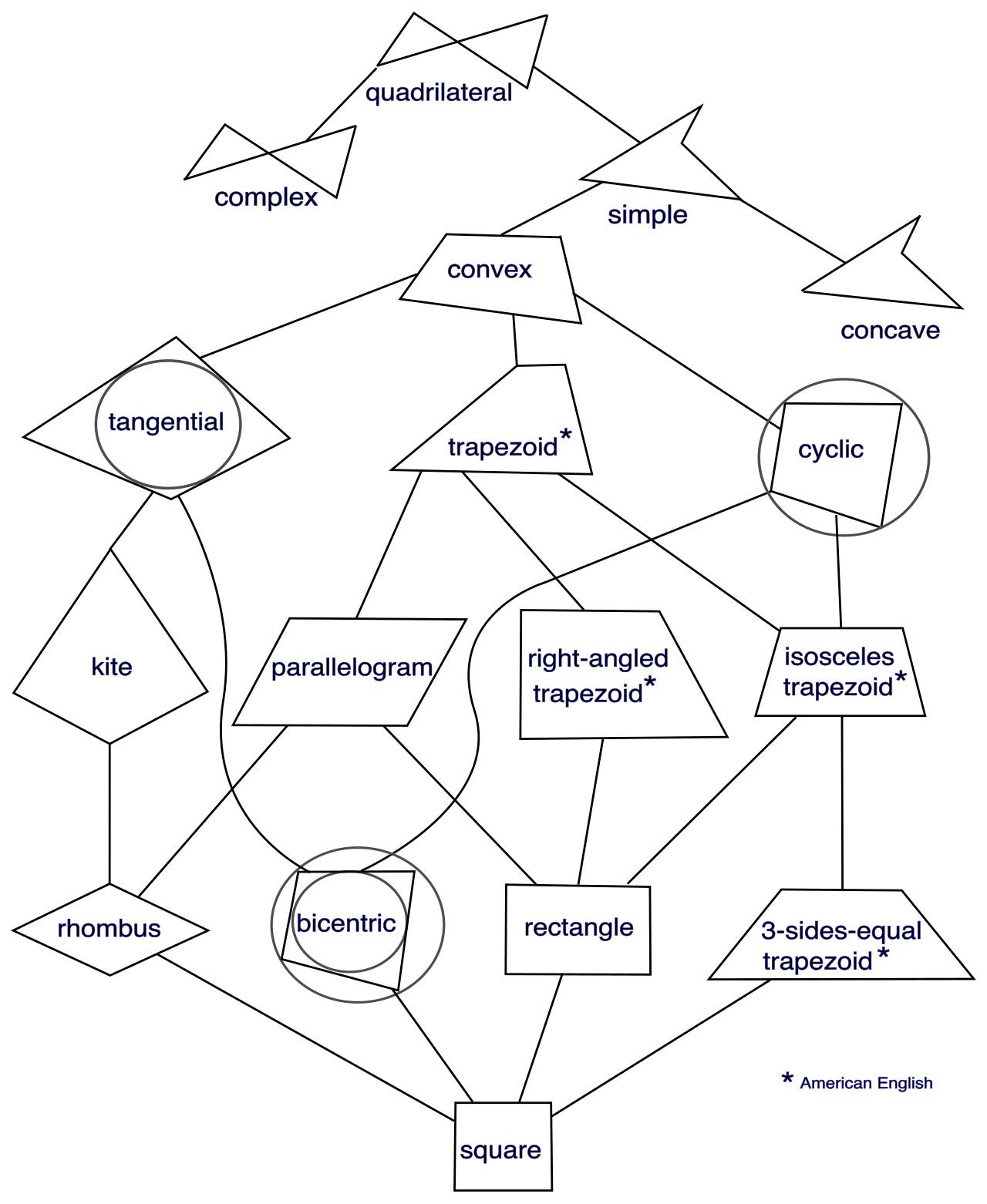
Before we categorize specific shapes, we must understand the overarching rule that binds all quadrilaterals. By drawing a single diagonal line from one corner to the opposite corner, you slice any quadrilateral into two distinct triangles. Because the interior angles of a single triangle must sum to 180∘, the two triangles combined yield 180∘×2=360∘.
The Universal Angle Law: The sum of the interior angles of any quadrilateral is exactly 360 degrees.
This leads directly to our first practical application. To find a missing angle in a quadrilateral, subtract the sum of the three known interior angles from 360 degrees. If a survey of a bizarrely shaped four-sided lot reveals corners measuring 70∘, 110∘, and 80∘, the final corner is entirely predetermined: 360∘−(70∘+110∘+80∘)=100∘.
When we impose the condition that opposite sides must run in the exact same direction, we create a highly stable structure. A parallelogram is a quadrilateral possessing exactly two pairs of parallel opposite sides.
The instant we demand that both pairs of opposite sides are parallel, the geometry fights back by forcing several other traits into existence. These are not separate, unrelated facts; they are inevitable consequences of the parallel constraint.
Side and Angle Consequences
Because the parallel sides must span the exact same gap across the interior, the opposite sides of a parallelogram are equal in length. Furthermore, the uniform tilt of the shape dictates that the opposite interior angles of a parallelogram are equal in measure. If the bottom-left corner is 60∘, the top-right corner is undeniably 60∘.
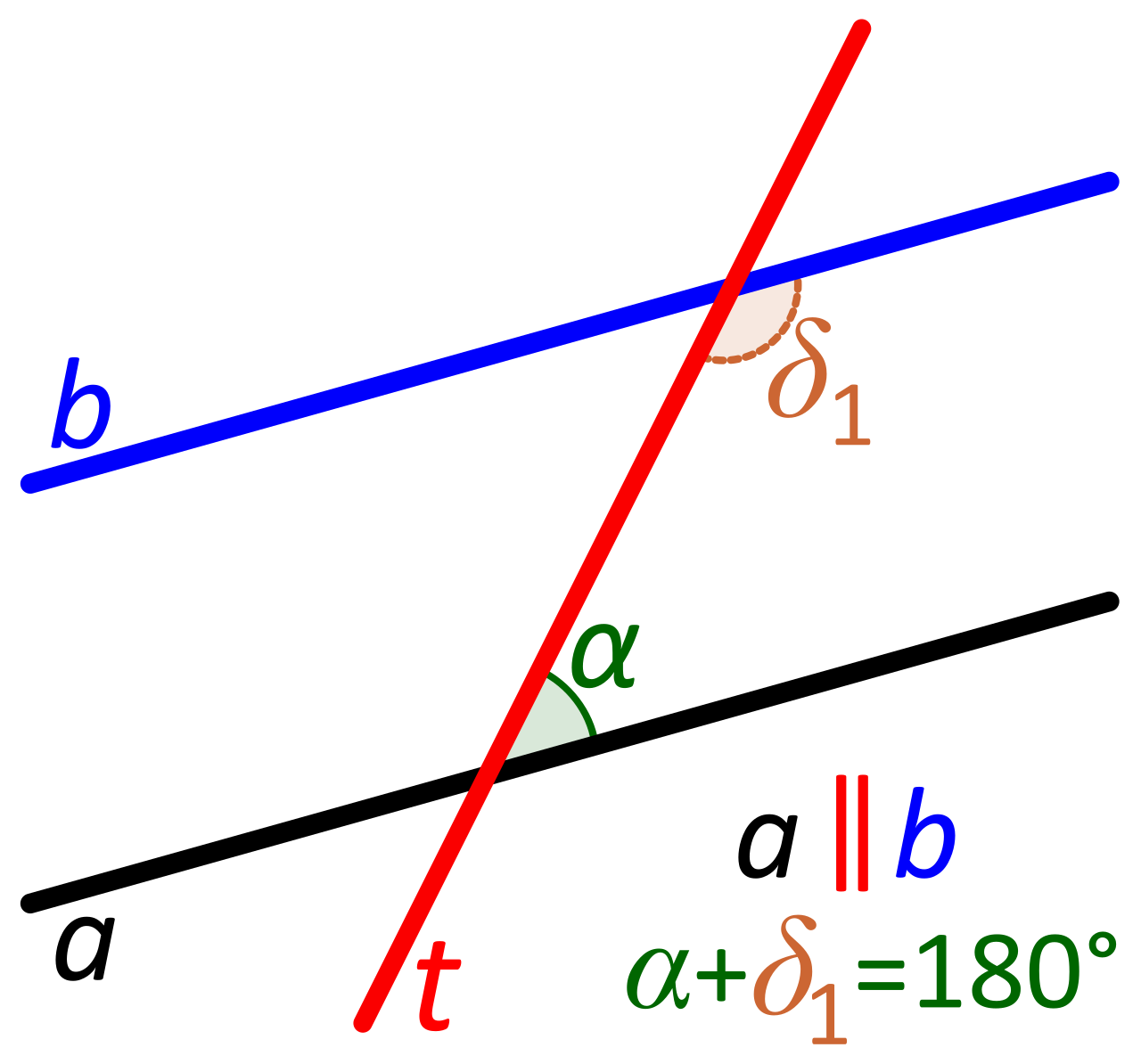
What about neighboring angles? Think of the parallel sides as train tracks, and the side connecting them as a transversal straight line crossing those tracks. Because of the rules of parallel lines, any two consecutive interior angles of a parallelogram are supplementary. Expressed numerically, the sum of any two consecutive interior angles of a parallelogram is exactly 180 degrees.
Diagonal Consequences
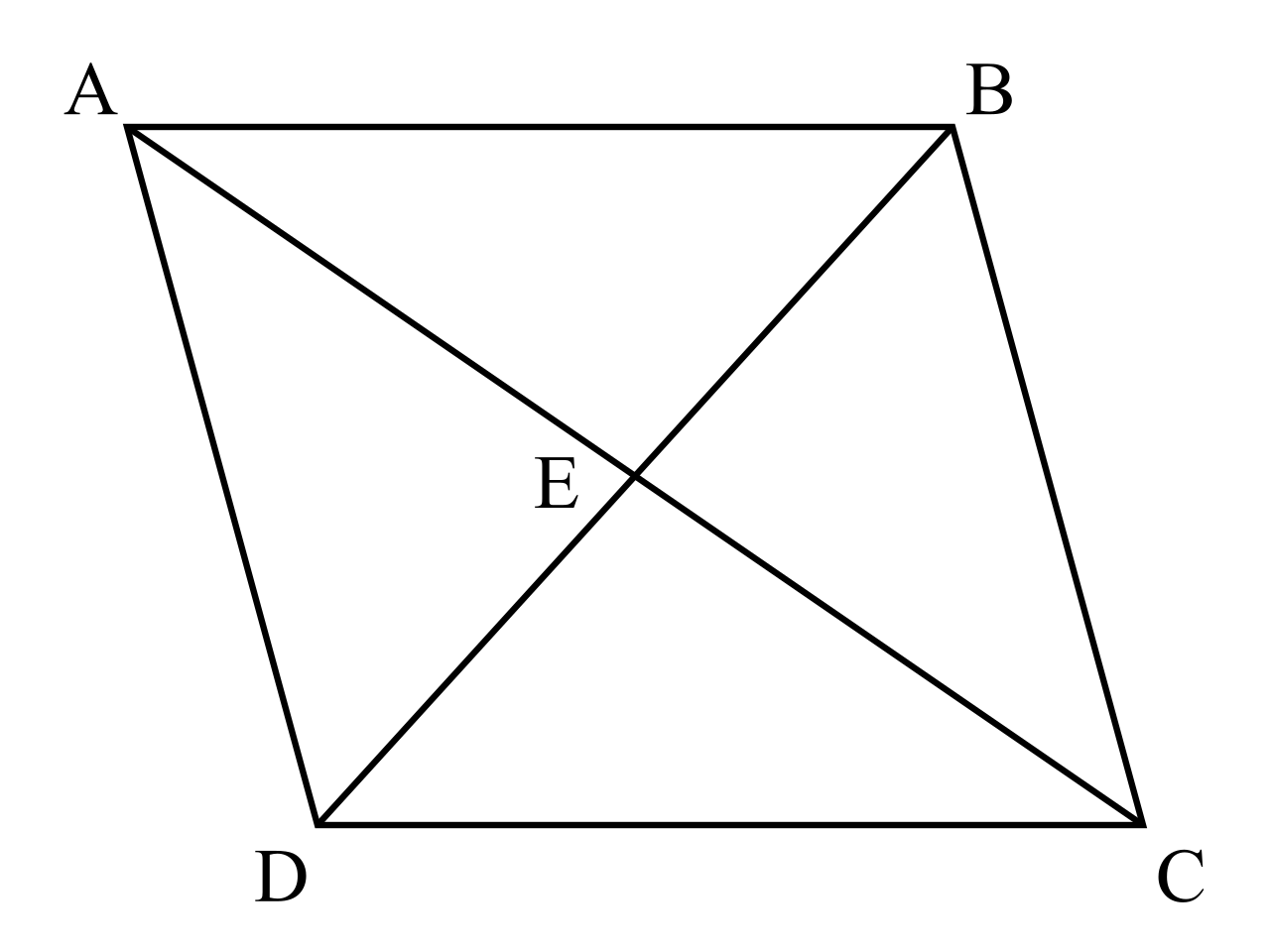
Finally, let us look at the internal cross-bracing. If you connect the opposite corners of a parallelogram, the crossing lines behave beautifully: the two diagonals of a parallelogram bisect each other. This means they cut each other perfectly in half at their intersection point.
If the parallelogram is the parent, it has two specialized offspring. Each takes the parallelogram template and adds a single new, extreme constraint.
The Rectangle: Forcing Right Angles
Suppose we take a slanted parallelogram and push its sides until it stands perfectly upright. By doing so, we define a new shape: a rectangle is a type of parallelogram containing exactly four right interior angles.
Right Angle Constraint: Because the sum of the angles must be 360∘ and they are all identical, each interior angle of a rectangle measures exactly 90 degrees.
What is the consequence of this upright posture? In a slanted parallelogram, one diagonal is stretched long, and the other is squashed short. But once the frame is forced into 90∘ upright perfection, the distances between opposite corners equalize. Therefore, the two diagonals of a rectangle are equal in length.
The Rhombus: Forcing Equal Sides
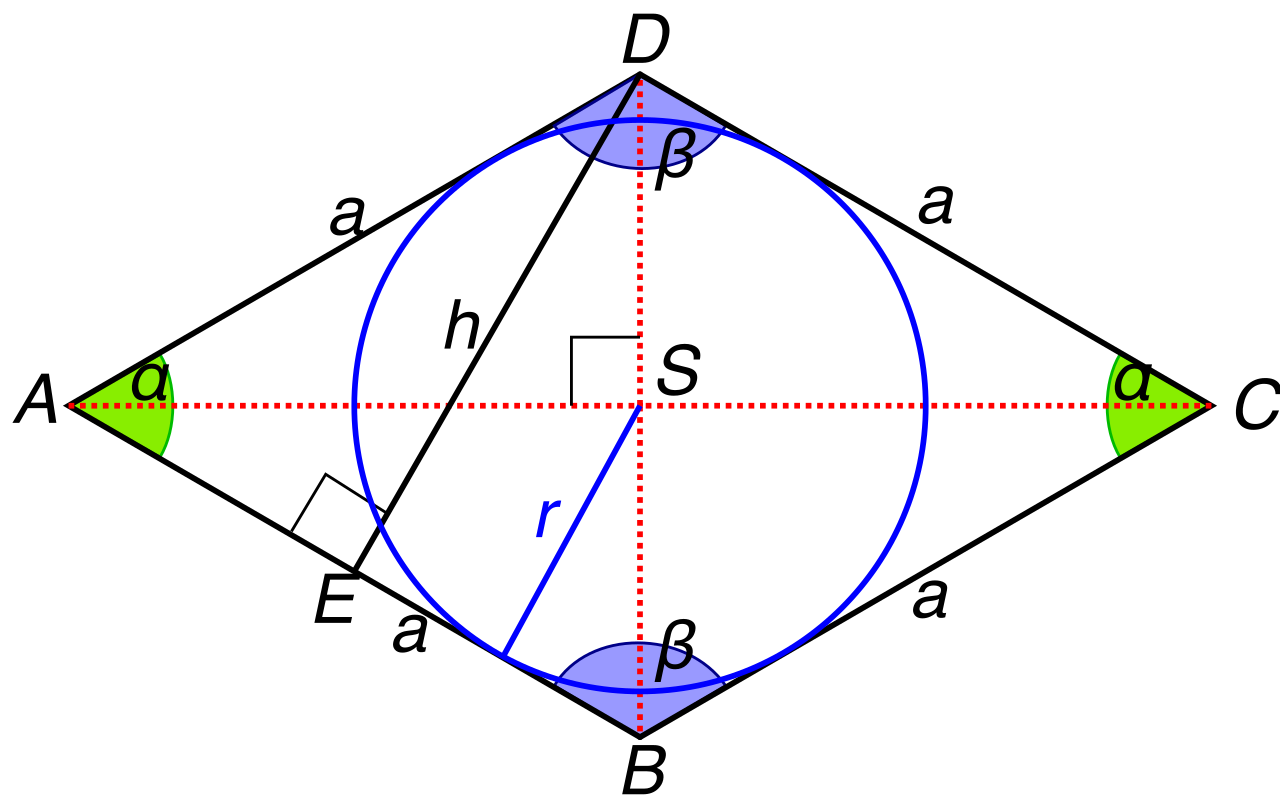
Now, return to the original, slanted parallelogram. Instead of fixing the angles, let us fix the sides. A rhombus is a type of parallelogram possessing four sides of equal length.
Think of a rhombus as a highly symmetric diamond. Because all four sides exert the exact same structural "pull" toward the center, the diagonals interact in a mathematically profound way. The symmetry forces the two diagonals of a rhombus to intersect at exactly a 90-degree angle. Furthermore, because of this perfect side-length symmetry, the diagonals of a rhombus bisect the interior angles of the rhombus, splitting the corner angles flawlessly in half.
What happens if we demand everything at once? We want the upright 90∘ corners of the rectangle and the identical side lengths of the rhombus.
A square is a type of quadrilateral containing four right angles and four sides of equal length. Because it satisfies every single constraint we have discussed, it represents the intersection of all our previous categories. Therefore:
- A square inherently possesses all the geometric properties of a parallelogram.
- A square inherently possesses all the geometric properties of a rectangle.
- A square inherently possesses all the geometric properties of a rhombus.
Because it inherits from the rectangle, the two diagonals of a square are equal in length. Because it inherits from the rhombus, the two diagonals of a square are strictly perpendicular to each other. It is the ultimate geometric hybrid.
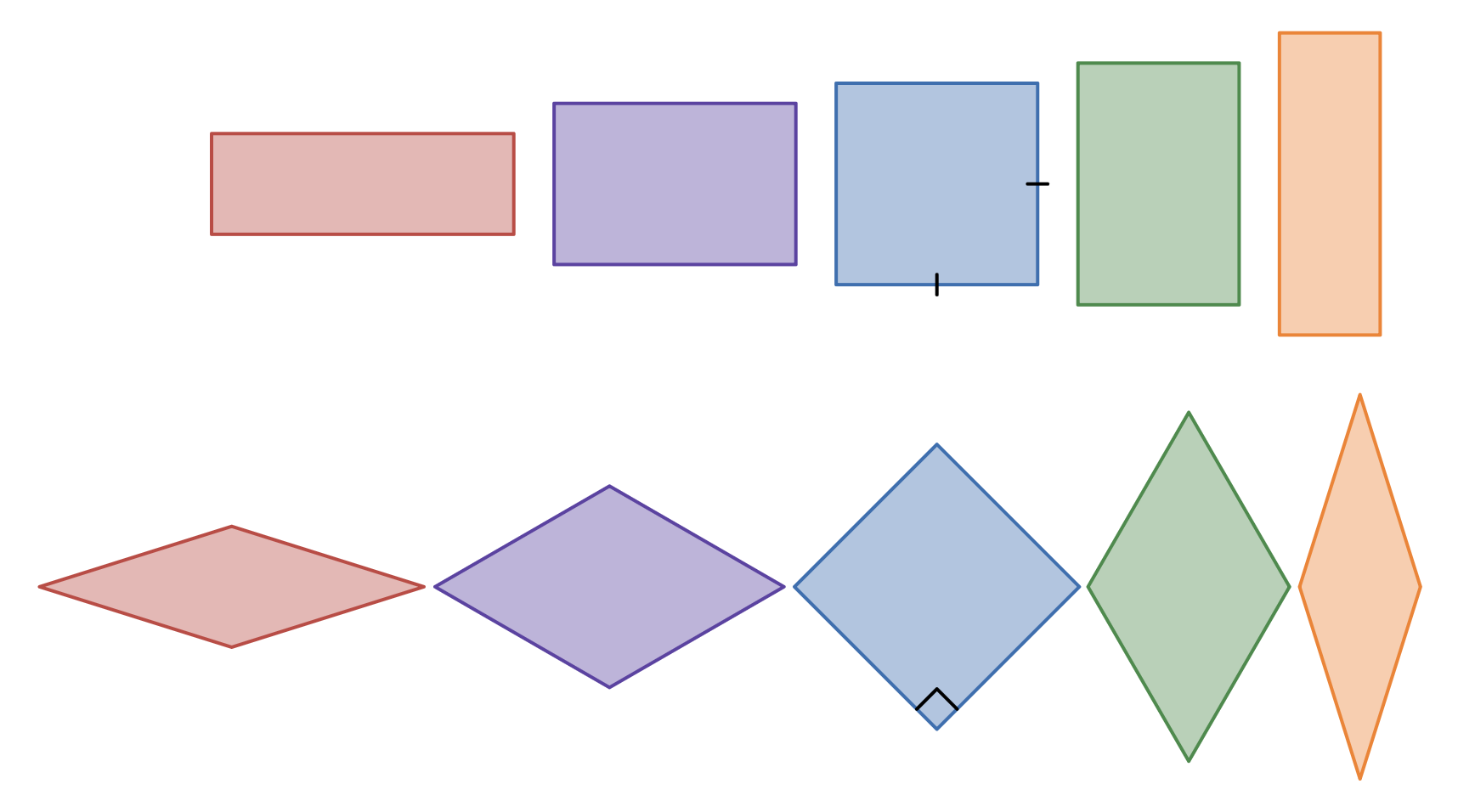
Comparative Summary of the Parallelogram Family
| Property | Parallelogram | Rectangle | Rhombus | Square |
|---|---|---|---|---|
| Opposite sides parallel | Yes | Yes | Yes | Yes |
| Opposite sides equal length | Yes | Yes | Yes | Yes |
| Opposite angles equal | Yes | Yes | Yes | Yes |
| Consecutive angles = 180∘ | Yes | Yes | Yes | Yes |
| Diagonals bisect each other | Yes | Yes | Yes | Yes |
| Interior angles exactly 90∘ | No | Yes | No | Yes |
| All four sides equal length | No | No | Yes | Yes |
| Diagonals equal in length | No | Yes | No | Yes |
| Diagonals intersect at 90∘ | No | No | Yes | Yes |
| Diagonals bisect interior angles | No | No | Yes | Yes |
Not all quadrilaterals belong to the parallelogram family. We must also examine shapes built on different defining constraints.
The Trapezoid
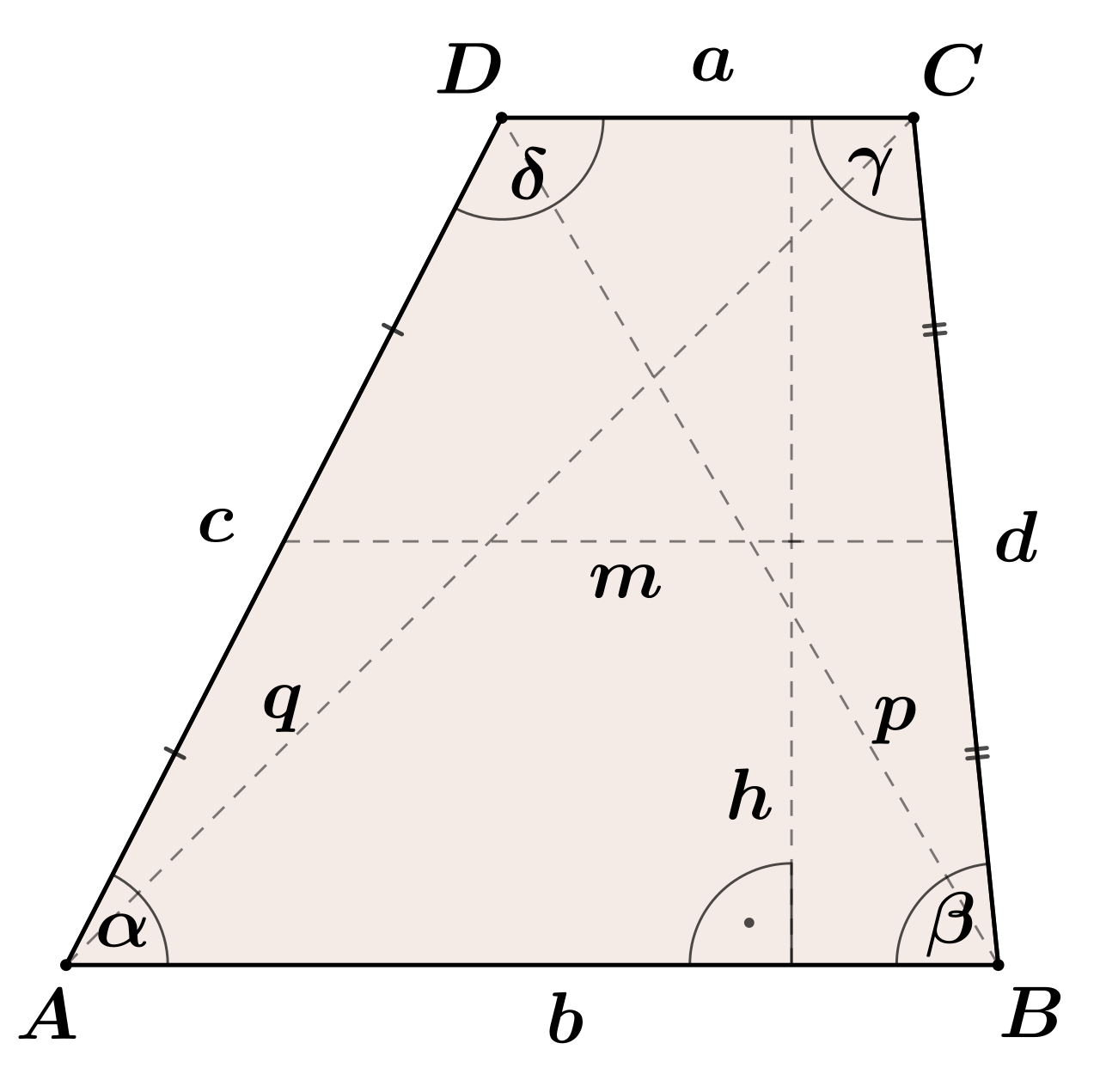
Instead of two pairs of parallel sides, what if we only have one? A trapezoid is a quadrilateral containing exactly one pair of parallel sides.
To discuss the anatomy of this structure: the two parallel sides of a trapezoid are identified as the bases of the trapezoid (typically the top and bottom). The two non-parallel sides of a trapezoid are identified as the legs of the trapezoid.
Because the bases run parallel to each other, the transversal line connecting them (the leg) still obeys the rules of parallel geometry. Thus, the consecutive interior angles connecting the parallel bases of a trapezoid are supplementary (summing to 180∘). Note carefully: this only applies to the top and bottom angle on the same side, not the angles stretching across the shape.
The Isosceles Trapezoid
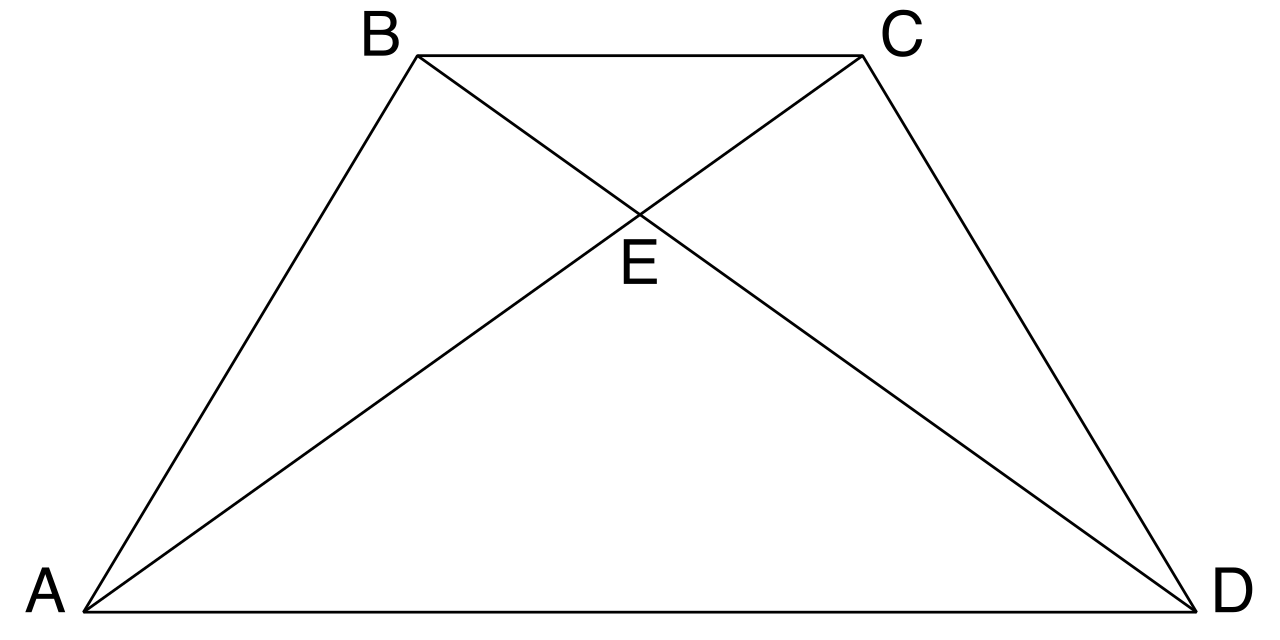
If we take a standard trapezoid and balance it perfectly left-to-right, we create an isosceles trapezoid, which is a trapezoid where the two non-parallel legs are equal in length.
This bilateral symmetry creates distinct guarantees:
- The base angles of an isosceles trapezoid are equal in measure. (If the bottom-left is 75∘, the bottom-right is 75∘).
- Just as an upright frame forced the diagonals of a rectangle to match, this left-right symmetry dictates that the two diagonals of an isosceles trapezoid are equal in length.
The Kite
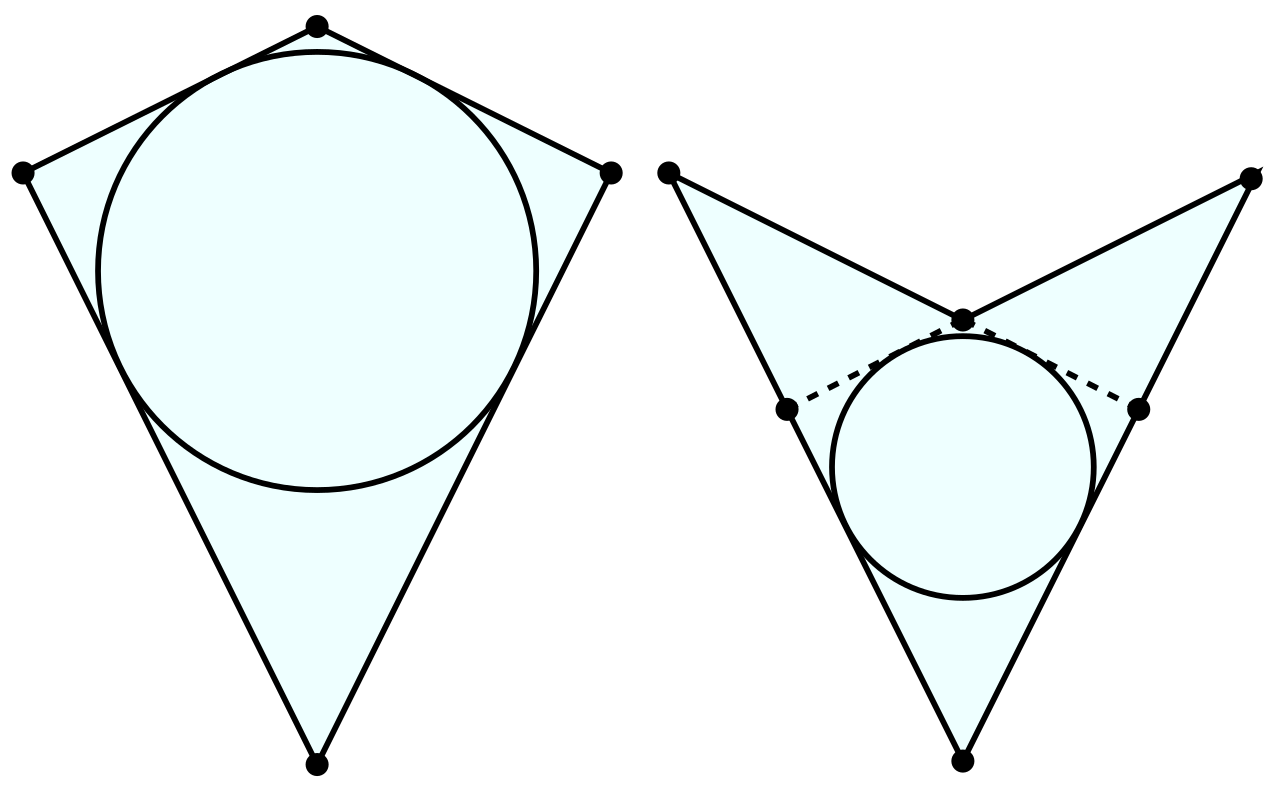
Finally, let us abandon parallel lines altogether and look at a shape defined entirely by adjacent symmetry. Imagine the traditional aerodynamic flying toy. A kite is a quadrilateral containing exactly two distinct pairs of equal-length consecutive sides.
In a parallelogram, opposite sides are equal. In a kite, adjacent sides (sides next to each other) match in length.
Because the top two sides match and the bottom two sides match, the structural crossbars must meet in a highly specific way to maintain balance. The two diagonals of a kite are strictly perpendicular to each other, forming a perfect cross of right angles at their intersection. Additionally, the horizontal axis must be perfectly balanced, meaning the longer diagonal of a kite bisects the shorter diagonal of the kite.
Your success on the Praxis Core Mathematics exam will not come from merely reciting definitions, but from combining them logically to uncover missing data.
Scenario: You are given a parallelogram with consecutive interior angles labeled as (3x+10)∘ and (2x+20)∘. How do you find x? Execution: Rely on the property: The sum of any two consecutive interior angles of a parallelogram is exactly 180 degrees. (3x+10)+(2x+20)=180 5x+30=180 5x=150 x=30
Geometry is a language of absolute logic. When you identify the shape, you immediately gain access to the full suite of constraints governing its sides, angles, and diagonals. View quadrilaterals not as abstract drawings, but as structural frameworks where every length and intersection is deliberate, connected, and governed by universal rules.