Properties of Whole Numbers: Factors and Multiples
Not sure you’re ready?
Take the ~3-minute readiness diagnostic and see where you stand.
Whole numbers are the elemental atoms of mathematics. Just as a physicist breaks down matter to understand its properties, a mathematician breaks down a number into its constituent parts—its factors—or builds it outward into infinite sequences—its multiples. This invisible scaffolding governs everything from the repeating rhythms of music to the complex cryptographic algorithms securing modern digital communication. To master the properties of whole numbers is to understand the genetic code of arithmetic. We are not merely memorizing isolated, arbitrary rules; we are learning how numbers interact, how they bond together through multiplication, and how they predictably fracture through division.

To truly grasp the behavior of numbers, we must first distinguish between looking inward (breaking a number down) and looking outward (scaling a number up).
Factor: A factor of a whole number is an integer that divides the whole number without leaving a remainder.
Think of a whole number as a specific length of physical track. Its factors are the exact, integer-sized segments of rail that can perfectly span that length without any piece hanging over the edge. For the number 12, the integers 1, 2, 3, 4, 6, and 12 are factors because they divide into 12 flawlessly.
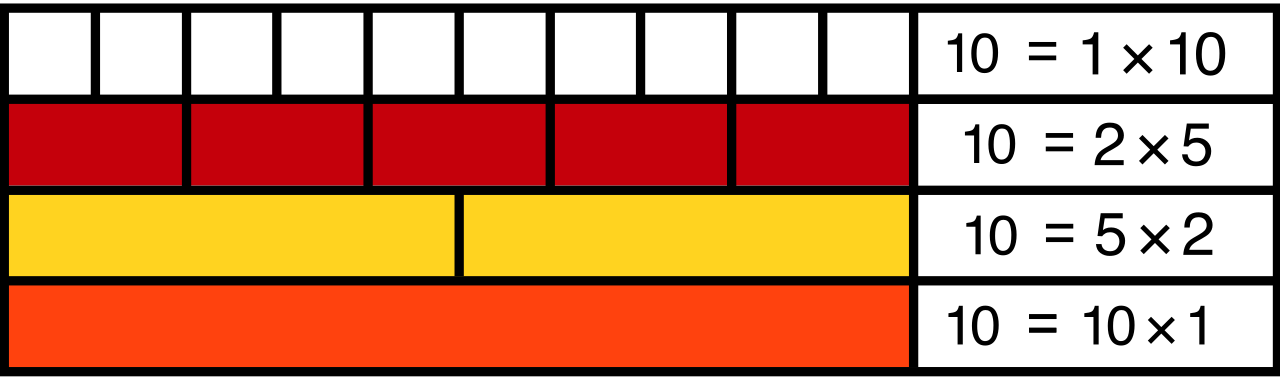
There are two fundamental truths about factors that anchor our entire number system:
- The number 1 is a factor of every whole number. Because any length can be built by laying down units of 1, it is the universal building block.
- Every whole number is a factor of itself. Naturally, a track of length 12 can be spanned by a single rail of length 12.
Conversely, if factors are the pieces making up the track, multiples are what happens when we lay identical tracks end-to-end indefinitely.
Multiple: A multiple of a whole number is the product of that whole number and any integer.
If we take the number 5, its multiples are 5, 10, 15, 20, and so on. They sweep outward toward infinity. Because any number multiplied by 1 is itself, it logically follows that every whole number is a multiple of itself.
When we analyze the factors of whole numbers, a striking pattern emerges. Some numbers can be fractured into many different constituent parts, while others fiercely resist division.
Prime Number: A prime number is a whole number greater than 1 that has exactly two distinct positive factors.
The only two distinct positive factors of a prime number are 1 and the prime number itself. Numbers like 2, 3, 5, 7, and 11 are mathematical indivisibles. You cannot build a rectangle of area 7 using smaller integer side lengths; you are trapped with a single 1 by 7 line.
Composite Number: A composite number is a whole number greater than 1 that has more than two distinct positive factors.
Numbers like 4, 6, 8, and 9 are composite. They possess a rich internal structure and can be assembled in multiple ways.
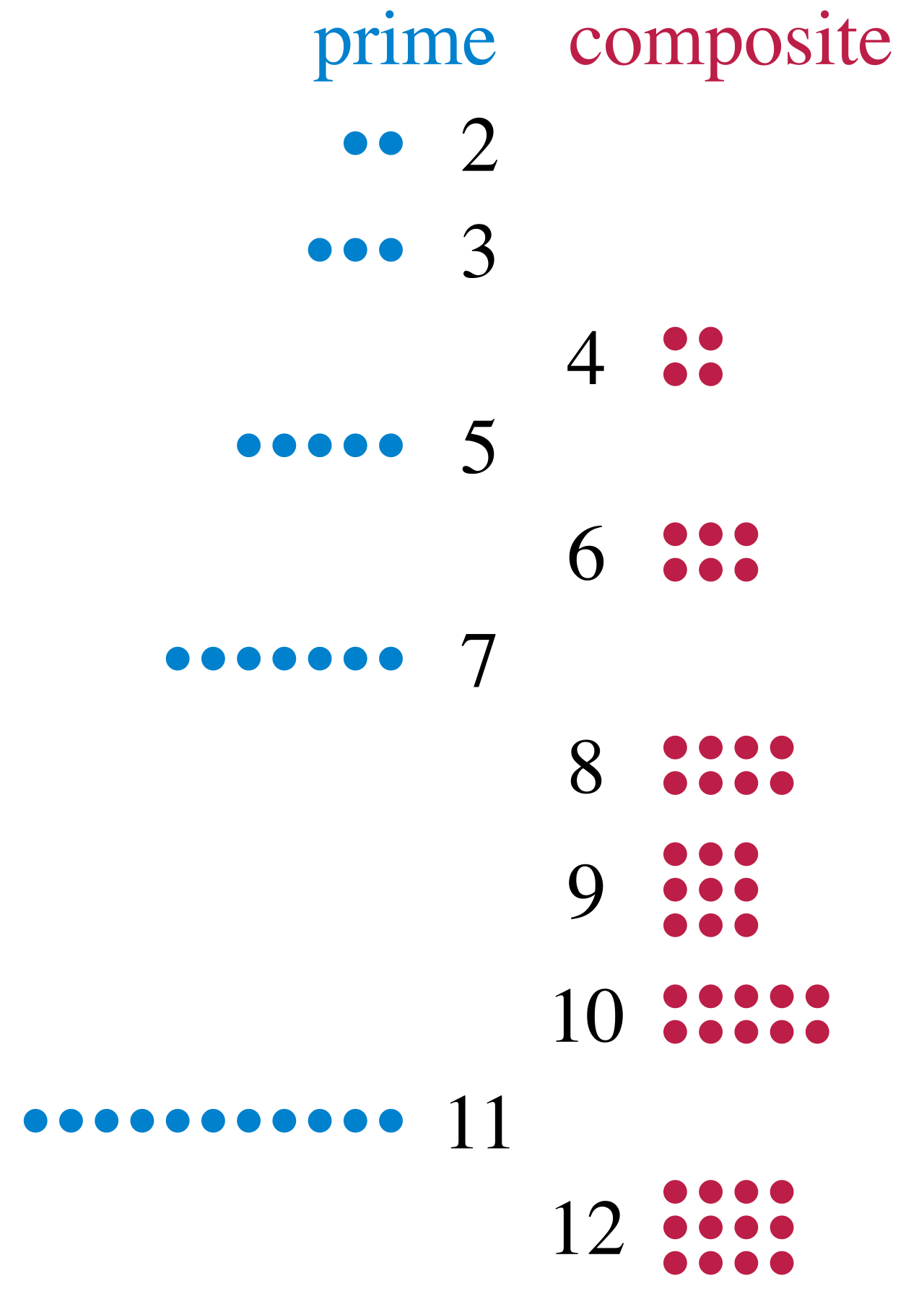
This brings us to a peculiar and profound outlier: the number 1. You might instinctively want to classify it as prime, but remember our strict definition: a prime must have exactly two distinct positive factors. The number 1 only has a single positive factor (itself). Thus, the number 1 is neither a prime number nor a composite number. It stands alone as a unique unit.
One of the most profound properties of integers is their "parity"—whether they can be perfectly paired off without a remainder.
Even Number: An even number is any integer that is evenly divisible by 2. Odd Number: An odd number is any integer that leaves a remainder of 1 when divided by 2.
If you have an even number of stones, you can divide them into two perfectly equal piles. If you have an odd number, creating two equal piles will inevitably leave exactly one stone stranded on its own.
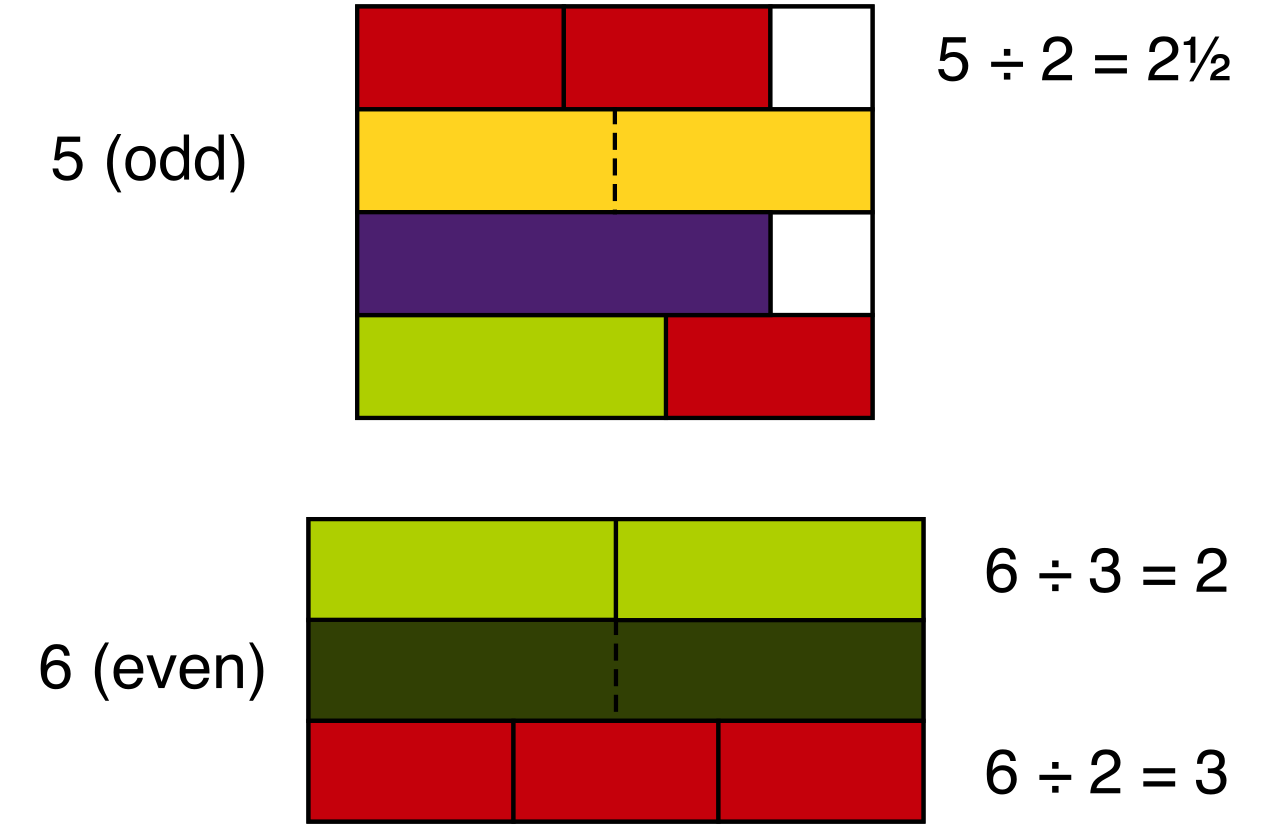
This brings us to the conceptual anchor of parity: The number 0 is an even number. This often confuses students, but it mathematically obeys the absolute rule of evens. Can 0 be divided by 2 without a remainder? Yes. 0÷2=0, with a remainder of 0. If you have zero stones, you can form two equal piles of zero stones. It is flawlessly even.
The Inviolable Rules of Evens and Odds
When we perform basic operations on numbers, their parity behaves in highly predictable ways. You do not need to memorize these by rote; simply visualize the piles of stones.
Addition and Subtraction
- The sum of two even numbers is always an even number. (Two perfectly paired piles combine to make a larger perfectly paired pile).
- The sum of two odd numbers is always an even number. (Each odd number has one "stranded" stone. When you add them together, those two stranded stones finally pair up!).
- The sum of an even number and an odd number is always an odd number. (The even pile is paired, but the odd pile brings its one stranded stone, which remains unpaired in the final sum).
Because subtraction is simply the inverse of addition, the physical geometry remains identical:
- The difference between two even numbers is always an even number.
- The difference between two odd numbers is always an even number.
- The difference between an even number and an odd number is always an odd number.
Multiplication
Multiplication is repeated addition. If you add an even number to itself any amount of times, it stays perfectly paired. Thus, if either number in a multiplication problem is even, the product is instantly infected with "evenness."
- The product of two even numbers is always an even number.
- The product of an even number and an odd number is always an even number.
The only way to achieve an odd product is to repeatedly add odd numbers an odd number of times:
- The product of two odd numbers is always an odd number.
| Operation | Condition 1 | Condition 2 | Result |
|---|---|---|---|
| Sum | Even | Even | Even |
| Sum | Odd | Odd | Even |
| Sum | Even | Odd | Odd |
| Difference | Even | Even | Even |
| Difference | Odd | Odd | Even |
| Difference | Even | Odd | Odd |
| Product | Even | Even | Even |
| Product | Odd | Odd | Odd |
| Product | Even | Odd | Even |
In higher-level arithmetic, we rarely have the luxury of performing long division every time we want to test for factors. Fortunately, our base-10 number system hides structural shortcuts within the digits themselves. Understanding these divisibility rules allows you to instantly perceive the anatomical makeup of massive numbers.
The "Tail-End" Rules (2, 4, 5, 10)
Because 10 is the foundation of our counting system, certain numbers only care about the very end of the sequence.
- Divisibility by 2: A whole number is divisible by 2 if the final digit of the whole number is 0, 2, 4, 6, or 8. (Since every 10 is divisible by 2, any tens, hundreds, or thousands place is automatically safe. We only have to inspect the ones place).
- Divisibility by 5: A whole number is divisible by 5 if the final digit of the whole number is exactly 0 or 5. (Every group of 10 contains two 5s, so everything above the ones place is already a multiple of 5).
- Divisibility by 10: A whole number is divisible by 10 if the final digit of the whole number is exactly 0.
- Divisibility by 4: A whole number is divisible by 4 if the last two digits of the whole number form a number that is divisible by 4. (Why two digits? Because 10 is not divisible by 4, but 100 is. Therefore, every hundred, thousand, and million is perfectly divisible by 4. We only need to check the tens and ones place. For example, in 5,732, we only check 32. Since 32 is divisible by 4, the entire colossal number is too).
The "Sum of Digits" Rules (3 and 9)
These rules seem almost magical, but they are direct consequences of algebra.
- Divisibility by 3: A whole number is divisible by 3 if the sum of all the digits in the whole number is divisible by 3.
- Divisibility by 9: A whole number is divisible by 9 if the sum of all the digits in the whole number is divisible by 9.
Why does this happen? Think about the number 100. It is exactly 99+1. The number 10 is 9+1. Every power of 10 is merely a multiple of 9 plus a remainder of 1. Because of this architectural quirk, all the "substance" of a base-10 number can be stripped away in chunks of 9, leaving behind only the sums of the digits themselves to be tested. If those digits sum to 27, you know the whole construct is divisible by 9, and consequently by 3.
The "Composite" Rule (6)
- Divisibility by 6: A whole number is divisible by 6 if the whole number is divisible by both 2 and 3.
This is a beautiful example of factors working in tandem. Because 2 and 3 are prime components of 6, any number that satisfies both the rule for 2 (it ends in an even digit) and the rule for 3 (its digits sum to a multiple of 3) has all the necessary "DNA" to be divided by 6.
Mathematical problems frequently require us to find harmony between two completely different numbers. We achieve this by finding where their internal factors overlap, or where their outward multiples synchronize.
Greatest Common Factor (GCF): The Greatest Common Factor of two whole numbers is the largest positive integer that divides both whole numbers without leaving a remainder.
The GCF is fundamentally a problem of fair distribution and scale. Imagine you are an artisan with 24 rubies and 36 sapphires. You wish to create identical necklaces, utilizing all your stones with none left over. What is the maximum number of identical necklaces you can make?
You are looking for the largest integer that lives inside both 24 and 36.
- Factors of 24: 1, 2, 3, 4, 6, 8, 12, 24
- Factors of 36: 1, 2, 3, 4, 6, 9, 12, 18, 36
The Greatest Common Factor is 12. You can create 12 exquisite necklaces, each containing 2 rubies and 3 sapphires.
Least Common Multiple (LCM): The Least Common Multiple of two whole numbers is the smallest positive integer that is a multiple of both whole numbers.
If the GCF is about scaling down, the LCM is about synchronization over time. Imagine two orbiting planets. Planet A completes an orbit every 4 years. Planet B completes an orbit every 6 years. If they align today, how many years will pass before they perfectly align again?
We project their multiples outward to see where their timelines intersect.
- Multiples of 4: 4, 8, 12, 16, 20, 24...
- Multiples of 6: 6, 12, 18, 24, 30...
The Least Common Multiple is 12. Even though they will align again at year 24, the first (least) time they sync up is at year 12.
By commanding factors, multiples, prime construction, parity rules, and divisibility traits, you do more than just execute arithmetic. You gain the ability to predict the behavior of numbers before you even begin a calculation. You are reading the structural blueprints of mathematics itself.