Place Value, Naming, and Ordering Numbers
Not sure you’re ready?
Take the ~3-minute readiness diagnostic and see where you stand.
The architecture of the modern mathematical universe rests upon a single, magnificent constraint: the physical position of a symbol on a page strictly dictates its absolute magnitude. Without this spatial grammar, tracking the mass of a star or the width of an atom would require an endless, unwieldy invention of unique symbols. Instead, by leveraging just ten digits and a strict set of spatial rules, any quantity in the universe can be expressed precisely. This system transforms simple arithmetic into a scalable, elegant machinery, forming the foundational bedrock for the Praxis Core Mathematics exam. Master the geometry of place value and the topography of the number line, and you master the very language in which mathematics is written.

We operate within the base-10 number system, an ingenious framework that relies heavily on a digit's location to impart meaning. It is not enough to know what a digit is; you must know where it is.
The fundamental rule of this system is scaling. The base-10 number system dictates that each place value is ten times the value of the place immediately to the right. Consequently, if you reverse your gaze, the inverse is equally true: each place value is one-tenth the value of the place immediately to the left in the base-10 number system.
When dealing strictly with an integer—a whole number with no fractional components—the system anchors itself on the right. In an integer, the rightmost digit occupies the ones place. From this anchor, every shift to the left magnifies the value by a power of ten. Moving to the left from the ones place, the sequence of place values is tens, hundreds, thousands, ten-thousands, and hundred-thousands.
| Hundred-Thousands | Ten-Thousands | Thousands | Hundreds | Tens | Ones |
|---|---|---|---|---|---|
| 100,000 | 10,000 | 1,000 | 100 | 10 | 1 |
The Principle of Total Value: A specific digit's total mathematical value is determined by multiplying the digit by the specific place value the digit occupies.
If you encounter the number 407,250, the digit 4 is not merely "four." It resides in the hundred-thousands place. Its true mathematical value is 4×100,000=400,000. The 7 represents 7×1,000=7,000.
Notice the zeros in 407,250. What happens to the ten-thousands place or the ones place? This is where the mathematical concept of zero reveals its genius. Zero functions as a placeholder in the place value system to maintain the correct mathematical position of other non-zero digits. Without zero standing guard in the ten-thousands column, the 4 would slip to the right, fundamentally destroying the number's magnitude, collapsing 407,250 into 47,250. Zero is the silent scaffolding holding the base-10 structure intact.
The base-10 system does not halt at the ones place. The physical world is full of partial quantities—half a gallon of fuel, a quarter-inch drill bit, or precisely $1.99. To represent the continuum of fractional values within this strict base-10 architecture, mathematics employs a symmetry-breaker.
The decimal point is a mathematical symbol that separates the whole number portion of a value from the fractional portion.
When we cross the threshold of the decimal point to the right, we enter the realm of fractions governed by powers of ten. The place value immediately to the right of the decimal point is the tenths place. To understand this intuitively, remember that the tenths place represents fractions with a denominator of ten. A value of 0.3 is exactly equal to 103.
As we continue scaling downward, the system's rule remains unbroken: every step right is one-tenth of the step before it. Moving to the right from the tenths place, the sequence of decimal place values is hundredths, thousandths, and ten-thousandths.
| Ones | Decimal Point | Tenths | Hundredths | Thousandths | Ten-Thousandths |
|---|---|---|---|---|---|
| 1 | . | 101 | 1001 | 1,0001 | 10,0001 |
There is a fascinating and highly practical consequence to the rightward bound of decimals: appending trailing zeros to the extreme right of a decimal number's fractional part does not alter the decimal's overall mathematical value.
Consider the number 0.5. It represents five tenths (105). If we append a trailing zero to write 0.50, it now technically reads as fifty hundredths (10050). Because 10050 mathematically reduces exactly to 105, the overall value remains untouched. A trailing zero simply slices the same quantity into smaller, more numerous theoretical fragments without changing the total amount.
Mathematics is not purely visual; it must be spoken. Because position dictates value, the way we verbalize numbers requires profound precision.
The most common error in spoken mathematics is the casual misuse of the word "and". You will often hear people say "three hundred and forty-two." In strictly formal academic mathematics, this is incorrect. To express a decimal number in words, the decimal point is read aloud using the word 'and'. The word "and" is strictly reserved to signal the boundary between whole numbers and fractions.
How do we verbalize the fractional components themselves? To express the fractional part of a decimal number in words, state the number as a whole number followed by the place value name of the rightmost digit.
Let us practice translating the number 204.053:
- Read the whole number portion: Two hundred four (notice the absence of "and").
- Read the decimal point: and
- Read the fractional part as if it were a whole number: fifty-three
- Append the place value of the rightmost digit (the 3 is in the thousandths place): thousandths
Therefore, 204.053 is properly spoken as: Two hundred four and fifty-three thousandths.
To truly grasp the comparative magnitude of numbers, we map them onto a continuous one-dimensional space. A horizontal number line is a visual representation where numerical values strictly increase from left to right. In perfect symmetry, numerical values strictly decrease from right to left on a horizontal number line.
Every mathematical map requires an origin—a reference point from which all distance and direction are measured. That origin is zero. Because zero represents the sheer absence of magnitude, the number zero is classified as neither positive nor negative. It is the great divide.
From zero, the number line branches into two distinct realms:
- Positive numbers are always located to the right of zero on a horizontal number line. Because value increases as we move right, a positive number moves toward infinite expansion.
- Negative numbers are always located to the left of zero on a horizontal number line. Because value decreases as we move left, a negative number moves toward infinite debt or deficit.

This structural topography leads to an immutable law of comparison: Any positive number is strictly greater than any negative number. A value of 0.0001 is structurally to the right of—and therefore greater than—a value of −1,000,000.
The Counterintuitive Nature of Negatives
When students look at a negative number, their brains often misinterpret the magnitude because they are reacting to the sheer size of the digit itself. This "size" is known as absolute value—the raw distance a number lies from zero, regardless of direction.
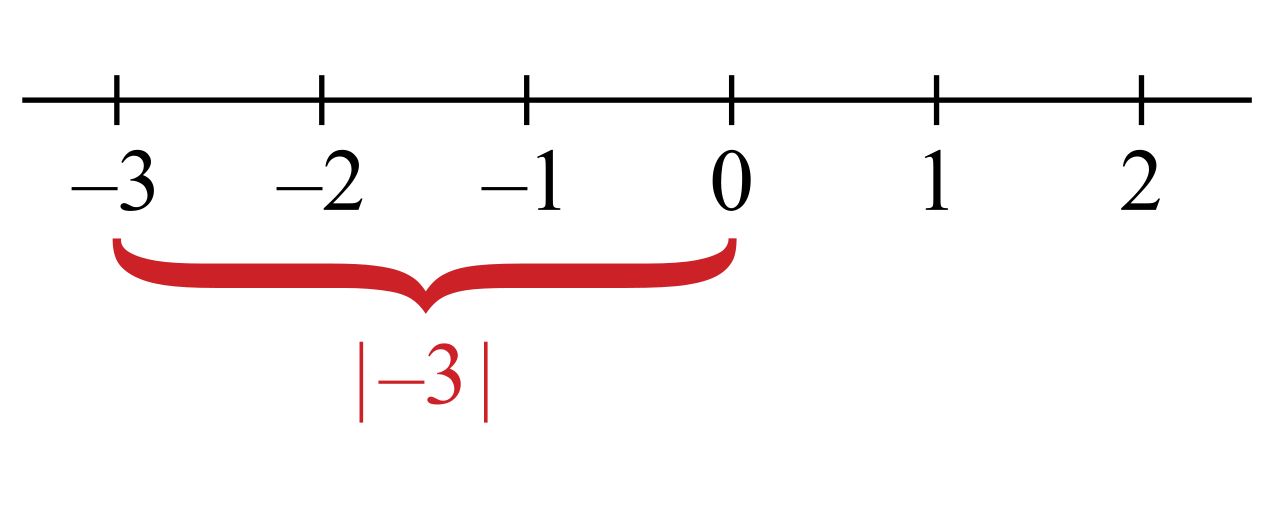
Here is the critical paradigm shift required for negatives: For negative numbers, the number possessing the larger absolute value represents the smaller overall mathematical value.
Think of absolute value as the weight of an anchor. A heavier anchor drags you deeper down into the ocean. On a horizontal layout, a negative number with a larger absolute value is positioned further to the left on a horizontal number line than a negative number with a smaller absolute value.
Consider −5 and −50. The absolute value of −50 is 50, which is undeniably larger than the absolute value of −5. But because it is negative, that "heavier weight" pushes it much further to the left on the number line. Therefore, −50<−5.
The Praxis Core will rarely ask you to compare clean, uniform lists of integers. Instead, you will be handed a messy ecosystem of positive fractions, negative decimals, and integers, and asked to impose order on them.
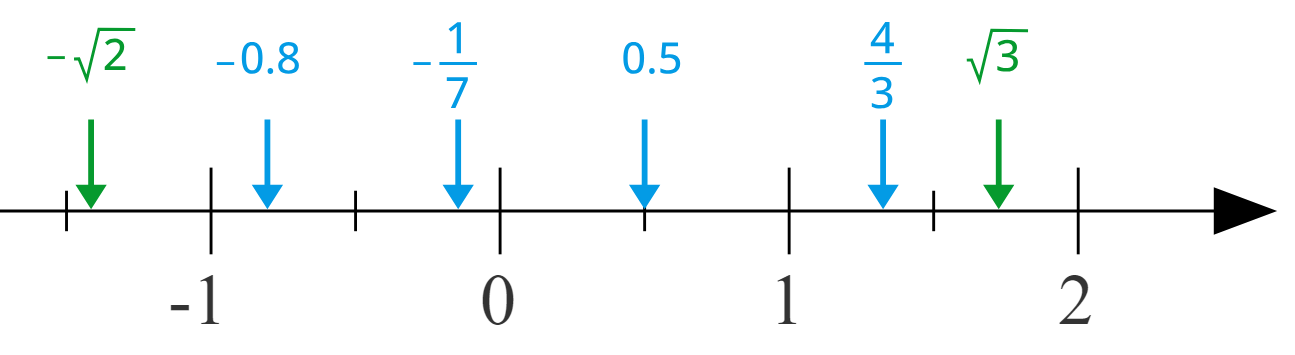
The universal, unbreakable strategy is standardizing the data. To effectively compare a mixed set of fractions and decimals, convert all the values into a single common numerical format. You cannot easily evaluate if 83 is greater than 0.35 by simply staring at them; their architectures are too distinct.
Method 1: Converting to Decimals
For many, standardizing into decimals is the most intuitive approach. A fraction can be mathematically converted into a decimal by dividing the fraction's numerator by the fraction's denominator.
If you wish to compare 83 to 0.35:
- Divide 3 by 8.
- 3÷8=0.375.
- You are now comparing 0.375 to 0.35.
When comparing two positive decimal numbers, align the decimal points vertically and sequentially compare the digits from left to right.
Let us align them: 0.375 0.350 (Remember, appending trailing zeros does not alter the mathematical value!)
Scanning from left to right: The ones places (0) are identical. The tenths places (3) are identical. In the hundredths place, the 7 is greater than the 5. The comparison halts here. The number 0.375 is greater than 0.350, meaning 83>0.35.
Method 2: Comparing via Common Denominators
If you prefer to keep values in their fractional form, the base-10 rules of decimal place value no longer apply. You must synthesize a new shared scale. To compare fractions without converting the fractions into decimals, rewrite the fractions so all the fractions share a common denominator.
Imagine you must compare 32 and 85. By finding the lowest common multiple of the denominators 3 and 8 (which is 24), we scale both fractions:
- 32=2416
- 85=2415
Now that the fragments are cut to the exact same size (twenty-fourths), we simply evaluate the count of those fragments. When comparing positive fractions that share a common positive denominator, the fraction containing the larger numerator possesses the greater overall value. Because 16 is greater than 15, 2416>2415, which proves 32>85.
Beware the trap of negative fractions, however. When the fractions sit to the left of zero, the rule mirrors our logic of absolute values. When comparing negative fractions that share a common positive denominator, the fraction containing the more negative numerator possesses the lesser overall value.
Compare −43 and −54.
- Find a common positive denominator: 20.
- Scale the fractions: −43 becomes 20−15. −54 becomes 20−16.
- Evaluate the numerators: −16 has a larger absolute value than −15, meaning it is positioned further to the left on the number line.
- Therefore, −16 is less than −15.
- Conclusion: −54<−43.
The Capstone: Putting It All Together
To synthesize these concepts on the exam, approach any mixed list algorithmically:
- Divide the list immediately into negatives and positives. (Negatives are always strictly less than positives).
- Look for zero as your natural boundary.
- Convert the positive subset into a uniform format (e.g., all decimals aligned vertically) to order them from least to greatest.
- Convert the negative subset into a uniform format, keeping a vigilant eye on absolute value: the negative with the largest numerical look is mathematically the smallest.
- Merge the lists from left (most negative) to right (most positive).
By treating numbers not as arbitrary scratches on a page, but as exact locations within a meticulously structured base-10 space, you dissolve the anxiety of calculation. Place value is the ultimate mathematical compass. Trust the compass, respect the spatial grammar, and ordering any conceivable list of numbers becomes a triumph of pure logic.