CA-RES Format & Logistics: What to Expect on Test Day
In short
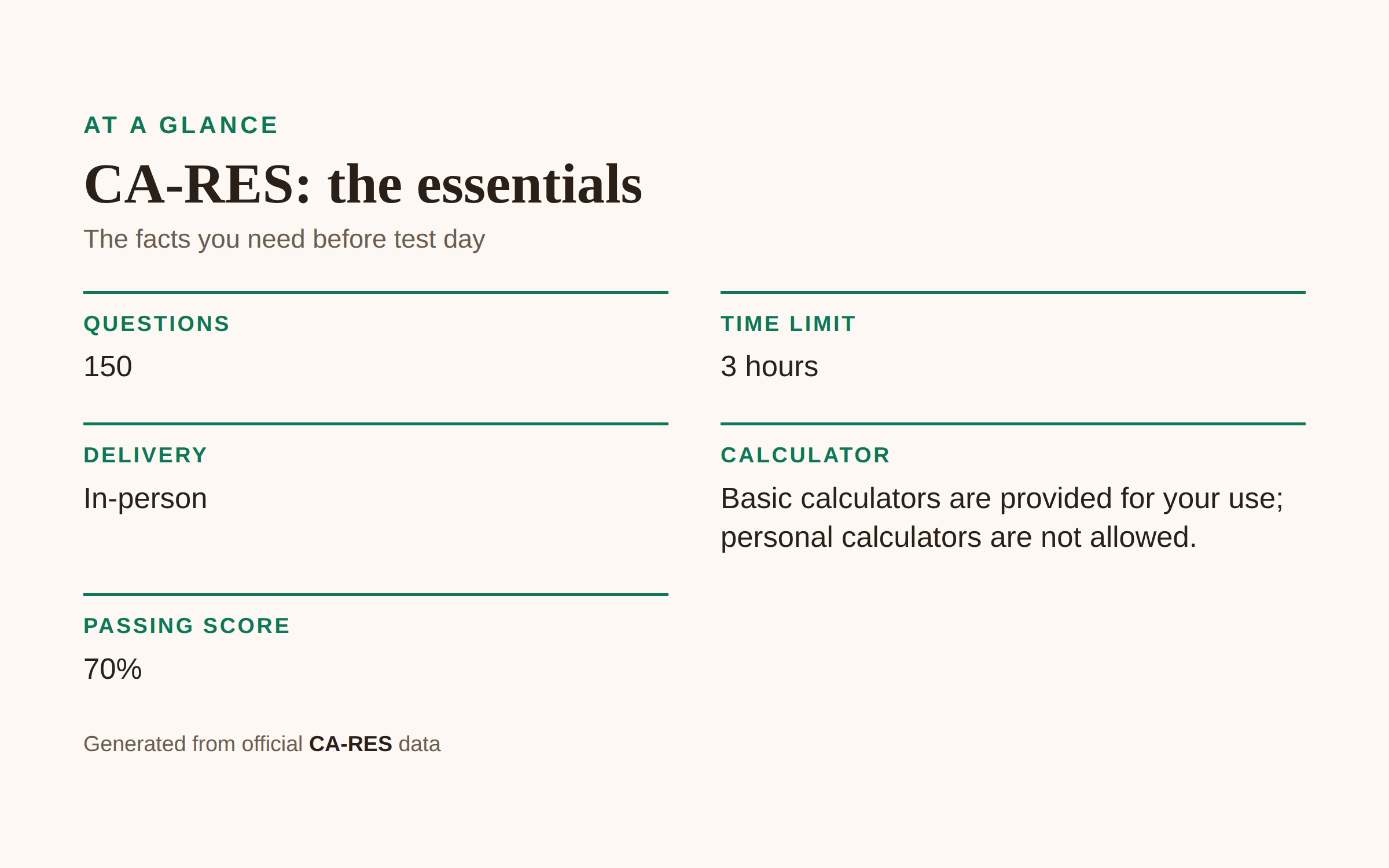
The California Real Estate Salesperson exam is 150 multiple-choice questions with 3 hours on the clock. Delivery is in-person, at a testing center. The Department of Real Estate sets the pass mark at 70%, which is 105 right answers out of the 150. Basic calculators are provided on site and personal ones are not allowed. Eleven subject areas share the exam.
The format at a glance
Three hours, start to finish. Spread across 150 questions, that is 1 minute 12 seconds each — the pace you are keeping whether you track it or not. Question 75 should land somewhere near the 90-minute mark.
Seventy percent passes, so 105 have to be right. That leaves 45 you can afford to lose.
The eleven subject areas are nowhere near even.
| Subject area | Weight | Questions (of 150) | Study hours |
|---|---|---|---|
| General Principles of Agency | 17% | ~26 | 18 |
| Valuation and Market Analysis | 14% | ~21 | 15 |
| Practice of Real Estate | 13% | ~20 | 15 |
| Contracts | 12% | ~18 | 13 |
| Property Ownership | 9% | ~14 | 10 |
| Financing | 9% | ~14 | 10 |
| Property Disclosures | 8% | ~12 | 9 |
| Transfer of Title | 8% | ~12 | 9 |
| Land Use Controls | 6% | ~9 | 7 |
| Leasing and Property Management | 2% | ~3 | 3 |
| Real Estate Calculations | 2% | ~3 | 4 |
Agency is the biggest single block of questions on the test, and the study hours follow it: 18 of them, more than any other subject area gets. The hours column totals 113, which is the whole prep estimate for this exam.
Each question count above is its weight applied to 150. Four of them land on half a question and are rounded up, so the column comes to 152. Read every figure as a share of the exam.
The table leaves out topic counts, and those decide where an hour earns most. Agency splits its 17% across five study topics, a little over five questions each. Property Ownership's 9% is spread across eight topics, so one of those is worth under two questions.
Real Estate Calculations sits at the bottom, 2% of the exam and about three questions. Leasing and Property Management is another 2%, three more. Skip both subject areas outright and you have spent 6 of your 45 allowed misses.
Your version of the test is drawn from a much larger pool of subject matter, so the outline maps what could be asked. Some of it will not appear on the day. That is the argument for giving the small areas their hour anyway: you cannot know which of them are on your version until you are sitting there.
California law moves, and the DRE keeps the question pool current with it, so study material written before a change can be out of date. Do not revise from broker material either. The broker exam weights the same subjects differently and pitches them at a different level of difficulty.
What test day looks like
Everything happens in one room. You sit the California Real Estate Salesperson exam in person, at a testing center, in a single three-hour session.
Practice your math on a plain calculator, because a basic one is what you will be handed. Real Estate Calculations is about three questions of the 150 — commission splits, prorations, a capitalization rate, an area or a volume.
One question type, one clock. Pacing is the part you can still control once you are in the room:
Settle what the stem is actually asking before you look down at the options →
then eliminate everything you can positively rule out.
At 1 minute 12 seconds a question, a long deliberation is time borrowed from somewhere else on the test.
Property Ownership is 9% of the exam, and the outline breaks it into eight topics:
- Real and personal property conveyances
- Legal property descriptions
- Measuring structures and land
- Liens, easements and encumbrances
- Surface, subsurface, air and water rights
- Basic types of ownership and tenancy
- Common-interest, trusts and business ownership
- California community property, vesting and water rights
Some vocabulary turns up in multiple-choice scenarios across the whole exam, and three terms are worth being able to place on sight. A fixture is personal property that has become part of the land or a building, so the law treats it as real property. An encumbrance is a claim against a property: a lien, an easement, an encroachment. Fee simple carries the maximum rights an owner can hold.
This exam tests federal principles and California statutory law together, and the California half is the part generic study material tends to thin out. Property Disclosures, 8%, turns on the Transfer Disclosure Statement (TDS) and the Natural Hazard Disclosure (NHD). Practice of Real Estate, 13%, covers the DRE's rules against commingling trust funds, plus the Unruh Civil Rights Act and the Fair Employment and Housing Act. Financing, 9%, wants RESPA, TILA and TRID alongside California's own usury limits. Learn those acronyms well enough to recognize one in a stem under time pressure.
Common questions
How many questions are on the CA-RES exam? 150, all of them multiple choice, drawn from eleven subject areas.
How long do you get? 3 hours for the whole exam.
What is the passing score? 70%, so 105 of the 150. The Department of Real Estate sets that figure and it is the same for every candidate.
Can you bring your own calculator? No. Personal calculators are not allowed, and a basic one is provided at the testing center.
Which subject area is heaviest? General Principles of Agency, at roughly 17% of the questions — about 26 of the 150.
Where do you take it? In person, at a testing center.
How much study time does it take? Around 110 to 120 hours. Adding up the eleven subject areas gives 113, and across 16 weeks that is about 7 hours a week.
Those 113 hours break into 55 topics across the eleven subject areas, so you can take them one at a time. Only Ever's practice questions and study guides for this exam are free — the part other providers put behind a paywall. Try the free practice questions, score yourself subject area by subject area, and you will find out where your 45 allowed misses are going.