A 16-Week CA-RES Study Plan That Fits a Real Schedule
In short
Budget about 113 hours across 16 weeks — an average of seven a week, though the weeks are far from even. General Principles of Agency, Valuation and Market Analysis, and Practice of Real Estate take 48 of those hours between them. The plan works through the eleven domains one at a time, keeping each domain's hours in a single block.
How long the prep takes
113 hours is the estimate for the California Real Estate Salesperson exam, and it is an odd number because it is the eleven domains added up. Divide it across 16 weeks and you get 7.1 hours a week (113 ÷ 16).
Here is where every hour goes, sorted biggest first. The order you study them in comes in the next section.
| Domain | Hours | Share of the exam |
|---|---|---|
| General Principles of Agency | 18 | 17% |
| Valuation and Market Analysis | 15 | 14% |
| Practice of Real Estate | 15 | 13% |
| Contracts | 13 | 12% |
| Property Ownership | 10 | 9% |
| Financing | 10 | 9% |
| Property Disclosures | 9 | 8% |
| Transfer of Title | 9 | 8% |
| Land Use Controls | 7 | 6% |
| Real Estate Calculations | 4 | 2% |
| Leasing and Property Management | 3 | 2% |
The hours track the weights closely. Three domains pull away from that pattern, and each one changes how a week feels.
Real Estate Calculations is 2% of the paper and still takes 4 hours, the biggest gap between weight and time on the list. Land Use Controls is 6% and takes 7 hours across only three topics, so each sitting runs long. Property Ownership runs the other way, with 10 hours spread over eight topics, which makes for short and frequent sessions. Topic count tells you how the week feels. Hours tell you how long it takes.
The exam itself is 150 multiple-choice questions in 3 hours, and the pass mark is 70%, set by the California Department of Real Estate and identical for every candidate. Do the arithmetic once, at the start. 70% of 150 is 105 questions right, which leaves you 45 to lose. Three hours across 150 questions is 1.2 minutes each.
Week by week
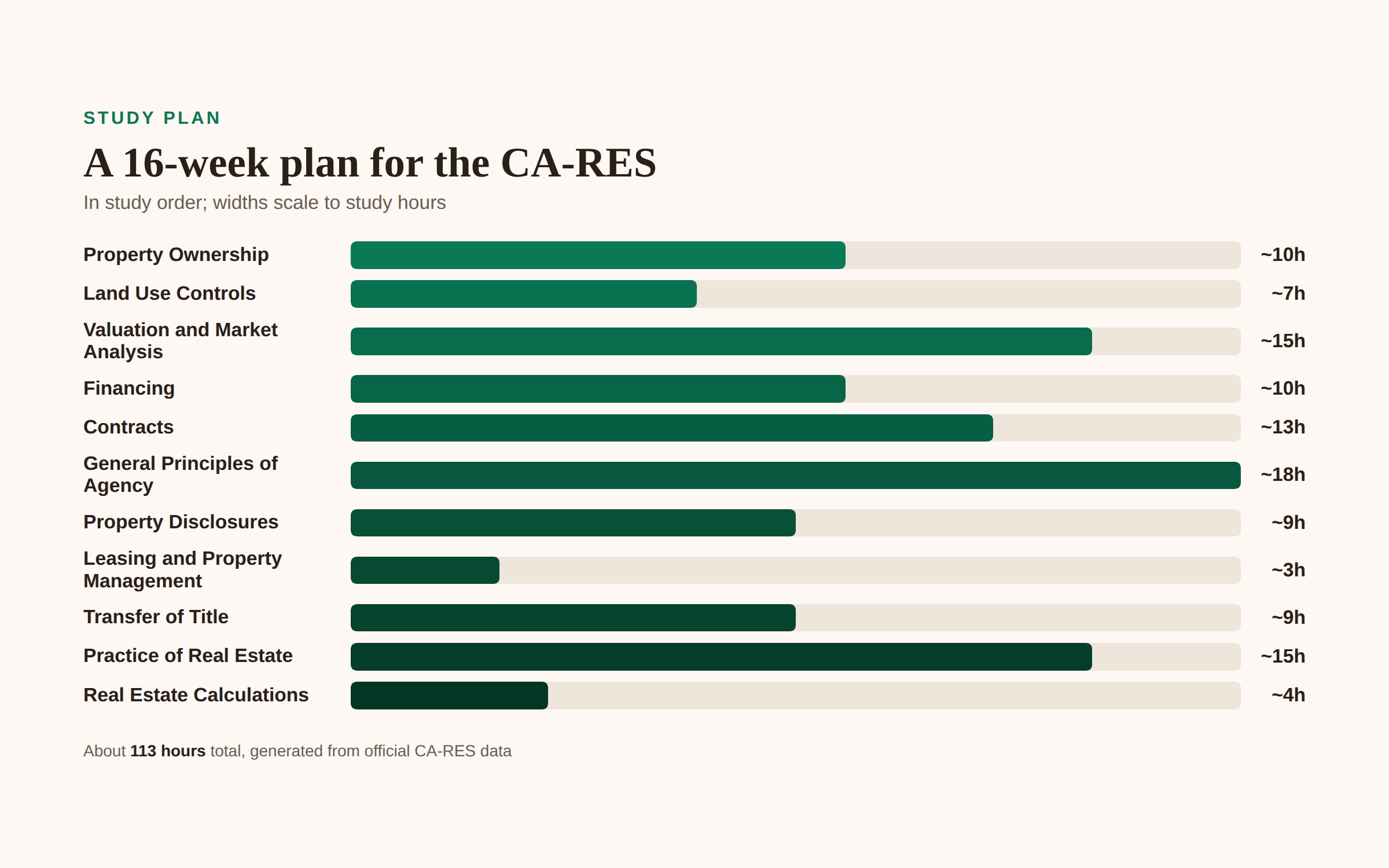
The order below takes the eleven domains in turn, with each domain's hour budget kept whole so no week straddles two subjects.
| Week | Focus | Hours |
|---|---|---|
| 1 | Property Ownership — first half | 5 |
| 2 | Property Ownership — second half | 5 |
| 3 | Land Use Controls | 7 |
| 4 | Valuation and Market Analysis — first half | 7.5 |
| 5 | Valuation and Market Analysis — second half | 7.5 |
| 6 | Financing | 10 |
| 7 | Contracts — first half | 6.5 |
| 8 | Contracts — second half | 6.5 |
| 9 | General Principles of Agency — first half | 9 |
| 10 | General Principles of Agency — second half | 9 |
| 11 | Property Disclosures | 9 |
| 12 | Leasing and Property Management | 3 |
| 13 | Transfer of Title | 9 |
| 14 | Practice of Real Estate — first half | 7.5 |
| 15 | Practice of Real Estate — second half | 7.5 |
| 16 | Real Estate Calculations | 4 |
Weeks 1 and 2 go to Property Ownership, which has eight topics — tied with Practice of Real Estate for the most in the plan. You cover real and personal property and how fixtures move between the two, legal property descriptions, liens and easements, and the vesting rules that make California community property a subject of its own. Week 3 turns to what government and neighbors can do to land you own: taxation, eminent domain and escheat, zoning and building codes, and the private controls written into CC&Rs.
Weeks 4 and 5 are valuation. The 15 hours go on three separate approaches to value — sales comparison, cost, and income — plus how an appraisal differs from a comparative market analysis and from a broker price opinion. Week 6 is Financing, the heaviest single week in the plan at 10 hours across seven topics. Among those topics is the deed-of-trust structure, which means knowing what a trustor, a trustee and a beneficiary each do. Another is the federal disclosure set of TILA, RESPA and TRID. California's own financing and credit laws sit alongside them, usury limits included.
Weeks 7 and 8 go to Contracts: 13 hours across 7 topics. Much of it comes down to telling a valid contract from a void one from a voidable one. On the California side, the material to watch is the contract forms and listing agreements, plus the rules covering advance fees.
Weeks 9 to 11 are the heaviest stretch. General Principles of Agency is the largest domain on the exam at 17%, roughly 26 of the 150 questions, and its 18 hours are the biggest allocation in the plan. You need the fiduciary duties an agent owes a principal, the events that create and end an agency, and the steps California sets for confirming a dual agency. Property Disclosures follows in week 11 and picks up where agency leaves off: the Transfer Disclosure Statement, the Natural Hazard Disclosure, and the duty to disclose material facts.
Week 12 is the lightest in the plan at 3 hours. Leasing and Property Management is 2% of the exam and covers two topics: the obligations that run between a landlord and a tenant, and how fair housing rules bear on qualifying a tenant and setting a rent. Use the lighter week to go back over agency and disclosures while they are still fresh.
Weeks 13 to 15 close out the main material. Transfer of Title covers the deeds, the title search and title insurance, and the transfers that work differently — foreclosures, short sales and probate. Practice of Real Estate then takes 15 hours over eight topics. This is where the DRE's own rules concentrate: licensing and discipline, trust-fund handling and record keeping, and fair housing under federal law and under California's Unruh Civil Rights Act and FEHA.
Week 16 is Real Estate Calculations, 4 hours, and it sits last so the methods are fresh on exam day. Prorations, commission splits, capitalization rate, loan-to-value, and area and volume all get practiced here. A basic calculator is provided at the test center and your own is not permitted, so do your practice on the simplest one you own. Add a timed set on top of that week's 4 hours: a full run of practice questions inside the 3-hour limit, scored by domain, then re-read wherever you dropped the most.
Inside a week, the loop that works is short:
Read the topic and take notes once →
answer practice questions on it in the same session →
mark every wrong answer with the reason you missed it →
re-read only those reasons before you start the next session.
Two things about the table are worth saying out loud. First, nine of the sixteen weeks run above seven hours, and weeks 12 and 16 run well below it, so the seven-hour average describes very few of the weeks in it. Move a weekend block forward when a heavy week lands badly, and keep the total intact. Second, the CA-RES paper is built by sampling a large subject-matter pool, and not every topic turns up on the form you sit. With 55 topics feeding 150 questions, you cannot predict which topics appear, and that is the argument for covering all eleven domains.
If you have less time (or more)
The 113 hours stay 113 hours whether you spread them over 16 weeks or 8. A shorter plan is a heavier week.
| Weeks available | Hours per week |
|---|---|
| 8 | 14.1 |
| 12 | 9.4 |
| 16 | 7.1 |
| 24 | 4.7 |
Eight weeks at 14 hours is close to a second job. If that is what your exam date allows, protect the four largest domains — General Principles of Agency, Valuation and Market Analysis, Practice of Real Estate, and Contracts. That is 61 of the 113 hours, 54% of your study time, covering 56% of the questions. Compress the smaller domains to one careful pass each, and leave the big four at full length.
Going longer than 16 weeks carries one real risk. The exam is revised as California law and standard practice change, so on a 24-week plan your week-4 notes are months old by exam day. Re-read the state-specific topics in your final month: California agency disclosure, trust-fund handling, and the required disclosures.
If you can add hours without adding weeks, add them to Real Estate Calculations. Four hours covers the methods themselves, and every extra hour goes into getting them quick enough to use at 1.2 minutes a question.
Common questions
How many hours should I plan for? Around 113, which is what the eleven domains add up to. Anywhere in the 110 to 120 range is a reasonable target for a paper spanning both federal principles and California statutory law.
How many topics is that across? 55, over the eleven domains — from 2 in Leasing and Property Management up to 8 each in Property Ownership and Practice of Real Estate.
How many questions is the exam, and how long do I get? 150 multiple-choice questions in 3 hours. That works out at 1.2 minutes a question.
What score do I need? 70%, which is 105 of the 150 questions. The California Department of Real Estate sets it at the same level for every candidate.
Which domain should I study first if I am short on time? General Principles of Agency, the largest single domain at about 17% of the questions and 18 study hours. The plan above puts it in weeks 9 and 10, after the ownership and valuation groundwork, so move it earlier if you are compressing.
Can I bring my own calculator? No. The test center provides a basic calculator and personal ones are not permitted, so do your practice math on a basic calculator too.
Is 16 weeks the right length? 16 weeks puts the 113 hours at about seven a week on average. Pick the number of weeks that makes your weekly hours survivable, then work back from your exam date.
Only Ever's practice questions and study guides for this exam are free, including the AI-generated sets. Try the free practice questions, score yourself by domain, and let the weakest domains pick your next study hour.