How to Pass the Praxis 5001 (Elementary Education: Multiple Subjects) in 2026
In short
The Praxis 5001 is four separately timed subtests, not one long exam: 245 questions in 4 hours 35 minutes of testing time. Budget around 140 hours of study across four to five months. The reliable way through is to prepare and sit each subtest as its own exam, starting with your weakest subject.
What the Praxis 5001 tests
Four subtests, four test codes, four separate clocks:
| Subtest | Questions | Time | Per question | Content split |
|---|---|---|---|---|
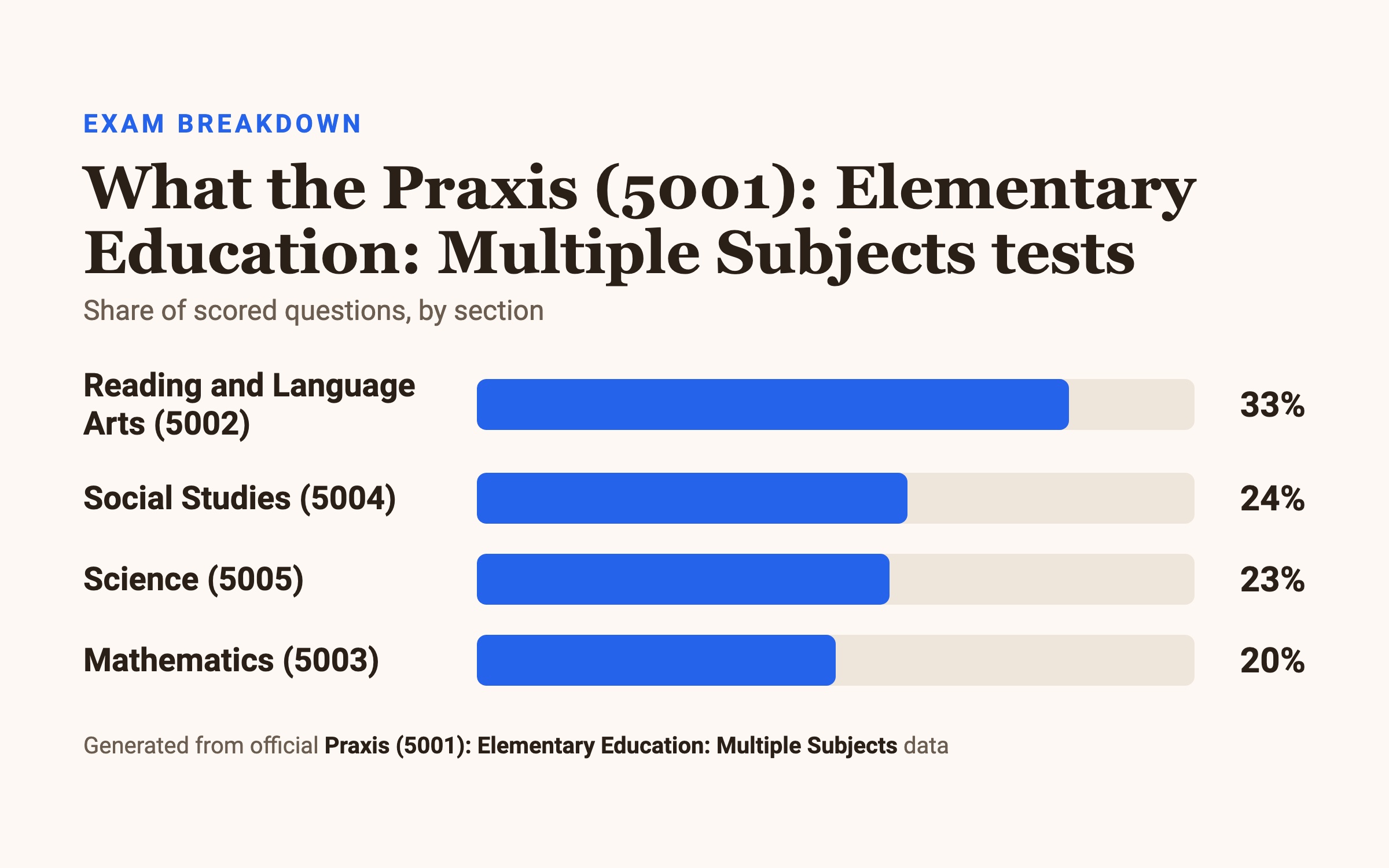
| Reading and Language Arts (5002) | 80 | 90 min | 1 min 8 sec | Reading 47%, Writing/Speaking/Listening 53% |
| Mathematics (5003) | 50 | 65 min | 1 min 18 sec | Numbers and Operations 40%, Algebraic Thinking 30%, Geometry/Measurement/Data 30% |
| Social Studies (5004) | 60 | 60 min | 1 min 0 sec | US History/Government/Citizenship 45%, Geography/Anthropology/Sociology 30%, World History/Economics 25% |
| Science (5005) | 55 | 60 min | 1 min 5 sec | Earth, Life, and Physical Science in near-even thirds |
Reading and Language Arts is the heaviest single block at 80 of the 245 questions. Social Studies is the tightest clock on the test: 60 questions in 60 minutes.
Two logistics points shape how you study. A calculator is provided only on Mathematics (5003) and Science (5005). There is none on Reading and Language Arts or Social Studies, and you can't bring your own to any of them.
The second point is the passing score, which your state or licensing agency sets. Check its requirement before you register.
The plan, section by section
The 245 questions cover four full elementary curricula, which is why we budget around 140 study hours. Spread over 20 weeks that's about seven hours a week. Compressed into eight weeks it's closer to eighteen — a part-time job on top of whatever you already do.
The hours divide roughly in proportion to how much each subject asks of you:
Reading and Language Arts — about 45 hours →
Mathematics — about 35 hours →
Social Studies — about 30 hours →
Science — about 30 hours.
Start with Reading and Language Arts, because it's the biggest block and the one candidates underestimate. The foundational-literacy content is the reason. Phonological and phonemic awareness and phonics and word analysis are tested from the teacher's side. You already read fluently. The exam asks whether you can name the stage a struggling six-year-old is stuck at and pick the instructional move that gets them past it. That's a separate skill, and it's learnable in a few weeks if you start it early.
Mathematics next, at 35 hours. The heaviest slice is Numbers and Operations at 40% of the subtest, so put your first sessions on place value, rational-number operations, and fractions and decimals before you touch algebra. Then work up through proportional relationships, linear equations, and patterns. Finish with the geometry, measurement, and data content that shares the last 30%.
Social Studies and Science are each about 30 hours. Both are recall-heavy, which is why spaced review beats long sessions here — the material is a large volume of discrete facts, and repeated short exposures are what fix those in memory. For Social Studies, front-load US history, the structure of government, and citizenship, since that's nearly half the subtest. For Science, rotate Earth, Life, and Physical week to week. The thirds are even, so an uneven study split creates a weak area.
Book the subtests on separate days if your schedule allows. All four are available daily, and each can be registered on its own. Sitting all four in one 4-hour-35-minute session is legal and simpler to schedule, but fatigue in hour four lands on Science, which is 55 of your 245 questions.
Where candidates lose points
-
Studying "for the Praxis 5001" as one block. Four subtests mean four separate readiness levels. You can pass three and fail one. The one you fail is the one you retake, so a subject you're already strong in is the wrong place for your last three weeks.
-
Running out of clock on Social Studies. Sixty questions in sixty minutes means a question you spend three minutes on borrows time from two others. Practice that subtest against a timer specifically, and build the habit of flagging and moving at 60 seconds, because that is all the average question can have.
-
Assuming the calculator is always there. Candidates who practice all their arithmetic with a calculator open get caught on Reading and Language Arts and Social Studies. Numbers appear there inside charts and data questions, with no calculator on screen.
-
Paying 180. The combined 5001 registration is 64 each. If you know you're taking all four, register them together even if you plan to sit them on different days.
-
Forgetting the 28-day rule. You must wait 28 days before retaking the same test, so a failed subtest costs you a month against your program deadline. That's the argument for tackling your weakest subject early.
-
Studying from material for a different test. Praxis 5006 (Elementary Education: Assessment) and 7811 (Content Knowledge for Teaching) are different exams with different blueprints, and prep material for them circulates under similar names. Check the four-digit code on anything you buy or download.
One more thing worth knowing while you plan. ETS has launched a replacement series, Elementary Education Fundamentals — test codes 8002 through 8006 — that will eventually replace 5001. Both are live right now. ETS has not published a final test date for 5001, and states are adopting the new series on their own timelines. Confirm which one your state requires before you register. Nothing about your 5001 preparation is wasted if your state moves later, but registering for the wrong test is an expensive mistake.
Every domain on this syllabus maps to short, 15-minute study units on Only Ever, and the practice questions are free — including the AI-generated question sets that other prep tools put behind a paywall.
Common questions
How long is the Praxis 5001? 4 hours 35 minutes of testing time in total, split across four separately timed subtests: Reading and Language Arts (5002) 90 minutes, Mathematics (5003) 65 minutes, Social Studies (5004) 60 minutes, and Science (5005) 60 minutes.
What is the passing score for the Praxis 5001? Your state or licensing agency sets it, and the requirement can differ by certification area within a state. Look yours up on the ETS scores page before you register.
Do I have to take all four subtests on the same day? No. The combined registration lets you sit all four in one session, but each subtest can also be registered and taken on its own, and all four are available daily. The combined registration costs 64 each, or $256 in total.
What types of questions are on the Praxis 5001? Selected-response and numeric-entry. There are no essays. ETS describes the counts as approximate — roughly 80 questions on Reading and Language Arts, 50 on Mathematics, 60 on Social Studies, and 55 on Science — and each subtest may include unscored pretest questions that look identical to the scored ones. Answer everything; there's no penalty for guessing.
Is a calculator provided for the mathematics and science subtests? Only on those two. Mathematics (5003) and Science (5005) both provide an on-screen scientific calculator. Reading and Language Arts (5002) and Social Studies (5004) do not have one, and you cannot bring your own calculator to any subtest.
How many hours should I study for the Praxis 5001? Around 140 hours is a realistic budget for the full four-subtest exam, which works out to about seven hours a week across 20 weeks. If you're only retaking one subtest, scale from that subject's share: roughly 45 hours for Reading and Language Arts, 35 for Mathematics, and 30 each for Social Studies and Science.