Characteristics and income taxation of business entities
Not sure you’re ready?
Take the ~3-minute readiness diagnostic and see where you stand.
The architecture of a business entity acts as a precise mechanism that determines the exact trajectory of every dollar a business earns. When a financial planner evaluates a client’s enterprise, they are not merely looking at an organizational chart; they are analyzing a complex hydraulic system of taxation and legal exposure. The choice of entity dictates whether a dollar of profit will be taxed once, twice, or partially shielded by deductions, and whether that dollar will be subjected to the friction of self-employment taxes. Understanding these structures is not an exercise in memorizing tax code—it is the foundational science of preserving a client's wealth, optimizing their operational cash flow, and walling off their personal assets from catastrophic legal ruin.
The most organic forms of business are those where the legal identity of the owner and the business are inextricably linked. These are the pass-through entities, where profits flow directly to the owners' personal tax returns without facing taxation at the entity level.
Sole Proprietorships
A sole proprietorship is an unincorporated business owned by one individual. It is the default state of commerce. Because the business and the individual are legally indistinguishable, the owner retains unlimited personal liability for the debts and obligations of the business. If the business is sued, the owner's personal assets—their home, their brokerage accounts—are fully exposed.
For tax purposes, the simplicity is absolute. The income and expenses of a sole proprietorship are reported on Schedule C of the business owner's personal Form 1040. All net income generated from a sole proprietorship is subject to two distinct taxes:
- Ordinary income tax at the individual owner level.
- self-employment tax (covering Medicare and Social Security).
A Note on LLCs: To cure the unlimited liability problem without losing the tax simplicity, a sole proprietor often forms a Limited Liability Company (LLC). A single-member limited liability company is treated as a disregarded entity for federal income tax purposes unless it explicitly elects corporate taxation. It offers the legal shield of a corporation but remains a sole proprietorship (Schedule C) in the eyes of the IRS.
Partnerships
When a business expands to multiple owners, it requires a new chassis. A partnership is an unincorporated business owned by two or more individuals or entities. Like the sole proprietorship, partnerships are pass-through entities that do not pay federal income tax at the entity level. (By default, a multi-member limited liability company is taxed as a partnership for federal income tax purposes).
However, because the IRS needs to track the flow of money, a partnership must file an annual informational tax return on Form 1065. The partnership’s income, losses, and deductions then flow through to the individual partners and are reported on their personal Schedule K-1.
The critical distinction in partnership taxation lies in how a partner interacts with the business, which dictates their exposure to self-employment tax:
- General Partners: A general partner is actively involved in the business. Therefore, their distributive share of partnership ordinary business income is fully subject to self-employment tax.
- Limited Partners: A limited partner is a passive investor. Their distributive share of partnership ordinary business income is generally exempt from self-employment tax.
- Guaranteed Payments: Often, a partner provides specific services or capital independent of the firm's profitability. They receive guaranteed payments. These payments are treated as ordinary income to the partner and, when made for services, are strictly subject to self-employment tax, regardless of whether the partner is general or limited.
When a business seeks absolute legal separation from its owners, it incorporates. The corporate form introduces a permanent legal barrier protecting the owners' assets, but it demands strict adherence to structural and tax rules.
C-Corporations: The Impermeable Fortress
A C-corporation is a separate taxable entity distinct from its owners. Because it is an independent "person" under the law, shareholders of a C-corporation enjoy limited liability protection against the debts of the business.
The C-corporation is designed for infinite scalability. It has no restrictions on the maximum number of shareholders, no restrictions on the types of entities that can be shareholders (foreign investors, other corporations, and partnerships are all welcome), and it is legally permitted to issue multiple classes of stock (e.g., preferred shares, super-voting shares).
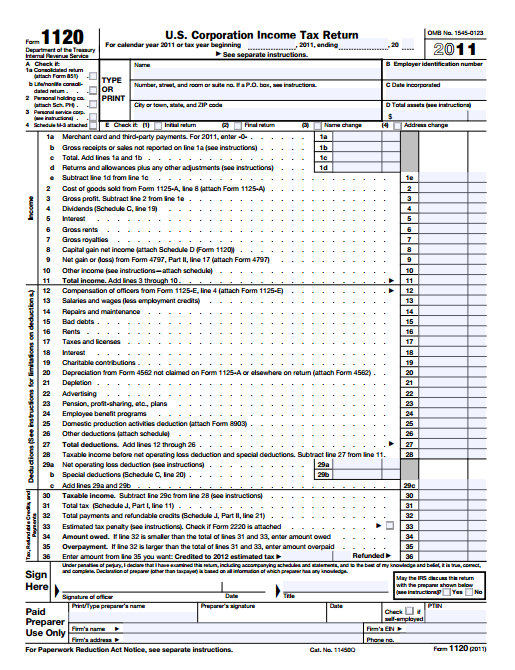
The cost of this robust architecture is double taxation. C-corporation income is taxed first at the entity level. The federal corporate income tax rate for C-corporations is a flat 21 percent. If the corporation retains those earnings, the tax stops there. However, if the corporation distributes those after-tax profits to its owners, double taxation occurs: the corporate income is taxed at the entity level and taxed again at the shareholder level upon dividend distribution.
Mitigating Corporate Double Tax: To prevent triple or quadruple taxation when corporations own shares in other corporations, C-corporations may utilize a dividends received deduction (DRD) for dividends received from other domestic corporations.
S-Corporations: The Hybrid Compromise
What if a client wants the legal shield of a corporation but the pass-through taxation of a partnership? They file for an S-election. An S-corporation is a pass-through entity for federal income tax purposes. S-corporations avoid double taxation by passing corporate income, losses, deductions, and credits directly through to shareholders, who report their pro-rata share of business income on their personal tax returns via Schedule K-1.
Because the S-corporation provides such a favorable tax environment, the IRS enforces severe structural limitations on who can use it. To qualify:
- An entity must be a domestic corporation.
- It is limited to a maximum of 100 shareholders (though family members can be treated as a single shareholder when determining this limit).
- Shareholders must be individuals, certain trusts, or estates.
- Crucially, partnerships and C-corporations are prohibited from being shareholders.
- Nonresident aliens are prohibited from being shareholders.
- The entity is restricted to having only one class of stock. (However, differences in voting rights among shares are permitted within the single class of stock requirement, allowing founders to maintain control).
The S-Corporation Tax Strategy (and the IRS's Countermeasure): Because S-corporation income flows to the owner's 1040, it is subject to ordinary income tax. However—and this is a critical planning concept for CFP practitioners—the distributive share of S-corporation net income passed through to a shareholder via a K-1 is not subject to self-employment tax.
If left unchecked, a business owner would simply take all their profit as a K-1 distribution to evade payroll taxes entirely. To prevent this, the IRS dictates that S-corporation shareholders who provide services to the business must be paid reasonable compensation in the form of W-2 wages. This wage is subject to standard payroll taxes. The remaining profit can then flow out via the K-1, legally bypassing self-employment tax.
Summary of Entity Characteristics
| Feature | Sole Proprietorship / Single-Member LLC | Partnership / Multi-Member LLC | C-Corporation | S-Corporation |
|---|---|---|---|---|
| Taxation | Pass-through (Ordinary + SE Tax) | Pass-through | Double Taxation (Flat 21% + Dividend tax) | Pass-through |
| Tax Form | Schedule C (1040) | Form 1065 / Schedule K-1 | Form 1120 | Form 1120-S / Schedule K-1 |
| SE Tax on Profits? | Yes | Yes for General Partners; No for Limited Partners | N/A (Dividends are not SE income) | No (Only W-2 wages are subject to payroll tax) |
| Owner Limits | One | Two or more | Unlimited | Max 100 (Family = 1) |
| Allowed Owners | Individual | Anyone | Anyone | US Individuals, certain trusts/estates |
| Stock Classes | N/A | N/A | Multiple | One (Voting diffs allowed) |
Introduced under Section 199A, the Qualified Business Income (QBI) deduction acts as an equalizing mechanism, allowing eligible taxpayers to deduct up to 20 percent of their qualified business income. This effectively lowers the top marginal rate for pass-through business owners, leveling the playing field against the flat 21 percent C-corporation rate.
This is a structural gift to pass-through entities. The QBI deduction is available to owners of sole proprietorships, partnerships, S-corporations, and some trusts and estates. By definition, income generated by a C-corporation does not qualify for the QBI deduction.
Mechanically, the QBI deduction is taken below the line as a deduction from adjusted gross income (AGI) to arrive at taxable income. However, it is a unique below-the-line deduction because it does not require the taxpayer to itemize deductions. A client can take the standard deduction and still claim their QBI deduction.
Defining "Qualified" Income
To calculate the deduction, one must isolate the exact stream of eligible revenue. Qualified Business Income is defined strictly as the net amount of qualified items of income, gain, deduction, and loss from an eligible trade or business.
The IRS purposefully excludes income that is related to investments or personal labor rather than the core operational business itself. Therefore, the following are strictly excluded from the calculation of QBI:
- Capital gains and capital losses
- Dividend income
- Interest income not allocable to a trade or business
- Reasonable compensation (W-2 wages) paid to an S-corporation shareholder
- Guaranteed payments made to a partner
The Limitations and Phase-Outs
The QBI calculation is not a blank check. It is bounded by a series of statutory ceilings and phase-outs that require careful navigation.
1. The Overall Income Cap: The QBI deduction cannot exceed 20 percent of the taxpayer's taxable income (calculated before the QBI deduction and excluding net capital gains). This ensures the deduction only shields business income, not a taxpayer's entire portfolio of wealth.
2. The Statutory Thresholds: The complexity of QBI scales with a client's wealth.
- Below the Threshold: Taxpayers with taxable income below a statutory threshold amount can claim the full 20 percent QBI deduction without being subjected to wage or property limitations.
- Exceeding the Threshold: For taxpayers exceeding the statutory taxable income threshold, the IRS wants to ensure the business is a genuine economic engine, not just a tax shelter. Therefore, the deduction may be limited based on:
- The W-2 wages paid by the business.
- The unadjusted basis immediately after acquisition (UBIA) of qualified property (e.g., real estate, heavy machinery).
3. The Specified Service Trade or Business (SSTB) Trap: Congress deliberately targeted high-income professionals whose primary business asset is their own reputation and skill. The QBI deduction is subject to aggressive phase-out rules for taxpayers operating a Specified Service Trade or Business (SSTB).
An SSTB includes fields such as health, law, accounting, actuarial science, performing arts, and consulting. (Financial planners fall squarely into the consulting bucket). However, the tax code carves out a specific and highly testable exception: Engineering and architecture are explicitly excluded from the definition of an SSTB, rendering them immune to the harsh SSTB phase-out rules.
If a client operates an SSTB, the QBI deduction begins to dissolve as their income rises. If a taxpayer's taxable income exceeds the upper phase-out threshold, no Qualified Business Income deduction is allowed for an SSTB, period. The deduction drops completely to zero, regardless of how many W-2 wages the firm pays or how much property it owns.
For the financial planner, mastering these rules is what separates standard advice from structural alchemy. Whether deciding to transition a high-earning LLC to an S-corporation to manage self-employment tax, or managing a client's adjusted gross income to keep them from breaching the SSTB phase-out threshold, the characteristics and taxation of business entities form the absolute bedrock of advanced tax planning.