Illinois Property Insurance Laws & Residual Markets
Not sure you’re ready?
Take the ~3-minute readiness diagnostic and see where you stand.
An insurance policy is fundamentally a mathematical promise mapped across time. In exchange for a known premium, an insurer assumes an unknown future risk. However, for a property insurance market to remain solvent and functional, the parameters of this promise must be heavily regulated. The Illinois Insurance Code acts as the structural reinforcement of this market, balancing the insurer’s need to accurately price and manage risk with the consumer’s fundamental need for financial stability. When you study Illinois property insurance law, you are not merely memorizing arbitrary timeframes; you are learning the state's precise engineering for preventing catastrophic market failure and protecting property owners from sudden, unmerited financial exposure.
An insurance contract is not an irrevocable marriage, but severing it requires strict due process. The state of Illinois enforces rigid rules distinguishing cancellation (terminating a policy mid-term) from nonrenewal (declining to offer a new contract at the end of the term).
The Underwriter’s Probationary Period: The First 60 Days
When a new property insurance policy is issued, the insurer has a brief window to verify that the risk they accepted matches reality. During the first 60 days of a new property insurance policy, an insurer may cancel for almost any reason. Think of this as the underwriter’s probationary period.
However, even within this window, there are basic procedural requirements. If a policyholder's initial premium payment check is returned for insufficient funds (NSF), the property policy issued in Illinois can be considered null and void from the start, as the legal consideration required to form the contract never materialized.
Cancellation After 60 Days: The Statutory Shield
Once a property policy has been in force for 60 days, the policyholder has integrated this coverage into their financial foundation. Consequently, cancellation is severely restricted to specific statutory reasons. An insurer can cancel a property policy after 60 days if:
- Fraud or Misrepresentation: The insured obtained the policy through misrepresentation or fraud.
- Increase in Risk: There is an increase in the originally accepted risk (e.g., the policyholder starts storing industrial explosives in a residential garage).
- Declining Property Condition: The physical condition of the property deteriorates to an uninsurable state.
Crucial Exception for Property Decline: If cancellation is based on a decline in property condition, the insurer cannot simply drop the policy overnight. The insurer must allow the insured time to make repairs, granting them up to 90 days to correct the deficiencies before canceling the policy.
Cancellation Notice Requirements
Time is the essential currency of consumer protection. A policyholder must have time to secure replacement coverage.
- General Cancellation: Illinois property insurers must provide at least 30 days written notice for policy cancellation.
- Nonpayment of Premium: The only exception to the 30-day rule is for unpaid bills. Insurers must provide at least 10 days written notice if a cancellation is due to nonpayment of premium.
Nonrenewal: Declining the Next Term
If an insurer decides they do not wish to continue the relationship at the end of the policy term, they must initiate a nonrenewal. Because a nonrenewal provides more natural lead time than a mid-term cancellation, the baseline notice requirement is longer: Illinois property insurers must generally provide at least 60 days written notice of their intention to nonrenew a policy.
Furthermore, if an insurer decides to reclassify a policy due to an excess of claims (which fundamentally changes the nature of the policy or premium), they must provide a 60-day notice prior to a change in the policy.
The 5-Year Rule
Illinois law introduces a fascinating caveat for long-standing policies. A shorter 30-day nonrenewal notice is permitted for policies in effect for five years or more, but only under specific conditions:
- The insured obtained the five-year-old policy through misleading information.
- The five-year-old policy experiences a significant increase in risk.
The Anatomy of a Valid Nonrenewal Notice
A valid nonrenewal notice in Illinois is a highly regulated document. It is not enough to simply say "we are dropping you."
- Factual Basis: A nonrenewal notice must clearly articulate the specific factual reasons for discontinuing coverage. A nonrenewal notice simply stating "fraud" or "misrepresentation" without a factual basis is legally insufficient in Illinois.
- Right to Appeal: The notice must explain the policyholder's right to appeal the nonrenewal decision to the Department of Insurance.
- Alternative Markets: The notice must advise the policyholder of their potential eligibility for the Illinois FAIR Plan Association.
- Distribution: The insurer cannot just mail this to the homeowner and call it a day. The insurer must mail the nonrenewal notice to the policyholder's last known mailing address, and must simultaneously send the notification to the named insured's insurance producer of record and to the mortgagee or lienholder listed on the policy.
Illinois property law recognizes that some losses are entirely outside the insured's control, and penalizing them for these events contradicts the societal purpose of insurance.
Hate Crimes
An insurer is prohibited from canceling a homeowners policy solely based on claims for losses resulting from a hate crime. This protection has strict parameters:
- Timeframe: The hate crime cancellation protection applies to claims made during the preceding 60 months.
- Burden of Proof: The insured must provide evidence from a police report identifying the loss-causing act as a hate crime to receive this cancellation protection.
Credit Reports and Day Care Homes
- Credit Information: An insurer is prohibited from nonrenewing a homeowners policy solely based on credit report information. Your credit score might impact your rate, but it cannot be the sole reason you lose your home's protection.
- Day Care Operations: Providing childcare is a vital community service. Therefore, an Illinois insurer cannot deny or cancel a homeowners policy solely because the applicant operates a licensed day care home on the premises. However, because child care carries intense liability risks, an insurer may exclude liability coverage for injuries arising out of the business operations of a licensed day care home.
Claims, Contractors, and Refunds
When a loss occurs, the speed of capital deployment is vital.
- Claims Payment: Illinois insurers must offer payment within 30 days of affirming liability on a property claim if the amount is undisputed.
- Premium Refunds: If a policy is canceled, insurers must refund unearned premiums within 30 days of cancellation.
Furthermore, the state protects homeowners from predatory contractors post-loss. Contractors offering home repair services cannot promise to rebate any portion of a homeowner's insurance deductible as a sales inducement. If a homeowner signs a repair contract and their insurer subsequently denies the property damage claim, the homeowner can cancel the home repair contract within 5 business days of the denial.
What happens when the standard insurance market looks at a property and decides the risk is simply too high? If a property cannot be insured, a bank will not finance it. If a bank won't finance it, real estate commerce halts. To prevent this, Illinois created a "market of last resort."
FAIR is an acronym for Fair Access to Insurance Requirements. The Illinois FAIR Plan Association provides basic property insurance to applicants unable to obtain coverage in the standard market.
Structure and Funding
The Illinois FAIR Plan operates as a not-for-profit property insurance association. Who pays for it? The industry itself. The FAIR Plan is financially supported by all authorized property insurance companies operating in Illinois. If you want the privilege of selling property insurance in this state, you must help backstop the market of last resort.
Eligibility and Standards
Because the FAIR Plan is a safety net, it requires proof that you actually need it, and it enforces basic civic standards.
- Location: The applicant's property must be located within the state of Illinois.
- Market Rejection: To qualify, an applicant must have three unsuccessful attempts to purchase property coverage from standard insurance companies.
- Safety Standards: Properties must meet basic fire, loss prevention, and safety standards. The FAIR Plan requires an on-site property inspection to confirm this.
- Occupancy: Vacant or unoccupied dwellings are strictly ineligible for coverage through the Illinois FAIR Plan.
Because it is a residual market, if the insured subsequently improves their property or finds a better insurance policy in the standard market, Illinois FAIR Plan policies may be canceled without penalty.
Coverages and Statutory Limits
The FAIR Plan offers Dwelling Property, Commercial Property, and Homeowners coverage policies. While standard policies may offer optional endorsements, the FAIR Plan also offers Earthquake coverage as an optional endorsement on Dwelling and Homeowners policies.
Because the FAIR Plan is designed to provide basic access rather than luxury coverage, the state imposes strict maximum coverage limits:
| Property Type | Maximum FAIR Plan Coverage Limit |
|---|---|
| Residential Dwelling | $750,000 |
| Personal Belongings / Contents | $375,000 |
| Commercial Property | $1,000,000* |
> Crucial Exception: FAIR Plan commercial property coverage limits do not apply to farm or manufacturing properties.
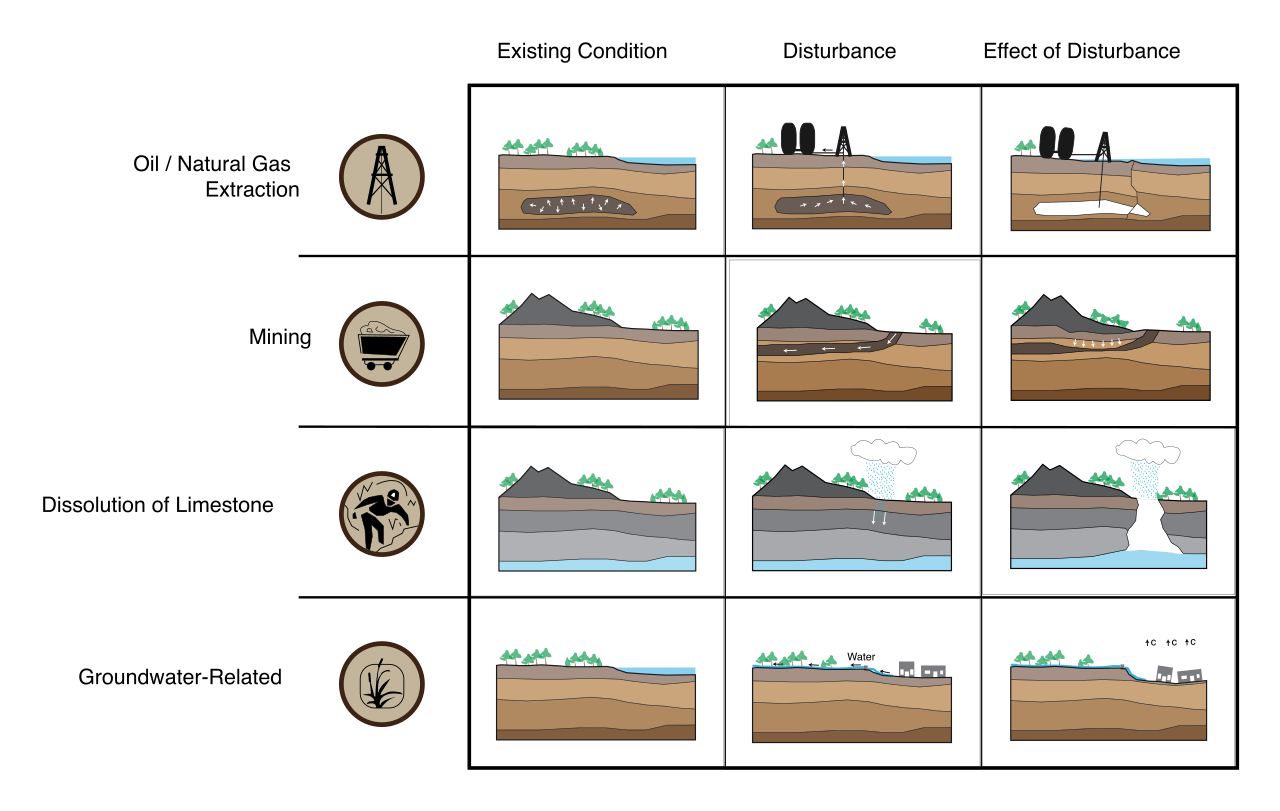
Illinois has a rich history of underground coal mining. Over decades, the wooden supports in abandoned, unmapped underground mines decay, causing the earth above to collapse. This specific phenomenon is called Mine Subsidence.

Definition: Mine subsidence is defined as lateral or vertical ground movement caused by a failure initiated at the level of a man-made underground mine.
It is vital to distinguish this from natural geological events. Mine subsidence coverage explicitly excludes ground movement caused by earthquakes, landslides, or volcanic eruptions.
The Mandatory Availability Rule
Standard property policies exclude earth movement. Because mine subsidence is a massive, localized risk in Illinois, the state intervened. The Illinois Mine Subsidence Insurance Fund provides reinsurance for mine subsidence losses to all participating insurers, ensuring the industry can bear catastrophic collapses. The Fund provides a maximum reinsurance limit of $750,000 per residence.
Illinois law mandates that insurers must make mine subsidence insurance coverage available for residences and commercial buildings. This availability mandate also extends to individuals living in shared structures; coverage must be made available for living units within a cooperative or condominium building.
The Mandatory County Mechanism
In certain designated counties with high concentrations of abandoned mines, the state takes an aggressive "opt-out" approach rather than an "opt-in" approach. In designated mandatory counties, mine subsidence coverage is automatically added to property insurance policies.
However, consumers always retain the right to control their coverage. Policyholders in mandatory mine subsidence counties have the right to waive the coverage, but they can only do so by signing a written rejection form.
Professor's Summary: As you prepare for your exam, view these regulations not as disconnected facts, but as a cohesive system. The 60-day cancellation windows protect underwriters; the 30- and 60-day notice rules protect consumers' time; the FAIR plan protects the macroeconomic stability of real estate; and the Mine Subsidence fund protects against the hidden geographical ghosts of Illinois' industrial past. Master the intent behind these laws, and the numerical facts will naturally fall into place.