Disaster Recovery Concepts
Not sure you’re ready?
Take the ~3-minute readiness diagnostic and see where you stand.
When a major arterial bridge collapses, supply chain managers do not have the luxury of pausing the world while engineers investigate the structural failure. Their immediate crisis is measured in two harsh metrics: how much cargo was lost in the river, and exactly how many hours it will take to reroute the stranded delivery trucks. In enterprise networking, hardware fails, power grids go dark, and natural storms sever fiber-optic trunks. This is a mathematical certainty. Your role as a network professional is not merely to build systems that work under ideal conditions, but to engineer resiliency so that when the inevitable catastrophe strikes, the business survives. Disaster recovery is the science of calculating acceptable loss, engineering redundant infrastructure, and rigorously proving that those backup systems will function when the primary data center goes silent.

Before we can design a redundant network, we must quantify failure. Network reliability and recovery are governed by four fundamental metrics. Two of these metrics describe the day-to-day reliability of our hardware, while the other two establish our strict operational limits during a catastrophic disaster.
Measuring Hardware Reliability: MTBF and MTTR
When you provision a core router or a storage array, you are buying a machine with physical limitations. We measure the inherent reliability of these components using Mean Time Between Failures (MTBF).
Mean Time Between Failures (MTBF) measures the predicted elapsed time between inherent failures of a network system during normal operation.
If a manufacturer states a switch power supply has an MTBF of 500,000 hours, they are applying statistical probability to the lifespan of its capacitors and circuits. Consequently, higher Mean Time Between Failures (MTBF) values indicate greater reliability of a hardware component.
However, components will eventually fail. When the NOC alarms sound, the focus shifts to Mean Time to Recovery (MTTR). MTTR represents the average time required to repair a failed network component and restore functionality. If a fan tray dies, your MTTR is the time it takes an on-site technician to recognize the alert, walk to the server rack, swap the part, and verify system cooling is restored.
Defining Disaster Thresholds: RPO and RTO
While MTBF and MTTR apply to individual components, widespread disasters require a macro-level approach. When a data center floods, the business needs to know exactly how much data was lost and when operations will resume.
Recovery Point Objective (RPO) dictates the maximum acceptable amount of data loss during a disaster.
Think of RPO as looking backward in time from the moment of failure. RPO is measured as a specific unit of time prior to the disaster event. If a financial institution performs database snapshots every four hours, their RPO is four hours. In the worst-case scenario, up to four hours of transactions will be unrecoverable. For a bank, a four-hour RPO might be catastrophic, demanding a multi-million dollar upgrade to achieve synchronous, zero-loss replication.
Recovery Time Objective (RTO) dictates the maximum acceptable amount of downtime for a network service.
If RPO looks backward at data loss, RTO looks forward at system restoration. RTO defines the exact time frame within which a system must be fully restored after an outage. If an e-commerce platform has an RTO of two hours, the network engineering team has exactly 120 minutes from the moment of the outage to spin up backup systems, re-route DNS, and process customer traffic before violating their Service Level Agreement (SLA).
To meet aggressive RTO and RPO metrics, organizations lease or build secondary data centers. The level of readiness at these secondary locations dictates how quickly the network can recover, scaling across three distinct tiers: Cold, Warm, and Hot.
Cold Sites
A cold disaster recovery site provides physical building space, power, and environmental cooling. Crucially, a cold disaster recovery site does not contain pre-installed computer hardware or active network data links. It is an empty, conditioned shell.
If your primary data center is destroyed, your team must order new servers, wait for shipping, rack the hardware, pull the cables, install the operating systems, and download backups from off-site storage. Because of this monumental logistical effort, restoring operations at a cold site typically requires days or weeks to procure equipment and restore data. It is highly cost-effective, but demands an incredibly forgiving RTO.
Warm Sites
A warm disaster recovery site contains pre-installed server hardware and network infrastructure. The racks are bolted down, the switches are cabled, and the WAN circuits are active. However, the data is stale.
A warm disaster recovery site requires administrators to load recent data backups before assuming production operations. Because the physical foundation is already laid, restoring operations at a warm site typically requires several hours to a few days. It serves as an excellent middle ground, offering a reasonable RTO without the staggering costs of real-time synchronization.
Hot Sites
For mission-critical enterprises, minutes matter. A hot disaster recovery site maintains an exact, fully operational replica of the primary network infrastructure.
Unlike warm sites, a hot site uses continuous data replication to maintain real-time synchronization with the primary data center. If a user updates a file in the primary facility, that change is immediately replicated over a dedicated fiber link to the hot site. Because the secondary site is a mirror image holding live data, restoring operations at a hot site typically takes only minutes to complete.
| Site Type | Hardware Installed? | Data Status | Typical RTO | Cost Profile |
|---|---|---|---|---|
| Cold | No (Space, Power, HVAC only) | None | Days to Weeks | Low |
| Warm | Yes | Stale (Requires manual backup load) | Hours to Days | Moderate |
| Hot | Yes | Real-time synchronized replication | Minutes | Very High |
While redundant sites protect against the loss of an entire facility, network engineers must also design internal resiliency within the data center. We achieve this by deploying network appliances (like firewalls, load balancers, or core switches) in High-Availability (HA) clusters.
Active-Passive Clusters
An active-passive high-availability cluster designates one primary node to handle all live network traffic. While this primary node works, the cluster maintains at least one secondary node in a dormant standby state. The standby node continuously monitors the health of the primary through a mechanism known as a "heartbeat" link.
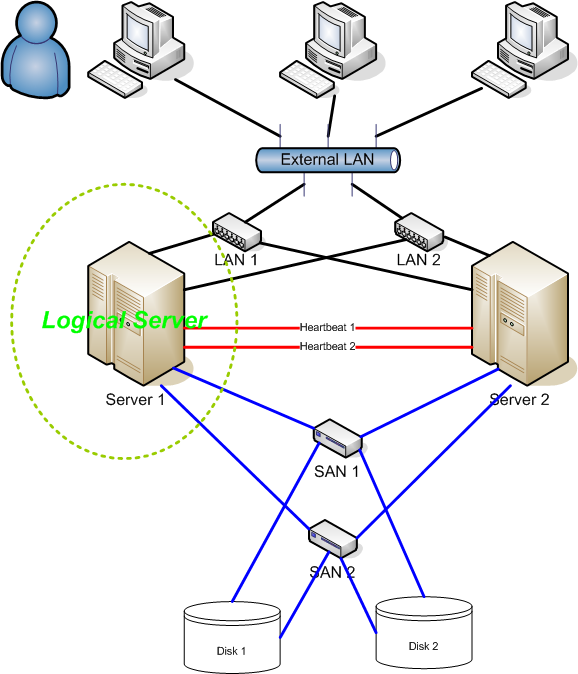
If someone unplugs the primary firewall, the heartbeat drops. A standby node in an active-passive setup automatically assumes network operations upon detecting a primary node failure. This hand-off—where MAC addresses and IP routing responsibilities migrate from the dead appliance to the standby appliance—is precise and programmatic. The transition process from a failed primary node to a standby secondary node is called failover.
Active-Active Clusters
By contrast, an active-active high-availability cluster distributes network traffic simultaneously across multiple operational nodes. You are paying for two expensive firewalls; an active-active setup ensures both are working for you right now.
However, because both nodes are processing live traffic simultaneously, active-active configurations require load balancing mechanisms to distribute incoming requests among participating nodes. If one node fails in an active-active setup, the remaining nodes must have enough overhead capacity to absorb the newly orphaned traffic.
A disaster recovery plan written in a binder but never tested is not an engineering solution; it is a liability. Network administrators validate their resiliency strategies through a graduated progression of testing methodologies, stepping carefully from theoretical discussion to full-scale simulated catastrophe.
Tabletop Exercises
You do not begin testing a DR plan by pulling power cords. A tabletop exercise involves stakeholders verbally walking through the disaster recovery plan step-by-step in a conference room setting. The team is presented with a scenario—for instance, a ransomware infection crippling the core storage array—and personnel must explain exactly who they would call, which runbooks they would open, and what commands they would issue. This exposes procedural logic gaps without risking a single byte of live data.

Disaster Recovery Simulations
Once the theory holds up in a conference room, we move to technical verification. A disaster recovery simulation tests specific recovery procedures in an isolated environment without affecting live production systems. A technician might be tasked with restoring yesterday's SQL database backup to an isolated VLAN. This proves the data is actually restorable and that the IT staff knows how to operate the backup software.
Parallel Testing
Parallel disaster recovery testing involves spinning up secondary systems to ensure functionality alongside uninterrupted primary production systems. In this scenario, the hot or warm site is brought fully online, and administrators inject test traffic to verify that routing, authentication, and application servers operate exactly as expected at the secondary location. Production traffic remains completely unaffected at the primary site.
Full Failover Testing
Finally, there is the ultimate proof of resiliency. A full failover test involves intentionally shutting down the primary site to verify the secondary site can handle the live production workload. This is a high-stakes, planned event—often executed at 2:00 AM on a Sunday. By forcing the network into a failover state, you definitively prove that your load balancers will redirect user traffic, your active-passive clusters will transition seamlessly, and your hot site will bear the exact capacity of your real-world users.
When your full failover test succeeds, you have transitioned your network from theoretical resilience to proven operational survival.