Discharge, Breach, and Frustration
A ship is chartered to carry cargo, the charterer discovers the vessel's engine room is undermanned and the crew incompetent, and by the time the vessel is finally seaworthy nineteen weeks of a two-year charter have been lost to repairs. Is that failure so serious that the charterer can walk away, or merely a defect to be compensated in damages while the voyage continues? The English courts spent a century building a doctrinal machine to answer exactly this question — and the answer turns out to depend not on labels fixed at the moment of contracting, but on what the breach actually costs the innocent party in real terms. That machine is the law of discharge: the rules that tell us when a contract's obligations come to an end, and what each party is entitled to once they do.
The cleanest way a contract ends is also the most common: both sides do exactly what they promised. Discharge by performance occurs when both parties have fully and exactly carried out their contractual obligations — nothing remains owing, nothing remains undone, and the contract simply expires by fulfilment.
English law has historically taken an unforgiving view of what "fully and exactly" means. Under the entire obligations rule, certain contracts require complete and precise performance before any payment becomes due at all — a builder who finishes 95% of a house gets nothing until the last brick is laid, because the obligation is entire rather than divisible. This can produce brutally unfair results, which is why equity and later case law carved out the doctrine of substantial performance: a party who has performed most of an obligation may still claim the contract price, subject to a deduction for defects. Crucially, the deduction is calibrated to the cost of remedying the defect, not the full contract price — the substantially-performing party is not disqualified from payment altogether, they simply pay for what they failed to deliver. A client under SQE1's applied lens should think of this as the difference between a client who gets nothing for a near-complete job and one who gets paid, minus repair costs.
Parties are as free to unmake a contract as they were to make it. Discharge by agreement happens where both parties agree to release each other from remaining obligations. But contract formation rules do not evaporate just because the parties are ending rather than starting a relationship: discharge by agreement requires fresh consideration from both sides, unless the release is made by deed, in which case the formality of the deed substitutes for consideration.
Where the release is packaged with new consideration for giving it up, lawyers call this accord and satisfaction — the accord is the agreement to discharge, and the satisfaction is the consideration that supports the release. A subtler problem arises where the obligations are one-sided: if only one party still has anything left to perform, releasing that party from the remaining duty requires either consideration flowing the other way or execution of a deed, because a bare promise to forgive a debt is otherwise unenforceable for want of consideration.
Parties can also build their own exit ramp into the contract itself. A condition subsequent is a term that automatically discharges the parties on the occurrence of a specified future event — for example, a lease that terminates automatically if planning permission is refused. No breach, no election, no drama: the trigger fires and the contract ends by its own terms.

This is the doctrinal heart of the topic, and the one most heavily tested at SQE1 because it turns on classification, not just facts. Discharge by breach occurs where a party fails, without lawful excuse, to perform an obligation the contract requires. But here is the counterintuitive rule that trips up every student on first encounter: an ordinary breach of contract does not by itself terminate the contract. Only a repudiatory breach gives the innocent party the right to terminate. Every other breach simply generates a damages claim while the contract itself lives on.
So what makes a breach repudiatory? English law answers this by classifying contractual terms into three tiers, and the tier a term belongs to dictates the remedy available when it is broken.
| Term type | Definition | Remedy on breach |
|---|---|---|
| Condition | A term so central to the contract's purpose that its breach undermines the whole point of the bargain | Terminate and claim damages |
| Warranty | A term of lesser importance, collateral to the main purpose | Damages only — no right to terminate |
| Innominate term | A term whose classification is undetermined in advance; the remedy depends on the seriousness of the actual consequences of breach | Terminate only if the breach deprives the innocent party of substantially the whole benefit of the contract |
Hong Kong Fir Shipping Co Ltd v Kawasaki Kisen Kaisha Ltd (1962) established the innominate term category. The charterparty required the vessel to be "seaworthy," but the Court of Appeal refused to treat seaworthiness as an automatic condition — instead it asked whether the actual delay caused by the unseaworthiness (nineteen weeks lost to repairs, out of a two-year charter) deprived the charterer of substantially the whole benefit of the contract. It did not, so only damages were available, not termination.
This innominate-term analysis is what elevates SQE1 questions above rote memorisation: you cannot simply label a term "condition" or "warranty" from the contract's wording alone. You must ask whether the parties intended automatic classification, and if the term is innominate, you must look at what the breach actually did before you can advise a client whether they may walk away.
Ways of Committing Repudiatory Breach
A repudiatory breach does not require a single dramatic act; the law recognises several routes to the same conclusion:
- Renunciation — a party clearly demonstrates, by words or conduct, an intention not to perform its obligations at all.
- Disabling performance — a party commits repudiatory breach by disabling itself from performance, for example by selling or destroying the very goods that are the contract's subject matter, so that performance becomes impossible by the breaching party's own act.
- Anticipatory breach — a party indicates before the due date for performance that it will not perform. This is repudiatory even though the performance date has not yet arrived.
Hochster v De La Tour (1853) held that where a party anticipatorily repudiates, the innocent party need not wait helplessly for the performance date to pass before suing — they may accept the repudiation and sue for damages immediately. This is a favourite exam trap: students assume a claim can only arise once the breach date has actually arrived, but anticipatory breach lets the clock start running early.
The Innocent Party's Election
Once a repudiatory or anticipatory breach has occurred, the innocent party faces a binary choice, and SQE1 scenarios are built to test whether candidates spot which option was actually exercised.
- Accept the repudiation and terminate — the contract ends, future obligations are discharged, and the innocent party can sue for damages.
- Affirm the contract — the innocent party treats the contract as continuing, remains bound by their own future obligations, and forgoes the right to terminate for that breach (though not necessarily the right to damages).
Acceptance is not passive. It must be communicated clearly and unequivocally to the party in breach — silence or ambiguous conduct will not suffice, because the breaching party is entitled to know where they stand.
White and Carter (Councils) Ltd v McGregor (1962) confirmed that an innocent party with a legitimate interest in performing may affirm the contract and continue performance without needing the other party's cooperation, effectively forcing the contract to run its course and preserving the full contract price rather than a discounted damages claim. This case is regularly used to test whether students understand that affirmation is a genuine, sometimes commercially aggressive, choice — not a fallback.
Affirmation, once made, is not the end of the innocent party's risk. Two further doctrines can strip away the right to terminate even after a clear repudiatory breach:
- Waiver by estoppel — if the innocent party's own conduct leads the breaching party reasonably to believe the breach will not be relied upon, the right to terminate can be lost.
- Delay as affirmation — unreasonable delay in electing to terminate can itself be treated as affirmation, because silence over time starts to look like acceptance of the status quo.
The Consequences of Termination for Breach
Termination for breach is not a time machine; it does not unwind the contract from the beginning. It operates prospectively — discharging future obligations while leaving already-accrued rights and liabilities untouched. An accrued right, such as an entitlement to be paid for work already completed before termination, survives the termination intact. And critically, a party who validly terminates for repudiatory breach does not forfeit their damages claim — they remain entitled to sue for losses caused by the breach, on top of being freed from further performance.
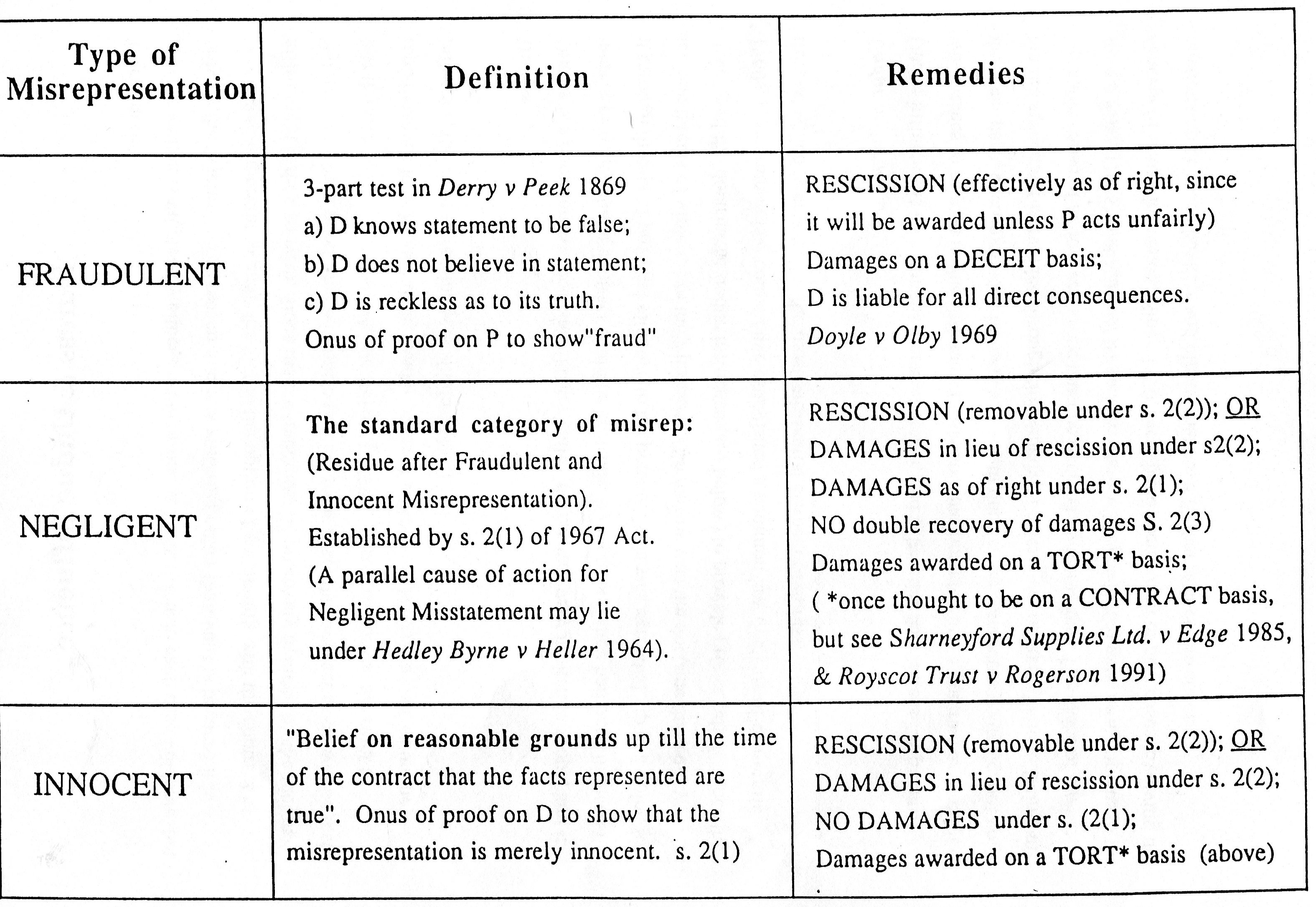
This prospective character is what distinguishes termination for breach from rescission for misrepresentation, a comparison SQE1 loves to test. Rescission for misrepresentation unwinds the contract retrospectively, as if it never existed (subject to bars to rescission); termination for breach only discharges what remains to be done, leaving the past performance and its consequences in place.
Frustration is the law's answer to a genuinely different problem: not a party's failure to perform, but an external event that makes the bargain the parties actually struck impossible to fulfil. Frustration discharges a contract automatically where, after formation, an event occurs that renders performance impossible, illegal, or radically different from what was originally contemplated. The word "automatically" is doing real work here: unlike discharge by breach, frustration operates by operation of law, with no election required from either party — the contract simply ends the moment the frustrating event crystallises.

Taylor v Caldwell (1863) is the founding case. A music hall hired for a concert burned down before the performance date, through no fault of either party. The court held the contract was discharged: performance had become impossible, and holding the parties to an impossible bargain would be absurd.

Frustration is not confined to physical destruction. A contract can also be frustrated by supervening illegality — for instance, the outbreak of war rendering performance illegal because it would amount to trading with an enemy. And frustration can occur even where physical performance remains possible, if the entire commercial purpose underlying the contract has collapsed:
Krell v Henry (1903): a room was hired specifically to view the King's coronation procession. When the procession was cancelled due to illness, the contract was frustrated — the shared purpose (viewing the procession) had failed entirely, even though the room itself was still perfectly available.
Herne Bay Steamboat Co v Hutton (1903): by contrast, a boat hired to view a naval review and cruise around the fleet was not frustrated when the review was cancelled, because viewing the review was not the sole foundation of the contract — the boat could still be used to cruise the fleet, so the commercial purpose survived in substantial part.
These two cases are usually paired in SQE1 questions precisely because they reach opposite outcomes on similar facts: the lesson is that frustration for failure of purpose demands that the purpose was the sole foundation of the bargain, not merely one motive among several.
The Threshold Is High
Frustration is deliberately hard to establish, because the law is reluctant to let a party escape a bad bargain simply because circumstances changed.
Davis Contractors Ltd v Fareham Urban District Council (1956) held that frustration requires the obligation to become radically different from what was undertaken — not merely more onerous, more expensive, or less profitable. A building contract that became far more costly and slower than expected due to labour shortages was not frustrated; the contractor had simply made a bad bargain on a fixed price.
This "radically different" test is the safety valve that prevents frustration becoming an escape hatch for ordinary commercial risk. A contract is not frustrated merely because subsequent events make performance more expensive or commercially less attractive for one side — that risk is treated as allocated by the bargain itself.
Bars to Frustration
Even where an event genuinely disrupts performance, frustration will not be available in several recognised situations:
- Foreseeability — frustration cannot be relied upon where the event was reasonably foreseeable and could have been provided for expressly in the contract. If the parties could have anticipated the risk and chosen not to address it, the law will not rescue them from that choice.
- Self-induced frustration — where the frustrating event results from a party's own choice, election, or default, that party cannot rely on frustration; the doctrine exists for external shocks, not self-inflicted wounds.
Maritime National Fish Ltd v Ocean Trawlers Ltd (1935): a charterer needed a fishing licence to operate a trawler but had only a limited number of licences to allocate across its fleet. It chose to allocate the licences to its own vessels rather than the chartered one. The court held frustration could not be relied on, because the charterer's own allocation decision — not an external event — caused the vessel to become unusable under the licensing scheme.
- Express force majeure clauses — frustration does not apply where the contract already contains an express force majeure clause covering the event that occurred; the parties have already allocated that risk by agreement, so the common law doctrine has no gap to fill.
Frustration is also not limited to contracts for goods or services. National Carriers Ltd v Panalpina (Northern) Ltd (1981) confirmed that even a lease of land can in principle be frustrated in sufficiently extreme circumstances, though such cases remain rare given how much risk is normally allocated within a lease's own terms.
Frustration and the Sale of Specific Goods
A related but narrower rule applies specifically to sales of goods. Section 7 of the Sale of Goods Act 1979 provides that a contract for specific goods is avoided where the goods perish, without fault of either party, before risk has passed to the buyer. This is a statutory analogue to Taylor v Caldwell, tailored to the sale-of-goods context and triggered by risk allocation rather than the general frustration test.
Once a contract is frustrated, someone may have already paid money, done work, or delivered value under a bargain that has now collapsed through nobody's fault. Because frustration is fault-free, ordinary damages are not available — you cannot sue someone for an event that was nobody's doing. Instead, Parliament stepped in with a bespoke statutory regime.

The Law Reform (Frustrated Contracts) Act 1943 governs the financial consequences between the parties where an English law contract has been frustrated.
Its key provisions repay memorisation, because SQE1 tests them at the level of specific subsections:
| Provision | Effect |
|---|---|
| s.1(2) | Sums paid before the frustrating event are recoverable; sums due but unpaid cease to be payable. The court may also permit a payee to retain or recover expenses incurred before the frustrating event, out of sums paid or payable. |
| s.1(3) | Where a party has conferred a valuable non-monetary benefit on the other party before the frustrating event, that party may recover a just sum for the benefit conferred. |
| s.2(3) | The parties may exclude or modify the Act's provisions by express agreement in their contract. |
| s.2(5) | Excludes most charterparties, contracts for carriage of goods by sea, and contracts of insurance from the Act — though a time charterparty or a charterparty by way of demise is not excluded and remains subject to the Act. |
The s.2(5) carve-out is a classic trap: candidates assume "charterparty" is a single excluded category, but the exclusion is narrower than it looks, and the two named exceptions (time charterparties and demise charterparties) pull back into the Act's scope.
Frustration is not the only route by which a failed contract raises restitutionary questions. More broadly, restitution on termination aims to reverse an unjust enrichment wherever a benefit was conferred under a contract that has since failed — whether that failure comes from breach, frustration, or another route to discharge. A claim in unjust enrichment requires three elements: the defendant was enriched, that enrichment came at the claimant's expense, and the circumstances are ones the law treats as unjust.
Two specific restitutionary remedies recur throughout SQE1 contract scenarios:
- Total failure of consideration allows a payer to recover money paid under a contract where none of the bargained-for performance has actually been received — if you paid a deposit for a service that never happened at all, you can recover the deposit in full.
- Quantum meruit allows a party to recover reasonable payment for work done outside a contract altogether, or for work done after the contract has already been discharged — a useful remedy where the entire-obligations rule or a repudiatory breach would otherwise leave a party unpaid for real value delivered.
One further wrinkle deserves separate treatment because it interacts with the condition/warranty/innominate framework above: the treatment of time limits. Ordinarily, a time stipulation might be treated as an innominate term or even a warranty. But making time of the essence elevates a time stipulation to the status of a condition, meaning late performance itself amounts to repudiatory breach, triggering the innocent party's right to terminate regardless of how minor the actual delay turns out to be.
Where time was not originally of the essence, a party is not stuck with an indefinite waiting game. That party may serve notice fixing a reasonable new deadline and thereby making time of the essence for future performance — converting what was previously a matter for damages only into a condition whose breach permits termination.
SQE1 examiners test this topic by presenting a scenario and asking which of the four routes to discharge is engaged, and then what follows from that classification. Keep the map firmly in view: discharge by breach, agreement, performance, and frustration are the four principal recognised routes by which a contract can come to an end, and each carries its own consequences.
- Performance and agreement are typically clean exits, contested only over entire obligations, substantial performance, or the need for consideration/deed.
- Breach requires you to classify the term (condition, warranty, or innominate) before you can say whether termination — not just damages — is available, and then to track the innocent party's election between acceptance and affirmation.
- Frustration is automatic, fault-free, and narrow — barred by foreseeability, self-inducement, or an existing force majeure clause — and triggers the Law Reform (Frustrated Contracts) Act 1943's specific financial regime rather than ordinary damages.
- Underlying all of this, restitutionary principles (unjust enrichment, total failure of consideration, quantum meruit) provide a safety net wherever a contract's collapse would otherwise leave one party holding a benefit they never bargained to keep.
Master the classification questions — condition vs warranty vs innominate term, and frustration vs mere hardship — and the remedy questions answer themselves.