Creation of Express Trusts
A settlor can say almost anything and mean almost anything by it — "I want you to have this," "look after this for the kids," "this is as much yours as mine" — and only some of those sentences create a trust. The law's task in this topic is to sort genuine, binding trust obligations from gifts that failed, wishes that were never binding, and promises equity refuses to enforce. Every SQE1 problem question on trust creation is really asking the same thing: has this arrangement cleared the hurdles the law sets for a trust to exist and to bite?
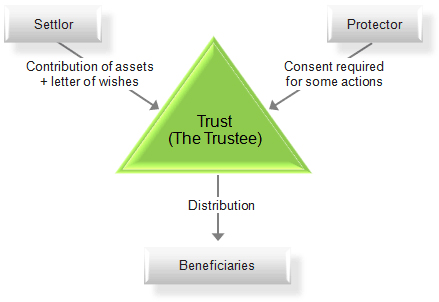
Before a trust can operate at all, it must clear a threshold test laid down in Knight v Knight: certainty of intention, certainty of subject matter, and certainty of objects. Fail any one of the three, and there is no trust — the property either stays with the person who purported to create it, results back to them, or (if a gift was intended instead) may still succeed as an outright gift if the formalities for that were met. Think of the three certainties as three separate locks on the same door; all three must turn before the trust machinery engages.
Certainty of Intention
The settlor must have shown an imperative intention to impose a binding obligation on the trustee — not a hope, not a request, not moral guidance about what "ought" to happen to the property. Courts look at substance over form: no particular form of words or technical language is required, so a document that never uses the word "trust" can still create one, and a document littered with the word "trust" can still fail if the underlying language is merely aspirational.
The dividing line is illustrated by two contrasting cases you should be able to deploy against each other in an exam answer:
Paul v Constance: A man repeatedly told his partner that money in his bank account was "as much yours as mine." Informal, unlawyerly, entirely oral — and yet the court held this showed sufficient certainty of intention to create a trust over the account, because the repeated statements evidenced a genuine, ongoing intention to hold the money for both of them.
Jones v Lock: A father, irritated that he hadn't bought his baby son a present, thrust a cheque at the child saying "I give this to baby." No trust was found. The father's words showed an intention to make an outright gift, not to hold the cheque on trust with himself as trustee — and since the gift was never properly completed (the cheque was never endorsed over), it failed entirely, with no trust to save it.
This distinction between a failed gift and a declared trust matters enormously in practice, because the two produce opposite outcomes when a transfer goes wrong: an incomplete gift simply fails and the property stays with the would-be donor, whereas a validly declared trust binds the trustee immediately regardless of any later transfer of legal title. Precatory words — mere expressions of hope, wish, or moral obligation, such as "I would like X to look after the family" — sit firmly on the gift/no-trust side of that line and do not create a trust.
Certainty of Subject Matter
Two things must be certain here, and students routinely conflate them: (1) the trust property itself must be identifiable, and (2) the beneficial shares each beneficiary is to receive must also be identifiable. A trust can fail on either ground independently.
| Case | What failed | Why |
|---|---|---|
| Palmer v Simmonds | Trust of the "bulk" of an estate | "Bulk" was too vague to identify the property |
| Sprange v Barnard | Trust of "the remaining part" of a fund after the primary beneficiary's death | No certain mechanism identified what would remain |
| Boyce v Boyce | Trust of houses to be divided between two beneficiaries by one beneficiary's "choice" | The beneficiary who was meant to choose died before choosing, so the dividing mechanism collapsed |
A trickier version of the subject-matter problem arises with unascertained tangible goods carved out of a larger bulk — a promise to hold "20 of my 100 cases of wine" on trust, for instance. Because tangible items are not interchangeable in the eyes of equity, such a trust fails unless the specific 20 cases are actually segregated from the rest. This is exactly what sank the customers in Re London Wine Co: they had paid for wine, but because their bottles were never physically separated from the general stock, no trust interest ever arose, and they ranked merely as unsecured creditors when the company collapsed.
Contrast that with intangible, fungible property. In Hunter v Moss, a declaration of trust over 50 unsegregated shares (out of a larger shareholding of the same class in the same company) was upheld, precisely because one share of a class is functionally identical to any other — there is nothing to "segregate" in any meaningful sense, so certainty of subject matter was satisfied without it.
Finally, a beneficial entitlement described in flexible but objectively ascertainable terms can still be certain. In Re Golay, a direction to provide a beneficiary with a "reasonable income" succeeded, because "reasonable" is a standard the court itself can objectively apply and quantify — unlike "bulk" or "remaining part," it isn't vague, it's just evaluative.
Certainty of Objects
The beneficiaries — the "objects" of the trust — must be identifiable with certainty, but the test for that certainty depends entirely on what kind of trust you are dealing with.
A fixed trust requires the trustees to distribute the property in shares predetermined by the settlor — the trustees have no discretion over who gets what. A discretionary trust gives the trustees discretion to decide which members of a defined class receive property, and in what proportions.
Because a fixed trust requires the trustees to calculate exact predetermined shares for every beneficiary, the certainty test is strict: the complete list test, meaning every single beneficiary must be capable of being ascertained and listed. If even one potential beneficiary cannot be identified, the trustees cannot perform their mechanical duty, and the fixed trust fails.
Discretionary trusts don't need a complete list — trustees are exercising judgment across a class, not executing a predetermined formula — so the House of Lords in McPhail v Doulton adopted a more forgiving test: the "is or is not" test. The question is simply whether it can be said with certainty that any given individual is or is not a member of the class. You don't need to be able to draw up the whole list; you just need a rule sharp enough to sort any candidate in or out.
Applying the "is or is not" test surfaces a further distinction that examiners love to test:
- Conceptual certainty asks whether the words describing the class have a clear meaning (e.g., "my employees" is conceptually clear; "my good friends" arguably is not).
- Evidential uncertainty is a different, lesser problem — the practical difficulty of proving whether a particular real person falls within an otherwise conceptually clear class. Evidential uncertainty alone does not invalidate a discretionary trust, because it goes to proof, not to the meaning of the class itself.
Even a conceptually and evidentially certain class can still sink a discretionary trust on a separate, administrative ground: administrative unworkability. If the class is so large or so hopelessly wide that no trustee could sensibly exercise discretion over it, the trust fails regardless of how clearly the class is defined. The classic illustration is R v District Auditor, ex parte West Yorkshire Metropolitan County Council, where a trust for the benefit of "any or all of the inhabitants" of West Yorkshire — a class of roughly 2.5 million people — was struck down as administratively unworkable. Related but distinct is capriciousness: a trust can also fail if the settlor's choice of beneficiaries has no rational connection to the settlor's own affairs or purposes (imagine a trust for "all the tall people in London"), because such a class gives trustees nothing sensible to exercise judgment about.
What a Discretionary Beneficiary Actually Has
Before the trustees exercise their discretion, a beneficiary under a discretionary trust has no proprietary interest in any specific trust property — you cannot point to an asset and say "that's mine" until the trustees choose to appoint it to you. What the beneficiary does have is a right to be considered: the trustees must genuinely turn their minds to whether that beneficiary should receive a distribution, even if the ultimate answer is no.
One further consolidating point ties fixed and discretionary trusts back together: both still require certainty of intention and certainty of subject matter in exactly the same way as any other express trust — the complete-list versus is-or-is-not distinction only affects the objects certainty. Once the beneficiaries of a discretionary trust are, between them, of full age and capacity and together absolutely entitled to the whole beneficial interest, they can invoke the rule in Saunders v Vautier to collapse the trust early and direct the trustees to transfer the property straight to them — a useful escape valve to remember when a client asks "can we just end this trust now?"
Assuming the three certainties are satisfied, the next question is whether the trust was created in a way the law recognises as formally valid — and here, everything turns on what kind of property is being put into trust.
Personal property (money, shares, most chattels) is the simplest case: a trust of personal property can be created orally or by conduct, with no writing requirement at all. This is exactly why Paul v Constance succeeded on the facts — spoken words about a bank account were enough.
Land is different, and this is where students most often lose marks by conflating two distinct statutory formalities:
Section 53(1)(b) of the Law of Property Act 1925: A declaration of trust of land must be "manifested and proved" by signed writing. Crucially, the trust itself can still be created orally — what the statute demands is that written, signed evidence of that oral declaration exists. Get the order right: the oral declaration is valid law from the moment it's made; the writing is proof, not the act of creation itself.
Section 53(1)(c) of the Law of Property Act 1925: A disposition of a subsisting equitable interest must be in writing, signed by the person disposing of it (or their authorised agent).
The key skill is telling these two provisions apart on the facts. Section 53(1)(b) governs a settlor first declaring a trust of land. Section 53(1)(c) governs the different situation of a beneficiary who already has an equitable interest under an existing trust dealing with that interest — assigning it, gifting it, or directing the trustees to hold it for someone else. If a client is the original settlor putting their house into trust, think 53(1)(b); if a client already holds a beneficial interest and wants to pass it on, think 53(1)(c).
A trust of land that lacks the section 53(1)(b) writing is not automatically void — it is merely unenforceable. The trust exists in principle; the beneficiary simply cannot enforce it in court without the required signed evidence coming into existence.
One further exemption is essential to know cold: section 53(2) carves out resulting, implied, and constructive trusts entirely from these writing formalities. Section 53(1)(b) and (c) exist to prevent fraud in the deliberate, express creation or transfer of interests — they have no work to do where a trust arises automatically by operation of law rather than by the parties' own express declaration.
Trusts created by will answer to yet another formality regime entirely: the trust must comply with the formalities for a valid will. Section 9 of the Wills Act 1837 requires the will to be in writing, signed by the testator (or by someone else in the testator's presence and at their direction), with that signature made or acknowledged in the presence of two witnesses present at the same time, each of whom must then also sign in the testator's presence. Miss any element of that sequence and the will — and any trust it purports to create — fails.
Certainty and formality get a trust off the ground conceptually, but a trust only becomes enforceable once it is constituted — meaning legal title to the trust property has actually, validly landed either in the hands of the trustee, or the settlor has validly declared themselves trustee of property they already own. An incompletely constituted trust is not merely weak; it is unenforceable by the beneficiaries entirely, no matter how clear the settlor's intention was.
Milroy v Lord sets out the three routes by which a settlor can benefit an intended beneficiary:
- An outright transfer of the property to the beneficiary as a gift.
- A transfer to trustees to hold on trust for the beneficiary.
- A self-declaration of trust, where the settlor keeps the legal title but declares themselves trustee for the beneficiary.
The rule in Milroy v Lord is unforgiving about mixing these up: if a settlor attempts one mode and it fails — say, an attempted outright transfer that was never legally completed — the court will not rescue it by treating the failed attempt as if the settlor had instead chosen a different mode, such as reinterpreting a botched gift as a self-declaration of trust. This is the doctrinal engine behind two maxims you should be able to state precisely:
"Equity will not assist a volunteer": a person who gave no consideration cannot compel completion of an incompletely constituted trust, or completion of an imperfect gift. "Equity will not perfect an imperfect gift": equity will not simply relabel a failed outright gift as a trust in the donee's favour to save it.
The flip side is equally important for advising trustees: once a trust is properly constituted, it binds the trustee immediately and completely — even though the beneficiaries paid nothing and gave no consideration for it whatsoever. Constitution, not consideration, is what makes a trust enforceable.
Transferring Legal Title: The Method Depends on the Asset
Because constitution turns on whether legal title has actually moved, you need to know the correct transfer mechanism for each asset type a client might bring you:
| Asset | How legal title transfers |
|---|---|
| Land | Deed complying with formality requirements, then registration at HM Land Registry (where title is registered) |
| Shares | Executing a stock transfer form and registering the transfer with the company |
| Chattels | Deed of gift, or physical delivery coupled with intention to transfer ownership |
| Chose in action (e.g. a debt) | Written notice of the assignment given to the debtor |
The Re Rose Exception and Its Descendants
The strict Milroy v Lord logic can feel harsh where a donor has done almost everything required and only some external administrative step remains outstanding. Re Rose carved out the first crack in that strictness: where a donor has executed a valid stock transfer form and has done everything within their own power to transfer shares, the transfer is treated as effective in equity from that date — even before the company completes registration, which is a step entirely outside the donor's control.

This "everything in the donor's power" logic was exported beyond shares in Mascall v Mascall, where the same principle applied to a transfer of registered land: once the donor had executed the transfer deed and handed over the land certificate, the transfer was effective in equity even though HM Land Registry had not yet registered it.
Pennington v Waine then pushed the exception further, and more controversially. The Court of Appeal held that a gift of shares could take effect in equity even though the donor had not done everything within her power to complete the transfer, because it would have been unconscionable for the donor to recall the gift on the facts (the donee had, in reliance, already agreed to become a company director). This shifts the test from a mechanical "did the donor do everything they could?" to a more flexible, fact-sensitive unconscionability enquiry — useful to flag in an answer as a doctrinal expansion, and one that has attracted academic criticism for its unpredictability.
A separate, narrower exception applies where the donor is one of several trustees. In T Choithram International SA v Pagarani, the House of Lords held that a gift to a trust of which the donor was already one of several trustees took effect immediately on the donor's clear declaration, because equity does not require some further formal transfer from a person to themselves acting jointly as a co-trustee — the property was already vested, in part, in the right hands.
Perfecting Gifts Through Death: Strong v Bird
A different escape route from an imperfect lifetime gift arises not from equity's flexibility during the donor's life, but from a fortunate coincidence at death. Under the rule in Strong v Bird, an imperfect lifetime gift is perfected if three things line up: (1) the donor intended an immediate gift, (2) that intention continued unchanged right up to the donor's death, and (3) the intended donee is subsequently appointed as the donor's executor. Legal title to the asset vests in the executor by operation of the administration of the estate, and because that person was always meant to have the property as donee, equity lets the intended gift stand rather than forcing them to hand the asset back to the estate they are administering.
Re Ralli's Will Trusts stretched this rule one step further: the perfecting mechanism also works where the intended donee later becomes a trustee of the donor's estate, rather than an executor. The underlying logic is identical — title has landed, by operation of law, in the hands of the very person the donor always meant to benefit, so equity sees no reason to unwind it.
Covenants to Settle Future Property
Finally, watch for a client who has promised — by deed or covenant — to settle property they do not yet own onto trust once they acquire it. A covenant to settle after-acquired or future property does not, by itself, create a trust of that property: a trust cannot attach to an asset the settlor does not yet own, so there is nothing for the trust obligation to bite on until the property actually arrives. And because the intended beneficiary under such a covenant is typically a volunteer, they generally cannot obtain specific performance or damages in equity to compel the settlor to perform the covenant once the property is acquired — this is "equity will not assist a volunteer" doing its work again, this time in the context of a broken promise about the future rather than a botched immediate transfer.
A useful way to interrogate any SQE1 trusts problem is to run through the checks in sequence: Is there certainty of intention (imperative words, not precatory ones)? Is the subject matter — and each beneficiary's share — identifiable? Are the objects certain under the right test for a fixed or discretionary trust? Were the correct formalities followed for that type of property? And, finally, has the trust actually been constituted — has legal title moved, or has the settlor validly declared themselves trustee? A trust that stumbles at any one of these stages is not a trust at all, however clearly everyone understood what the settlor "meant" to do — and knowing precisely where an arrangement fails, and whether an exception like Re Rose, Pennington, Choithram, or Strong v Bird might rescue it, is exactly the applied judgment SQE1 is testing.