Statutory Interpretation
Words on a page cannot anticipate every fact pattern that will later be thrown at them, and a shopkeeper who puts a flannel shirt in a window is not, in ordinary commercial parlance, "offering" that shirt for sale — she is inviting customers to come in and make her an offer. That distinction between an invitation to treat and an offer is precisely why the flick knife displayed in a shop window in Fisher v Bell (1961) never triggered the offence of "offering for sale" an offensive weapon under the Restriction of Offensive Weapons Act 1959: the shopkeeper walked free, and Parliament had to amend the statute to close the gap. That single case is the cleanest illustration in English law of a much larger problem you will confront constantly in practice: legislation is drafted in general language, but disputes arrive in specific, often unforeseen, shapes. Statutory interpretation is the disciplined method by which courts bridge that gap, and SQE1 tests it because every piece of client advice you give is, at bottom, an argument about what a statutory provision means.

English courts have never settled on a single theory of interpretation. Instead, they have developed four overlapping approaches, and the skill tested at SQE1 is knowing which one a court will reach for and why.
The literal rule: words in a statute are given their plain, ordinary, and grammatical meaning, even if the result seems absurd or unjust to a reasonable observer.
The literal rule prizes certainty and respects the separation of powers — if Parliament wrote something silly, Parliament, not the judiciary, should fix it. Whiteley v Chappell (1868) shows the rule at its starkest: the defendant impersonated a dead person to cast a vote, but was acquitted of impersonating "any person entitled to vote," because a dead person cannot, in the literal sense, be entitled to vote at all. London and North Eastern Railway Co v Berriman (1946) is the rule's most notorious casualty. A railway statute provided compensation to the families of workers killed while "relaying or repairing" the track; Mr Berriman was killed while oiling the points, and the House of Lords held that oiling is neither relaying nor repairing, so his widow recovered nothing. The result was harsh, but the words were not ambiguous, so there was no legal hook on which to hang a more generous reading.

That last point is the key to understanding when courts abandon the literal rule: they need a trigger — an ambiguity, an absurdity, or a defect the literal words fail to address. This gives you three escape routes.
The golden rule permits a court to depart from the literal meaning where that meaning would produce an absurd, inconsistent, or repugnant result.
The golden rule has a narrow and a wide application, and SQE1 examiners like to test the difference.
- Narrow application: used where a word is capable of more than one literal meaning, and the court selects whichever meaning avoids absurdity. In R v Allen (1872), the word "marry" in the bigamy offence under section 57 of the Offences Against the Person Act 1861 could not, taken in its strict legal sense, ever be committed — the civil law will not recognise a second marriage as valid, so nobody could ever "marry" a second time in the literal sense. The court instead read "marry" to mean "go through a ceremony of marriage," preserving the offence's obvious purpose.
- Wide application: used where a word has only one possible literal meaning, but applying it would offend public policy, so the court modifies it anyway. Re Sigsworth (1935) is the textbook example: a son murdered his mother, who died intestate, and the literal wording of the Administration of Estates Act 1925 would have let him inherit her estate. The court refused to let a murderer profit from his crime and read in an implicit exception, even though the statutory language contained no such qualification.

Adler v George (1964) sits at the boundary between narrow and wide application and is worth knowing precisely because it is contestable: the Official Secrets Act 1920 made it an offence to obstruct a member of the armed forces "in the vicinity of" a prohibited place, and the defendant had been arrested inside the prohibited place itself. Reading "in the vicinity of" literally would have created the absurd result that being near the prohibited place was an offence but being inside it was not, so the court extended the phrase to cover being physically inside as well as nearby.
The mischief rule directs a court to identify the defect or "mischief" in the law that the statute was enacted to remedy, and to interpret the statute so as to suppress that mischief and advance the remedy.
This is the oldest of the interpretive approaches, tracing to Heydon's Case (1584), which set out four questions any court applying the rule should ask: what was the state of the common law before the Act; what was the mischief and defect for which the common law did not provide; what remedy Parliament resolved and appointed to cure it; and what is the true reason for that remedy. Smith v Hughes (1960) is the rule in action: prostitutes soliciting from windows and balconies were convicted under the Street Offences Act 1959 of soliciting "in a street," even though they were not literally standing in the street, because the mischief Parliament targeted was solicitation visible to and disturbing the public — a mischief just as present when projected from a window as from the pavement.
The purposive approach requires a court to interpret legislation in the manner that best achieves Parliament's underlying policy objective, going beyond identifying a single historical mischief to ask what the legislation as a whole is for.
The purposive approach is the modern preferred method, and you should present it that way in any SQE1 answer: today's courts are far more willing to ask "what was this Act trying to achieve?" than to hunt for a narrow historical defect. It is applied with particular vigour to legislation implementing EU-derived or human rights obligations, where a narrow mischief-based reading risks defeating a broader legislative scheme.
None of these four approaches operates in isolation. Courts apply a rough hierarchy: start with the literal rule, and only turn to the golden rule, mischief rule, or purposive approach where the literal meaning is genuinely ambiguous or produces an unacceptable result. A well-structured SQE1 answer walks through that hierarchy explicitly rather than picking a favourite rule and asserting it applies.
| Approach | Trigger for use | Core question |
|---|---|---|
| Literal | Default starting point | What do the words say? |
| Golden (narrow) | Word has multiple literal meanings | Which meaning avoids absurdity? |
| Golden (wide) | Single meaning offends public policy | Should the meaning be modified anyway? |
| Mischief | Literal meaning fails to cure the defect | What gap was Parliament closing? |
| Purposive | Modern default for broad legislative schemes | What is the Act trying to achieve overall? |
Whichever approach a court favours, it does not read the disputed words in a vacuum. It has recourse to aids to construction, split into intrinsic and extrinsic sources.
Intrinsic aids are found within the statute itself: the long title, the short title, any preamble, section headings, and — critically — the Act's own interpretation or definitions section. The long title may be used to identify the general purpose and scope of the legislation, giving a court a quick orientation to what the Act is for before it construes a specific provision. Where a statute defines a term for itself, that definition takes precedence over the ordinary dictionary meaning whenever the term is used in that statute — you should always check for a definitions section before reaching for a dictionary. Headings and punctuation may also be considered, but only as a soft aid: they cannot override the plain meaning of the operative words of a section, since headings are drafting conveniences, not enacted substantive text.

Extrinsic aids are sources found outside the statute: dictionaries contemporary with the enactment (useful for recovering what a word meant to the drafters, not what it means today), earlier case law, other statutes dealing with the same subject matter, international treaties, and Hansard — the official record of parliamentary debates. Black-Clawson International Ltd v Papierwerke Waldhof-Aschaffenburg AG (1975) confirmed that reports of the Law Commission, Royal Commissions, or similar advisory bodies may be consulted to identify the mischief a statute was designed to address, even though the reports themselves are not law. Similarly, explanatory notes published alongside a Bill or Act may guide a court on the legislation's background and objective, but — like headings — they are not part of the enacted law and cannot be used to contradict the clear words of the statute.
The most contested extrinsic aid is Hansard itself. For a long time courts refused to look at parliamentary debate at all, on the view that it was constitutionally inappropriate to scrutinise what individual members of Parliament said rather than what Parliament as a body enacted. That changed with Pepper (Inspector of Taxes) v Hart (1993), where the House of Lords held that Hansard may be consulted as an aid to construction, but only where three conditions are all satisfied: the legislation is ambiguous or obscure (or its literal meaning leads to absurdity); a minister or the promoter of the Bill made a clear statement directed at the very point in issue; and that statement discloses the mischief the provision was aimed at or Parliament's intention. This is a narrow gateway, not a general licence to trawl Hansard for helpful soundbites, and SQE1 questions often test whether a candidate can spot that one of the three conditions is missing.
Alongside these broader aids sit three long-standing Latin maxims — rules of language rather than rules of substance — that help a court work out what a specific word or phrase means from its textual neighbours.
- Ejusdem generis ("of the same kind"): where general words follow a list of specific words belonging to the same class or genus, the general words are limited to that same class. Powell v Kempton Park Racecourse Co (1899) is the classic illustration: a statute prohibited keeping a "house, office, room, or other place" for betting. The listed items — house, office, room — were all enclosed indoor spaces, so "other place" was read as similarly confined to enclosed spaces, and an open-air betting enclosure fell outside the prohibition entirely.
- Noscitur a sociis ("it is known by its associates"): the meaning of a word is coloured by the words that accompany it in the same phrase or section — you interpret a word by the company it keeps, even without a strict list-plus-general-term structure.
- Expressio unius est exclusio alterius ("the expression of one thing is the exclusion of another"): where a list of specific items is given without any accompanying general words, items not named on the list are impliedly excluded. This is the mirror image of ejusdem generis: without a catch-all phrase to extend the list, the list is treated as exhaustive.
Courts also bring a standing set of background assumptions to every statute — presumptions that Parliament is taken to have intended unless it says otherwise in clear, express words. These matter because they shift the burden: a party arguing for the presumption's displacement must point to language clear enough to rebut it.

- Against retrospective effect: statutes are presumed not to operate retrospectively, and this presumption is applied with particular force where retrospective effect would create or increase criminal liability, or interfere with vested rights.
- In favour of mens rea: a criminal offence is presumed to require proof of a guilty mind unless Parliament has used clear words creating strict liability. Sweet v Parsley (1970) shows the presumption doing real work: the House of Lords held it applied to the offence of being "concerned in the management of premises used for smoking cannabis" under the Dangerous Drugs Act 1965, so a landlady who had no knowledge that her tenants were using the premises to smoke cannabis was not guilty, because Parliament had not clearly excluded the mental element.
- Against ousting the courts' jurisdiction: a statute is not read as removing or restricting access to the courts unless Parliament uses express and unambiguous words to that effect.
- Against binding the Crown: legislation does not bind the Crown unless it does so expressly or by necessary implication.
- Against depriving a person of property, liberty, or compensation: clear and express words are required before a statute is read as taking these away.
- Against altering the common law: Parliament is not taken to have changed existing common law beyond what is expressly stated, or necessarily implied, in the legislation.

Two further interpretive tools sit closer to statutory drafting mechanics than to judge-made presumption, but are tested in the same breath. Under the Interpretation Act 1978, unless a contrary intention appears in the statute itself, masculine words are read to include the feminine, and singular words are read to include the plural — a default drafting convention that saves every subsequent Act from spelling out "he or she" and "singular or plural" every time.
None of these aids, presumptions, or Latin maxims are freestanding rules that displace the four primary approaches above. They are tools courts reach for within whichever primary approach — literal, golden, mischief, or purposive — is otherwise in play, helping resolve exactly which meaning that approach should settle on.
The interpretive landscape shifted decisively with the Human Rights Act 1998. Section 3 requires courts, so far as it is possible to do so, to read and give effect to both primary and subordinate legislation in a way that is compatible with Convention rights — and this duty applies to legislation whenever it was enacted, including statutes passed long before the Human Rights Act itself. Section 3 goes further than the ordinary purposive approach: it can require a court to depart from the plain meaning of even clear statutory words, provided the resulting interpretation remains one the legislation can bear.

Where legislation genuinely cannot be read compatibly with Convention rights — where any compatible reading would cross from interpretation into rewriting the statute — a higher court may instead issue a declaration of incompatibility under section 4. Crucially, a section 4 declaration does not affect the continuing validity, operation, or enforcement of the legislation; it is a signal to Parliament that the law should be reconsidered, not a judicial power to strike the statute down.
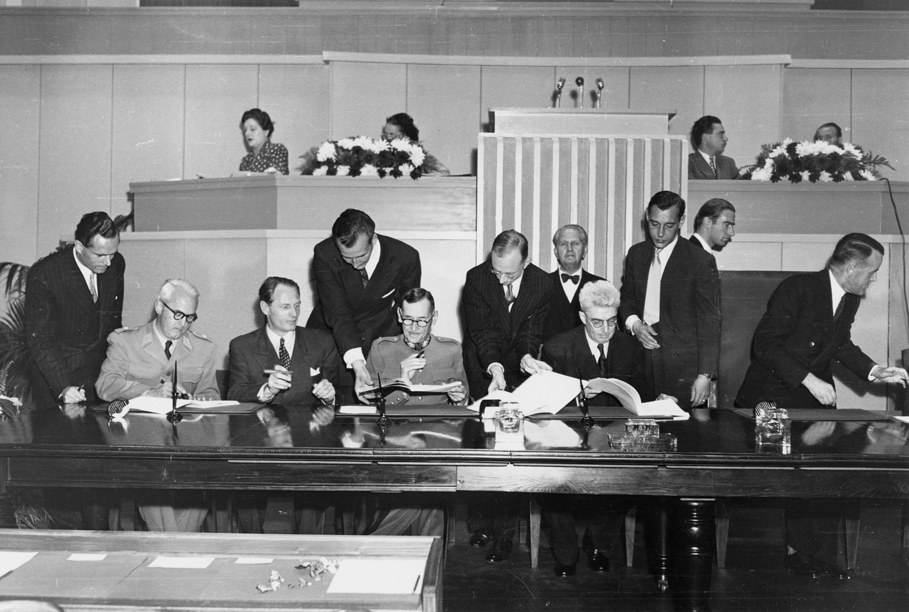
A related, though distinct, purposive obligation arises for legislation implementing an international treaty or convention: domestic courts construe such legislation consistently with the treaty's own purpose, drawing where necessary on the travaux préparatoires (the preparatory background materials to an international agreement) to recover what the treaty was designed to achieve, so that the domestic implementing statute and the international obligation it enacts do not pull in different directions.