Chemical Reactions and Solutions
Not sure you’re ready?
Take the ~3-minute readiness diagnostic and see where you stand.
The human body is not merely a vessel; it is a continuously operating chemical reactor. Every heartbeat, muscle contraction, and electrical impulse in the nervous system relies on the precise rearrangement of atoms. In clinical practice, whether you are administering an IV drip, calculating a medication dosage, or analyzing arterial blood gases, you are directly manipulating chemical reactions and solutions. To master these interventions, we must first understand the fundamental rules that govern how matter interacts, transforms, and seeks equilibrium.
To understand a chemical reaction, we must learn to read its language. A chemical equation is simply a recipe of molecular transformation.
Reactants are the starting substances in a chemical reaction, the raw ingredients. Once the transformation occurs, the new materials left on the bench are the products, which are the substances formed as a result of a chemical reaction. To show the direction of this transformation, the arrow in a chemical equation points from the reactants to the products.
But the universe keeps a strict ledger. The Law of Conservation of Mass states that matter is neither created nor destroyed in a chemical reaction. If you start with 100 grams of material, you must end with 100 grams of material. Consequently, the total mass of the reactants must equal the total mass of the products in a closed system (a system where nothing escapes into the environment).
To reflect this reality on paper, we must balance our equations. A balanced chemical equation has an equal number of atoms for each element on both sides of the equation.
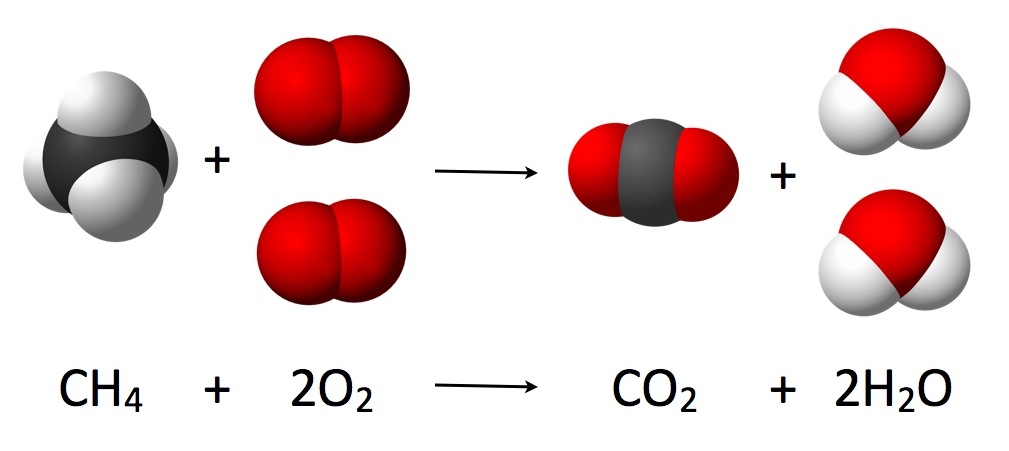
How do we balance them?
- Chemical equations are balanced by adding numerical coefficients in front of chemical formulas. (Think of this as changing the number of molecules).
- Subscripts within a chemical formula cannot be changed when balancing a chemical equation. (Changing a subscript changes the actual identity of the molecule. H₂O is water; H₂O₂ is hydrogen peroxide—one you drink, the other bleaches hair. Never touch the subscripts.)
Matter recombines in predictable patterns. We classify these reactions by how the atoms reorganize themselves.
| Reaction Type | The Mechanism | Example / Analogy |
|---|---|---|
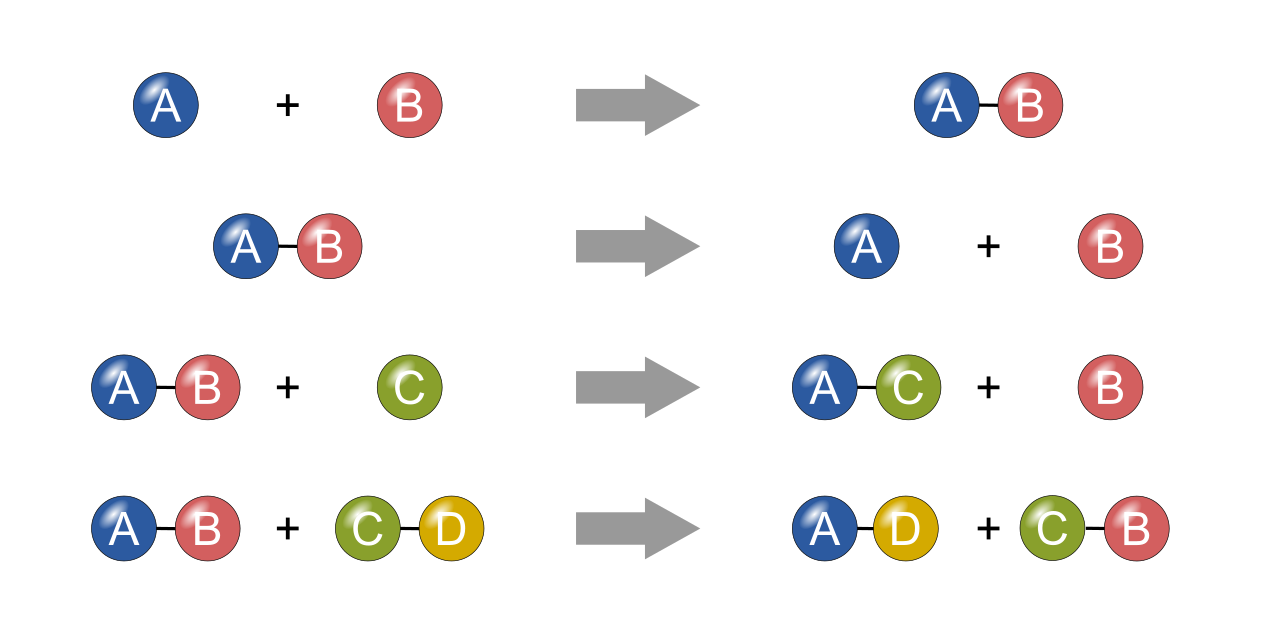
| Synthesis | A synthesis reaction occurs when two or more simple substances combine to form a single, more complex product. | A + B → AB. Building a complex protein from simple amino acids. |
| Decomposition | A decomposition reaction occurs when a complex substance breaks down into two or more simpler substances. | AB → A + B. Glycogen breaking down into individual glucose molecules for energy. |
| Single Replacement | A single replacement reaction involves one uncombined element replacing another element within a compound. | A + BC → AC + B. A chemical "cutting in" on a dance partner. |
| Double Replacement | A double replacement reaction involves the exchange of positive ions between two reacting ionic compounds. | AB + CD → AD + CB. Two pairs swapping dance partners entirely. |
Beyond these four, we have combustion reactions, which involve a substance reacting rapidly with oxygen gas. Because of the intense release of energy, combustion reactions produce heat and light. When you look closely at organic fuels, the complete combustion of a hydrocarbon produces carbon dioxide and water.
Finally, reactions are categorized by how they handle heat. An endothermic reaction absorbs heat energy from the surrounding environment (it feels cold, like a chemical ice pack). Conversely, an exothermic reaction releases heat energy into the surrounding environment (it feels hot).
Why do some medications act instantly while others take hours? Why do we refrigerate blood samples? The answers lie in Collision Theory, which states that for a reaction to happen, three strict conditions must be met:
- Reactant particles must collide in order for a chemical reaction to occur.
- Reactant particles must have sufficient energy during a collision to trigger a reaction.
- Reactant particles must have the correct molecular orientation during a collision (the geometric "lock and key" alignment must be exact).
Even if particles hit each other perfectly, they must hit hard enough. Activation energy is the minimum amount of energy required to initiate a chemical reaction. Think of it as the initial push needed to roll a heavy boulder down a hill.
We can manipulate the speed of these reactions by tweaking the environment:
Temperature
Increasing the temperature of a chemical system increases the kinetic energy of the particles. They move faster. Because they are racing around, this higher kinetic energy causes reactant molecules to collide more frequently and to collide with greater force. Therefore, increasing the temperature of a system generally increases the rate of a chemical reaction.
Concentration and Pressure
Increasing the concentration of reactants places more particles in a given volume. Imagine a crowded room versus an empty one; people will bump into each other far more often in a crowd. Thus, a higher concentration of reactants leads to more frequent particle collisions, which in turn increases the rate of a chemical reaction.
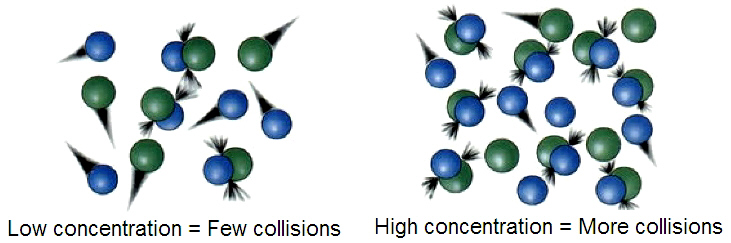
For gases, pressure acts like concentration. Increasing the pressure of a gaseous system increases the concentration of gas molecules. Squeezing gas into a tighter space forces the molecules closer together, so higher pressure in a gaseous system increases the reaction rate.
Surface Area
If a reactant is a solid block, only the atoms on the outside can react. Increasing the surface area of a solid reactant exposes more particles to other reactants. (This is why chewing your food aids digestion). Consequently, a greater surface area of a solid reactant increases the rate of a chemical reaction.
Catalysts
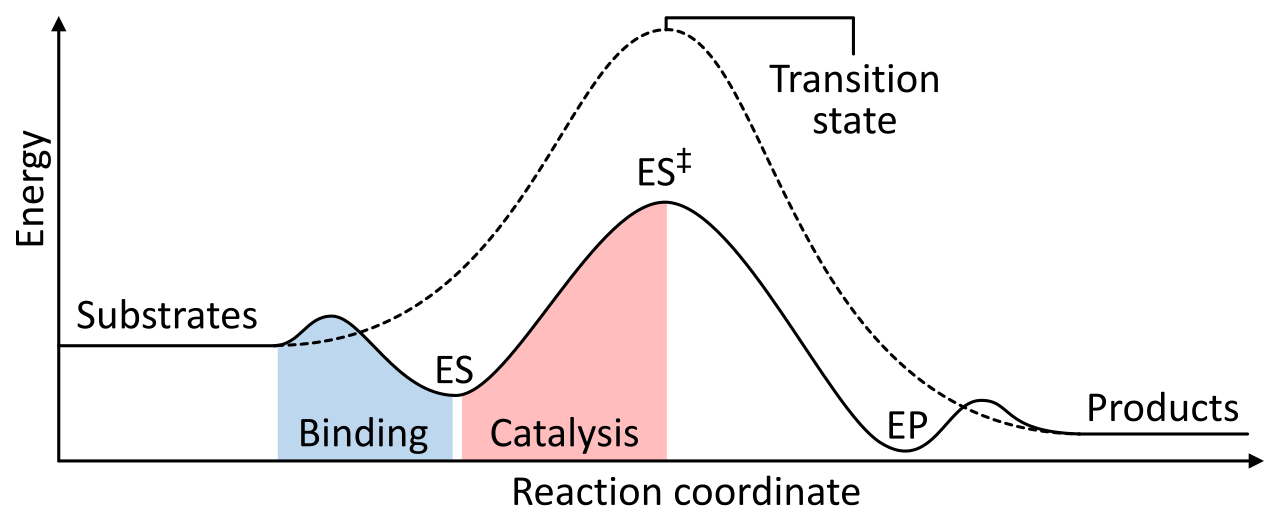
Sometimes, we cannot safely raise the temperature or pressure—like inside the human body. Here, we use catalysts. A catalyst is a substance that speeds up a chemical reaction without being consumed in the process. It works by offering a shortcut. A catalyst increases the reaction rate by lowering the activation energy required for the reaction. In biology, enzymes are biological catalysts that speed up chemical reactions within living organisms, allowing life-sustaining chemistry to happen at standard body temperature.
In healthcare, almost everything you deliver to a patient—saline, antibiotics, nutrients—is an aqueous solution.
A solution is a homogeneous mixture composed of two or more substances. It looks identical throughout. A solute is the substance that gets dissolved in a solution (like salt). A solvent is the substance that dissolves the solute in a solution (like water).
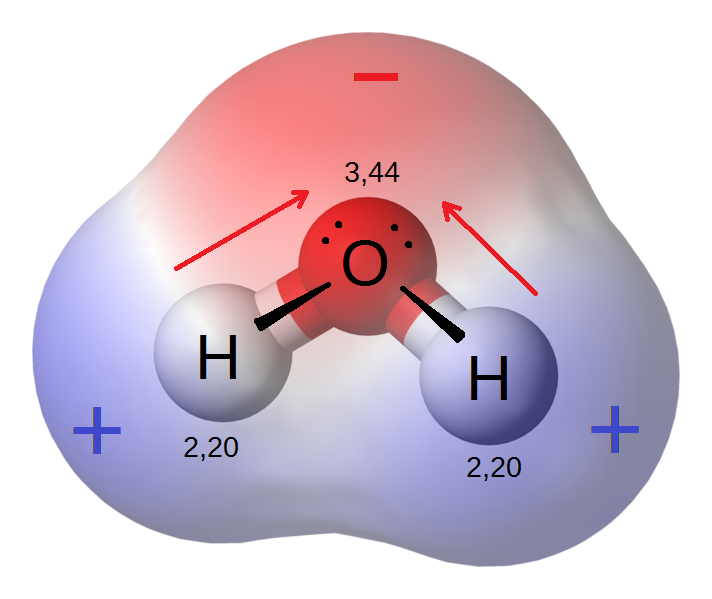
Water is often called the universal solvent. Why? Because of its molecular geometry, water acts as an excellent solvent because water molecules are highly polar. They have a slightly positive end and a slightly negative end, allowing them to pull apart and surround a massive variety of ionic and molecular solutes.
Concentration and Solubility Limits
Concentration is a measure of the amount of solute dissolved in a specific volume of solution. In the lab, the most common unit is Molarity. Molarity is a unit of concentration defined as the number of moles of solute per liter of solution.
But you cannot dissolve an infinite amount of solute into a solvent. Solubility is the maximum amount of a solute that can dissolve in a given amount of solvent at a specific temperature.
- An unsaturated solution contains less than the maximum amount of dissolved solute at a given temperature. (You can still dissolve more).
- A saturated solution contains the maximum amount of dissolved solute possible at a given temperature. (Any extra will just sink to the bottom).
- Through careful heating and cooling, we can occasionally create a supersaturated solution, which contains more dissolved solute than a saturated solution at the same temperature. (This state is highly unstable).
Temperature and pressure dictate solubility:
- The solubility of most solid solutes in liquid solvents increases as temperature increases. (Think of dissolving sugar in hot tea versus iced tea).
- However, the solubility of gaseous solutes in liquid solvents decreases as temperature increases. (Warm soda goes flat quickly because the dissolved carbon dioxide escapes).
- For gases, pressure is paramount: The solubility of a gas in a liquid is directly proportional to the pressure of that gas above the liquid. (This is why opening a pressurized soda bottle releases bubbles).
Osmosis
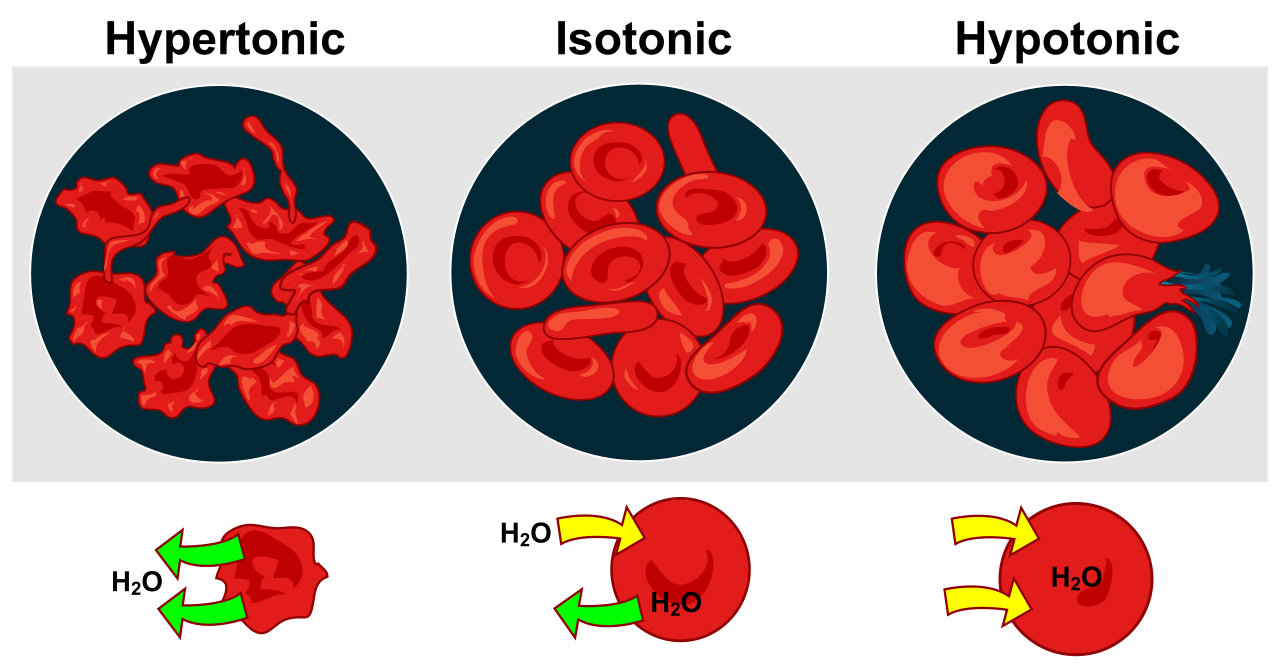
In the body, solutions are separated by cell membranes. Osmosis is the net movement of solvent molecules across a semipermeable membrane. Crucially, during osmosis, solvent molecules move from an area of lower solute concentration to an area of higher solute concentration. The solvent (water) rushes toward the heavily concentrated side to dilute it, seeking balance. If you inject a patient with pure water instead of properly concentrated saline, osmosis will force water into their red blood cells until they burst.
Every fluid in the body has an exact acidity level it must maintain. Let's define the extremes.
There are two primary ways to define acids and bases:
- Arrhenius Definition: An acid is a substance that produces hydrogen ions (H⁺) in an aqueous solution, while a base is a substance that produces hydroxide ions (OH⁻) in an aqueous solution.
- Brønsted-Lowry Definition: This is broader. An acid is a proton donor, and a base is a proton acceptor. (A hydrogen ion is just a proton, so these definitions align beautifully).
Experientially, acids generally taste sour (think lemons, which contain citric acid). Bases generally taste bitter and feel slippery to the touch (like soap, which is highly basic).
The pH Scale
To measure this, we use the pH scale. The pH scale measures the hydrogen ion concentration of a solution.
- The pH scale typically ranges from 0 to 14 at standard temperature.
- A pH value of exactly 7 indicates a neutral solution at standard temperature (like pure water).
- A pH value less than 7 indicates an acidic solution.
- A pH value greater than 7 indicates a basic solution.
Crucially, the pH scale is a logarithmic scale. This means it does not scale linearly. A change of one unit on the pH scale represents a tenfold change in hydrogen ion concentration. A pH of 3 is ten times more acidic than a pH of 4, and one hundred times more acidic than a pH of 5. Small numbers mean massive chemical changes.
Strength vs. Concentration
Do not confuse an acid's concentration (how much is mixed in) with its strength (its chemical behavior).
- Strong acids completely dissociate into ions when placed in water. (Hydrochloric acid is an example of a strong acid. Every molecule breaks apart into H⁺ and Cl⁻).
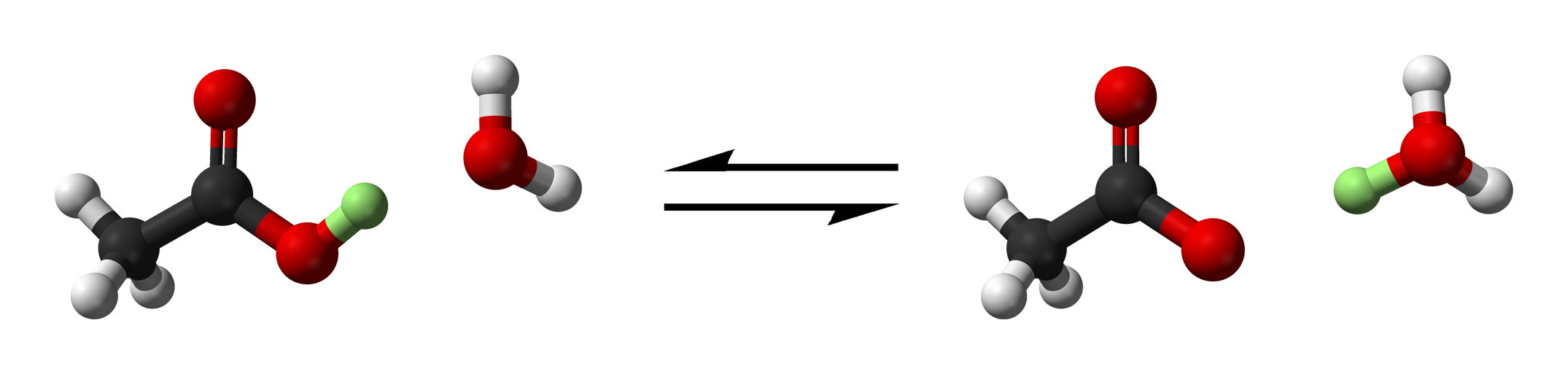
- Weak acids only partially dissociate into ions when placed in water. (Acetic acid is an example of a weak acid, found in vinegar).
- Similarly, strong bases completely dissociate into ions when placed in water. (Sodium hydroxide is an example of a strong base).
- Weak bases only partially dissociate into ions when placed in water. (Ammonia is an example of a weak base).
Neutralization and Buffers
What happens when you mix an acid and a base? They cancel each other's extremes. A neutralization reaction occurs between an acid and a base.
The products of an acid-base neutralization reaction are a salt and water. A salt is an ionic compound formed from the cation of a base and the anion of an acid.
Living organisms cannot survive wild swings in pH. They survive using buffers. A buffer is a solution that resists significant changes in pH. They act like chemical sponges, soaking up excess H⁺ or OH⁻. Buffers maintain pH stability when small amounts of strong acid or strong base are added to a solution.
This is a life-or-death concept in medicine. Human blood contains buffer systems to maintain a stable pH near 7.4. If your blood pH drops to 7.2 or rises to 7.6, cellular machinery begins to fail rapidly. By understanding these chemical rules—from the conservation of mass to the buffering of acids—you are not just learning textbook chemistry; you are learning the mechanical blueprints of human survival.