Equations and Inequalities
Not sure you’re ready?
Take the ~3-minute readiness diagnostic and see where you stand.
Imagine administering an intravenous medication where the total volume entering a patient’s bloodstream must exactly match the sum of a constant baseline fluid rate and a variable medicated drip. If one side of this physiological scale tips, the patient's fluid balance is compromised. At its core, algebra is simply the mathematics of maintaining this absolute balance. In a clinical setting, an unknown variable is not just an abstract letter x; it is the exact milligrams of a drug needed, the hours remaining until a dosage is safe, or the precise threshold of a patient's blood pressure. Understanding how to isolate and solve for these unknowns is not merely an academic exercise to pass an exam—it is the foundational grammar of safe and effective patient care.

To manipulate math, we must first agree on what we are looking at. An equation is a mathematical statement asserting equality between two expressions. It is a perfectly balanced scale. When we say two things are equal, we are stating a fact about the universe in that moment.
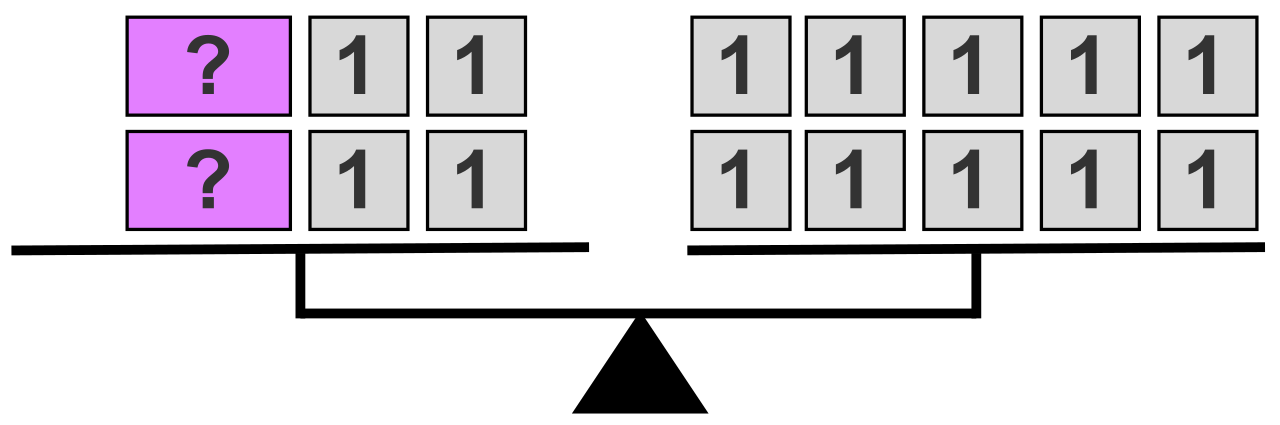
For the ATI TEAS 7, you will primarily deal with a one-variable linear equation. This is an equation that has a single unknown quantity and no exponents greater than one on the variable. Within these equations, you will encounter two types of numbers:
- A mathematical constant is a fixed numerical value that stands alone without a variable in an algebraic expression. Think of this as the baseline 5 mL flush you always use, regardless of the patient's weight.
- A coefficient is a numerical value that is multiplied by a variable in an algebraic term. If you administer 2 mg of medication per kilogram of a patient's weight, the "2" is the coefficient of the variable weight (x), written as 2x.
The primary goal of solving an algebraic equation is to isolate the variable on one side of the equal sign. You want to peel away the layers of numbers until the unknown stands entirely alone.
Important Note: Variables can be validly isolated on either the left or the right side of the equal sign during the equation-solving process. x=5 is mathematically identical to 5=x. Do not let a right-sided variable confuse you.
How do we isolate the variable without destroying the delicate balance of our equation? By utilizing inverse operations—pairs of mathematical operations that undo the effects of each other.
- Addition and subtraction are inverse operations.
- Multiplication and division are inverse operations.
If a variable has 4 added to it, we subtract 4 to undo it. If it is multiplied by 3, we divide by 3. However, whatever surgical adjustment we make to one side of our scale, we must exactly mirror on the other side. This is guaranteed by the properties of equality:
- The addition property of equality states that adding the same number to both sides of an equation does not change the truth value of the equation.
- The subtraction property of equality states that subtracting the same number from both sides of an equation maintains equality.
- The multiplication property of equality states that multiplying both sides of an equation by the same non-zero number maintains equality.
- The division property of equality states that dividing both sides of an equation by the same non-zero number maintains equality.
Real-world equations rarely arrive neatly pre-packaged. Before you start shifting weights across the equal sign using inverse operations, you must organize what you have.
Combining Like Terms
First, look for like terms. These are terms in an algebraic expression whose variables and exponent values are exactly the same (e.g., 3x and 5x). Like terms can be combined into a single term by adding or subtracting their numerical coefficients. Just as you wouldn't chart heart rate and respiratory rate as a single combined number, you cannot add 3x and 4y. But 3x+5x easily combines to 8x.
The Distributive Property
Often, terms are locked inside parentheses, representing a grouped quantity. The distributive property is used to remove parentheses when solving equations by multiplying the term outside the parentheses by each term inside.
The distributive property is algebraically defined as a(b+c)=ab+ac.
If a patient needs 3 doses of a cocktail containing 5 mg of Drug A and x mg of Drug B, represented as 3(5+x), the total requirement is 15+3x.
Clearing Fractions
Fractions can obscure the simplicity of an equation. A linear equation containing fractions can be simplified by multiplying every term on both sides by the least common denominator (LCD) of the fractions. This clever use of the multiplication property of equality wipes the fractions out completely, leaving you with whole, manageable numbers.
Once you isolate your variable, you will arrive at one of three possible realities.
- Exactly One Solution: A one-variable linear equation with exactly one solution occurs when solving yields a single distinct value for the variable (e.g., x=12). This is the standard outcome: the patient needs exactly 12 mg of the drug.
- No Solution: Sometimes, the math breaks down. A one-variable linear equation has no solution if simplifying both sides algebraically results in a false statement like 3=5. This indicates an impossible scenario—like programming an IV pump to deliver two different volumes simultaneously.
- Infinitely Many Solutions: Conversely, an equation has infinitely many solutions if simplifying both sides algebraically results in a universally true statement like 4x=4x. This means that no matter what value you choose for x, the equation holds true.
Regardless of your result, a careful practitioner always verifies their work. Checking a solution involves substituting the calculated variable value back into the original equation to verify that it produces a mathematically true statement. If your dosage calculation leads back to the correct total volume, you can proceed with confidence.
In healthcare, strict equality is rare. We care about vital signs staying within normal limits, blood sugar being below a threshold, or urine output being above a minimum volume.

An inequality is a mathematical statement comparing two values to show if one is less than, greater than, or not equal to another value.
- The symbol < represents "less than".
- The symbol > represents "greater than".
- The symbol ≤ represents "less than or equal to".
- The symbol ≥ represents "greater than or equal to".
Solving an inequality utilizes the exact same properties of equality and inverse operations we just discussed, with one critical, vital exception.
Adding or subtracting the same value to both sides of an inequality does not change the direction of the inequality symbol. However, the logic of the number line flips when we introduce negative scaling. Multiplying or dividing both sides of an inequality by a negative number requires reversing the direction of the inequality sign to maintain a true statement.
Consider this carefully:
Multiplying both sides of the inequality −2x<4 by −0.5 changes the inequality symbol to >, resulting in x>−2.
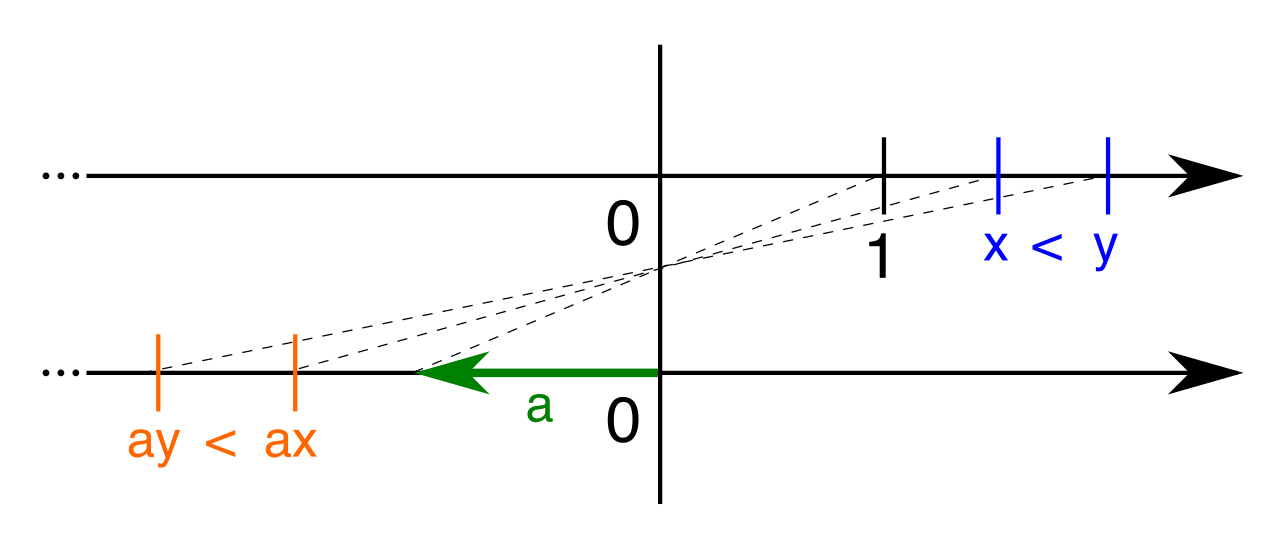
If you fail to flip the sign when multiplying or dividing by a negative, your entire clinical parameter reverses. You would interpret a minimum required dose as a maximum toxic dose!
Visualizing the Threshold on a Number Line
We graph inequalities on a horizontal number line to instantly see the entire set of possible solutions.
- An arrow pointing to the right on a horizontal number line represents values greater than a specific boundary number.
- An arrow pointing to the left on a horizontal number line represents values less than a specific boundary number.
But what about the boundary number itself?
- An open circle on a number line graph indicates that the boundary value is not included in the solution set of an inequality. Therefore, an open circle on a number line graph is used to represent "less than" strict inequalities (<) and "greater than" strict inequalities (>).
- A solid circle on a number line graph indicates that the boundary value is included in the solution set of an inequality. Consequently, a solid circle on a number line graph is used to represent "less than or equal to" (≤) and "greater than or equal to" (≥) inequalities.

Math is simply a specialized language used to describe reality. Translating a word problem into an equation requires identifying the unknown quantity and assigning a letter variable to represent that quantity. Once you establish your x, you must decode the English phrasing into mathematical operators.
Here is your translation guide for the TEAS 7:
| English Phrase | Mathematical Operator | Example |
|---|---|---|
| "is" | Equals (=) | "The total is 50" translates to =50. The word "is" in a real-world word problem typically translates to an equal sign in an algebraic equation. |
| "sum", "more than", "increased by" | Addition (+) | These phrases in word problems generally indicate the operation of addition. |
| "difference", "less than", "decreased by" | Subtraction (−) | These phrases in word problems generally indicate the operation of subtraction. |
| "product", "times", "fraction of" | Multiplication (×) | These phrases generally indicate the operation of multiplication. "A fraction of the dose" implies multiplying the dose by a fraction. |
| "quotient", "per", "ratio" | Division (÷) | These phrases generally indicate the operation of division. "Milligrams per kilogram" means mg divided by kg. |
| "at least" | Greater than or equal to (≥) | The phrase "at least" in a word problem translates to the "greater than or equal to" mathematical symbol. If a patient needs at least 2 liters of fluid, they can have 2 or more. |
| "at most" | Less than or equal to (≤) | The phrase "at most" in a word problem translates to the "less than or equal to" mathematical symbol. If a patient can tolerate at most a $500 copay, they can pay $500 or less. |
By breaking down the complex paragraphs of a clinical scenario or exam question into these structural elements, you transform a confusing block of text into a simple, solvable equation or inequality. You isolate the unknown, respect the balance of the operations, and ultimately arrive at truth—the precise calculation that guides your next action.