Fractions
Not sure you’re ready?
Take the ~3-minute readiness diagnostic and see where you stand.
Imagine holding a 50-milligram scored tablet of metoprolol, but the prescribed dose is 25 milligrams. You snap the tablet precisely in half. You are no longer dealing with whole integers; you have entered the realm of fractional mathematics. In nursing and allied health, the margin between healing and harm often rests on the precise calculation of parts of a whole—whether determining weight-based pediatric dosages, calculating intravenous drip rates, or titrating liquid suspensions. Fractions are not arbitrary mathematical hurdles constructed for an entrance exam; they are the fundamental language of proportion, dilution, and dosage. A deep, intuitive grasp of fractions ensures that when a life depends on the exact administration of a fractional dose, you measure with absolute mathematical certainty.
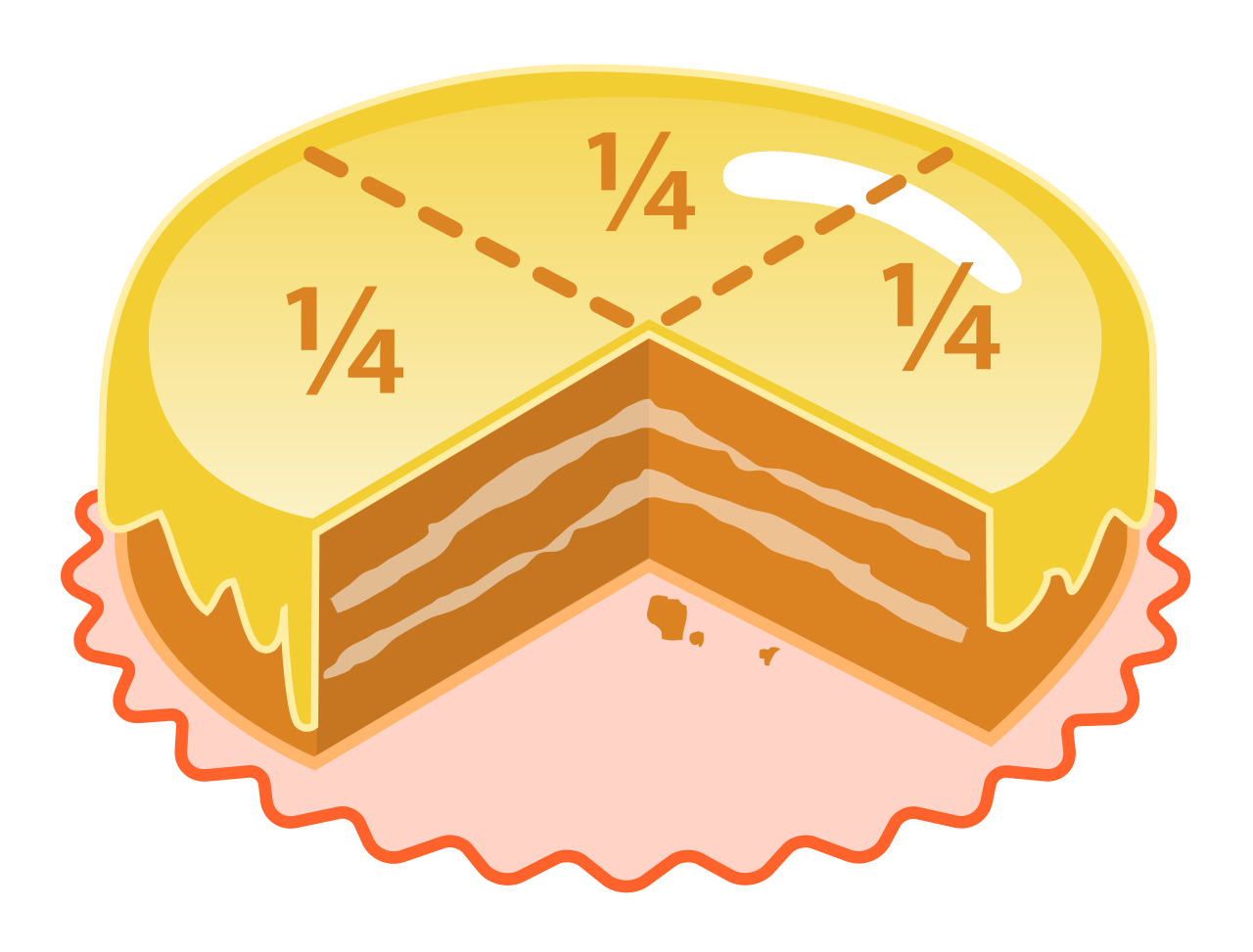
To understand fractions, we have to look closely at what the numbers are actually telling us. A fraction is simply a way of representing a piece of a larger reality.
The top number of a fraction is called the numerator. The numerator of a fraction represents the specific number of parts being considered out of a whole. If you draw up 3 mL of a medication from a vial, that 3 is your numerator.
The bottom number of a fraction is called the denominator. The denominator of a fraction represents the total number of equal parts that make up a whole. If the vial originally held 10 mL total, the 10 is your denominator. You are holding 103 of the vial's total volume.
Between them sits a simple horizontal bar. Never forget that a fraction line represents the mathematical operation of division. Writing 43 is conceptually identical to writing 3÷4.
Because fractions are division, we must respect the rules of division—specifically, how the universe handles zero.
- A fraction with a numerator of zero and a non-zero denominator is equal to zero. If you have 50 of a pill, you have zero medicine.
- However, a fraction with a denominator of zero is mathematically undefined. You cannot take 5 units of medication and divide them into 0 total parts. It breaks the logic of physical reality.
Finally, do not let whole numbers trick you into thinking they live outside the world of fractions. Any whole number can be expressed as a fraction by using the whole number as the numerator and the number one as the denominator. The number 5 is functionally identical to 15.
In your daily practice, you will encounter fractions in three distinct forms. Understanding how to identify and fluidly move between these forms is critical for dosage calculations.
- A proper fraction has a numerator that is less than its denominator. (e.g., 21 or 83). These represent values strictly less than one whole.
- An improper fraction has a numerator that is equal to or greater than its denominator. (e.g., 45 or 99). These represent values equal to or greater than one. Do not let the word "improper" fool you; mathematically, these are often the easiest to work with when multiplying or dividing.
- A mixed number consists of a whole number combined with a proper fraction. (e.g., 141). This is how human beings naturally count physical objects—"one and a quarter tablets."
Translating Between States
Often, a protocol will give you a mixed number, but the mathematics require an improper fraction.
Converting a mixed number to an improper fraction begins by multiplying the whole number by the fraction's denominator. Think of this as finding out how many fractional pieces make up those whole units. Next, add the original numerator to the product of the whole number and the denominator to determine the new numerator. Throughout this transformation, the original denominator remains unchanged.
Example: To convert 321 to an improper fraction: Multiply 3×2=6. Add the original numerator (1) to get 7. Keep the denominator 2. The result is 27.
Conversely, you might calculate an answer as an improper fraction, but you need to document it as a mixed number for clarity. Converting an improper fraction to a mixed number requires dividing the numerator by the denominator. Remember that fraction line! When you do this division, the division quotient becomes the whole number part, representing how many full units you have. The leftover pieces don't disappear; the division remainder becomes the numerator of the new fractional part.
Example: To convert 411 to a mixed number: 11÷4=2 with a remainder of 3. Thus, the mixed number is 243.
Nature doesn't care if you call a half-dose 21 or 105; the physical amount of medicine is exactly the same. Equivalent fractions are different fractions that represent the exact same numerical value.
How do we construct them? It's a matter of scaling. Multiplying both the numerator and denominator of a fraction by the same non-zero number creates an equivalent fraction. If you multiply 21 by 33, you get 63. Similarly, dividing both the numerator and denominator of a fraction by the same non-zero number creates an equivalent fraction.
This principle of division leads us directly to simplification. A cluttered fraction is an invitation for a medication error. Simplifying a fraction involves dividing both the numerator and the denominator by their greatest common factor. You pull out the shared multiples until there is nowhere left to go. A fraction is fully simplified when the numerator and denominator share no common factors other than the number one.
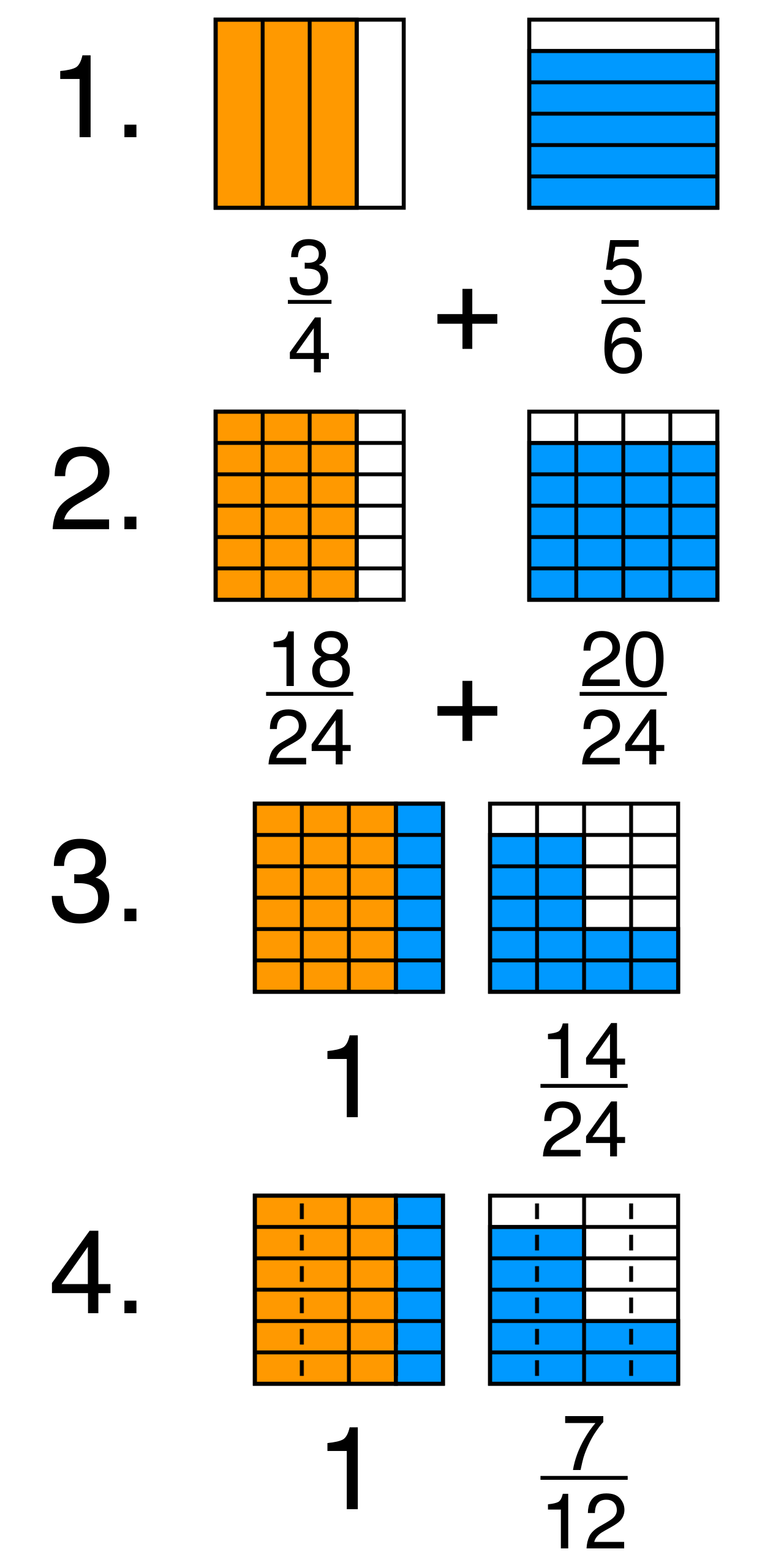
You cannot directly add thirds and fifths any more than you can directly add liters and ounces without converting them to a common unit first. When combining fractional quantities—like adding fluid intake from different sources—you must establish common ground.
Identical Denominators
If the denominators already match, the hard work is done.
- When adding fractions with identical denominators, the final sum's numerator is calculated by adding the original numerators.
- Similarly, when subtracting fractions with identical denominators, the final difference's numerator is calculated by subtracting the original numerators.
- In both cases, the original denominator remains unchanged in the final sum or difference. If you have 2 eighths and add 3 eighths, you have 5 eighths (85). The size of the pieces (eighths) doesn't change, only the count.
Different Denominators
If the pieces are different sizes, we hit a roadblock. Adding fractions with different denominators requires converting the fractions into equivalent fractions with a common denominator first. The exact same rule applies to subtraction: Subtracting fractions with different denominators requires converting the fractions into equivalent fractions with a common denominator first.
To do this efficiently, we look for a common denominator, which is a shared mathematical multiple of the denominators of two or more fractions. While any common multiple works, finding the least common denominator (the smallest positive common multiple of the denominators of two or more fractions) keeps your numbers small and manageable.
Working with Mixed Numbers
When adding mixed numbers, the whole number parts are added together separately from the fractional parts. (e.g., 141+242=343).
Subtraction, however, can introduce a beautiful mechanical challenge. If you try to subtract 341−143, you cannot subtract 3 from 1 in the fraction column. Therefore, subtracting mixed numbers often requires borrowing one whole unit from the whole number portion.
What actually happens when we borrow? When borrowing one whole unit in mixed number subtraction, the borrowed unit is converted into an equivalent fraction with the same denominator as the fractional part.
Example: In 341, borrow 1 from the 3 (making it 2). That borrowed 1 becomes 44. Add it to your existing 41 to get 45. Your new mixed number is 245. Now you can easily subtract 143 to yield 142 (which simplifies to 121).
Adding and subtracting fractions can feel rigid because of the common denominator requirement. Multiplication and division are entirely different beasts—they are much more flexible, but require strict adherence to a specific set of operational rules.
Multiplication
When you take a fraction of a fraction, you multiply. To multiply two fractions, calculate the new numerator by multiplying the original numerators together. Then, calculate the new denominator by multiplying the original denominators together. You simply multiply straight across the top and straight across the bottom.
If you are dealing with whole numbers attached to those fractions, stop immediately. Before multiplying mixed numbers, each mixed number must be converted into an improper fraction. You cannot just multiply the whole numbers and fractions separately; you will get mathematically invalid results.
Division and the Power of the Reciprocal
To understand fractional division, we must first introduce a powerful mathematical tool: the reciprocal. The reciprocal of a fraction is created by swapping the positions of the numerator and the denominator. The reciprocal of 32 is 23.
There is a magical symmetry to this. Multiplying a fraction by its reciprocal always results in a product of exactly one. (32×23=66=1).
How does this help us divide? Division by a fraction is mechanically identical to multiplication by its inverse. Therefore, to divide two fractions, multiply the first fraction by the reciprocal of the second fraction. Keep the first fraction as it is, change the division sign to multiplication, and flip the second fraction upside down.
Just as with multiplication, mixed numbers cannot participate directly in division. Before dividing mixed numbers, each mixed number must be converted into an improper fraction. Only after converting them to improper fractions can you apply the reciprocal and multiply.
In a clinical setting, you will constantly evaluate whether a newly ordered dose is an increase or decrease from the baseline. You must be able to glance at fractions and immediately determine which holds a greater value.
- Same Denominator: The pieces are the same size. Therefore, when comparing two fractions with the same denominator, the fraction with the larger numerator represents the larger numerical value. (85 is greater than 83).
- Same Numerator: You have the same number of pieces, but the sizes of the pieces differ. When comparing two fractions with the same numerator, the fraction with the smaller denominator represents the larger numerical value. Why? Imagine dividing a single pill. A pill divided into 4 pieces (41) yields larger chunks than a pill divided into 8 pieces (81).
When neither the numerators nor the denominators match, you have three highly effective strategies to deploy:
| Strategy | How it Works |
|---|---|
| Common Denominators | Two fractions with different denominators can be accurately compared by converting both into equivalent fractions with a common denominator. Once the denominators match, simply compare the numerators. |
| Cross-Multiplication | Cross-multiplication can compare two fractions by multiplying the numerator of each fraction by the denominator of the opposite fraction. If comparing 32 and 53, multiply 2×5=10 (representing the left side) and 3×3=9 (representing the right side). Since 10>9, then 32>53. |
| Decimal Conversion | Remember that a fraction is just division. Two fractions can be accurately compared by converting each fraction into its equivalent decimal value. Divide the numerator by the denominator. 43=0.75 and 54=0.80. It is immediately clear that 0.80 is the larger value. |
Mastering fractions is not simply a matter of memorizing rules to pass the HESI A2 exam. It is about rewiring your brain to see proportions, relationships, and quantities with absolute clarity. Every time you find a common denominator, simplify a ratio, or multiply by a reciprocal, you are practicing the precision required to safely navigate the complex numerical landscape of modern healthcare.