Rates and Nuclear Chemistry
Not sure you’re ready?
Take the ~3-minute readiness diagnostic and see where you stand.
The human body is a meticulously timed theater of chemical transformations. Some events, like the flash of a pain receptor or the neutralization of stomach acid by a chewable antacid, occur in fractions of a second. Others, such as the metabolism of an intravenously administered drug or the decay of a radiographic tracer injected for a scan, unfold predictably over hours or days. To practice medicine is to intervene in this timeline. By understanding chemical kinetics—the mechanics governing how and why reactions happen at a specific speed—and nuclear chemistry—the spontaneous physical alterations of the atoms themselves—healthcare professionals can predictably control the pace of healing, safely dose radioactive diagnostics, and fundamentally understand how the physical universe governs biology at the subatomic and atomic levels.
Before we can control a biological process, we must understand the physical rules of engagement. In chemistry, the reaction rate is the speed at which reactants are converted into products in a chemical reaction.
But why do some reactants convert instantly while others take centuries? The answer lies in collision theory.
Collision theory states that reactant particles must collide in order to form products. If they do not touch, they do not react.
However, simply bumping into one another is not enough. Imagine two cars gently tapping bumpers in a parking lot; no real damage is done because the energy is too low. For a chemical reaction to occur, two strict criteria must be met during the collision:
- Energy: Reactant particles must collide with sufficient energy to break existing chemical bonds. The molecular scaffolding of the old substances must be shattered before new products can be built.
- Orientation: Reactant particles must collide with the correct spatial orientation to successfully react. Think of a lock and key, or attempting to plug in a USB cable. If the molecules hit each other backwards or sideways, they will simply bounce off one another unchanged.
This energy threshold brings us to one of the most critical concepts in chemistry and biology: activation energy.
Activation energy is the minimum amount of energy required to initiate a chemical reaction.
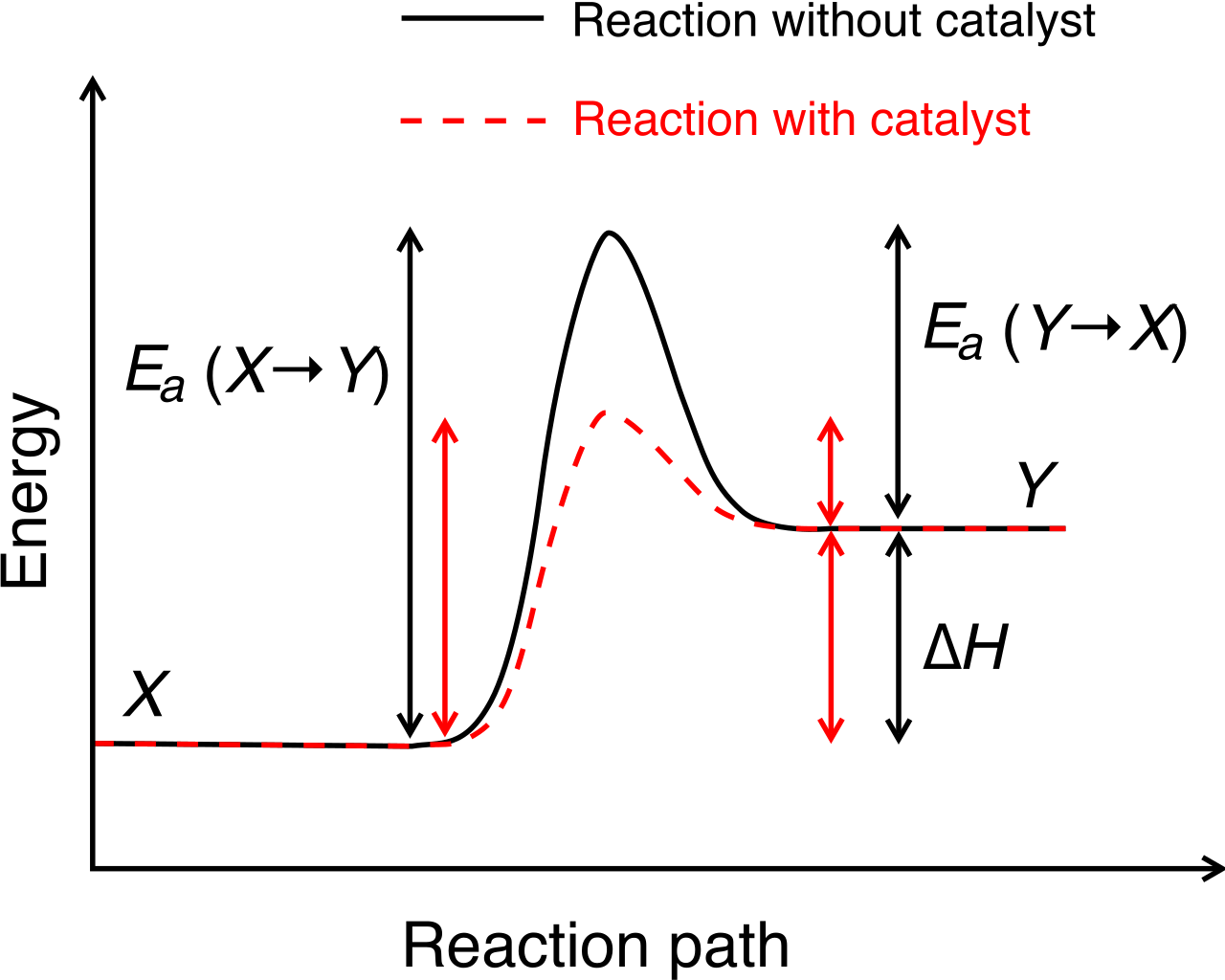
Picture activation energy as a steep hill. Even if a boulder (the reactants) would naturally roll down the other side into a valley (the products), you must first expend energy to push that boulder all the way up to the peak. If a collision lacks the activation energy to crest the hill, the reaction fails.
In a clinical setting, you are constantly manipulating reaction rates. When you pack a patient in ice to slow metabolic damage, or crush a pill so it absorbs faster in the stomach, you are exploiting the five fundamental factors that affect reaction rates.
1. Temperature
Increasing the temperature of a reaction system increases the average kinetic energy of the particles. Because the particles are moving faster and more erratically, two things happen:
- Higher average kinetic energy results in more frequent collisions between reactant particles.
- Higher average kinetic energy results in more forceful collisions between reactant particles.
More frequent and forceful collisions mean a much higher percentage of those collisions will successfully exceed the activation energy. This is why human bodies run fevers—to speed up the immune system's metabolic reaction rates—and why we refrigerate vaccines to slow down the chemical reactions that cause them to degrade.
2. Concentration
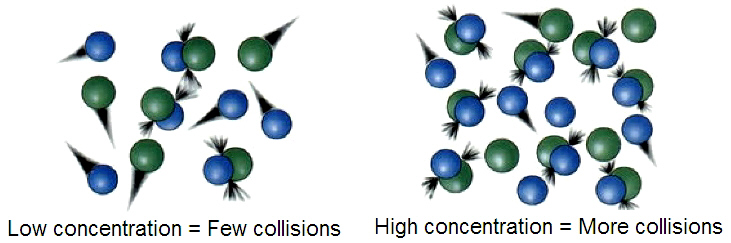
Increasing the concentration of reactants increases the number of particles in a specific volume. Imagine a school gymnasium with only ten blindfolded students walking around. Collisions will be rare. Now, put one thousand blindfolded students in that same gym. A higher concentration of reactants leads to more frequent collisions between particles. In medicine, providing a patient with 100% oxygen via a non-rebreather mask dramatically increases the concentration of O2 in the alveoli compared to room air (21%), drastically speeding up the rate of oxygen binding to hemoglobin.
3. Surface Area
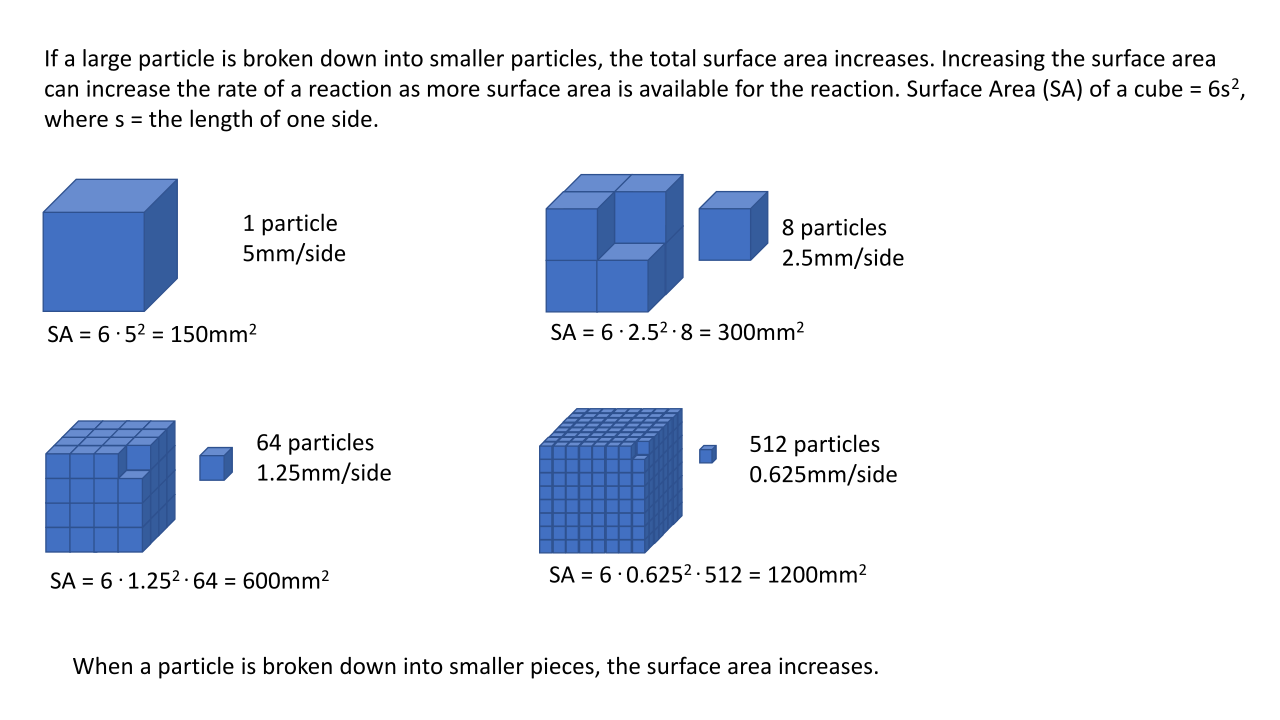
When dealing with solids, reactions can only happen on the outside surface where particles are exposed. Increasing the surface area of solid reactants exposes more particles to potential collisions. Consequently, increasing the surface area of a solid reactant increases the overall rate of the chemical reaction. If you swallow a solid aspirin tablet, your stomach acid can only attack the outer layer. If you chew the aspirin, you shatter it into thousands of tiny fragments, massively expanding the exposed surface area and delivering the drug to the bloodstream much faster.
4. Pressure
For gases, pressure acts much like concentration does for solutions. Increasing pressure increases the reaction rate of gases by forcing gas molecules closer together. By compressing the space, the gas particles have nowhere to go but into each other, resulting in highly frequent collisions. This principle is applied in hyperbaric oxygen therapy to force gases rapidly into tissues.
5. Catalysts
Sometimes, we cannot safely increase temperature or pressure to speed up a reaction—especially inside the fragile human body. This is where catalysts come in. A catalyst is a substance that speeds up the rate of a chemical reaction. But how does it achieve this without adding heat or pressure? A catalyst speeds up a reaction by providing an alternative pathway with a lower activation energy.
If activation energy is a steep mountain you must push a boulder over, a catalyst blasts a tunnel straight through the base of the mountain. The body relies heavily on biological catalysts called enzymes to digest food and copy DNA at life-sustaining speeds. Crucially, a catalyst is not consumed during the chemical reaction. It merely facilitates the process and emerges completely unchanged, ready to catalyze the next reaction.
While chemical kinetics deals with the shuffling and sharing of electrons in the outer shell of atoms, nuclear chemistry dives into the heavy, dense heart of the atom: the nucleus.
To understand nuclear chemistry, we must first understand isotopes. An isotope is an atom of an element that has the same number of protons but a different number of neutrons. For example, Carbon-12 and Carbon-14 both have 6 protons (which is what makes them Carbon), but Carbon-14 has two extra neutrons.
Often, this irregular ratio of protons to neutrons creates internal tension. The nucleus becomes physically unstable. Radioisotopes are unstable isotopes that spontaneously undergo radioactive decay.
Radioactivity is the spontaneous emission of radiation from an unstable atomic nucleus.
The atom is trying to relieve its internal stress. By spitting out energetic particles or waves of energy, radioactive decay transforms an unstable atomic nucleus into a more stable atomic nucleus.
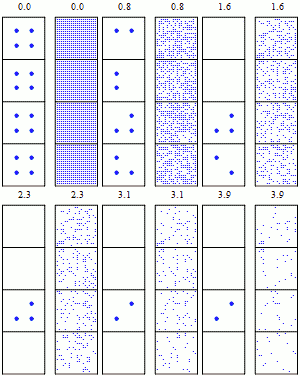
Because this decay occurs at a strict, predictable statistical rate, we measure it using the concept of half-life. Half-life is the specific amount of time required for exactly one-half of the radioactive atoms in a sample to decay. If a radioactive medical tracer has a half-life of 2 hours, and you inject 100 mg, only 50 mg of the radioactive substance will remain active after 2 hours. After 4 hours, 25 mg will remain. This allows pharmacologists to design precise imaging dyes that clear the patient's system shortly after the scan is complete.
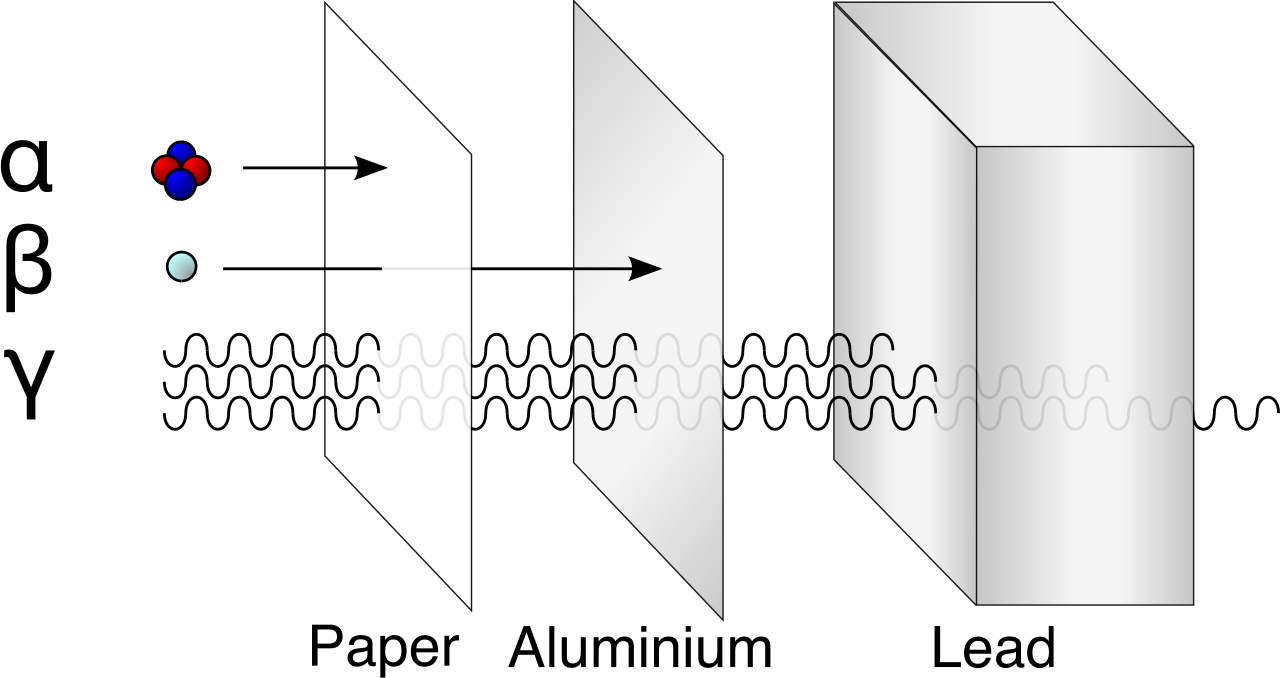
When a radioisotope decays, it ejects radiation. However, not all radiation is created equal. The type of radiation determines how it interacts with human tissue and what shielding is required to protect healthcare workers.
Alpha (α) Radiation
Alpha radiation consists of alpha particles emitted from an unstable atomic nucleus. Structurally, an alpha particle is identical in composition to a helium nucleus.
- Composition: An alpha particle contains exactly two protons and two neutrons.
- Charge: Because it lacks electrons but has two protons, an alpha particle has a positive two electrical charge.
- Mass: It is massive on a subatomic scale; an alpha particle has an atomic mass number of four.
- Penetrating Power: Because they are so large and heavy, alpha particles have the lowest penetrating power among common types of nuclear radiation. They are easily blocked; in fact, alpha particles can be completely stopped by a single sheet of paper (or the dead outer layer of human skin). However, if an alpha-emitting substance is inhaled or swallowed, it can cause severe internal cellular damage.
Beta (β) Radiation
Beta radiation consists of high-energy electrons emitted from an unstable atomic nucleus. But wait—how does an electron come out of the nucleus, which only contains protons and neutrons?
During beta minus decay, a neutron within the nucleus transforms into a proton. To balance the cosmic ledger of electrical charge, the nucleus ejects a high-energy electron in the process.
- Charge: A beta particle has a negative one electrical charge.
- Mass: Because electrons are incredibly tiny, a beta particle has an atomic mass number of zero.
- Penetrating Power: Being much smaller and faster than alpha particles, beta particles have moderate penetrating power compared to other common forms of radiation. To protect against them, heavier shielding is required; beta particles can be completely stopped by a thin sheet of aluminum foil.
(Note on Antimatter: The universe also features a mirror image to the beta particle. A positron is an antimatter particle with the exact same mass as an electron, but crucially, a positron carries a positive one electrical charge. Positron Emission Tomography—or PET scans—utilize radioactive dyes that emit these antimatter positrons to detect cancer in the body!)
Gamma (γ) Radiation
Unlike alpha and beta radiation, which are physical particles of matter, gamma radiation consists of high-energy electromagnetic waves. It is pure energy, akin to X-rays but vastly more powerful.
- Charge: Gamma rays possess no electrical charge.
- Mass: Gamma rays possess an atomic mass of zero.
- Penetrating Power: Because they have no mass and no charge to snag on surrounding matter, gamma rays have the highest penetrating power among common types of nuclear radiation.
Protecting staff from gamma radiation requires serious biological shielding. Gamma rays can be blocked by thick layers of lead or can be blocked by thick layers of concrete. In medicine, carefully targeted gamma rays are utilized in radiation oncology to destroy deep-seated tumors precisely because of their incredible ability to penetrate tissue.
Summary of Radiation Types
| Type | Symbol | Composition | Charge | Mass | Penetrating Power | Blocked By |
|---|---|---|---|---|---|---|
| Alpha | α | Helium nucleus (2p, 2n) | +2 | 4 | Lowest | Paper / Skin |
| Beta | β | High-energy electron | -1 | 0 | Moderate | Aluminum foil |
| Gamma | γ | Electromagnetic wave | 0 | 0 | Highest | Thick Lead / Concrete |
At the most extreme ends of nuclear chemistry, humanity has learned not just to observe atomic decay, but to force nuclear transmutations.
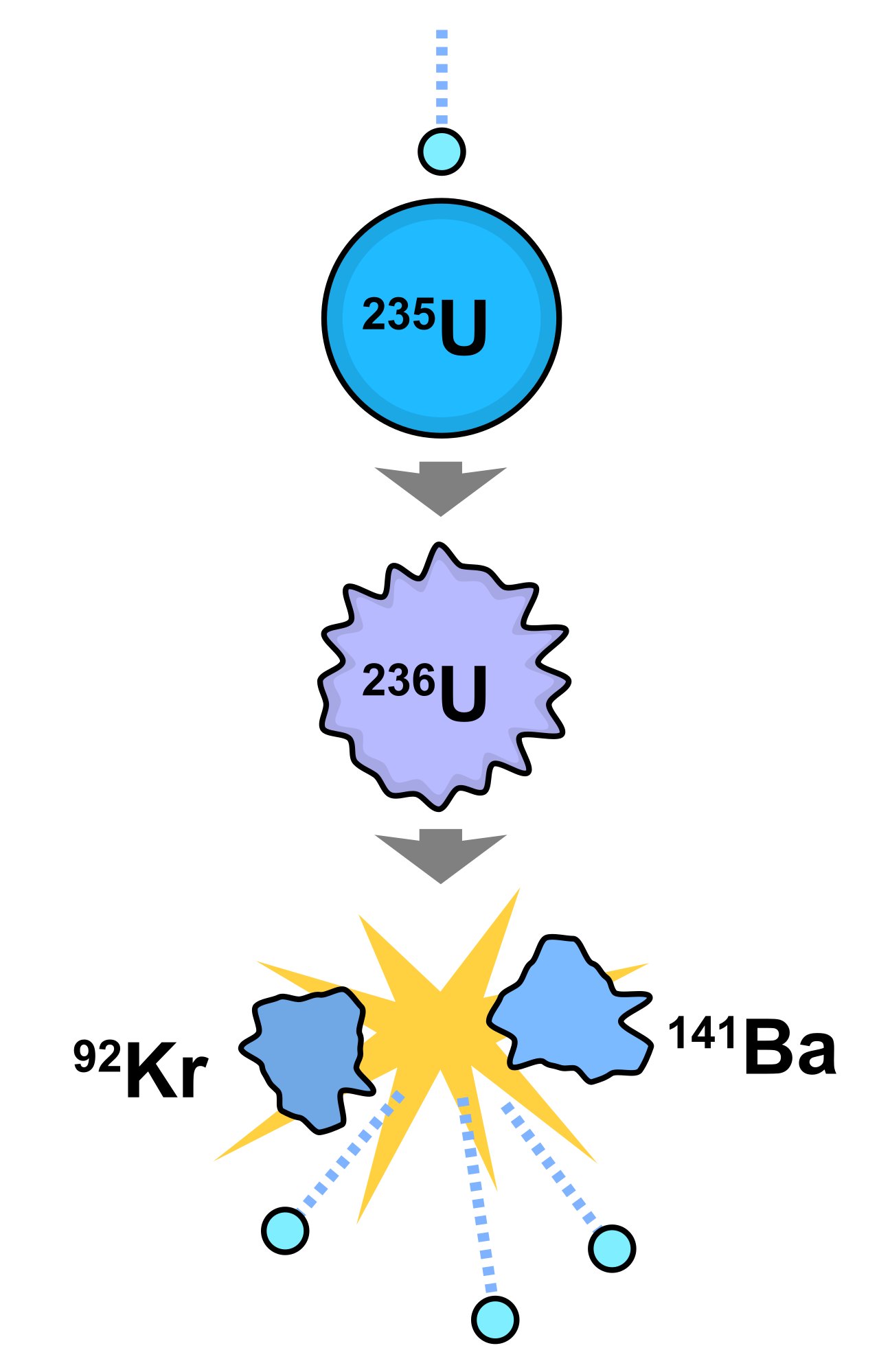
Nuclear fission is the process of splitting a heavy atomic nucleus into two or more lighter nuclei. When you violently split a massive, unstable atom (like Uranium-235), it leaves behind lighter elements and sheds a staggering amount of kinetic energy. Nuclear fission reactions release a massive amount of energy. This is the exact process used in modern nuclear power plants and to create certain medical isotopes in specialized reactors.
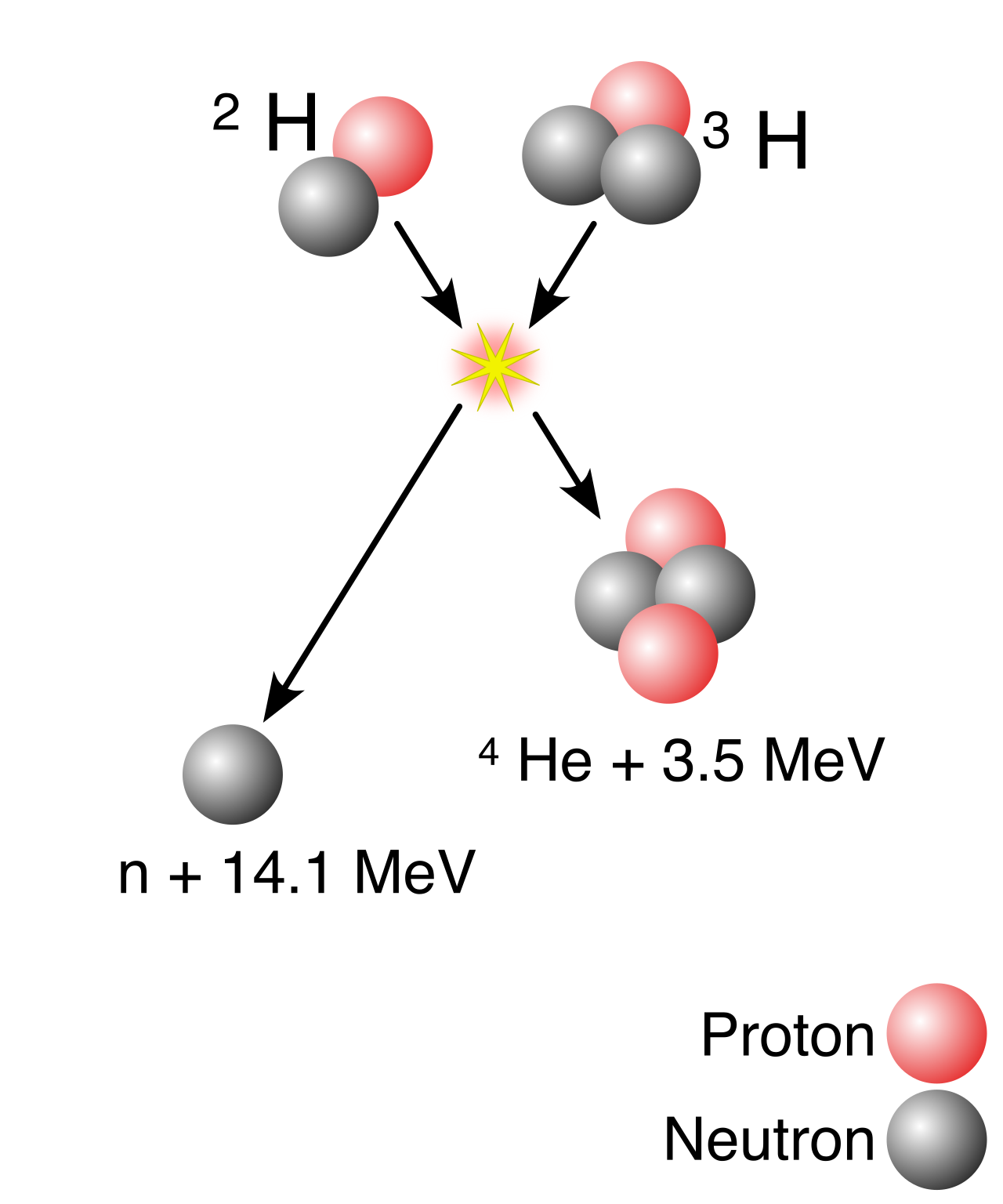
On the flip side, we have fusion. Nuclear fusion is the process of combining two light atomic nuclei to form a single heavier nucleus. Imagine taking two lightweight hydrogen atoms and smashing them together so hard that they melt into a single helium atom.
While fission is powerful, nuclear fusion releases a significantly larger amount of energy per gram of fuel than nuclear fission. It is the most powerful chemical process in the known universe. So powerful, in fact, that nuclear fusion is the primary energy source that powers stars. The light and heat you feel from the sun on your skin is the direct result of billions of tons of hydrogen fusing into helium every second.