Percentages and Commissions
Not sure you’re ready?
Take the ~3-minute readiness diagnostic and see where you stand.
In the physical world, gravity and electromagnetism dictate how objects interact. In the real estate market, percentages are the fundamental forces dictating how capital flows. Every transaction you will navigate—whether it is calculating the slice of a closing check that compensates your labor, determining the leverage a bank extends to a buyer, or projecting the decaying value of a physical asset—relies on a constant mathematical relationship between a part, a whole, and a rate. Grasping these relationships is not merely about passing an examination; it is about understanding the mechanical gears of real estate finance. You are about to map exactly how money moves through a property transaction.
Before we look at commissions or mortgages, we must establish the underlying mathematical engine that drives them all. Real estate math is almost entirely composed of three-variable equations. If you understand the relationship between these three variables, you never have to memorize a rote formula again.
To visualize this, professionals use the T-bar method. The T-bar method is a visual math tool that places the partial amount on the top half of the T and the total amount and rate on the bottom half.
| Part (The Slice) |
|---|
| Total (The Whole) × Rate (The Percentage) |
Here is the operational rule of the T-bar: the horizontal line represents division, and the vertical line represents multiplication.
- In the T-bar math method, the top number is always divided by the known bottom number to find the missing variable.
- In the T-bar math method, the two bottom numbers are multiplied together to find the top partial amount.
If you have the Part and the Total, you divide to find the Rate. If you have the Rate and the Total, you multiply to find the Part. Every single concept we are about to discuss—from the broker's fee to the bank's interest—is simply the T-bar method wearing different clothes.
A real estate commission is typically calculated as a percentage of the final property sales price. It is the cost of liquidity—the fee charged for matching a seller's illiquid asset with a buyer's cash.
Using our T-bar model, the "Total" is the sales price, the "Rate" is the commission percentage, and the "Part" is the commission paid. Therefore, the total commission amount equals the property sales price multiplied by the commission rate.
Calculating Total Commission: Total Commission = Final Sales Price × Commission Rate
If a Brooklyn townhouse sells for $1,500,000 and the negotiated commission rate is 6%, the math is straightforward: $1,500,000 × 0.06 = $90,000.

But what if you only have partial information? Algebra allows us to run the engine in reverse.
- To calculate the sales price based on a known commission amount and a known commission rate, divide the total commission amount by the commission rate (Sales Price = Commission / Rate).
- To calculate the commission rate based on a known commission amount and a known sales price, divide the total commission amount by the sales price (Rate = Commission / Price).
The Commission Cascade: Splits and Co-Brokerage
In a perfectly frictionless world, the listing broker would pocket that entire $90,000. In reality, the modern real estate market relies on cooperation.
A co-brokerage commission split distributes the total commission amount between the listing broker's firm and the selling broker's firm (the firm representing the buyer). If the listing agreement specifies a 50/50 split with a co-broker, our $90,000 total commission instantly becomes $45,000 for the listing firm and $45,000 for the selling firm.
Yet, as a salesperson, you are an independent contractor operating under an employing broker. You do not keep the firm's entire share. A salesperson's commission amount is calculated by multiplying the employing broker's share of the commission by the salesperson's agreed percentage split.
If your independent contractor agreement entitles you to a 60% split of your broker's earnings, your take-home pay on this transaction is 60% of $45,000, which equals $27,000. The money cascades down: from the gross sales price, to the total commission, to the firm's share, to your pocket.
Reverse Engineering: Net Amount to the Seller
Sellers rarely care about the gross sales price; they care about their net. The net amount to the seller after commission equals the gross sales price minus the total commission amount.
However, you will frequently encounter a client who dictates, "I need to walk away with exactly $940,000 to pay off my mortgage and fund my retirement. Price the property accordingly." How do you solve for the gross sales price when the commission depends on a sales price you don't yet know?
We factor the equation. If Gross Price - (Gross Price × Rate) = Net, then Gross Price × (100% - Rate) = Net.
Calculating Required Sales Price: Required Sales Price = Desired Net / (100% - Commission Rate)
To find the required sales price to yield a specific net amount to the seller after commission, divide the desired net amount by 100 percent minus the commission rate. If the seller needs $940,000 net, and you charge a 6% commission, you divide $940,000 by 0.94 (which is 100% - 6%). The required sales price is exactly $1,000,000.
Most buyers do not have $1,000,000 in liquid capital. They require leverage, which means they must rent capital from a bank.
Interest is the cost charged by a lender for borrowing money. Think of it as the rent paid on currency. Simple annual interest is calculated by multiplying the outstanding loan principal by the annual interest rate.
Simple Annual Interest Formula: Annual Interest Amount = Outstanding Principal × Annual Interest Rate
If a buyer secures a $800,000 loan at a 5% interest rate, the simple annual interest is $800,000 × 0.05 = $40,000.
Because mortgages are typically paid monthly, we must isolate the monthly cost. To find the monthly interest amount on a loan, divide the annual interest amount by 12. In our example, $40,000 divided by 12 yields a first-month interest charge of approximately $3,333.33.
Returning to our T-bar engine, we can rearrange these variables at will:
- To calculate the loan principal based on a known annual interest amount and interest rate, divide the annual interest amount by the annual interest rate.
- To calculate the annual interest rate based on a known annual interest amount and loan principal, divide the annual interest amount by the loan principal.
Risk Mitigation: Loan-to-Value (LTV) Ratio
Banks are fiercely protective of their capital. They use the Loan-to-Value (LTV) ratio, which expresses the mortgage loan amount as a percentage of the property value. LTV is the ultimate measure of lender risk.
The maximum permitted loan amount equals the property value multiplied by the lender's maximum Loan-to-Value ratio. If a lender allows an 80% maximum LTV on a $1,000,000 property, they will lend up to $800,000. Consequently, the required down payment percentage for a property purchase equals 100 percent minus the Loan-to-Value ratio percentage (in this case, 100% - 80% = 20% down payment).
Here is a critical rule that trips up many aspiring professionals: How does the bank determine the "Value" in Loan-to-Value? The property value used in a Loan-to-Value percentage calculation is the lesser of the appraised property value or the agreed purchase price.
Why? Because a bank will not fund a buyer's overpayment. If the purchase price is $1,000,000 but the appraisal comes in at $900,000, the bank uses $900,000 as the baseline value. If the maximum LTV is 80%, they will only lend $720,000 (80% of $900,000). The buyer must cover the gap in cash. Conversely, if the buyer secures a steep discount and buys for $900,000 when the appraisal says $1,000,000, the bank uses the $900,000 purchase price. The bank limits its exposure to the most conservative metric available.
Manipulating the Yield: Points and Origination Fees
Lenders often adjust their yield or compensate themselves upfront using points.
A discount point is an upfront fee paid to the lender at closing to lower the interest rate on a mortgage. By paying cash today, the buyer "buys down" the cost of the loan over time.
The foundational rule here is absolute: one mortgage discount point equals one percent of the total loan amount. Do not confuse the loan amount with the purchase price. Mortgage points are calculated based on the loan amount rather than the property purchase price.
Calculating Mortgage Points: Dollar Cost of Points = Loan Amount × Number of Points (as a %)
If a buyer purchases a $1,000,000 home with an $800,000 loan and pays 2 discount points, the dollar cost of mortgage points is calculated by multiplying the loan amount ($800,000) by the number of points expressed as a percentage (2%). The cost is $16,000.
Similarly, banks charge a fee merely to process and underwrite the loan. A loan origination fee is often expressed mathematically as points or as a percentage of the loan amount. If a bank charges a 1% origination fee on an $800,000 loan, the buyer pays $8,000 at closing just to secure the financing.
Physical assets are rarely static in value. Over time, market forces and physical entropy alter the worth of real property.
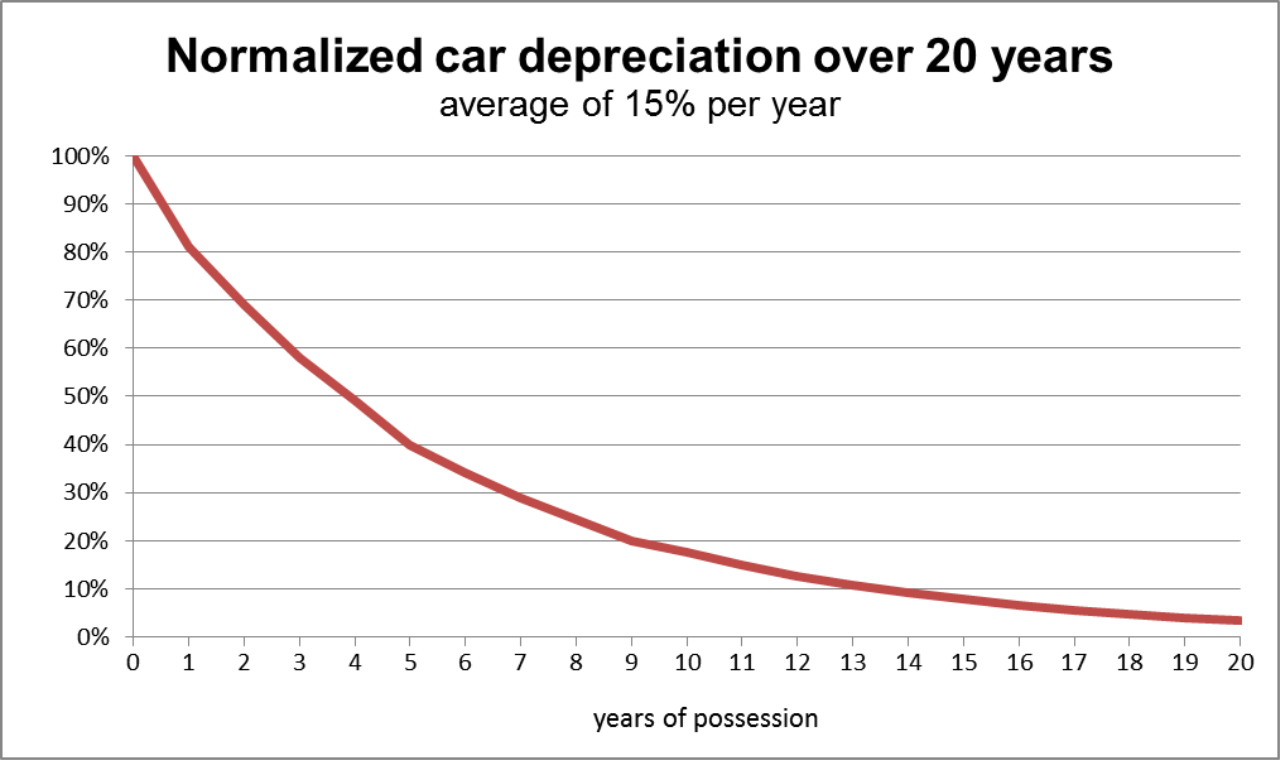
Appreciation is the increase in the financial value of a property over time. Conversely, depreciation is the decrease in the financial value of a property over time.
To quantify these changes, we apply the rate of change to the original baseline. The total dollar amount of property appreciation equals the original property value multiplied by the appreciation rate. If a $500,000 condo appreciates by 10%, the total dollar amount of appreciation is $50,000.
To bypass calculating the dollar amount and skip straight to the current value, you add the rate to 100% (or 1). The new property value after appreciation equals the original value multiplied by one plus the appreciation rate (Value × 1.10 = $550,000).
The same logic applies to loss. The total dollar amount of property depreciation equals the original property value multiplied by the depreciation rate. The new property value after depreciation equals the original value multiplied by one minus the depreciation rate. If a commercial asset loses 5% of its value due to market conditions, its new value is the original cost multiplied by 0.95.
Measuring Success: Rates of Return
When an investor sells an asset, they measure their success as a percentage of the capital they initially deployed.
The percentage rate of profit on a real estate investment is calculated by dividing the dollar profit amount by the original cost of the property. If an investor buys a parcel of land for $200,000 and sells it for $250,000, the dollar profit is $50,000. The profit rate is $50,000 / $200,000 = 25%.
If the market turns and they sell the $200,000 parcel for $160,000, they have suffered a $40,000 loss. The percentage rate of loss on a real estate investment is calculated by dividing the dollar loss amount by the original cost of the property. The loss rate is $40,000 / $200,000 = 20%.
Notice the recurring theme: whether calculating profit or loss, the denominator—the base of your calculation—is always the original cost of the property, not the final sales price. The past anchors the measurement of the future.
Mastering these calculations ensures that when a client looks at you across a closing table and asks, "What exactly is this costing me?", you are not fumbling for an app or a calculator. You will understand the architecture of their transaction from the ground up.