Scope of Antifraud Provisions
At the foundation of modern financial markets lies a simple, non-negotiable premise: capital cannot flow where trust does not exist. If investors cannot rely on the basic truthfulness of the information they receive, the entire architecture of the market collapses. To prevent this, lawmakers constructed a legal firewall to protect market integrity at the state level. Section 101 of the Uniform Securities Act governs antifraud provisions for securities transactions. It is the absolute, inescapable baseline of ethical conduct in the financial industry. For a securities professional, mastering this section is not merely a regulatory hurdle; it is understanding the physics of your profession—the universal laws that dictate what can and cannot be done when navigating the complex machinery of capital formation.
To understand the Uniform Securities Act (USA), we must first look to its federal ancestor. The antifraud provisions of the Uniform Securities Act are modeled closely after Rule 10b-5 of the Securities Exchange Act of 1934. Just as physicists rely on the laws of thermodynamics to explain energy transfer everywhere in the universe, regulators rely on these provisions to police the transfer of securities.
Under Section 101, the law establishes sweeping boundaries. Specifically, the Uniform Securities Act prohibits:
- Employing any device to defraud a person in connection with a securities transaction.
- Employing any scheme or artifice to defraud a person in a securities transaction.
- Making any untrue statement of a material fact during a securities transaction.
- Omitting a material fact necessary to make statements not misleading.
- Engaging in any business practice that operates as a fraud or deceit upon any person.
Notice the deliberate breadth of the language: any device, any scheme, any practice. Regulators know that human ingenuity is boundless, particularly when it comes to separating people from their money. Instead of trying to list every conceivable scam, the law establishes a universal catch-all for dishonesty.
The Gravity of a "Material Fact"
In the context of fraud, not all information carries the same weight. If an agent mistakenly tells a client that a prospectus is printed on recycled paper when it is not, that is technically an untrue statement. But does it matter?

The law focuses on the concept of materiality. A material fact under the Uniform Securities Act is information a reasonable investor would consider important when making an investment decision. If knowing a specific piece of information would alter a rational person's decision to buy, hold, or sell a security, it is material.
Crucial Distinction: A lie of omission is treated with the exact same severity as a lie of commission. The Uniform Securities Act prohibits omitting a material fact necessary to make statements not misleading. Disclosing partial truths that ultimately mislead an investor violates the Uniform Securities Act antifraud provisions. You cannot tell an investor about the brilliant upside of a new tech startup while conveniently "forgetting" to mention that the company's patent was just invalidated by a federal court.
When studying state securities law, you will spend hours memorizing complex exemptions. You will learn which securities don't have to be registered and which transactions are exempt from normal regulatory filing.
Forget all of that when it comes to Section 101.
There are zero exemptions from the antifraud provisions of the Uniform Securities Act for any securities transaction. None. Fraud is considered so corrosive to the market that the law offers no safe harbor.
To break this down:
- The Uniform Securities Act antifraud provisions apply regardless of whether the security is registered in the state.
- The Uniform Securities Act antifraud provisions apply strictly to securities that are exempt from state registration (such as U.S. government bonds or municipal securities).
- The Uniform Securities Act antifraud provisions apply strictly to transactions that are exempt from state registration (such as isolated non-issuer transactions or private placements).
Whether you are trading a highly regulated, fully registered blue-chip stock on an exchange, or facilitating an exempt private transaction between two institutions, the antifraud rules apply.
Furthermore, these rules govern the entire lifecycle of a trade. The antifraud rules of the Uniform Securities Act apply directly to the offer of any security, the sale of any security, and the purchase of any security. If fraud occurs during the mere offer of a security—even if no transaction ultimately takes place—a violation has occurred.
The Universality of the Actor
Who is subject to these laws? In short: everyone.
The Uniform Securities Act antifraud provisions apply to all persons conducting securities transactions. A "person" in this context could be a human being, a corporation, a partnership, or an estate.
Do not fall into the trap of thinking that only licensed professionals can be prosecuted for securities fraud. A person does not need to be registered as an agent to be subject to the Uniform Securities Act antifraud provisions. Similarly, a person does not need to be registered as a broker-dealer to be subject to the Uniform Securities Act antifraud provisions. If a retired school teacher, acting entirely on their own, manipulates a stock price or defrauds a neighbor in a securities transaction, they have violated Section 101.
Furthermore, the law is immune to clever structuring. The antifraud provisions of the Uniform Securities Act cover fraudulent actions committed directly by an individual, but they equally cover fraudulent actions committed indirectly through a third party. You cannot ask your cousin to spread a false rumor about a stock to pump its price and claim innocence because you didn't say it yourself.
While the reach of Section 101 is vast, it has a rigid jurisdictional boundary. The Uniform Securities Act antifraud provisions only apply to products explicitly defined as securities.
If an asset is not a security, the State Securities Administrator has no jurisdiction over it, and Section 101 does not apply. If fraud occurs in these non-security transactions, the victim must seek justice through general criminal fraud statutes, common law, or other specialized regulators—but not through the Uniform Securities Act.

| Asset Class | Governed by USA Antifraud Rules? | Why? |
|---|---|---|
| Common Stock | Yes | Explicitly defined as a security. |
| The Uniform Securities Act antifraud provisions do not apply to transactions involving physical real estate. | No | Physical real estate is not a security; it is regulated by state real estate commissions. |
| The Uniform Securities Act antifraud provisions do not apply to transactions involving traditional life insurance policies. | No | Traditional (non-variable) life insurance is regulated by state insurance commissioners. |
| The Uniform Securities Act antifraud provisions do not apply to transactions involving fixed annuities. | No | Fixed annuities carry no investment risk for the purchaser and are categorized strictly as insurance products. |
Note: If real estate is packaged into a Real Estate Investment Trust (REIT), or if an annuity is a Variable Annuity, they cross the threshold and become securities, immediately falling back under the jurisdiction of USA Section 101.
Understanding the abstract definitions is only half the battle for a Series 63 candidate. You must be able to recognize fraud in practice. Everyday pressures—the need to close a sale, the desire to reassure a nervous client, the temptation to cut a corner—can lead individuals across the line. Let us examine the specific behaviors that constitute clear violations of the Uniform Securities Act.
The Illusion of Endorsement
A foundational tenet of securities regulation is that regulators demand full disclosure, but they do not evaluate the quality of an investment.
- Stating that a state Securities Administrator has approved a security violates the Uniform Securities Act antifraud provisions. Administrators clear securities for sale; they never approve or endorse them.
- Claiming that a security's state registration equates to regulatory endorsement violates the Uniform Securities Act. Registration merely means the issuer filed the required paperwork and paid the fees. It is not a seal of safety.
Distorting Risk and Reality
Investment carries inherent risk, and any attempt to obscure that reality is deceitful.
- Promising guaranteed returns on equity investments violates the Uniform Securities Act antifraud provisions. Equities fluctuate based on market conditions. Guaranteeing a return on a stock is mathematically and legally impossible.
- Representing a speculative security as risk-free violates the Uniform Securities Act antifraud provisions. If you are selling a penny stock in a gold mining startup, framing it to a client as a "safe alternative to a savings account" is outright fraud.
- Exaggerating the past performance of a security violates the Uniform Securities Act antifraud provisions. You cannot alter historical data to make an investment look more attractive.
- Making baseless statements about a security's future exchange listing violates the Uniform Securities Act antifraud provisions. Telling a client, "Buy this now, it's going to be listed on the New York Stock Exchange next month," when you have no factual basis for that claim, is an illegal inducement.
Market Manipulation and Price Games
The market relies on the organic forces of supply and demand to set prices. Artificial interference destroys this mechanism.
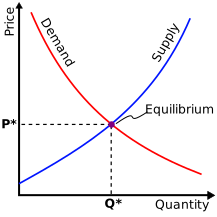
- Creating a false impression of active market trading for a security violates the Uniform Securities Act antifraud provisions. Practices like "wash trades" or "matched orders"—where investors buy and sell to each other rapidly to make a stock look hot—are highly illegal.
- Intentionally misquoting a stock's current market price violates the Uniform Securities Act antifraud provisions. Telling a client a stock is trading at $50 when it is actually trading at $45, perhaps to influence their decision or hide a loss, is straightforward fraud.
- Distributing false financial information about an issuer violates the Uniform Securities Act antifraud provisions. Pumping a stock by releasing fake earnings reports or fraudulent press releases corrupts the entire pricing mechanism of the market.
Information Asymmetry and Withheld Truths
As a financial professional, your clients rely on you to illuminate the dark corners of their transactions. Weaponizing your informational advantage against them is a strict violation.

- Failing to disclose known conflicts of interest to an investor violates the Uniform Securities Act antifraud provisions. If you are recommending a stock because your brother-in-law is the CEO, or because your firm is paying you a massive, undisclosed bonus to offload it, the client has a right to know. The conflict alters the nature of your advice—it is a material fact.
- Failing to inform a client of unusually high transaction fees constitutes a fraudulent omission under the Uniform Securities Act. While standard fees don't require advance disclosure in every casual conversation, if a transaction carries a fee that a reasonable investor would balk at, omitting that fee is a deceptive practice.
- Providing inside information to a client for trading purposes violates the Uniform Securities Act antifraud provisions. Insider trading—trading on material, non-public information—is not a perk of the job; it is a felony. Providing this information to a client makes you a "tipper" in an illegal scheme.
As you prepare for the Series 63, you must internalize Section 101 not just as a list of rules to memorize, but as the philosophical core of your future profession. When you execute trades, offer advice, or distribute prospectuses, you are handling the life savings, retirement dreams, and financial security of the public.
The Uniform Securities Act's antifraud provisions are unapologetically broad, strictly enforced, and universally applied because the cost of losing the public's trust is systemic collapse. Master this scope, understand where the boundaries lie, and respect the gravity of material facts. This knowledge is what separates an amateur looking for a quick commission from an elite, trusted professional in the capital markets.