Civil Liability and Private Remedies
In physics, when an equation becomes unbalanced, forces naturally act to restore equilibrium. The Uniform Securities Act (USA) operates on the exact same principle when a financial transaction is corrupted by illegality or deception. State securities law is not simply interested in punishing rule-breakers—that is the domain of criminal courts and state administrators. Instead, Section 410 of the USA establishes a rigorous mechanical framework designed to undo the mathematical damage of a mistake. If an agent or firm violates the rules of the transaction, the law empowers the client to force a complete financial reversal, returning the client’s capital as though the illegal transaction had never occurred in the first place.

To understand private remedies, we must first define exactly what actions tear the fabric of a legal securities transaction. Under the Uniform Securities Act, a client may bring a civil lawsuit against a seller if the seller violated state securities laws.
The most common triggers for these lawsuits are fundamental failures of disclosure or registration. Specifically, the Uniform Securities Act imposes civil liability on a person who sells an unregistered, non-exempt security. If the state requires a security to be registered and it is not—and it fails to qualify for an exemption—the sale is intrinsically flawed, regardless of whether the investment ultimately makes or loses money.
Furthermore, truth is the bedrock of the financial markets. Therefore, the Uniform Securities Act imposes civil liability on a person who sells a security using an untrue statement of a material fact. Similarly, silence can be just as destructive as a lie. The Uniform Securities Act imposes civil liability on a person who omits a material fact during the sale of a security. If an agent leaves out a piece of information that a reasonable investor would need to make an informed decision, they have triggered civil liability.
It is important to note that this framework extends beyond broker-dealers and their agents. Investment advisers face civil liability under the Uniform Securities Act for providing fraudulent investment advice. Whether through malicious intent or severe negligence, advice that deceives the client opens the door to immediate civil action.
When a violation occurs, the liability rarely stops at the individual who pushed the button. The law casts a wide net to ensure the client is made whole, utilizing a concept known as joint and several liability.
If an agent executes an illegal sale, the firm’s leadership is presumed responsible. Officers and directors of a broker-dealer are jointly and severally liable for the civil securities violations of the firm's agents. Furthermore, the net catches anyone on the ground who facilitated the act; an employee who materially aids in an illegal securities sale is jointly and severally liable with the primary violator. If an administrative assistant knowingly processes the paperwork for a fraudulent, unregistered stock sale, they share the liability.
The Ignorance Defense: Is there any escape from the blast radius? Yes, but the burden of proof rests on the leadership. A control person can avoid joint and several liability by proving a lack of knowledge of the facts constituting the securities violation. They must demonstrate that even with the exercise of reasonable care, they could not have known the illegal act was occurring.
The Survival of Liability and Tainted Contracts
Civil liability under the USA is remarkably durable. A common misconception is that a lawsuit dies if one of the involved parties passes away. This is mathematically untrue under state law. Under the Uniform Securities Act, civil liability survives the death of the plaintiff, meaning the victim's estate can continue the lawsuit to recover lost funds. Equally, civil liability survives the death of the defendant; the plaintiff can seek recovery directly from the deceased violator’s estate.
Furthermore, any legal agreement built on a violation is fundamentally radioactive. Contracts made in violation of the Uniform Securities Act cannot be enforced by the violating party. If you draft a contract requiring a client to buy an unregistered, non-exempt security, you cannot take that client to court to force them to pay. In fact, a person who knowingly makes an illegal contract under the Uniform Securities Act loses the right to base a lawsuit on that contract entirely. The law will not lend its power to enforce an illegal act.
If a client successfully sues an agent or firm, how much do they get? This is where candidates often make a critical mistake. They assume the client will win a massive windfall. But remember our opening principle: the USA seeks equilibrium, not retribution. Therefore, punitive damages are not awarded in civil lawsuits brought under the Uniform Securities Act.
The law simply reconstructs the client's finances as if they had never met the violator. The calculation of this recovery is precise.
In a successful civil lawsuit under the Uniform Securities Act, a purchaser is entitled to recover the original purchase price of the security. Because the client was deprived of the use of their capital, they are also compensated for lost time; the purchaser is entitled to recover interest at the state's legal rate.
To ensure the client does not suffer further financial harm from the process of seeking justice, a purchaser who wins a civil lawsuit under the Uniform Securities Act is entitled to recover reasonable attorney's fees, and is entitled to recover court costs.

However, the universe must balance perfectly. If the client received any financial benefit while holding the illegal investment, that benefit must be subtracted. In a successful civil lawsuit under the Uniform Securities Act, the purchaser's recovery amount must be reduced by any income received from the security (such as dividend or interest payments).
Broker-Dealer vs. Investment Adviser Recovery
The math looks slightly different depending on whether the lawsuit targets a broker-dealer's sale or an investment adviser's guidance.
| Liability Target | Recovery Formula |
|---|---|
| Seller / Agent | Original Purchase Price + State Legal Interest + Attorney's Fees + Court Costs - Income Received |
| Investment Adviser | A client suing an investment adviser under the Uniform Securities Act can recover the cost of the investment advice, plus any financial loss resulting directly from the investment advice, plus interest, attorney's fees, and court costs. |
Clients cannot hold an illegal trade over an agent's head forever. The law establishes a strict timeframe during which a civil claim must be filed.
The statute of limitations for bringing a civil lawsuit under the Uniform Securities Act is three years from the date of the sale. Alternatively, the statute of limitations for bringing a civil lawsuit under the Uniform Securities Act is two years from the discovery of the violation.
How do these two clocks interact? The law enforces whichever deadline arrives first. A civil lawsuit under the Uniform Securities Act is barred if not brought before the earlier of three years from the sale or two years from the discovery of the violation.
Example: An agent sells an unregistered, non-exempt security to a client on January 1, 2020. The client discovers the security was illegally sold to them on January 1, 2022.
- Clock 1 (3 years from sale): Expires January 1, 2023.
- Clock 2 (2 years from discovery): Expires January 1, 2024. Because the rule dictates the earlier of the two dates, the lawsuit is barred if not filed by January 1, 2023.
Imagine an agent realizes they have accidentally sold a client an unregistered, non-exempt security. Must they sit in terror, waiting up to three years for a lawsuit? No. The USA provides a mechanism to preemptively fix the mistake.
A seller can avoid civil lawsuits under the Uniform Securities Act by issuing a Letter of Rescission to the purchaser.
A Letter of Rescission is a written offer by a seller to buy back a security sold in violation of the Uniform Securities Act. It is an admission of error and a proactive offer to balance the equation before lawyers get involved.
To be valid, the math in the letter must perfectly mirror what a court would order. Therefore:
- A Letter of Rescission must include an offer to refund the original purchase price of the security.
- A Letter of Rescission must include an offer to pay interest on the purchase price at the state legal rate.
- Just as in a lawsuit, the refund amount offered in a Letter of Rescission must be reduced by any income the buyer received from the security.
What happens if the client already panicked and sold the security at a loss? The agent is still liable for the financial damage. If a buyer has already sold an illegally purchased security, a Letter of Rescission must offer damages equal to the original purchase price plus interest minus the resale price.
The 30-Day Ultimatum
When a client receives a Letter of Rescission, they cannot simply file it away and treat it as a free "put option" to use if the market crashes later. The law forces them to make a choice.
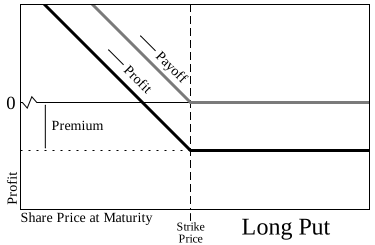
A buyer has 30 days to respond to a Letter of Rescission.
If the client ignores the letter, they forfeit their legal leverage. A buyer who fails to respond to a Letter of Rescission within 30 days loses the right to bring a civil lawsuit regarding that specific sale. By offering to make the client whole, the seller fulfills their obligation; if the client refuses to accept the money, the state will no longer allow them to clog the courts with a lawsuit over it.
However, if the client believes the calculation is wrong, or they wish to pursue the matter formally, they can explicitly reject the offer. A buyer who rejects a Letter of Rescission within 30 days retains the right to bring a civil lawsuit regarding that specific sale.
Why This Matters to You
As a future securities professional, mastering Section 410 is not just an academic exercise to pass the Series 63—it is your operational shield. Understanding the strict boundaries of civil liability, the precise triggers of the statute of limitations, and the exact mechanics of a Letter of Rescission allows you to navigate the inevitable errors of the financial industry without facing catastrophic personal ruin. You are learning the physics of financial consequence. Keep the equations balanced, and you will thrive.