Options Valuation and Rules
An option contract is fundamentally a probabilistic instrument with a built-in expiration date. When an investor purchases an option, they are not acquiring equity in a corporation or a debt obligation; they are acquiring a temporary, conditional right. The price of this right is dictated by the current reality of the underlying stock and the mathematical probability that this reality will change before the clock runs out. Because options are wasting assets—meaning their value inherently deteriorates as time passes—regulators impose strict, procedural safeguards on how broker-dealers permit clients to trade them. To master the regulatory framework of options trading for the Series 63 exam, one must first understand the anatomy of an option's pricing, as the financial mechanics directly dictate the regulatory requirements.
When a client wants to buy a call or a put, the total price an investor pays to purchase an option contract is known as the premium.
In the financial markets, this premium is never an arbitrary number. It is an exact equation composed of two distinct forces: immediate reality and future potential. Mathematically, an option's premium is the sum of the option's intrinsic value and the option's time value.
Premium = Intrinsic Value + Time Value
To understand how a contract is valued, we must isolate these two variables.
Intrinsic Value: The Immediate Reality
Intrinsic value is the absolute dollar amount by which an option contract is in-the-money. It represents the tangible, immediate value the option would possess if the investor exercised it this exact second. It is entirely independent of how much time is left on the contract; it relies solely on the relationship between the option's strike price and the current market price of the underlying stock.
The calculation of intrinsic value flips depending on whether the investor holds a call or a put:
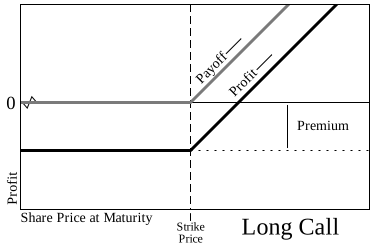
- Call Options: A call option gives the owner the right to buy stock. Therefore, a call option has intrinsic value when the underlying stock's market price is greater than the option's strike price. If a client owns a $50 call, and the stock is trading at $55, they have the right to buy a $55 asset for $50. The absolute dollar amount it is in-the-money is $5.
- Put Options: A put option gives the owner the right to sell stock. Thus, a put option has intrinsic value when the underlying stock's market price is less than the option's strike price. If a client owns a $50 put, and the stock drops to $40, they possess the right to sell a $40 asset for $50. The intrinsic value is $10.
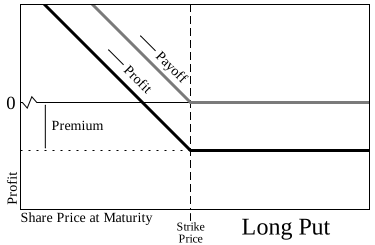
Crucially, an option cannot have negative intrinsic value. If the relationship between the strike price and the market price is unfavorable or perfectly equal, the intrinsic value hits a floor of zero.
| Option Status | Definition | Intrinsic Value |
|---|---|---|
| In-the-money (ITM) | The contract possesses immediate exercise value. | > $0 |
| At-the-money (ATM) | Market price perfectly equals the strike price. | Exactly $0 |
| Out-of-the-money (OTM) | The contract lacks immediate exercise value. | Exactly $0 |
Therefore, both an out-of-the-money option contract and an at-the-money option contract have an intrinsic value of zero.
Time Value and Time Decay: The Future Potential
If an out-of-the-money call has an intrinsic value of zero, why does it still cost money to buy? The answer is time.
Time value is the portion of an option's premium that exceeds the option's intrinsic value. It is the price the market assigns to the probability that an option will move into-the-money (or deeper into-the-money) before it expires.
If a client pays a $3 premium for an out-of-the-money call (Intrinsic Value = $0), the entire $3 premium consists of time value. If a client pays an $8 premium for a call with $5 of intrinsic value, the remaining $3 is the time value.
Because time only moves in one direction, time value is a decaying asset. Time value decreases as an option contract approaches the option contract's expiration date. If the underlying stock price remains perfectly flat, the option's premium will slowly evaporate simply because there is less time remaining for a favorable price swing to occur.
This continuous decrease in an option's time value as the expiration date approaches is known as time decay. You can think of an option like an hourglass; the sand is constantly slipping through the neck. The final mathematical certainty of an option is that an option contract's time value becomes zero precisely at the option's expiration. At that exact moment, the premium equals strictly the intrinsic value—nothing more.

Because options suffer from time decay and offer leveraged exposure, they possess risk profiles drastically different from standard equities. A client can buy a share of stock and hold it forever, waiting for a recovery. An option purchaser does not have that luxury; if they are wrong by the expiration date, they lose their entire premium.
Due to these amplified risks, securities regulations and FINRA Rule 2360 dictate a rigid, highly specific sequence of events that a broker-dealer agent must follow to open an options account.
Step 1: Client Assessment
Before any paperwork is signed, a broker-dealer must ascertain a customer's investment objectives before approving a customer account for options trading. Similarly, a broker-dealer must ascertain a customer's financial situation before approving a customer account. You cannot allow a client to buy a decaying asset without first confirming they have the risk tolerance and capital to absorb a total loss of their premium.
Step 2: The Disclosure Document
Once the agent understands the client's financial posture, the client must be educated on what they are buying. A broker-dealer must provide a customer with the official Options Disclosure Document to open an options account.
This is not an internal firm brochure; it is a standardized, industry-wide publication. The official Options Disclosure Document is titled Characteristics and Risks of Standardized Options.
Timing here is critical for the exam: The Options Disclosure Document must be delivered to a customer at or prior to the time the customer's options account is approved.
Step 3: Formal ROP Approval
A standard broker-dealer agent cannot unilaterally authorize a client to begin trading options. A Registered Options Principal (ROP) must officially approve a customer's account for options trading. The ROP acts as the firm's gatekeeper, ensuring the client's financial situation aligns with the risks outlined in the ODD.
Most importantly, a broker-dealer must approve a customer account for options trading before the entry of the initial options order in that account.
Step 4: Recordkeeping Requirements
Regulators expect absolute, verifiable chronological proof that these steps were followed in the correct order. Consequently, a broker-dealer must permanently record the specific date the Options Disclosure Document was furnished to a customer. Furthermore, the broker-dealer must permanently record the specific date the customer's options account was approved by the Registered Options Principal.
Here is a unique facet of options regulation that regularly tests candidates: A client can actually begin trading options the moment the ROP approves the account, even though the client hasn't signed the final paperwork yet.
However, they are placed on a strict countdown. A customer must sign a written options agreement to maintain an active options trading account. A customer must return the signed options agreement to the broker-dealer within 15 days of the options account approval date.
Why is this document so critical? The signed options agreement serves as legally binding proof of four things. It:
- Provides formal verification that the customer has received the Options Disclosure Document.
- Provides formal verification that the customer understands the risks outlined in the Options Disclosure Document.
- Verifies that the customer agrees to abide by the rules of the Options Clearing Corporation (the central clearinghouse that issues and guarantees all listed options).
- Establishes ongoing communication obligations. Specifically, the options agreement requires a customer to notify the broker-dealer of material changes in the customer's financial situation, and it requires a customer to notify the broker-dealer of material changes in the customer's investment objectives (e.g., losing a job, approaching retirement).
The Penalty Box: Missing the 15-Day Deadline
What happens if a client ignores your emails, goes on vacation, and fails to sign the document?
The broker-dealer must restrict the customer's options trading if the customer fails to return the signed options agreement within 15 days of account approval.
Important Distinction: The account is not completely frozen, nor are their existing positions liquidated. Instead, an options account restricted for a missing options agreement is limited exclusively to closing transactions.
To understand this restriction, you must separate options trades into two categories: opening transactions (which create or add to a position and thus increase risk) and closing transactions.
A closing transaction in an options account is a trade that reduces an existing options position, or a trade that eliminates an existing options position entirely.
If your client bought 5 Apple call options on Day 2 of their account being open, and on Day 16 they still haven't returned the signed agreement, they cannot buy more Apple calls, nor can they buy puts on Microsoft. They are prohibited from opening new risk. They are, however, fully permitted to sell their 5 Apple call options back to the market. Selling those existing calls is a closing transaction—it eliminates their existing position, thereby reducing their market exposure, which perfectly aligns with the regulator's goal of protecting an unverified client.