State Conduct Standards and NASAA Statements of Policy
Imagine giving someone the keys to your car, your bank account, and your future, all at once. When a client opens a brokerage account, they are performing an act of profound vulnerability. The NASAA Statement of Policy on Dishonest or Unethical Business Practices exists because the financial industry is fundamentally an architecture of trust. As an agent, you operate at the nexus of your client's resources and the complex machinery of the capital markets. The rules governing your conduct are not mere bureaucratic hurdles; they are the physical laws of your profession, designed to prevent the collapse of the trust that makes financial markets possible.

If you want to pass the Series 63 and survive in this industry, you cannot merely memorize these rules as a list of "don'ts." You must understand why they exist. Let us dissect the mechanics of ethical conduct, examining exactly where the boundaries lie.
At the core of your relationship with a client is the mandate that your actions must serve their specific realities. You are a diagnostician; you cannot prescribe medicine without examining the patient.
Agents must not recommend the purchase or the sale of a security without reasonable grounds to believe the transaction is suitable. Suitability determinations require you to rigorously examine the customer's investment objectives and their financial situation and needs. Because every client's financial geometry is distinct, agents must not make a blanket recommendation of the same security to all customers regardless of suitability. If you blast an email to 500 clients urging them to buy a volatile tech startup, you have failed this fundamental test.
Friction in the Machine: Churning
Every time you trade a client's account, it generates friction in the form of costs. Inducing excessive trading in a customer account to generate commissions is a prohibited practice known as churning.
How does regulators determine if an account is being churned? It is not just a raw number of trades. Churning determinations require evaluating the financial resources of the customer, the investment objectives of the customer, and the character of the customer account. Fifty trades a month might be perfectly suitable for an aggressive day-trading account funded by a multi-millionaire, but those same fifty trades in the conservative retirement account of a fixed-income pensioner constitute textbook churning. Agents must not induce excessive trading under any circumstances.
If you execute a transaction on behalf of a customer without specific authorization, you are crossing a bright ethical line. You cannot act on a "hunch" that your client would want a stock.
The Rules of Discretion
Discretionary authority allows you to decide the asset, the amount, or the action (buy/sell). Agents must not exercise discretionary power in effecting a transaction without prior written authority from the customer.
However, the market moves fast, and regulators carved out a precise exception for execution mechanics. A customer may grant an agent verbal discretionary authority for a specific transaction regarding solely time and price. For example, a client says, "Buy 1,000 shares of Apple today whenever you think the price is best."
Crucial Limitation: Verbal discretionary authority for time and price is only valid until the end of the business day. If the day ends and you haven't bought the shares, you cannot buy them tomorrow without fresh authorization.
Furthermore, you are bound by the client's identity. Agents must not execute a transaction on behalf of a customer upon the instruction of a third party without written third-party trading authorization. If a client's spouse calls demanding you liquidate a portfolio, unless you have that written authorization on file, your answer is a polite but firm "no."

A broker-dealer is a custodian of assets. Delaying or mismanaging those assets is tantamount to theft. Broker-dealers must not cause unreasonable delays in the delivery of securities purchased by customers, nor can they cause unreasonable delays in the payment of free credit balances upon customer request. When a client asks for their uninvested cash, you send it promptly.
Margin and Segregation
When clients borrow money to buy stock (margin), the risk profile of the firm changes. Yet, in the fast-paced reality of trading, requiring paperwork before a trade can cause missed opportunities. Thus, the rule states: Broker-dealers and agents must secure a properly executed written margin agreement promptly after the initial transaction in a margin account. You must not execute a transaction in a margin account without ensuring this agreement is secured right after that first trade.
Behind the scenes, assets must be strictly walled off. Broker-dealers must not fail to segregate customers' free securities and securities held in safekeeping. If a client holds fully paid stock, it cannot be mixed with the firm's inventory. Furthermore, broker-dealers must not hypothecate (pledge as collateral for a loan) a customer's securities without having a properly executed written consent from the customer.
Pricing Integrity
In all transactions, broker-dealers must not enter into a transaction with a customer at an unreasonable price, nor can they charge unreasonable commissions for broker-dealer services. What is "unreasonable" is dictated by current market conditions, the expense of executing the order, and the value of the services rendered.
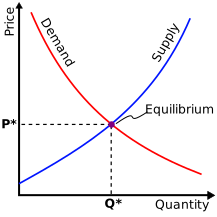
Securities markets operate on the assumption of genuine supply and demand. Faking this data is a severe violation.
- Fictitious Accounts: Agents must not establish or maintain an account containing fictitious information to execute transactions.
- Wash Trades: Agents must not effect transactions that involve no change in the beneficial ownership of a security. Buying and selling the same stock simultaneously through different accounts to create the illusion of trading volume is a manipulative practice known as a wash trade.
- Fictitious Quotes: Agents must not publish fictitious quotations for any security.
Front Running and Insider Trading
If you know a massive institutional client is about to buy 500,000 shares of a small-cap stock, the price is almost certainly going to jump. Agents must not purchase or sell a security for their own account based on advance knowledge of a pending customer order. This prohibited practice is known as front running. You cannot step in front of the client's market impact.
Similarly, agents must not effect securities transactions based on material, nonpublic information, commonly referred to as inside information. Not only are you prohibited from trading on it, but agents must not communicate material, nonpublic information to others to facilitate securities transactions.
The Myth of Guarantees
The market is inherently risky. Therefore, agents must not guarantee a customer against loss in any securities account, nor can they guarantee against loss in any specific securities transaction. If an agent says, "I'll cover your losses if this stock drops," they are violating state law.
When the lines between an agent's personal wallet and a client's account blur, disaster usually follows. The rules here are exceptionally strict.
Borrowing and Lending
As a baseline: Agents are prohibited from borrowing money or securities from a customer, and agents are prohibited from lending money or securities to a customer.
However, there are specific, logical exemptions based on the nature of the relationship:
| Permitted Borrowing (Agent borrowing from client) | Permitted Lending (Agent lending to client) |
|---|---|
| The customer is a financial institution engaged in the business of loaning funds (e.g., a bank). | The agent's broker-dealer is a financial institution engaged in the business of loaning funds. |
| The customer is an affiliate of the agent. | The customer is an affiliate of the agent. |
| The customer is an immediate family member of the agent. | The customer is an immediate family member of the agent. |
Profit and Loss Sharing
Can you share in a client's trading profits or losses? Yes, but only if you jump through specific administrative hoops. Agents must not share directly or indirectly in profits or losses in the account of any customer without written authorization from the customer AND written authorization from the employing broker-dealer. Both parties must agree in writing.
Selling Away
Agents must not effect securities transactions not recorded on the regular books of the broker-dealer. Running side-deals or shadow transactions is an unethical practice known as selling away.
Exception: An agent may effect a securities transaction outside the broker-dealer's regular books if authorized in writing by the broker-dealer prior to execution. Notice the sequence: the permission must be written, and it must arrive before the trade happens.
Mutual funds have complex fee structures, making them ripe for unethical manipulation. Regulators demand absolute transparency.
The "No-Load" Definition
You cannot simply call a fund "no-load" because there is no upfront fee.
- Agents must not state that an investment company is sold without a commission if the fund charges a front-end load.
- Agents must not state it is sold without a commission if it charges a contingent deferred sales load (back-end fee).
- Agents must not state a fund is no-load if the fund has a 12b-1 fee exceeding 0.25 percent (25 basis points) of average net fund assets per year.
- Agents must not state a fund is no-load if the fund has a service fee exceeding 0.25 percent of average net fund assets per year.
Breakpoints and Client Value
A breakpoint is the minimum dollar amount of investment required to qualify for a volume discount on a mutual fund sales charge. For example, investing $25,000 might trigger a lower percentage fee.
Because lower fees mean lower commissions for the agent, a malicious agent might keep the client in the dark. Agents must not recommend the purchase of investment company shares in amounts just below a breakpoint to avoid reducing the sales charge. This is an unethical practice known as a breakpoint sale.
To ensure clients get the best deal, agents must disclose relevant sales charge discounts on the purchase of shares in related investment company families and must disclose letters of intent (LOI) features that reduce mutual fund sales charges by allowing the client to reach a breakpoint over 13 months.
Fund Comparisons and Dividends
Mutual funds are built for specific purposes. Agents must not recommend buying different investment company portfolios with similar investment objectives to a customer without reasonable justification. (Why put a client in three different large-cap growth funds and charge them three sets of fees?)
Furthermore, recommending the purchase of mutual fund shares just before an ex-dividend date solely to capture the dividend is a prohibited practice known as selling dividends. Why? Because the fund price drops by the amount of the dividend, giving the client zero economic gain, but generating a taxable event for the client.
Finally, do not misrepresent the nature of fund yields. Agents must not state that an investment company's current yield constitutes a representation of future dividend payments or future capital gains. And when speaking to conservative clients, agents must not compare the performance of investment company shares to savings accounts without disclosing the differences in risk and the differences in guarantees (e.g., FDIC insurance).
The integrity of the market relies heavily on the information agents project to the public. Agents must not use advertising that contains any untrue statement of material fact. Just as importantly, agents must not fail to state a material fact necessary to make the statements made in advertising not misleading. Omitting a devastating risk factor is just as unethical as inventing a fake guarantee.
The Approval Myth
Regulators do not bless securities; they enforce disclosure. Therefore:
- Agents must not state that a security has been approved by the Securities and Exchange Commission (SEC).
- Agents must not state that a security has been approved by a state securities administrator.
- Agents must not represent that a broker-dealer registration implies approval by any regulatory body.
- Agents must not represent that an agent registration implies approval by any regulatory body.
Registration simply means you filed the proper paperwork and passed the required exams; it is not a government endorsement of your character or business acumen.
Handling Complaints
When the relationship breaks down, the regulators mandate a formal paper trail. Broker-dealers must respond to all formal written customer complaints. Notice the word written. A client yelling at you on the phone does not trigger the formal complaint resolution protocols. But the moment a complaint is reduced to writing (email, letter, text message), the clock starts. Consequently, agents must not conceal written customer complaints from the employing broker-dealer. Hiding a written complaint is a fast track to license revocation.
By internalizing these standards, you are not merely preparing to pass a test. You are learning the structural engineering required to maintain trust in an inherently complex, risk-laden financial system. Honor the boundaries, respect the client's resources, and keep your practice strictly in the light.