Customer Account Communications and Records
Trust in the financial markets is not an abstract virtue; it is a meticulously documented paper trail. When capital changes hands, the only difference between an orderly market and absolute chaos is the existence of verifiable, immutable records. As a General Securities Representative, your interactions with clients—every trade you execute, every statement you generate, and every account you open or close—form a continuous stream of legal evidence. Understanding the rules governing customer communications, account transfers, and record retention is not merely an exercise in regulatory compliance. It is the mechanics of how the industry protects the investing public and preserves its own structural integrity.
To manage a client's wealth is to maintain a constant, formalized dialogue about where their money is and what it is doing. This dialogue takes two primary forms: trade confirmations and account statements.
Trade Confirmations
A trade confirmation is the definitive receipt of a securities transaction. The cardinal rule of confirmations dictates that a broker-dealer must send a trade confirmation to a customer at or before the completion of a transaction. In the securities industry, the "completion" of a transaction is generally the settlement date—the moment when securities and funds officially change hands.
Because a broker-dealer can wear different hats when executing a trade, a customer trade confirmation must disclose the capacity in which the broker-dealer acted. This transparency prevents hidden conflicts of interest and dictates how compensation is reported:
- Acting as an Agent: The firm matches a buyer and seller. A broker-dealer acting as an agent must disclose the exact amount of commission charged on the trade confirmation.
- Acting as a Principal: The firm trades directly from its own inventory. A broker-dealer acting as a principal must disclose any markup or markdown on the trade confirmation for certain securities (such as corporate and agency debt).
Furthermore, a broker-dealer must disclose any control relationship with the issuer of a security on the trade confirmation. If your firm is executing a trade in the stock of its own parent company, the customer has a fundamental right to know about that relationship before settling the trade.
Account Statements
While confirmations document individual events, account statements provide the aggregate picture. The frequency of this communication depends entirely on the activity and risk profile of the account.
Broker-dealers must send customer account statements monthly for accounts with activity during that month. Account activity triggering a monthly statement requirement includes:
Even if an account sits entirely dormant, the industry requires periodic check-ins. Broker-dealers must send customer account statements at least quarterly for inactive accounts.
Risk Exemption: There is a specific trigger that bypasses the "activity" rule. Broker-dealers must send customer account statements monthly for accounts holding penny stocks, regardless of whether any trades occurred. Because penny stocks are highly volatile and inherently risky, regulators mandate that investors receive a monthly visual of their position's value.
Holding Customer Mail
Clients often travel, but the flow of financial information cannot simply be paused without strict parameters. A broker-dealer may hold customer mail for up to three months if the customer provides written instructions.
If a client requests a hold beyond three months, the rules become much stricter. Holding customer mail for longer than three months requires the customer to provide an acceptable reason related to safety or security. Convenience is not an acceptable reason to hold customer mail for longer than three months. Regulators view account statements as the primary tool for clients to detect unauthorized trading or fraud; indefinitely suspending mail for mere convenience creates an unacceptable blind spot.
Capital is mobile. When a customer decides to move their assets from one broker-dealer to another, the transition relies on the Automated Customer Account Transfer Service (ACATS). ACATS is the central nervous system for institutional asset transfers, standardizing what would otherwise be a chaotic process.
The process begins with the customer's authorization. A customer must sign a Transfer Initiation Form (TIF) to begin the ACATS process.
- The customer submits the Transfer Initiation Form to the receiving broker-dealer (their new firm).
- The receiving broker-dealer then submits the TIF into the ACATS system.
- Upon receiving the ACATS request, the carrying firm (the old firm) has one business day to validate the transfer instructions.
- After validating the instructions, the carrying firm has three business days to complete the transfer of assets.
Exceptions, Rejections, and Non-Transferable Assets
The carrying firm cannot arbitrarily halt a transfer to retain assets, but they can and will reject a transfer if the foundational data is flawed. A carrying firm may reject a transfer request due to a mismatch in the social security number or a mismatch in the account title (e.g., trying to transfer an individual account into a joint account). However, a carrying firm cannot reject a transfer request because the customer owes a non-transfer-related debt to the firm.
While ACATS handles most standard securities flawlessly, some assets simply cannot be transferred. Non-transferable assets typically include:
- Proprietary mutual funds managed exclusively by the carrying firm.
- Securities belonging to a bankrupt issuer.
When faced with non-transferable assets, customers have a choice. Customers can instruct the carrying firm to liquidate the non-transferable assets and transfer the cash, or they can instruct the firm to retain the non-transferable assets in the original account.
A firm is permitted to charge a reasonable fee for transferring an account to another broker-dealer, but the carrying firm must explicitly disclose any account transfer fees to the customer.
The Aftermath: Residual Balances
Even after an account is formally transferred, it is common for late dividends or interest to arrive at the old firm. A carrying firm must transfer residual credit balances within ten business days of accrual. To ensure the client does not lose track of these late-arriving funds, the requirement to transfer residual credit balances automatically lasts for six months after the initial account transfer.
A broker-dealer is defined by the records it keeps. The SEC and FINRA mandate a highly structured retention schedule, ensuring that investigators, auditors, and the firm itself can reconstruct events years after they happen.
Record retention periods are based on the fundamental nature of the document. The foundational architecture of the firm must be kept permanently, while daily transaction receipts are kept for shorter durations.
| Retention Period | Required Documents | Rationale |
|---|---|---|
| Lifetime | • Partnership articles<br>• Articles of incorporation<br>• Minute books<br>• Stock certificate books | These documents form the legal existence and corporate governance of the firm. |
| 6 Years | • Blotters (daily records of all activity)<br>• General ledgers (accounting records)<br>• Stock records (positions held)<br>• Customer account records (new account forms) | These are the primary financial and structural records. Note: Customer account records must be retained for six years after the account is closed. |
| 4 Years | • Customer complaints | Regulators heavily scrutinize complaint history to identify patterns of sales practice violations. |
| 3 Years | • Trade tickets (order tickets)<br>• Customer trade confirmations<br>• Customer account statements<br>• Retail communications | These capture the day-to-day interactions, trades, and marketing materials. |
Storage Logistics and Security
To ensure auditors can swiftly access recent data, broker-dealers must keep three-year and six-year records in a readily accessible location for the first two years.
Modern recordkeeping is heavily digitized, which introduces the risk of data manipulation. Therefore, electronic records must be stored in a Write-Once Read-Many (WORM) format. The WORM format prevents electronic records from being altered or erased, providing an immutable mathematical guarantee that a document reviewed during an audit is exactly the same document created at the time of the event.

The death of a customer is a critical legal juncture. When an account owner dies, the registered representative's primary duty shifts instantly from wealth generation to asset preservation.
Immediate Actions Upon Death
A registered representative must freeze a customer account immediately upon learning of the customer's death. You must cancel all open orders immediately and mark the account as deceased. At this stage, no further trading or distributions can occur until legal authority over the assets is firmly established.
The Paperwork of Estate Transfer
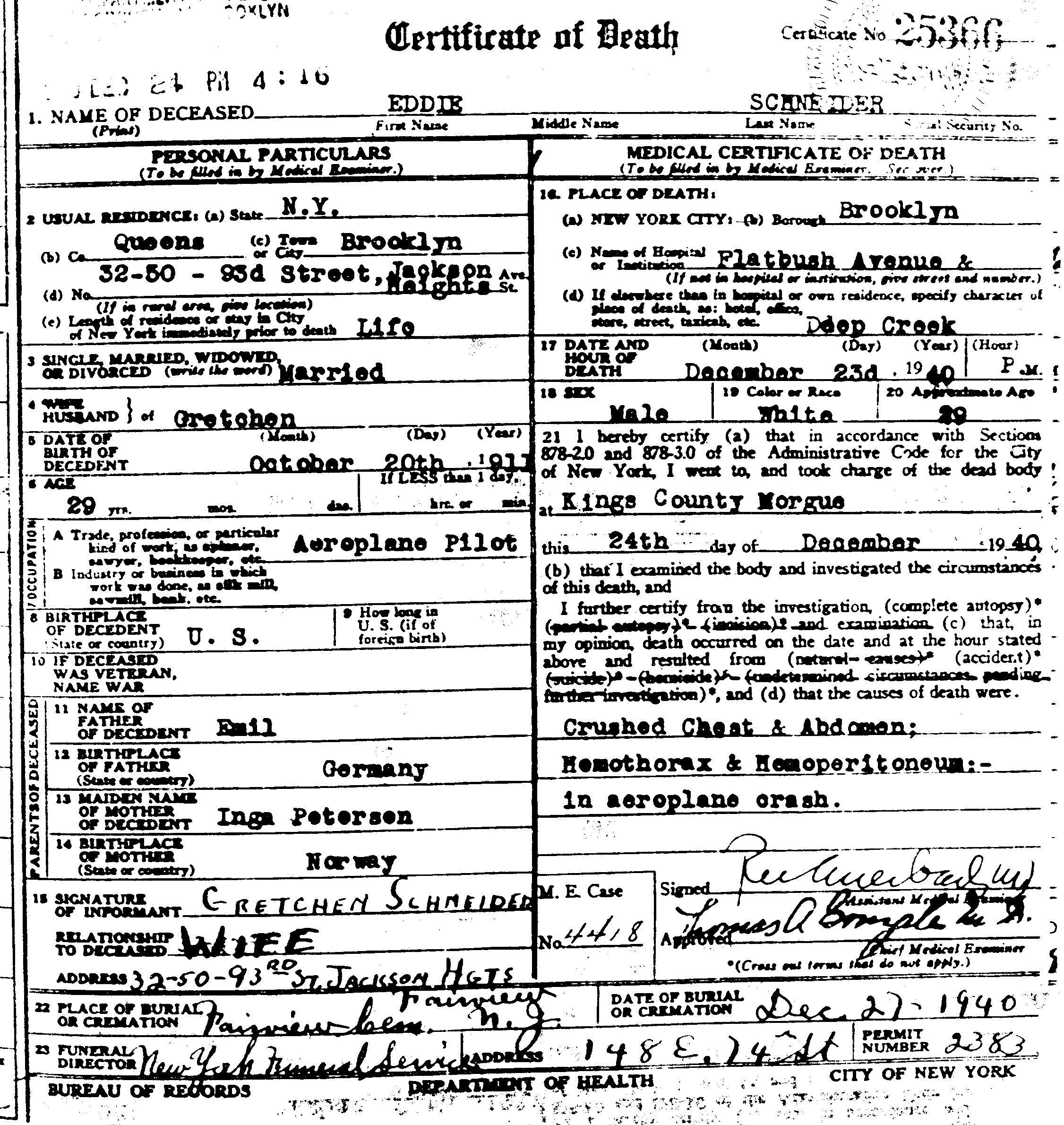
To unfreeze the account and distribute assets, the broker-dealer requires highly specific documentation. The foundational document is a certified death certificate, which a broker-dealer requires to process the transfer of deceased customer assets.
Depending on the state and the nature of the estate, additional documentation is often necessary:
- Affidavit of Domicile: A broker-dealer requires an affidavit of domicile to confirm the legal residence of a deceased customer. This is crucial because state laws dictate the probate process.
- Inheritance Tax Waiver: A broker-dealer requires an inheritance tax waiver to process the transfer of deceased customer assets in certain states, ensuring the state has no tax claim on the assets before they are moved.
- Letters Testamentary: A broker-dealer requires letters testamentary to identify the executor of a deceased customer's estate. This court-issued document proves the executor has the legal authority to command the assets.
How Account Structure Dictates the Outcome
The mechanics of what happens to the assets upon death depend entirely on the legal structure of the account:
- Joint Tenants with Rights of Survivorship (JTWROS): This structure is specifically designed to bypass probate. The surviving owner must simply provide a death certificate to assume full ownership of the entire account.
- Tenants in Common (TIC): In this joint structure, ownership is strictly partitioned. A deceased owner's fractional interest passes directly to the deceased owner's estate, not to the surviving account holder. The living owner retains their fraction, and the executor takes control of the deceased's fraction.
- Partnership Accounts: Because a partnership is a legal entity comprising specific individuals, the death of a partner requires the broker-dealer to freeze the partnership account. A frozen partnership account remains frozen until the broker-dealer receives a new or amended partnership agreement that reflects the revised legal structure of the business entity.