Investment Risks, Returns, and Disclosures
In physics, energy is never free; it is extracted at the cost of entropy and mechanical friction. The financial markets operate on identical principles. When you place a client’s capital into a security, the return they seek is the energy. To capture it, they must absorb inherent risks and overcome the mechanical friction of broker fees, regulatory costs, and taxation. As a registered representative, your primary job is not predicting the future—it is accurately measuring these forces so your clients understand precisely what they are buying.
Before we calculate returns, we must define the forces acting against a portfolio. In the financial ecosystem, risk is broadly divided into forces that act on the entire environment and forces that act on individual components.
Macroscopic Forces: Systematic Risk
Systematic risk represents the risk inherent to the entire market. Because it is a macroeconomic tide that lifts or lowers all boats, systematic risk cannot be eliminated through portfolio diversification. To quantify this exposure, we use beta, a metric that measures the systematic risk of an investment relative to the overall market. The market itself has a beta of exactly 1.0. Therefore, an investment with a beta greater than one exhibits higher volatility than the overall market.
Several specific forces fall under the umbrella of systematic risk:
- Interest Rate Risk: This is the systematic risk that bond prices will fall when prevailing interest rates rise.
- Duration: To measure this specific volatility, we use duration, a metric that measures a fixed-income security's price sensitivity to changes in interest rates. Think of duration as a mechanical lever: long-term bonds possess higher duration and greater interest rate risk than short-term bonds.
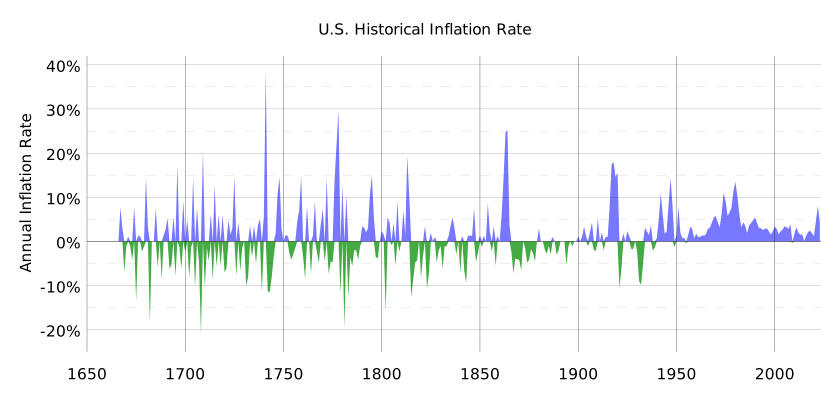
- Purchasing Power Risk: This is the risk that inflation will erode the real value of an investment's returns. Because their coupon payments are static, fixed-income securities carry higher purchasing power risk compared to equity securities.
- Reinvestment Risk: This is the risk that future cash flows from an investment must be reinvested at lower prevailing interest rates. For example, callable bonds expose investors to high reinvestment risk because issuers recall them precisely when rates drop. Conversely, zero-coupon bonds carry zero reinvestment risk during the life of the bond because they generate no periodic cash flows to reinvest.
Microscopic Forces: Nonsystematic Risk
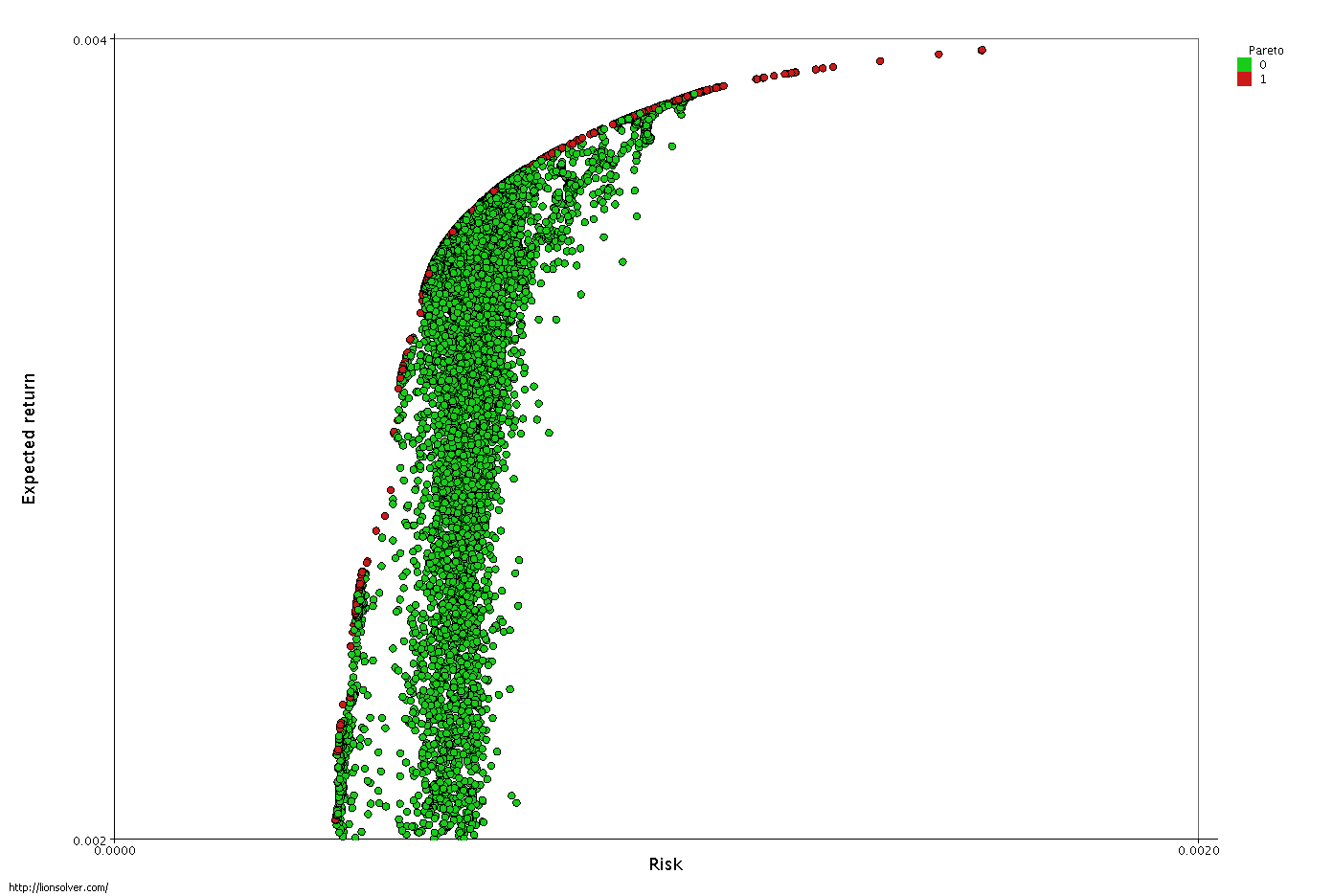
Nonsystematic risk represents the risk specific to a single company or industry. Unlike its macro counterpart, nonsystematic risk can be significantly reduced through portfolio diversification. If you effectively diversify away this risk and still beat the market, you are generating alpha, a metric that measures an investment's excess return relative to the expected risk-adjusted return.
Nonsystematic risk takes several forms:
- Business Risk: The nonsystematic risk that a specific company will fail due to poor management or uncompetitive products.
- Financial Risk: The risk that a company will default on debt obligations due to excessive leverage.
- Regulatory Risk: The risk that new government agency rules will negatively impact a specific business or industry.
- Legislative Risk: The risk that new statutory laws will negatively impact the value of an investment. For investors, tax code modifications are a primary source of legislative risk.
- Political Risk: The risk that government instability in a foreign country will negatively impact investments in that region.
Contextual and Mechanical Risks
Beyond the broad market and specific companies, the structure of an investment introduces unique hazards:
- Liquidity Risk: The risk that an asset cannot be sold quickly without accepting a significant price discount.
- Timing Risk: The risk that an investor incurs losses by buying or selling an asset at an inopportune point in the market cycle.
- Currency Risk: The risk that a foreign currency will depreciate in value against the United States dollar. Because they represent shares of foreign companies, American Depositary Receipts expose United States investors to currency risk.
- Credit Risk: The risk that a bond issuer will default on interest or principal payments. The ultimate baseline in finance is that United States Treasury securities are generally considered to carry zero credit risk.
Mortgage-backed securities and callable bonds contain specific interest-rate driven mechanical risks:
- Call Risk: The risk that an issuer will redeem a bond before maturity when prevailing interest rates fall.
- Prepayment Risk: The risk that mortgage-backed securities will be paid off earlier than expected due to falling interest rates.
- Extension Risk: The risk that mortgage-backed securities will be paid off slower than expected due to rising interest rates.
If risk is the cost, return is the payoff. Total return calculates investment performance by combining all generated income and capital appreciation over a specified period. To find the true purchasing power gained, you must calculate the real rate of return, which is calculated by subtracting the prevailing inflation rate from an investment's nominal return.
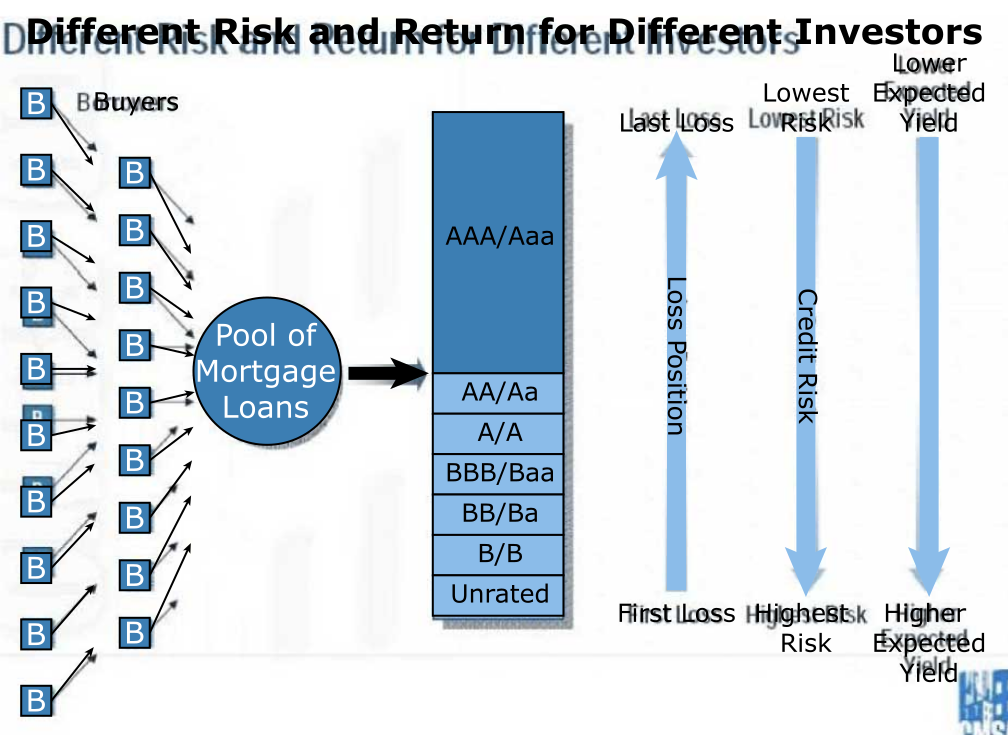
For fixed-income investments, yield is measured in progressive stages of accuracy:
- Nominal yield represents the annual interest payment of a bond divided by the bond's par value.
- Current yield represents the annual interest payment of a bond divided by the bond's current market price.
- Yield to maturity represents the annualized return of a fixed-income security held until the maturity date.
- Yield to call represents the annualized return of a callable bond redeemed at the earliest available date.
Because municipal and corporate bonds are taxed differently, you must normalize their yields to compare them accurately using these formulas:
Taxable equivalent yield formula = Tax-free municipal bond yield / (1 − investor's tax bracket) Tax-free equivalent yield formula = Taxable corporate bond yield × (1 − investor's tax bracket)
Trading is not frictionless. Broker-dealers facilitate the market, but the capacity in which they act dictates the type of friction applied.
A broker-dealer acts as a principal when trading securities from the firm's own inventory. A principal transaction involves a markup when the broker-dealer sells securities to a customer, and a markdown when the broker-dealer buys securities from a customer. Alternatively, a broker-dealer acts as an agent when facilitating a security trade between a customer and a third party. An agency transaction involves a commission charged by the broker-dealer for facilitating the trade. Fundamentally, a single transaction cannot assess both a commission and a markup.
To regulate this friction, the Financial Industry Regulatory Authority 5 Percent Policy serves as a guideline for fair markups on customer transactions. The 5 Percent Policy applies to secondary market trades of non-exempt securities. It does not apply to new securities issues sold by prospectus, and municipal bond transactions are explicitly exempt from the 5 Percent Policy.
Mutual Fund Mechanics
Mutual funds package diversified portfolios, but the sales charges vary sharply by share class. The maximum total sales charge permitted for a mutual fund under industry rules is 8.5 percent of the public offering price.
- Mutual fund Class A shares assess a front-end sales load at the time of purchase. They offer breakpoints that reduce the front-end sales charge for larger investment amounts. Individual investors, married couples, and corporate entities are eligible to receive mutual fund breakpoints. However, investment clubs are strictly prohibited from receiving mutual fund breakpoints.
- Mutual fund Class B shares assess a contingent deferred sales charge when the investor sells the shares. Mutual fund Class B shares do not offer breakpoints on sales charges, but they automatically convert to Class A shares after a specified holding period.
- Mutual fund Class C shares assess a level load consisting primarily of an annual 12b-1 fee. Because there is no front-end load but a continuous annual drag, mutual fund Class C shares are generally considered the most appropriate share class for short-term investors.
Mutual fund 12b-1 fees are deducted directly from fund assets to cover marketing and distribution costs. The maximum allowable 12b-1 fee for a mutual fund marketed as a no-load fund is 0.25 percent annually.
To achieve Class A breakpoints without depositing all capital on day one, investors have two tools. A letter of intent grants an investor up to 13 months to reach a mutual fund breakpoint threshold, and a letter of intent can be backdated up to 90 days to include prior mutual fund purchases. Alternatively, rights of accumulation permit investors to combine the value of existing mutual fund holdings with new purchases to qualify for breakpoints.
To ensure investors understand the risks and costs they are bearing, the industry mandates strict disclosures.
A trade confirmation must be sent to the customer at or before the settlement date of the transaction. Broker-dealers must disclose the firm's capacity as either principal or agent on the customer trade confirmation. The exact amount of a commission must be disclosed on trade confirmations for all agency transactions. In principal capacities, the exact amount of a markup or markdown must be disclosed on trade confirmations for riskless principal transactions, and the exact amount of a markup or markdown must be disclosed for principal trades involving National Market System securities.
For fixed-income, municipal bond trade confirmations must explicitly disclose if the specific bond is callable. Furthermore, to ensure the client understands their worst-case scenario, municipal bond yields displayed on customer trade confirmations must reflect the lower of the yield to call or the yield to maturity.
Additional systemic disclosures include:
- Control Relationships: Broker-dealers must disclose any control relationship with an issuer prior to executing a trade in that issuer's securities. Control relationship disclosures must be provided to the customer in writing on or before the trade settlement date.
- Margin Accounts: A broker-dealer must provide a risk disclosure document to customers before opening a margin account. These margin risk disclosures must be provided to customers on an annual basis after account opening.
- New Issues: A prospectus must be provided to a customer no later than the settlement date of a new mutual fund purchase.
Taxation is the final thermodynamic bleed on a portfolio's returns. Every transaction must be carefully tracked.
Capital Gains and Losses
To calculate taxes, you must know your basis. The cost basis of a purchased security includes the purchase price plus any broker commissions paid. Conversely, the taxable sale proceeds of a security equal the selling price minus any broker commissions paid.
- A long-term capital gain applies to assets held for more than one year. Long-term capital gains are taxed at a lower rate than an investor's ordinary income tax rate.
- Short-term capital gains apply to assets held for exactly one year or less. Short-term capital gains are taxed at an investor's ordinary income tax rate.
If an investor loses capital, net capital losses can be used to offset up to $3,000 of ordinary income per tax year. Unused net capital losses can be carried forward indefinitely to offset income in future tax years.
To prevent investors from artificially harvesting tax write-offs, the wash-sale rule prohibits an investor from claiming a capital loss if a substantially identical security is purchased within 30 days before or after the loss sale. The wash-sale rule applies to both realized stock losses and realized options losses. Be aware of the mechanics: purchasing a call option on a stock sold for a loss triggers the wash-sale rule, as you have reclaimed the right to buy the security.
Dividends and Corporate Actions
Qualified dividends are taxed at the investor's long-term capital gains tax rate, while non-qualified dividends are taxed at the investor's ordinary income tax rate.
If a mutual fund generates payouts, reinvested mutual fund dividends are taxable as ordinary income in the year they are distributed, even though the cash never hit the client's pocket. Conversely, stock dividends are not taxable upon receipt; instead, a stock dividend reduces the cost basis per share of the investor's holdings. Similarly, converting a corporate bond into common stock is not considered a taxable event.
Municipal Bond Taxation
Municipal bonds offer tax shelters, but they are not absolute. Interest income generated by municipal bonds is generally exempt from federal income taxation. Furthermore, interest income from municipal bonds issued within an investor's home state is generally exempt from state and local income taxation.
However, capital gains realized on the sale of municipal bonds are fully subject to federal capital gains taxation. This logic flows through to packaged products: municipal bond mutual fund distributions derived from capital gains are fully taxable to the investor.
Gifts and Estates
Wealth transfer introduces a specialized set of tax mechanics.
Gift Taxes: For 2026, the federal gift tax annual exclusion is $19,000 per recipient [1.1.1]. Married spouses can combine their annual gift tax exclusions to gift up to $38,000 per recipient in 2026 without filing a gift tax return. Gifts of assets between United States citizen spouses are completely exempt from federal gift taxes.
Annual exclusion gifts do not require the donor to file a federal gift tax return. However, gifts exceeding the annual exclusion amount require the donor to file a federal gift tax return, and critically, gifts exceeding the annual exclusion amount reduce the donor's lifetime estate tax exemption.
When a security is gifted, the donor's original cost basis transfers to the recipient if the market value exceeds the original cost. The donor's holding period transfers to the recipient if the market value exceeds the original cost as well. However, if a gifted security's market value is below the donor's cost, the recipient's basis for determining a loss is the market value on the gift date.
Estate Taxes: The federal estate tax is calculated based on the fair market value of all assets controlled by the decedent at death. Federal estate taxes are paid directly by the decedent's estate, and federal estate taxes must be paid before the remaining estate assets are distributed to beneficiaries.
The 2026 federal lifetime estate tax exemption limits the amount of assets exempt from estate taxes to $15 million per individual. For the heirs receiving the capital, inherited securities receive a step-up in cost basis to the fair market value on the decedent's date of death. As an added benefit, the holding period for inherited securities is automatically considered long-term for capital gains tax purposes, giving the beneficiary maximum flexibility.