Options: Characteristics
Options contracts are, at their core, instruments of standardized contingency. Before the modern era of finance, a contract to buy or sell an asset at a future date was a bespoke, fragile agreement between two individuals. If the market moved drastically, the losing party had a massive financial incentive to simply walk away. Today, when you facilitate an options trade for a client, you do not worry about the creditworthiness of the person on the other side of the trade. You are trading a standardized, mathematically precise instrument governed by strict rules and guaranteed by a central authority. Understanding the mechanics, pricing behavior, and structural boundaries of these listed options is the fundamental basis for managing portfolio risk and successfully passing the Series 7 examination.
To make options tradeable on a secondary market, the exchanges had to standardize them. When you look at an options chain, you are observing a highly structured hierarchy.
First, consider the options class: this consists of all options of the same type (either calls or puts) covering the same underlying security. If a client wants to look at "Apple calls," they are looking at an options class. Dig deeper, and you find the options series: this consists of all options of the same class that share the exact same strike price and the exact same expiration month (e.g., all Apple November $150 calls).
Every standard listed equity options contract operates under a strict set of specifications:
- Contract Size: A standard equity options contract represents 100 shares of the underlying stock.
- The Multiplier: Because of this 100-share footprint, the multiplier for a standard listed equity options contract is 100.
- Aggregate Exercise Price: When you calculate the total cost to exercise the contract, you find the aggregate exercise price by multiplying the strike price by 100. A contract with a $50 strike price dictates a $5,000 aggregate exercise price.
- Standard Expiration Limits: A standard equity options contract has a maximum expiration period of 9 months.
When your client buys an option, they pay a premium. This premium is not an arbitrary number; it is a dynamic price driven by the underlying stock price, time, and market volatility.
Intrinsic Value: The Objective Reality
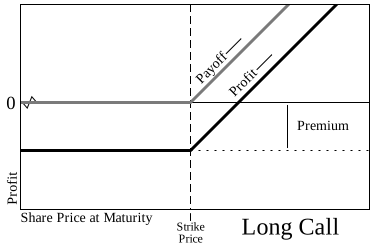
The intrinsic value of an options contract represents the exact amount by which the contract is currently in-the-money (ITM). It is the tangible value the contract would hold if it were exercised instantly.
- Calls: A call option is in-the-money when the market price of the underlying stock exceeds the strike price. Therefore, the intrinsic value of a call option equals the underlying stock price minus the strike price.
- Puts: A put option is in-the-money when the market price of the underlying stock is below the strike price. The intrinsic value of a put option equals the strike price minus the underlying stock price.
Crucially, the intrinsic value of an options contract can never fall below zero. If exercising the contract would result in a loss compared to the open market, the investor simply wouldn't exercise it. Therefore, an options contract has zero intrinsic value if the contract is exactly at-the-money (ATM) or out-of-the-money (OTM).
Time Value: The Price of Probability
If intrinsic value is the "now," time value is the "maybe." Time value is the portion of an options premium that exceeds the intrinsic value of the contract. You calculate it algebraically by subtracting the intrinsic value from the total options premium.
Why do investors pay for time value? They are paying for the probability that the option will move further into the money before it expires. Two primary laws govern time value:
- Volatility: Higher volatility in the underlying asset increases the time value of an options contract. Wider price swings mean a greater mathematical probability of the option moving favorably.
- Time Decay (Theta): Time value decreases as an options contract approaches the expiration date of the contract. Importantly, this decay is not linear. The rate of decline in the time value of an options contract accelerates as the expiration date nears. The window of opportunity is slamming shut, collapsing the probability of a favorable move.
For a market to function efficiently, participants must trust that contracts will be honored. This is the sole purpose of The Options Clearing Corporation (OCC).
The OCC issues all listed options contracts in the United States and guarantees the performance of those contracts. To achieve this, the OCC inserts itself into the middle of every single trade. It acts as the buyer to every seller of a listed options contract, and it acts as the seller to every buyer.
By acting as this universal counterparty, the OCC completely removes counterparty credit risk for options investors. If an option writer defaults, the OCC steps in and fulfills the obligation.
The Mechanics of Assignment and Exercise
When an options holder decides to exercise their right, they notify their broker, who notifies the OCC. The OCC must then find a short seller to fulfill the obligation. How is this handled fairly?
- OCC to Firm: The OCC assigns exercise notices to clearing member firms using a random selection method.
- Firm to Client: Once the clearing member firm receives the assignment, they must allocate it to an individual client who is short that specific contract. Clearing member firms may assign these exercise notices to customers using either a random selection method or a first-in, first-out (FIFO) method.
To protect investors from forgetting to exercise profitable contracts, the OCC operates an automatic exercise rule. The OCC automatically exercises any equity option that is in-the-money by $0.01 or more at expiration.
As a registered representative, your clients will rely on you to know exactly when they can trade and when their funds will settle.
| Action | Cutoff / Timeframe (Eastern Time) | Settlement |
|---|---|---|
| Trading Equity Options | 9:30 AM to 4:00 PM | T+1 (One business day after trade date) |
| Trading Broad-Based Index Options | 9:30 AM to 4:15 PM | T+1 (One business day after trade date) |
| Expiration Date | Listed equity options expire on the third Friday of the expiration month. | N/A |
| Trading Cutoff (Expiration Day) | 4:00 PM on the expiration date (for standard equities). | N/A |
| Exercise Cutoff (Expiration Day) | 5:30 PM on the expiration date. | N/A |
| Settlement of Exercise | Upon exercise, actual shares must change hands. | T+1 (One business day after exercise date) |
Options are categorized by when the holder is permitted to exercise their rights. Do not let the geographical names fool you; both trade heavily on U.S. exchanges.
- American-style options permit the options holder to exercise the contract on any business day prior to the expiration date. Standard equity options universally utilize American-style exercise rules.
- European-style options permit the options holder to exercise the contract only on the expiration date. Broad-based stock index options (like those tracking the S&P 500) generally utilize European-style exercise rules.
Because of this structural difference, the premium of a European-style option may trade at a discount to an identical American-style option. Why? Because the European option lacks the early-exercise flexibility inherent in the American counterpart. The market prices this lack of optionality accordingly.
While standard equity options max out at 9 months, some investors need extended horizons to hedge portfolios or speculate on long-term trends. Enter Long-Term Equity Anticipation Securities (LEAPS).
LEAPS provide investors with long-term options exposure. They are available for both individual equity securities and broad-based market indexes. A standard LEAPS contract on an individual stock behaves just like a standard option, covering exactly 100 shares of the underlying equity.
However, LEAPS differ dramatically in their time parameters and cost:
- Expiration: LEAPS have maximum expiration dates of 39 months.
- Premium & Decay: Because they hold massive amounts of time value, LEAPS command higher premiums than standard near-term options. However, the time value of a LEAPS contract decays at a slower rate than the time value of a standard near-term option. (Theta decay does not drastically accelerate until the option enters the standard 9-month window).
LEAPS Financial Requirements and Tax Treatment
Given their massive cost, the rules for financing and taxation are specific:
- Purchasing & Writing: Buyers of LEAPS must pay the full premium in cash (they cannot be bought on margin). Conversely, writers (sellers) of LEAPS must deposit margin to secure their massive long-term exposure.
- Taxation on Sale: If a client holds a LEAPS call option for more than 12 months and then sells it at a profit, the profit upon sale is treated as a long-term capital gain.
- Taxation on Exercise: This is a frequent point of confusion. If an investor exercises a LEAPS call option to buy the stock, the holding period of the option does not transfer to the stock. The holding period of the newly acquired stock begins on the date of exercise.
To prevent any single entity from cornering the market or creating systemic risk, FINRA and the exchanges establish strict volume ceilings.
Position limits restrict the maximum number of options contracts an investor can hold on the same side of the market for a single underlying security. The "same side of the market" groups strategies by their directional bias:
- The Bullish Side: Long calls and short puts are grouped together, as both profit when the underlying stock rises.
- The Bearish Side: Short calls and long puts are grouped together, as both profit when the underlying stock falls.
Similarly, Exercise limits restrict the maximum number of options contracts an investor can exercise within five consecutive business days. These limits are usually set at the exact same threshold as position limits to prevent market shock via mass exercise.
Adjustments for Corporate Actions
When a corporation alters its capital structure, it fundamentally changes the value of its stock. The OCC must step in to ensure options investors are neither unfairly enriched nor penalized.
- Cash Dividends: Standard equity options contracts are not adjusted for ordinary cash dividends. The market prices expected dividends into the premium. However, they are adjusted for special cash dividends.
- Stock Splits: The OCC adjusts both the strike price and the contract size of outstanding options contracts during a stock split to maintain the contract's aggregate value.
- Forward Stock Split: The stock gets cheaper, and there are more shares. The OCC decreases the strike price of the options contract and increases the number of shares underlying the contract (or issues additional contracts).
- Reverse Stock Split: The stock gets more expensive, and there are fewer shares. The OCC increases the strike price of the options contract and decreases the number of shares underlying the options contract.
Understanding these mechanics ensures that when a corporate action hits the tape, you can accurately explain to your client exactly why their $100 strike call option just transformed into a $50 strike call covering twice as many shares. You aren't just selling them a trade; you are guiding them through the architecture of the market.