Corporate and Municipal Bonds
Corporations and municipalities function as immense, capital-hungry engines, requiring vast sums of money to build factories, lay fiber-optic cables, or construct local hospitals. These are capital outlays far exceeding their immediate cash reserves. To bridge this gap, they issue debt securities—effectively taking a massive loan and fracturing it into thousands of tradable pieces. Understanding the architecture of these debt instruments is not merely an exercise in financial vocabulary; it is the study of how the physical and commercial world is funded. For the securities professional, mastering the structural, risk, and tax distinctions between corporate and municipal debt is the foundation of portfolio construction. It dictates how you manage a client's risk exposure, calculate tax-advantaged returns, and navigate the sprawling decentralized markets where these instruments change hands.

When you buy a corporate bond, you are lending money to a company. Corporate bonds represent debt obligations issued by private companies to raise capital. Rather than giving up ownership (as they would by issuing stock), the corporation promises to pay you interest over time and return your principal at a specific maturity date.
The mechanics of this market operate with distinct standards. First, the standard par value for a corporate bond is $1,000. When these bonds trade on the secondary market, they do not typically trade on centralized exchanges like the NYSE. Instead, corporate bonds primarily trade in the over-the-counter (OTC) market, an electronic network of dealers negotiating prices directly.
When quoting prices, corporate bonds trade in fractions of an eighth of a point (e.g., a quote of 98 1/8). Once a trade is agreed upon, the transaction moves to settlement. Corporate bonds settle one business day after the trade date (commonly referred to in the industry as T+1 settlement).
Taxation Reality Check: Unlike some of the specialized bonds we will explore later, the interest earned on corporate bonds is fully taxable at both the federal and state levels. Because investors must pay taxes on this income, corporate bonds typically must offer higher interest rates than their tax-advantaged municipal counterparts to attract capital.
Securing the Promise: Asset-Backed vs. Unsecured Bonds
If a corporation goes bankrupt, who gets paid first? The answer lies in the bond's collateral.
Secured corporate bonds are backed by specific assets owned by the issuing corporation. If the company defaults, bondholders have a legal claim to seize and sell those assets to recover their funds. Consider the practical reality of different industries; they secure debt using the assets natural to their operations:
- Mortgage bonds: These are secured corporate bonds backed by real estate or physical property owned by the issuer. A utility company might issue a mortgage bond backed by its power plants.
- Equipment trust certificates: These are secured corporate bonds backed by heavy machinery or transportation equipment. Airlines and railroads use these extensively, using the planes or locomotives themselves as the collateral.
- Collateral trust bonds: What if a holding company owns no factories or airplanes, but owns a massive portfolio of subsidiaries? They issue collateral trust bonds, which are secured corporate bonds backed by financial assets like stocks or other bonds held in a trust.
Conversely, unsecured corporate bonds are backed only by the general creditworthiness and reputation of the issuing corporation. There is no specific property to seize; investors are relying entirely on the company's promise and cash flow.
- Debentures: This is the formal term for a standard unsecured corporate bond.
- Subordinated debentures: These carry even higher risk. In the event of a corporate liquidation, subordinated debentures have a lower claim on assets than other unsecured debt. They are further back in the line of creditors.
Corporate Yield and Conversion Features
To entice investors to take on risk, corporations can structure bonds with unique features.
Some companies issue convertible bonds, which allow the bondholder to exchange the debt instrument for a specific number of shares of the issuing company's common stock. This is a brilliant mechanism: it offers the downside protection of a bond's fixed income, paired with the upside potential of a stock's capital appreciation.
If a company is fundamentally risky, it must simply pay more. High-yield bonds (historically and colloquially known as "junk bonds") are corporate bonds with credit ratings below Baa3 by Moody's or below BBB- by Standard & Poor's. The elevated yield compensates the investor for a mathematically higher probability of default.
Moving from the private sector to the public, municipal bonds are debt securities issued by states, cities, counties, or other local government entities. They fund everything from local schools and sewer systems to massive state highway projects.
Structurally, municipal bonds share trading DNA with corporate bonds: they primarily trade in the over-the-counter market rather than on centralized exchanges, and they also settle one business day after the trade date. Furthermore, because governments have taxation authority and provide essential services, municipal bonds are generally considered to have lower default risk than corporate bonds.
The Tax Advantage of Municipal Bonds
The single most defining feature of municipal bonds is their tax treatment. The interest income from most municipal bonds is exempt from federal income taxation.
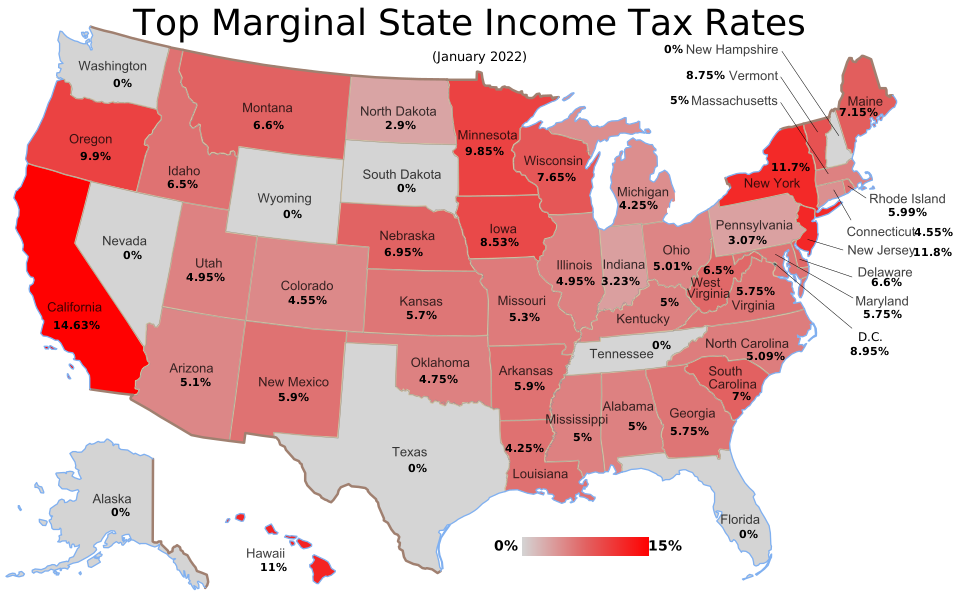
Furthermore, this interest income is typically exempt from state taxation if the investor resides in the issuing state. If a resident of California buys a bond issued by the city of San Diego, they generally pay zero federal and zero state tax on the interest.
Critical Distinction: It is only the interest income that enjoys this tax-free status. If an investor buys a municipal bond at a discount and later sells it at a premium, the capital gains realized from the sale of municipal bonds are subject to standard capital gains taxation.
Calculating the Tax-Equivalent Yield
Because municipal bonds are tax-exempt, their advertised yields are naturally lower than corporate bonds. For a securities professional, how do you mathematically prove to a client whether a 4% tax-free municipal bond is a better deal than a 6% taxable corporate bond?
You use tax-equivalent yield formulas to compare the tax-free yield of a municipal bond against the fully taxable yield of a corporate bond.
The formula scales the municipal yield up based on the investor's tax bracket:
Tax-Equivalent Yield=1−Investor’s Tax RateMunicipal Bond Yield
If a client is in the 35% tax bracket and looking at a 4% municipal bond, the math is 0.04/(1−0.35)=0.04/0.65=6.15%. That means a corporate bond would need to yield more than 6.15% to beat the municipal bond on an after-tax basis.
The municipal bond market is deeply bifurcated based on how the municipality plans to pay the bondholders back.
General Obligation (GO) Bonds
General Obligation bonds are backed by the full faith, credit, and taxing power of the issuing municipality. The government is essentially saying, "We will raise taxes to whatever level is necessary to ensure you are paid."
- Because raising taxes is a serious public matter, the issuance of General Obligation bonds typically requires voter approval.
- Governments cannot borrow infinitely. Debt limits are established by law to restrict the total amount of General Obligation debt a municipality can issue, protecting taxpayers from crushing tax burdens.
The source of the taxes depends on the level of government:
- Local General Obligation bonds (issued by cities, counties, and school districts) are primarily funded by property taxes. In finance literature, property taxes used to back local GO bonds are frequently referred to as ad valorem taxes (meaning "according to value").
- State General Obligation bonds, on the other hand, do not generally rely on property taxes. They are primarily funded by income taxes and sales taxes.

Revenue Bonds
Revenue bonds take a completely different approach. They are backed only by the income generated from the specific project funded by the bond issue. If a city issues a bond to build a toll bridge, the tolls collected pay the bondholders.
- Revenue bonds do not rely on the taxing power of the issuing municipality.
- Because the taxpayers are not on the hook if the project fails, the issuance of Revenue bonds does not require voter approval.
- However, investors need assurance that the project makes financial sense. Therefore, Revenue bond issuances require a feasibility study—an independent analysis to project the economic viability and expected cash flow of the proposed facility.

Beyond the standard GO and Revenue frameworks, the municipal market utilizes highly specialized instruments for unique situations:
| Bond Type | Characteristics & Backing |
|---|---|
| Double-Barreled Bonds | The safest of hybrid designs. These municipal bonds are backed by both a defined source of revenue AND the full faith and credit (taxing power) of the issuing municipality. |
| Special Tax Bonds | Municipal bonds backed by taxes levied on specific, non-essential goods such as gasoline, tobacco, or alcohol (often called "sin taxes"). |
| Special Assessment Bonds | Municipal bonds paid off by taxes levied only on the specific properties directly benefiting from the funded infrastructure (e.g., funding a new sidewalk by taxing only the houses on that specific street). |
| Moral Obligation Bonds | Municipal revenue bonds that have run into trouble. They carry a non-binding provision allowing the state legislature to appropriate funds to prevent a default if project revenues fall short. The state is not legally forced to pay, but does so to protect its credit rating. |
| Private Activity Bonds | Municipal bonds issued to finance facilities for private businesses (like a sports stadium or corporate headquarters). Because the public benefit is questionable, the interest on some private activity municipal bonds is subject to the federal Alternative Minimum Tax (AMT) for wealthy investors. |
| Build America Bonds | An anomaly created during the 2008 financial crisis. These are taxable municipal bonds that were issued with federal subsidies to help municipalities fund infrastructure projects, offering higher yields to investors while the federal government offset the issuer's borrowing costs. |
Municipalities collect taxes annually or semi-annually, but they have to pay teachers, police officers, and utility bills every single week. This creates a severe mismatch in cash flow. To solve this, municipalities issue municipal notes—short-term debt instruments (typically maturing in less than a year) issued to manage municipal cash flow before anticipated future revenues arrive.
These notes bridge the gap and are named exactly for the revenues they anticipate:
- Tax Anticipation Notes (TANs): Issued to finance current municipal operations in expectation of future tax receipts.
- Revenue Anticipation Notes (RANs): Issued to finance operations in expectation of future facility revenues (e.g., a transit authority waiting on a bulk subsidy payment).
- Tax and Revenue Anticipation Notes (TRANs): A hybrid note that combines the backing of both expected future taxes and expected future revenues.
- Bond Anticipation Notes (BANs): Issued to provide interim, short-term financing for a municipal project that will eventually be funded through a long-term bond issue.
- Grant Anticipation Notes (GANs): Issued by municipalities in expectation of receiving future funding from the federal government (such as federal highway grants).
- Construction Loan Notes (CLNs): Issued specifically to provide short-term municipal funding for the building of housing projects.
Because municipal bonds involve the complexities of local law, tax codes, and constitutional authority, investors require ironclad proof that the bond is legally sound and legitimately tax-exempt.
Every municipal bond is analyzed by a specialized attorney known as a bond counsel. The bond counsel issues a legal opinion to affirm the legality and tax-exempt status of a municipal bond issue.
When reviewing the legal opinion, securities professionals look for specific terminology that can feel counter-intuitive at first glance:
- Unqualified Opinion: This is exactly what you want. A municipal bond's legal opinion is characterized as unqualified if the bond counsel finds absolutely no legal restrictions, flaws, or pending litigation that could threaten the issuance. The counsel is backing the bond without any qualifications or doubts.
- Qualified Opinion: This is a red flag. A municipal bond's legal opinion is characterized as qualified if the bond counsel notes potential legal uncertainties regarding the issuance. The counsel is saying, "This bond is legal, qualified by the fact that there is a pending lawsuit over the land use."
Understanding these mechanisms—from the collateral backing a corporate equipment trust certificate to the nuanced tax implications of a private activity bond—allows the securities professional to properly align the massive debt architecture of the modern economy with the precise financial goals of the individual investor.