Debt Instruments: Treasury and Agency
When a corporation needs capital, it must persuade the market that its future revenues will cover the debt. When the United States government needs capital, it relies on something far more absolute: the constitutional power to tax its citizens and the sovereign power to print its own currency.
The U.S. government's power to tax and print money supports the backing of U.S. Treasury securities. Because they are backed by the full faith and credit of the U.S. government, U.S. Treasury securities are considered the safest type of fixed-income investment in the world. They form the bedrock of global finance—the baseline "risk-free rate" against which every other asset on the planet is measured.
If you are entering the securities industry, you must intimately understand this foundation. Your clients will rely on these instruments for safety, yield, and portfolio stabilization.
Before we categorize the instruments, we must understand the fundamental rules of the Treasury market.
First, consider taxation. The federal government taxes its own debt, but it does not permit lower jurisdictions to do so. Therefore, interest income from U.S. Treasury securities is subject to federal income tax, but it is entirely exempt from state and local income taxes.
Second, consider how these securities trade. The U.S. Treasury market is the most liquid financial market in existence. Because of this unparalleled liquidity, U.S. Treasury securities settle on the next business day after the trade date (T+1).
The Treasury issues debt across different time horizons, fundamentally divided into short-term, medium-term, and long-term securities.
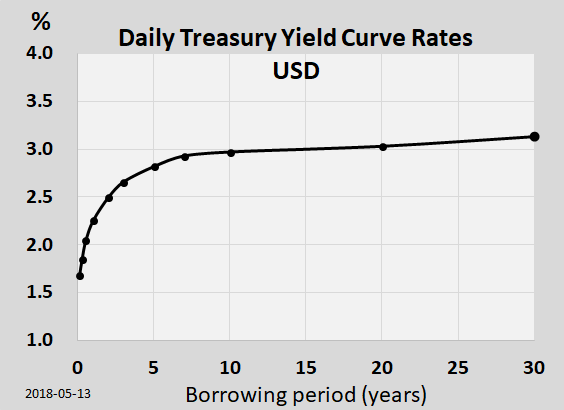
Treasury Bills (T-Bills)
Treasury bills are short-term U.S. government debt obligations. They are defined by their brevity: Treasury bills have maturities of one year or less. The Treasury issues them on a regular schedule, with common Treasury bill maturities including 4 weeks, 13 weeks, 26 weeks, and 52 weeks.
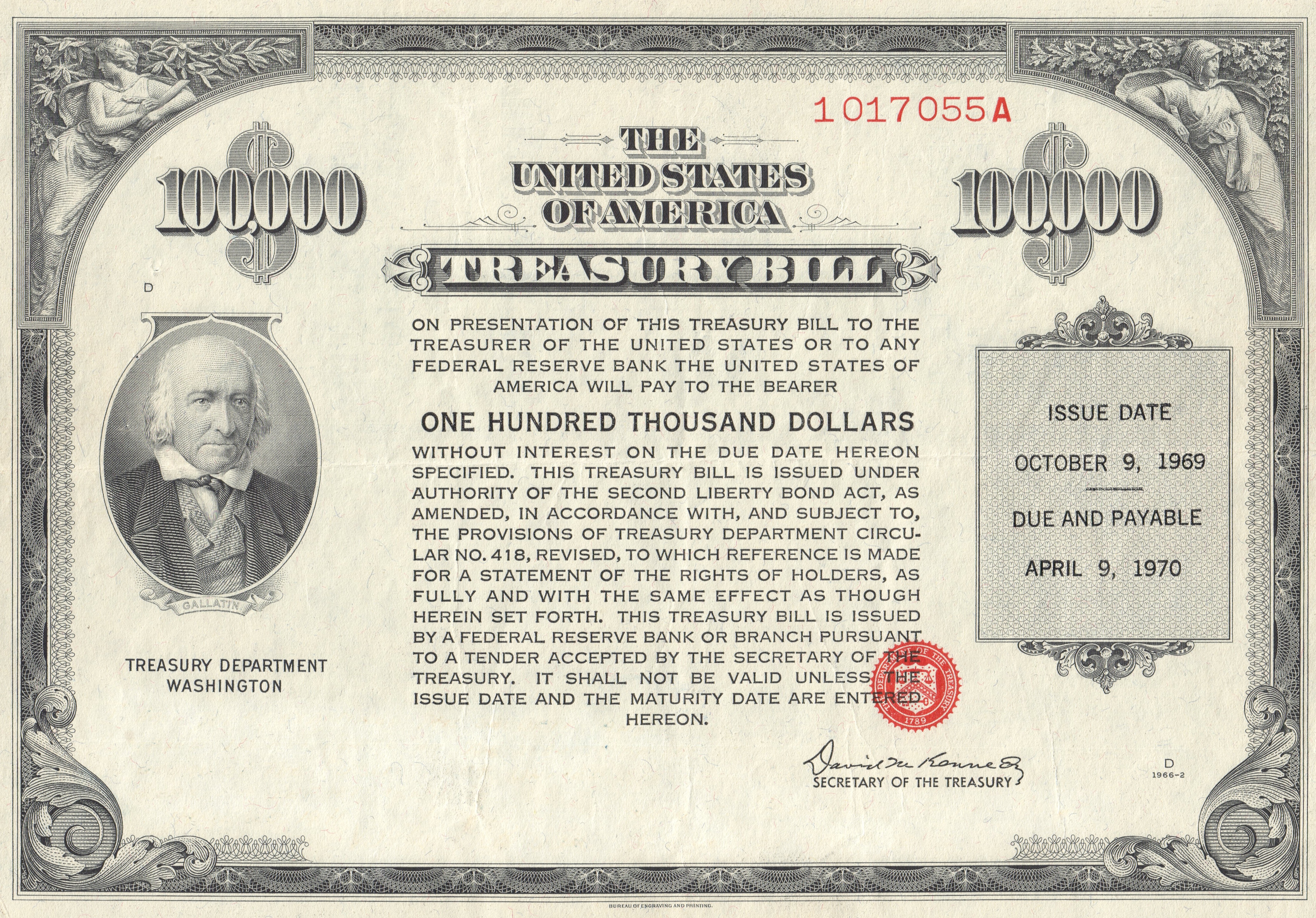
T-bills operate on a radically simple premise. Unlike longer-term debt, Treasury bills do not pay regular coupon interest payments. Instead, Treasury bills are issued at a discount to their par value. The return on a Treasury bill is simply the difference between the discounted purchase price and the face value received at maturity. Imagine buying a piece of paper for $9,800 today that the government promises to redeem for $10,000 in six months. That $200 difference is your interest.
Because they pay no coupons, the pricing convention for T-bills is unique. Treasury bills are quoted on a discount yield basis. This creates a mathematical quirk that frequently traps entry-level candidates: a higher discount yield on a Treasury bill corresponds to a lower dollar price.
The Bid/Ask Inversion: In every other market, the bid price (what a buyer is willing to pay) is lower than the ask price (what a seller demands). But because T-bills are quoted in yields, and a higher yield means a lower dollar price, the bid quote for a Treasury bill represents a higher discount yield than the ask quote.
Treasury Notes and Treasury Bonds
When the government needs to borrow for longer periods, it issues Notes and Bonds. Both Treasury notes and Treasury bonds pay fixed interest every six months.
- Treasury notes are medium-term U.S. government debt securities, issued with maturities ranging from two to ten years.
- Treasury bonds are long-term U.S. government debt securities, issued with maturities greater than ten years up to thirty years.
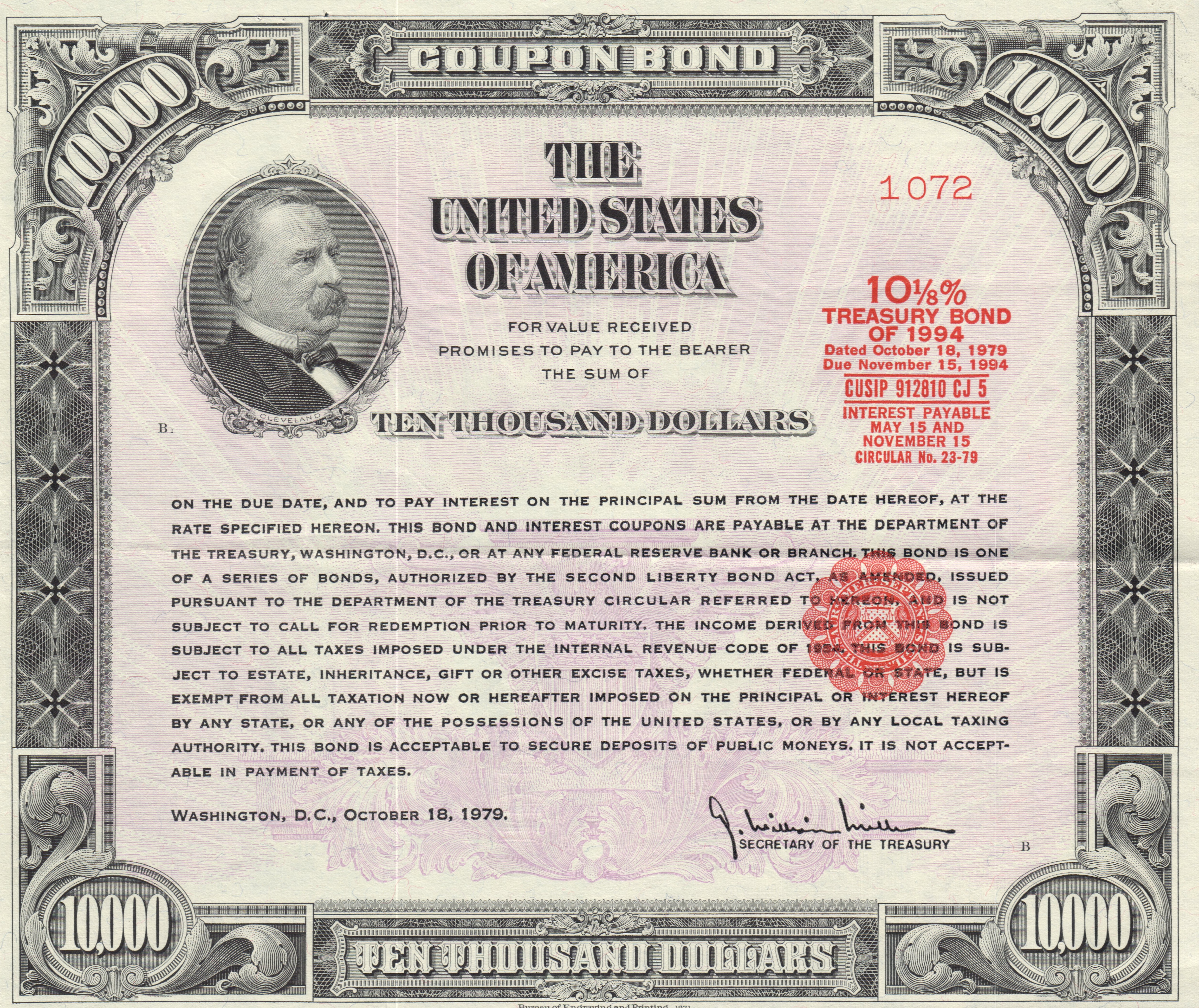
Unlike the discount yields of T-bills, Treasury notes and Treasury bonds are quoted as a percentage of par value in thirty-seconds (1/32) of a point.
Do not read a Treasury quote as a standard decimal. A quote of 98.16 for a Treasury bond does not mean 98.16%. It represents 98 and 16/32 percent of the bond's par value. Since a standard point in a Treasury bond quote equals ten dollars (1% of a standard $1,000 par value), the math works out elegantly. The "98" means $980, and the "16/32" is exactly one-half of a point, or $5. The actual price of the bond is $985.
Financial engineering allows institutions to mold Treasury cash flows to suit specific investor needs.
STRIPS and Receipts
Some investors—like pension funds—want guaranteed long-term payouts without the hassle of reinvesting semi-annual coupon payments. The solution is to strip a standard Treasury note or bond into its component parts.
Treasury STRIPS (which stands for Separate Trading of Registered Interest and Principal of Securities) are zero-coupon bonds issued directly by the U.S. Treasury. Treasury STRIPS are created by separating the interest and principal components of a Treasury note or bond into distinct, tradable securities. Because they are a direct U.S. obligation, Treasury STRIPS are backed by the full faith and credit of the U.S. government.
Before the government created STRIPS, Wall Street invented the concept. Treasury receipts are zero-coupon bonds created by broker-dealers. Broker-dealers create Treasury receipts by placing Treasury securities in a trust and selling separate claims on the interest and principal payments. However, because they are a derivative product created by a private institution, Treasury receipts are not backed by the full faith and credit of the U.S. government.
Treasury Inflation-Protected Securities (TIPS)
Inflation is the silent killer of fixed-income returns. To combat this, the government created TIPS, which stands for Treasury Inflation-Protected Securities.
Treasury Inflation-Protected Securities are U.S. government debt securities designed to protect investors from inflation. They do this through a brilliant mechanism: the principal value of a Treasury Inflation-Protected Security is adjusted semi-annually based on the Consumer Price Index (CPI).
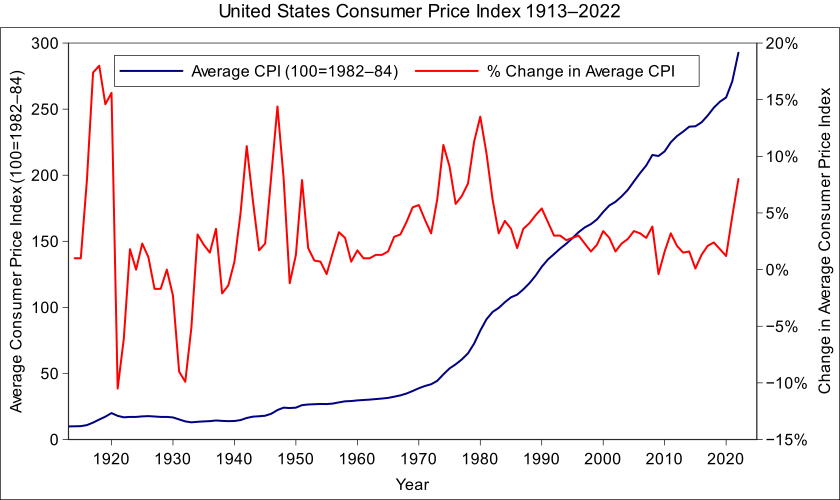
The coupon rate on a TIPS never changes. Instead, the fixed interest rate of a Treasury Inflation-Protected Security is applied to the inflation-adjusted principal value.
- During periods of inflation, the principal value of Treasury Inflation-Protected Securities increases. Consequently, the semi-annual interest checks grow larger.
- During periods of deflation, the principal value of Treasury Inflation-Protected Securities decreases, and the interest checks shrink.
However, the principal is protected from ultimate destruction: the U.S. Treasury guarantees that the amount paid at the maturity of a Treasury Inflation-Protected Security will not be less than the original principal amount.
The U.S. government has interests beyond just funding its own deficits. It wants to promote homeownership, support agriculture, and encourage higher education. To direct capital toward these social goals, the government uses Agencies and Government-Sponsored Enterprises (GSEs).
Government-sponsored enterprises are privately owned corporations created by Congress to reduce the cost of capital for certain borrowing sectors. By implicitly leaning on the perceived backing of the government, GSEs can borrow cheaply and pass those savings on to farmers, students, and homeowners.
Agency securities are debt obligations issued by U.S. government agencies or government-sponsored enterprises. Because they carry slightly more risk than direct Treasury obligations, agency securities generally offer slightly higher yields than U.S. Treasury securities. Operationally, they trade similarly to Treasuries; the settlement for agency securities typically occurs on the next business day for secondary market trades.
The Specialized Agencies
- The Farm Credit System (FCS) is a national network of lending institutions providing agricultural financing and credit.
- The Federal Home Loan Bank (FHLB) system provides liquidity to savings and loan institutions to support mortgage lending.
- The Student Loan Marketing Association—commonly known as Sallie Mae—provides student loans for higher education.
Taxation Trap: The taxation of agency debt can be counter-intuitive. Interest paid on Farm Credit System and Federal Home Loan Bank securities is subject to federal income tax, but it is generally exempt from state and local taxes, mirroring the tax treatment of direct Treasuries.
To vastly increase the amount of capital available for lending, financial institutions bundle thousands of individual loans together into a single investable security.
- Mortgage-backed securities (MBS) represent an ownership interest in a pool of mortgage loans.
- Asset-backed securities (ABS) represent an ownership interest in a pool of non-mortgage loans or receivables. Common assets backing asset-backed securities include auto loans, credit card receivables, and student loans.
The Mortgage Giants: Ginnie, Fannie, and Freddie
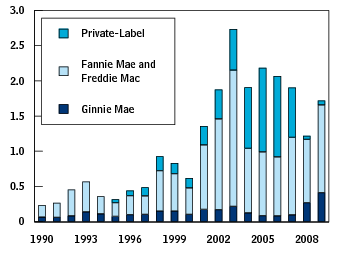
The secondary mortgage market is dominated by three massive entities. You must know exactly how they differ in origin, purpose, and backing.
| Agency/GSE | Full Name | Ownership | Backing | Core Function |
|---|---|---|---|---|
| Ginnie Mae (GNMA) | Government National Mortgage Association | Wholly owned U.S. government corporation within HUD | Explicit full faith and credit | Guarantees federally insured mortgages (FHA/VA). |
| Fannie Mae (FNMA) | Federal National Mortgage Association | Publicly held GSE | Not full faith and credit | Purchases conventional residential mortgages from financial institutions. |
| Freddie Mac (FHLMC) | Federal Home Loan Mortgage Corporation | Publicly held GSE | Not full faith and credit | Purchases residential mortgages primarily from savings and loan associations. |
Notice the critical distinction: most agency securities, including Fannie Mae and Freddie Mac securities, are not backed by the full faith and credit of the U.S. government. Ginnie Mae securities are the only mortgage-backed securities explicitly backed by the full faith and credit of the U.S. government.
Because mortgage payments consist of both interest and principal repayment, Ginnie Mae pass-through certificates pay interest and principal to investors on a monthly basis.
Taxation of Mortgage Debt: Unlike Treasuries or Farm Credit paper, mortgages are inherently local real estate transactions. Therefore, interest income from Ginnie Mae securities is fully taxable at the federal, state, and local levels. The exact same rule applies to the GSEs: interest income from Fannie Mae and Freddie Mac securities is fully taxable at the federal, state, and local levels.
When you buy a standard bond, you know exactly when you will get your money back. When you buy a mortgage-backed security, you surrender that certainty to the American homeowner.
Mortgages have embedded call options—homeowners can pay off their loans whenever they want. This creates two distinct, opposing risks for MBS investors.
Prepayment Risk
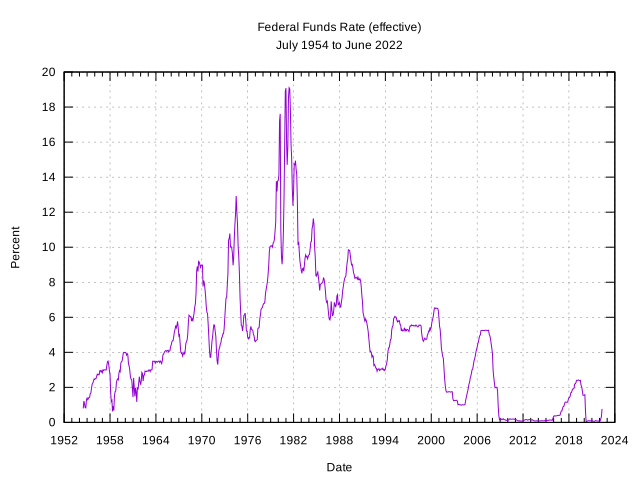
Prepayment risk is the risk that underlying loans in a mortgage-backed security will be paid off earlier than expected. This is not a random phenomenon; it is highly correlated with interest rates.
Prepayment risk for mortgage-backed securities typically increases when interest rates fall. Why? Because when homeowners refinance mortgages due to dropping interest rates, mortgage-backed securities investors receive their principal back sooner.
This sounds harmless until you realize when you are getting your money back. You are receiving a flood of returned principal exactly when prevailing interest rates have plummeted. Consequently, reinvestment risk increases for mortgage-backed securities investors when prepayment risk materializes. You are forced to reinvest that returned principal at the new, lower interest rates.
Extension Risk
Conversely, extension risk is the risk that underlying loans in a mortgage-backed security will be paid off slower than expected.
Extension risk for mortgage-backed securities typically increases when interest rates rise. When interest rates rise, homeowners are less likely to refinance, causing mortgage-backed securities investors to hold lower-yielding securities for a longer duration. Just when you wish you had your cash back to invest at the newly elevated interest rates, your capital is stubbornly locked in a low-yield environment.
Collateralized Mortgage Obligations (CMOs)
To manage the chaotic cash flows of prepayments and extensions, Wall Street invented the CMO. Collateralized Mortgage Obligations are multi-class debt instruments backed by a pool of mortgage pass-through securities or mortgage loans.
Instead of passing the monthly cash flows proportionally to all investors, a CMO acts like a series of waterfalls. It divides the cash flows into Tranches (the French word for "slices"). Tranches are distinct slices of a mortgage-backed security or asset-backed security.
By directing principal payments to the highest-priority tranche first, and only moving to the next tranche once the first is retired, tranches allow issuers to create different risk and maturity profiles from the same underlying pool of loans. Some investors can buy short-term, highly predictable tranches, while others buy longer-term tranches that absorb the bulk of the extension risk in exchange for higher yields.
Understanding this architecture—from the sovereign absolute of a Treasury Bill down to the engineered cash flows of a CMO Tranche—is what separates a layman from a true financial professional. Master this framework, and you will understand the mechanics that govern the global cost of capital.