Direct Participation Programs (DPPs)
Imagine a pipeline carrying water from a reservoir directly to a series of homes. The pipeline itself does not consume the water; it merely acts as a conduit, delivering the exact volume—along with any impurities—straight to the end user. In the financial markets, a Direct Participation Program (DPP) functions as this exact type of conduit for capital and tax consequences. It is a pooled investment vehicle designed to bypass the traditional friction of corporate-level taxation.
When your future clients invest in traditional equities, they suffer from thermodynamic loss in the form of "double taxation." A standard corporation pays taxes on its earnings at the corporate level, and then the investor pays taxes again when those remaining earnings are distributed as dividends. Because C corporations are subject to corporate-level taxation, the underlying mechanics of a C corporation cannot be classified as Direct Participation Programs.
A DPP eliminates this friction. A Direct Participation Program does not pay corporate-level taxes on its earnings. Instead, it utilizes an accounting mechanism known as pass-through tax treatment.
If the DPP acts as a pipeline, we must understand exactly what flows through it. A Direct Participation Program passes income directly to its investors, meaning the raw, untaxed revenue of the business flows straight to the limited partners. Crucially, however, the pipeline flows both ways in terms of economic reality: a Direct Participation Program passes financial losses directly to its investors, and it also passes tax benefits directly to its investors.
At the end of the year, Direct Participation Program investors are taxed directly on their fractional share of the program income.
To qualify under this strict regulatory definition, an investment entity must pass through both income and losses to qualify as a Direct Participation Program. This creates a vital dividing line for your exam: Real Estate Investment Trusts (REITs) do not pass financial losses through to investors. Because REITs only pass through income, Real Estate Investment Trusts are not classified as Direct Participation Programs.
The Passive Loss Wall
When losses flow through the DPP pipeline to your client, the IRS places a strict categorization on them. Because the investor is merely providing capital and not running the oil rig or leasing the equipment themselves, losses passed through from a Direct Participation Program are classified as passive losses.
The IRS builds a firewall around these passive losses. Investors can use passed-through passive losses from a Direct Participation Program to offset passive income (such as income generated from another DPP). However, they cannot cross the firewall:
- Investors cannot use passed-through passive losses from a Direct Participation Program to offset ordinary income (such as their W-2 salary).
- Investors cannot use passed-through passive losses from a Direct Participation Program to offset capital gains (such as the profits from selling standard stock).
Why this matters for your career: Clients often seek out DPPs precisely for the tax write-offs. If a client attempts to use the paper losses from an equipment leasing program to wipe out the taxes on their high-salary day job, they will face harsh penalties. Understanding the boundary of passive losses is a core competency of a registered representative.
While S corporations are legally structured as Direct Participation Programs and Limited Liability Companies can be structured as Direct Participation Programs (since both avoid corporate-level taxation), the vast majority of the securities industry relies on a more specialized model. Limited Partnerships are the most common structure for Direct Participation Programs.
A Limited Partnership requires two distinct classes of participants, fundamentally divided by their control over the enterprise and their exposure to its liabilities.
The General Partner (The Operator)
General Partners in a Limited Partnership manage the daily business operations. Because they hold the keys to the vehicle and make all executive decisions, the law demands absolute financial accountability to prevent moral hazard. Consequently, General Partners in a Limited Partnership have unlimited personal liability for the debts of the partnership. If the partnership goes bankrupt and owes millions, the creditors can seize the General Partner's personal assets.
The Limited Partner (The Capital)
Conversely, Limited Partners in a Limited Partnership provide capital for the investment. They are the silent financiers. In exchange for surrendering all operational control, Limited Partners in a Limited Partnership have limited liability. The absolute maximum they can lose is the amount they invested (plus any committed capital).
This protection is conditional. Limited Partners in a Limited Partnership are not permitted to manage day-to-day operations. The moment an investor steps across that boundary—perhaps by directing contractors on a job site or signing vendor checks—they breach the legal barrier. Limited Partners in a Limited Partnership lose limited liability protection if they engage in daily management decisions.
The Subscription Agreement
You cannot buy into a Limited Partnership simply by clicking "buy" on a brokerage terminal. The General Partner must carefully vet who is entering the partnership. Therefore, an investor must complete a Subscription Agreement to join a Limited Partnership.
Filing the paperwork is only the first step; the General Partner must sign the Subscription Agreement to formally accept a new Limited Partner. Crucially, this document is a legal transfer of operational authority. The Subscription Agreement grants the General Partner power of attorney to conduct business on behalf of the Limited Partnership, formally cementing the division of labor.

While LPs dominate the energy and leasing spaces, real estate requires a different approach due to property laws.
A Tenants in Common (TIC) arrangement is a type of Direct Participation Program primarily used for real estate investments. Unlike a traditional partnership where the entity owns the asset, a Tenants in Common arrangement gives multiple investors an undivided fractional interest in a single real estate property.
If you own 10 percent of an office building via a TIC, you own 10 percent of the actual bricks and mortar, not just shares in a company that owns the building. Because of this direct property ownership, Tenants in Common arrangements are frequently used to facilitate tax-deferred exchanges in real estate (commonly known as 1031 exchanges), allowing investors to roll the profits from one property directly into another without immediately paying capital gains taxes.
DPPs are designed for capital-intensive industries where heavy upfront costs generate massive depreciation or depletion deductions.
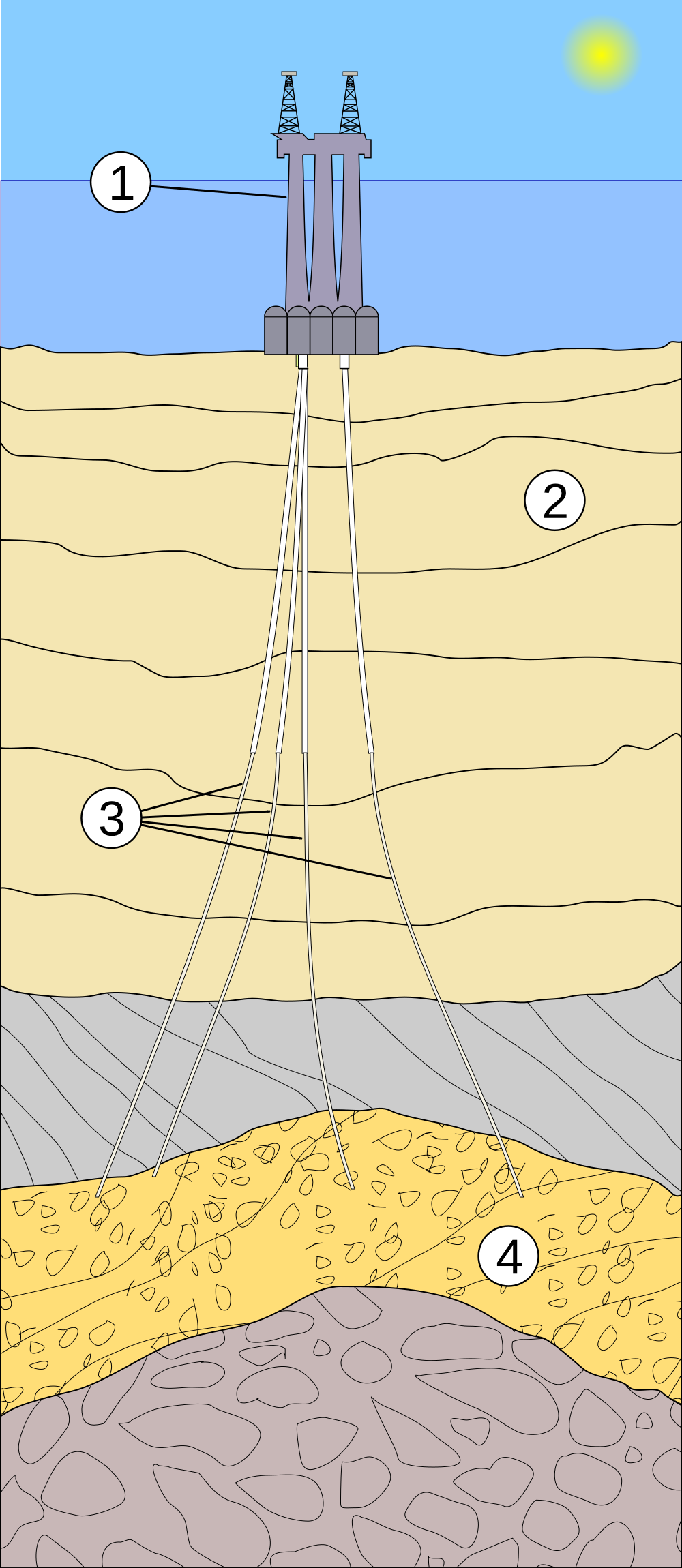
- Energy: Oil and gas exploratory programs are commonly structured as Direct Participation Programs. Investors fund the high-risk drilling of new wells. The intangible drilling costs (labor, fuel, survey work) pass through to investors as immediate tax deductions.
- Physical Assets: Equipment leasing programs are commonly structured as Direct Participation Programs. These programs purchase airplanes, railcars, or medical equipment and lease them to major corporations. The primary allure is not just the lease income; equipment leasing Direct Participation Programs offer tax advantages through equipment depreciation deductions, sheltering the income the program generates.
When analyzing the secondary market for these investments, we divide them into two categories based on where (and if) they trade.
| Feature | Listed DPPs | Unlisted DPPs |
|---|---|---|
| Exchange Status | Listed Direct Participation Programs trade on national stock exchanges. | Unlisted Direct Participation Programs do not trade on a national stock exchange. |
| Liquidity | Listed Direct Participation Programs offer higher liquidity than unlisted Direct Participation Programs. | Unlisted Direct Participation Programs are highly illiquid investments. |
| Secondary Market | Traded daily like normal equities. | Unlisted Direct Participation Programs generally lack a secondary market. |

Despite the obvious appeal of liquidity, most Direct Participation Programs are unlisted. The underlying assets (like an exploratory oil well or an aging fleet of railcars) are incredibly difficult to value on a day-to-day basis. Investors entering unlisted DPPs must be prepared to lock up their capital for years—often a decade or more—until the underlying assets are naturally exhausted or sold off.
Because unlisted DPPs are complex, highly illiquid, and often marketed aggressively for their tax benefits, regulators intervene to ensure investors are not bled dry by hidden fees before their money is even put to work.
If your broker-dealer helps raise capital for a DPP, the compensation is strictly capped. FINRA limits the total underwriting compensation for a Direct Participation Program to 10 percent of gross proceeds. Furthermore, to ensure the majority of the investor's dollar actually purchases the underlying assets, FINRA limits the total organization and offering expenses for a Direct Participation Program to 15 percent of gross proceeds.
The Liquidation Waterfall
When a Limited Partnership reaches the end of its life—whether through success, asset depletion, or bankruptcy—it must be liquidated. The law dictates a rigid hierarchy for who gets paid, reflecting the risk each party assumed.
- Secured Creditors: Banks that hold liens against the equipment or property take priority. During the liquidation of a Limited Partnership, secured creditors are paid first. (General, unsecured creditors follow immediately after).
- Limited Partners: Because they are silent investors who took no active role in the failure or conclusion of the business, during the liquidation of a Limited Partnership, Limited Partners are paid immediately after all creditors.
- General Partners: The operators absorb the ultimate risk of their management. During the liquidation of a Limited Partnership, General Partners are paid last.
The architecture of a DPP exposes your clients to two highly specialized risks not found in standard mutual funds or equities.
First, because the core value proposition of an oil drill or an equipment lease often hinges on the tax code, Direct Participation Programs carry legislative risk. Congress can rewrite the tax code at any moment. Legislative risk in a Direct Participation Program refers to the potential for tax law changes to eliminate program tax benefits. If Congress suddenly removes the depreciation schedules for leased equipment, an equipment leasing DPP might shift from a lucrative tax shield into a catastrophic loss overnight.

Second, the IRS monitors these programs with intense scrutiny. Direct Participation Programs carry high audit risk. This is not arbitrary; the high audit risk in a Direct Participation Program stems from the utilization of aggressive tax deductions. Since the entire purpose of the vehicle is often to generate massive, accelerated write-offs, the IRS is highly incentivized to audit the partnership to ensure those write-offs are mathematically and legally sound. If the IRS disallows a deduction at the partnership level, that disallowance flows straight through the pipeline to the investors, leaving them liable for unexpected back taxes and penalties.