Mutual Fund Costs and Features
Imagine millions of strangers deciding to pool their resources to purchase a massive fleet of commercial aircraft. Individually, none of these individuals can afford a single Boeing 777. Together, they can buy an entire airline. However, the moment they combine their capital, a series of complex practical problems arises. How do you value each person’s exact slice of the fleet as planes depreciate and ticket revenues fluctuate day to day? How do you equitably compensate the people negotiating the purchases, maintaining the fleet, and finding new investors to replace those who want to cash out?

A mutual fund is precisely this mechanism, applied to financial securities instead of aircraft. For the financial professional, mastering the cost structure, pricing mechanics, and shareholder privileges of a mutual fund is not merely about passing a regulatory exam. It is about understanding the actual machinery of wealth accumulation. When a client hands you their life savings, you must know exactly how much of their capital is going into the market, how much is being consumed by the machinery of the fund itself, and the precise rules governing their entry and exit.
To understand a mutual fund, we first have to measure it. The financial market is a chaotic, continuously breathing entity, but a mutual fund must distill that chaos into a single, actionable number for its investors.
Net Asset Value (NAV)
Because a mutual fund is an open-end management company, it does not trade on an exchange with prices constantly dictated by intraday supply and demand. Instead, the fundamental baseline for pricing is its Net Asset Value (NAV).
The Calculation: The Net Asset Value of a mutual fund is calculated by subtracting total liabilities from total assets and dividing the result by the number of outstanding shares.
By law, mutual funds must calculate their Net Asset Value at least once per business day. In practice, because asset values fluctuate throughout trading hours, mutual funds typically calculate their Net Asset Value at the close of regular trading on the New York Stock Exchange (usually 4:00 PM Eastern Time).
Forward Pricing
When a customer calls you at 11:00 AM to buy into a mutual fund, they do not get the price from the previous afternoon, nor do they get an 11:00 AM price. Mutual fund transactions use forward pricing.
Forward pricing means a mutual fund order is executed at the next Net Asset Value calculated after the fund receives the customer order. Think about the mechanics of this: if an investor could buy at yesterday's closing price while knowing today's market is surging, they could instantly arbitrage the fund, draining value from existing shareholders. Forward pricing ensures a level playing field.
The Public Offering Price (POP)
While the NAV is the intrinsic value of the share, it is not always the price the investor pays. If the fund charges an upfront sales fee to compensate the broker, the investor pays the Public Offering Price (POP).
The Formula: The Public Offering Price of a mutual fund is calculated by adding the Net Asset Value to the applicable front-end sales charge.
Regulatory bodies place strict limits on how much of a toll the industry can extract from an investor's principal. The maximum sales charge allowed by the Financial Industry Regulatory Authority (FINRA) for an open-end mutual fund is 8.5 percent of the Public Offering Price.
Running a fund requires portfolio managers, legal teams, administrators, and marketing budgets. These costs are categorized and passed on to the investor in highly specific ways.
Internal Fund Costs
Before we look at the broker's commission, we must understand the internal friction of the fund.
A mutual fund expense ratio measures the annual operating costs of the fund as a percentage of the average net assets of the fund. This is the invisible drag on performance; if a fund returns 8% but has an expense ratio of 1%, the investor sees a 7% return.
A major component of this ratio is often the 12b-1 fee. A 12b-1 fee is an annual mutual fund expense used to cover marketing, distribution, and shareholder service costs. FINRA dictates that the maximum 12b-1 fee allowed for marketing and distribution expenses is 0.75 percent of the average net assets of the mutual fund.
The Architecture of Share Classes
To provide flexibility in how investors pay these sales charges and fees, mutual funds are structured into different "classes" of shares. Every class represents the exact same underlying portfolio of assets, but the fee structure varies drastically.
| Feature | Class A Shares | Class B Shares | Class C Shares |
|---|---|---|---|
| Sales Charge Timing | Front-end | Back-end (CDSC) | Level Load |
| Ongoing 12b-1 Fees | Low | Higher | Highest |
| Best Time Horizon | Long-term, large investments | Long-term, smaller investments | Short-term (1 to 3 years) |
Class A Shares
Mutual fund Class A shares charge a front-end sales load deducted directly from the initial investment amount. If a client invests $10,000 with a 5% front-end load, $500 goes to the broker, and $9,500 actually purchases shares at the NAV. Because the investor pays the toll upfront, mutual fund Class A shares generally offer lower ongoing 12b-1 fees compared to other mutual fund share classes. Crucially, Class A shares are the only mutual fund share class eligible for breakpoint discounts on sales charges.
Class B Shares
Mutual fund Class B shares do not charge an upfront fee. Instead, they charge a Contingent Deferred Sales Charge (CDSC). A Contingent Deferred Sales Charge is a back-end fee paid if the investor redeems mutual fund shares within a specific number of years after purchase.
The fund wants the investor's capital to stay put. To incentivize this, the Contingent Deferred Sales Charge on mutual fund Class B shares gradually decreases to zero over a period of five to eight years. Furthermore, Class B mutual fund shares automatically convert to Class A shares once the back-end sales charge schedule reaches zero, instantly granting the investor the benefit of Class A's lower 12b-1 fees going forward.
Class C Shares
Mutual fund Class C shares charge a "level load" consisting primarily of ongoing 12b-1 fees. Because they continuously charge maximum 12b-1 fees, mutual fund Class C shares generally have the highest annual expense ratios among standard share classes. Since the ongoing drag on performance is so high, Class C mutual fund shares are generally considered most appropriate for investors with a short-term time horizon of one to three years.
No-Load Funds
Some funds bypass the broker entirely. A no-load mutual fund sells shares at exactly the Net Asset Value without any front-end or back-end sales charges. However, "no-load" does not mean "free to operate." These funds still have expense ratios. To legally market itself as a no-load fund, a no-load mutual fund cannot charge an annual 12b-1 fee greater than 0.25 percent of the average net assets of the fund.
When you go to a wholesaler, you expect a discount if you buy in bulk. The mutual fund industry operates on a similar principle for Class A shares.
Breakpoints are specific investment volume thresholds that qualify a mutual fund investor for a reduced front-end sales charge. For example, an investment of $1 to $49,999 might incur a 5% load, but crossing the $50,000 threshold drops the load to 4.5%.
As a registered representative, you have a fiduciary duty regarding these thresholds. A breakpoint sale is a serious regulatory violation occurring when a registered representative fails to disclose an impending breakpoint discount to a customer. If a client wants to invest $49,000, and you fail to inform them that finding another $1,000 would significantly reduce their fees, you have unethically protected your higher commission at the client's expense.
To help investors reach these volume discounts, funds offer several powerful privileges:
1. Letters of Intent (LOI)
What if an investor doesn't have $50,000 today, but plans to invest that much over the course of the year?
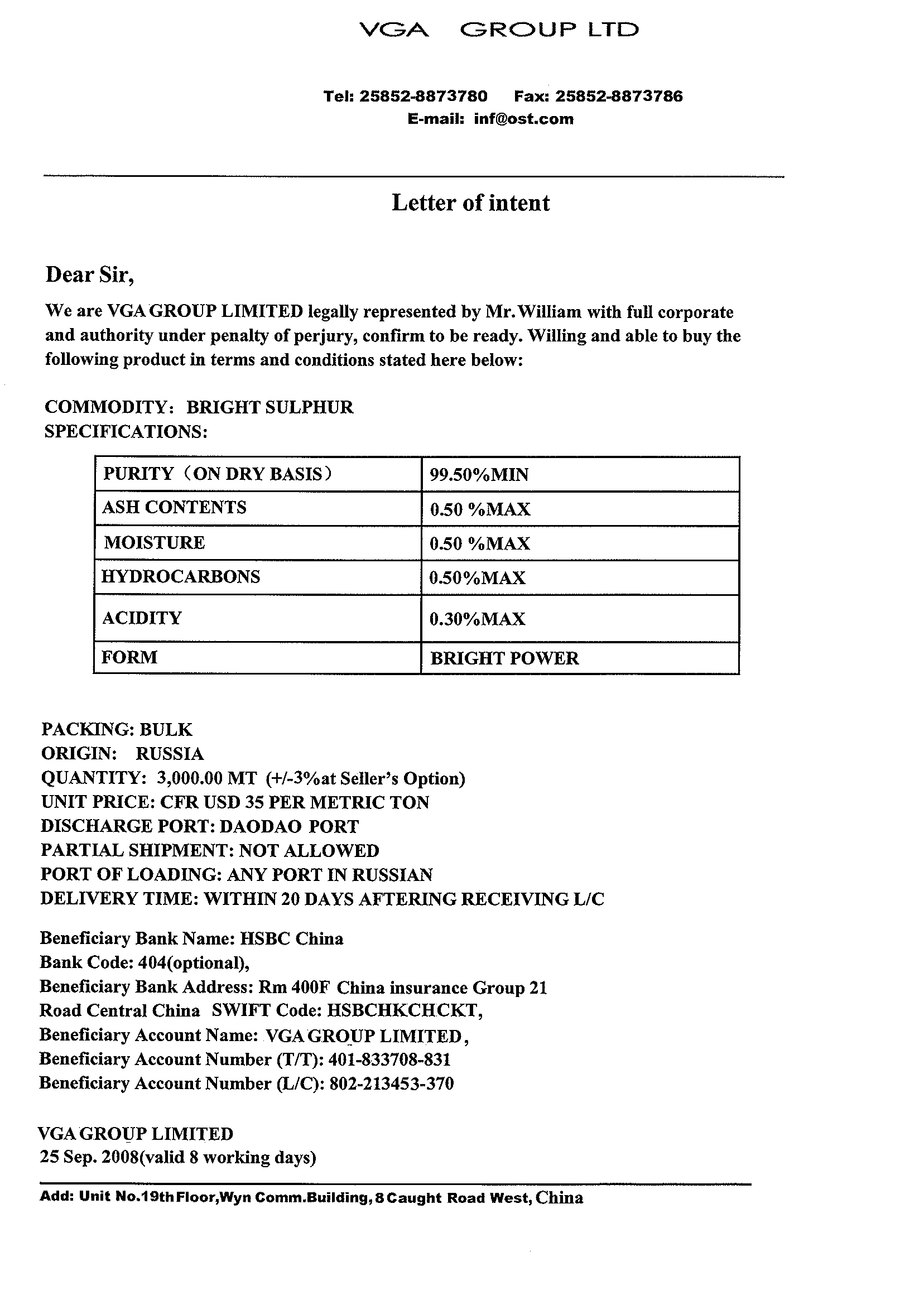
A Letter of Intent is a document allowing a mutual fund investor to receive a breakpoint discount based on a commitment to invest a specified total amount over time.
- Timeframe: A Letter of Intent for a mutual fund breakpoint discount is valid for a maximum period of 13 months.
- Retroactivity: It can even be backdated up to 90 days to include prior purchases in the breakpoint calculation.
- Obligation: A mutual fund Letter of Intent is a non-binding agreement. The investor cannot be sued for failing to deposit the funds.
- The Catch: When the LOI is signed, the fund issues shares at the discounted sales charge, but holds some shares in escrow. If an investor fails to complete a Letter of Intent within the required timeframe, the mutual fund will liquidate escrowed shares to cover the unpaid sales charge.
2. Rights of Accumulation (ROA)
While an LOI looks forward, ROA looks backward. Rights of Accumulation allow an investor to aggregate existing mutual fund holdings with new purchases to qualify for current breakpoint discounts.
- Unlike an LOI, Rights of Accumulation do not have a time limit for reaching a mutual fund breakpoint threshold.
- To reward long-term investors, Rights of Accumulation typically value existing mutual fund holdings at the current Net Asset Value to determine breakpoint eligibility. If a client invested $20,000 years ago, and market growth has pushed that NAV to $40,000, a new $10,000 investment puts them at the $50,000 breakpoint tier.
3. Combination Privileges
Investors do not have to hold just one fund to get a discount. Combination privileges allow investors to aggregate investments across different mutual funds within the same fund family (e.g., combining money in the Vanguard S&P 500 fund with money in a Vanguard Bond fund) to qualify for breakpoint discounts.
Market conditions change, and an investor's risk tolerance evolves. If a client invested in an aggressive growth fund in their 30s but wants to shift to a conservative income fund in their 60s, they shouldn't have to pay a sales charge all over again.
Mutual fund exchange privileges allow a shareholder to transfer investments between different funds within the same fund family without paying a new sales charge.
However, do not confuse a fee-free exchange with a tax-free exchange. Wall Street might waive the sales load, but the government still demands its due. An exchange between mutual funds within the same fund family is considered a taxable event by the Internal Revenue Service. Because the investor is technically selling shares of one fund to buy shares of another, any capital gains realized on the initial sale must be reported and taxed in the year the exchange occurs.