Packaged Products: Investment Companies
Constructing a properly diversified portfolio from scratch is akin to building a commercial freighter plank by plank. It requires vast resources, constant maintenance, and a deep understanding of market navigation. For the vast majority of investors, a far more practical solution is to simply purchase a ticket on a massive, professionally captained ship that is already charting the waters. In the financial markets, these collective vessels are known as packaged products, allowing thousands of investors to pool their money to achieve economies of scale and professional oversight that would be impossible to secure individually. As a financial professional, your job is to act as the harbor master. You must understand exactly how these vessels are built, how they are fueled, and who bears the ultimate risk of the voyage, so you can direct your clients to the right ship.
Following the chaos of the Great Depression, the U.S. government recognized that when retail investors pool their money, they need strict, transparent rules governing how that money is handled. The result was a bedrock piece of legislation: The Investment Company Act of 1940.

The Investment Company Act of 1940 classifies investment companies into three distinct types:
- Face-Amount Certificate Companies
- Unit Investment Trusts (UITs)
- Management Companies
While Face-Amount Certificate Companies are largely historical artifacts today, UITs and Management Companies form the backbone of modern packaged products. Furthermore, Management companies are legally subdivided into two distinct structures: open-end companies and closed-end companies.
Understanding the mechanical differences between these structures is not just an exam requirement; it is the fundamental vocabulary of the securities industry.
An open-end management company is commonly known as a mutual fund.
Think of a mutual fund as an infinitely expandable balloon. When a new investor wants to join, the fund simply creates new space. Open-end funds continuously issue new shares to investors. Because new shares are constantly being birthed into existence to absorb new money, the fund is effectively "open" to an unlimited number of participants.
The Mechanics of Buying and Selling
Because the fund is constantly issuing new shares, open-end fund shares do not trade on secondary markets (like the New York Stock Exchange). Instead, a direct relationship exists between the investor and the fund.
- Open-end fund shares are purchased directly from the issuing fund company.
- Open-end fund shares are redeemed directly by the issuing fund company.
When your client wants out, they don't look for another investor to buy their shares. They hand their shares back to the mutual fund, and the fund hands them cash from its reserves.
Because the mutual fund must be ready to write a check to redeeming investors on demand, it requires a simple, highly liquid capital structure. Consequently, open-end funds can only issue common stock. They are legally prohibited from issuing preferred stock, and they are legally prohibited from issuing bonds. They cannot tie up their capital in rigid debt obligations or preferred dividend promises when they must stand ready to redeem shares daily.
Pricing: The Concept of NAV and Forward Pricing
If a mutual fund doesn't trade on an exchange, how do we know what a share is worth?
Net Asset Value (NAV) = (Total Assets - Total Liabilities) / Number of Shares Outstanding
The price of an open-end fund share is inherently tied to its Net Asset Value. By law, open-end funds must calculate their Net Asset Value at least once per business day, typically at the close of the New York Stock Exchange (4:00 PM Eastern).
This creates a highly specific operational rule you must master: Open-end fund transactions operate on a forward pricing mechanism.
If your client places an order to buy or sell a mutual fund at 11:00 AM, they do not get the price at 11:00 AM. Forward pricing requires investors to buy or redeem shares at the next calculated Net Asset Value following the receipt of the order. This mechanism ensures fairness, preventing day-traders from exploiting intraday market movements at the expense of long-term shareholders.
When buying, the client pays the Public Offering Price (POP), which equals the Net Asset Value plus any applicable sales charge.
Mutual funds offer different "share classes" to accommodate different investor time horizons and fee preferences. As a registered representative, placing a client in the wrong share class is a fast track to regulatory discipline.
- Class A mutual fund shares typically charge a front-end sales load. The investor pays a fee upfront, which reduces the initial amount invested, but they enjoy lower ongoing expenses. This is ideal for long-term investors.
- Class B mutual fund shares typically charge a contingent deferred sales charge (CDSC). The investor pays no front-end load, but if they sell the fund before a certain number of years, they pay a back-end penalty.
- Class C mutual fund shares typically charge an ongoing level load. There is little to no upfront or back-end fee, but the internal annual expenses are much higher. This is generally only suitable for short-term time horizons.

Additionally, funds have marketing and operational costs. A 12b-1 fee is an annual fee charged by a mutual fund to cover marketing and distribution expenses. If a fund wants to market itself as a "bargain" to investors, the SEC imposes a strict limit: the maximum allowed 12b-1 fee for a mutual fund to describe itself as no-load is 0.25 percent of net assets.
Rewarding Size: Breakpoints and Letters of Intent
Volume discounts exist everywhere in commerce, and mutual funds are no exception. Mutual fund breakpoints provide quantity discounts on the front-end sales charge for larger monetary investments. If a client invests $49,000, they might pay a 5% load, but at exactly $50,000, the load drops to 4%.
What if a client doesn't have the $50,000 today, but will have it soon?
- A Letter of Intent (LOI) allows an investor to qualify for a mutual fund breakpoint discount by committing to future purchases. A mutual fund Letter of Intent is valid for a maximum duration of 13 months.
- Rights of Accumulation (ROA) allow an investor to combine existing mutual fund holdings with new purchases to qualify for breakpoint discounts.
Furthermore, because mutual funds are constantly issuing new securities to the public, the Securities Act of 1933 strictly dictates that all purchases of new mutual fund shares require the delivery of a prospectus.

If an open-end fund is an expanding balloon, a closed-end fund is a sealed vault.
Closed-end funds issue a fixed number of shares through an initial public offering (IPO). Once the IPO is complete, the vault is locked. The fund does not continuously create new shares, and critically, closed-end funds do not redeem shares directly with investors.
So, how does an investor get their money out? They take their shares to the open market. Closed-end funds trade actively on secondary markets such as stock exchanges. Investors liquidate closed-end fund shares by selling the shares to other investors on a secondary market exchange.
Pricing and Capital Structure
Because closed-end funds don't have to worry about investors demanding daily cash redemptions, they have the freedom to utilize complex capital structures. Closed-end funds are permitted to issue common stock, they are permitted to issue preferred stock, and they are permitted to issue bonds.
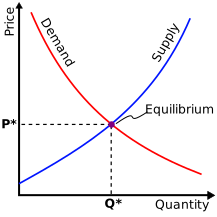
Their pricing mechanism is also entirely different from mutual funds. While a closed-end fund has a calculated NAV, the price of a closed-end fund share is determined by market supply and demand.
- If investors love the fund manager's strategy, a closed-end fund share can trade at a premium to its Net Asset Value.
- If the fund holds illiquid assets or falls out of favor, a closed-end fund share can trade at a discount to its Net Asset Value.
Finally, because the shares trade between investors on the secondary market after the IPO, a prospectus is only required during the initial public offering of a closed-end fund.
The Management Company Cheat Sheet
| Feature | Open-End (Mutual Fund) | Closed-End Fund |
|---|---|---|
| Share Issuance | Continuous | Fixed (IPO only) |
| Secondary Market? | No | Yes (Trades on exchange) |
| Pricing | Formulaic (NAV + Sales Charge) | Supply & Demand (Premium/Discount to NAV) |
| Capital Structure | Common stock ONLY | Common, Preferred, Bonds permitted |
| Redemption | Directly by the fund | Sold to another investor |
The second major category of investment company is the Unit Investment Trust.
Think of a UIT as a financial time capsule. A sponsor curates a specific, fixed portfolio of securities—perhaps 50 high-yielding municipal bonds. Once the trust is assembled, the doors are locked, and the portfolio sits completely untouched.
Because the holdings do not change, a Unit Investment Trust is not actively managed. Therefore, a Unit Investment Trust does not have a board of directors, and it does not employ an investment adviser. There is no one steering the ship; the ship is simply drifting on a predetermined current.
A Unit Investment Trust issues redeemable securities called shares of beneficial interest. Investors buy these units, collect the passive income generated by the underlying assets, and eventually, a Unit Investment Trust terminates on a predetermined specific maturity date. When the maturity date hits, the underlying securities are liquidated, and the proceeds are distributed to the investors.
Now we bridge the gap between Wall Street and the insurance industry.
When you buy a standard insurance product (like a fixed annuity), the insurance company guarantees your return. Because the insurance company is making a guarantee, the issuing insurance company bears the investment risk in a fixed annuity contract. They take your money, place it in their "general account," and invest it conservatively to ensure they can pay you. Because there is no investment risk to the purchaser, fixed annuities are not classified as securities.
But what if the investor wants higher returns and is willing to take on the risk of the stock market? Enter the variable contract.
A variable annuity is an insurance contract containing an investment component. Because the return is tied to market performance, the investor bears the entire investment risk in a variable annuity. Because the investor bears the risk, variable annuities are classified legally as securities. Therefore, selling a variable annuity requires both a securities license and a life insurance license.
The Separate Account
To legally separate the risky market investments from the safe, guaranteed funds of the insurance company, premiums paid into a variable annuity are invested in the insurance company separate account.
This separate account is heavily regulated; in fact, the separate account of a variable annuity is registered as an investment company. The investment performance of the separate account determines the financial return of a variable annuity. Crucially, because it is tied to market fluctuations, variable annuities do not guarantee a minimum rate of return.
The Two Phases of an Annuity
An annuity's lifecycle is split into two distinct periods:
- The Accumulation Phase: This is the period when the investor contributes premium payments. During this phase, the variable annuity investor purchases accumulation units in the separate account. As a protective measure for the investor's heirs, variable annuities typically provide a guaranteed death benefit during the accumulation phase.
- The Annuitization Phase: Eventually, the investor decides to turn their pile of money into a stream of income. The annuitization phase is the period when the investor receives income payments from the variable annuity contract.
When this transition occurs, a permanent mathematical event happens: upon annuitization, accumulation units are permanently converted into a fixed number of annuity units.
The Assumed Interest Rate (AIR) Seesaw
Once the investor is receiving checks, how does the insurance company decide how much to pay out each month?
The monetary value of a variable annuity unit fluctuates based on the performance of the separate account. To calculate the actual check amount, variable annuity payments are calculated against a baseline metric called the Assumed Interest Rate (AIR).
Think of the AIR as a target benchmark. It is a hurdle rate that the separate account must beat.
- If the separate account performance exceeds the Assumed Interest Rate, the next variable annuity payment increases.
- If the separate account performance falls below the Assumed Interest Rate, the next variable annuity payment decreases.
Variable Life Insurance
This same "separate account" architecture is applied to life insurance. In a traditional whole life policy, the death benefit and cash value are strictly guaranteed. But in a variable life insurance policy, the premium goes into the separate account.
While variable life insurance policies provide a minimum guaranteed death benefit (protecting the beneficiary if the market crashes), the cash value of a variable life insurance policy fluctuates based on separate account investment performance.
Why this matters to you: As you prepare for the FINRA SIE, you must intuitively grasp who takes the risk and how the product behaves structurally. When a client asks for liquidity without market volatility, you must know why a closed-end fund trading at a discount is inappropriate. When a client asks about variable annuities, you must recognize that you are selling a security subject to strict prospectus and suitability rules, not just an insurance policy. Understand the mechanics of the vessel, and you will guide your clients safely to harbor.