Options Basics
Imagine negotiating to buy a piece of commercial real estate. You believe the neighborhood is about to gentrify, driving up property values, but you do not have the capital to purchase the building today. Instead, you pay the current owner a non-refundable fee of $10,000 for the exclusive right to buy the property for $1 million at any point in the next six months. If the property's market value skyrockets to $1.5 million, you exercise your right, buy the building for the agreed-upon $1 million, and pocket the difference. If the neighborhood deteriorates and the building's value drops to $800,000, you simply walk away. You lose your $10,000 fee, but you avoid a $200,000 loss on the real estate. This mechanism—paying an upfront premium to secure a future transaction price without the obligation to follow through—is the exact mathematical and logical foundation of the options market.
In the securities industry, options contracts are legally classified as derivative securities. To understand an option, you must first understand that the value of a derivative security is fundamentally based on the price movements of an underlying asset. The option contract itself is simply a conditional agreement sitting on top of that asset.
At its most basic level, an option contract gives the buyer the right to buy or sell an underlying asset at a specific price.
The defining characteristic of an option—and the reason it is called an "option"—is the asymmetry of commitment between the two parties involved:
- The Buyer: An option contract does not impose an obligation on the buyer to exercise the contract. The buyer is paying for a choice.
- The Seller: The option seller has the obligation to fulfill the contract terms if the buyer exercises the option. Because they are underwriting the risk, the option seller is also formally referred to as the option writer.
Why this matters to your career: When your future clients buy options, they are buying flexibility and limited risk. When they sell (or write) options, they are taking on strict legal obligations. As a registered representative, your primary regulatory duty will be ensuring clients understand the severe risks attached to those obligations.
Every options transaction involves either a Call or a Put. You can buy or sell either one, creating four basic market positions.
Call Options
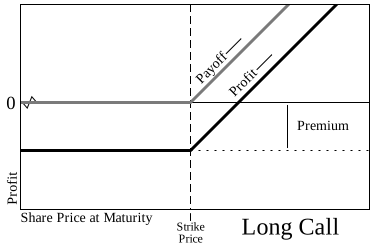
A call option gives the contract buyer the right to purchase the underlying asset. Because the buyer profits if the asset's price rises above the agreed-upon price, purchasing a call option is a bullish investment strategy.
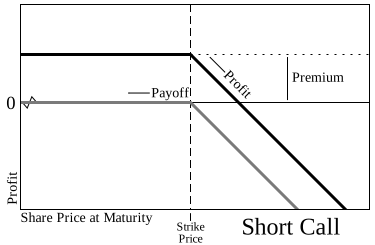
Conversely, writing a call places the seller on the opposite side of that trade. A call option imposes an obligation on the contract seller to sell the underlying asset upon exercise. If the buyer decides to "call" the stock away, the seller must deliver it, no matter how high the market price has climbed.
Put Options
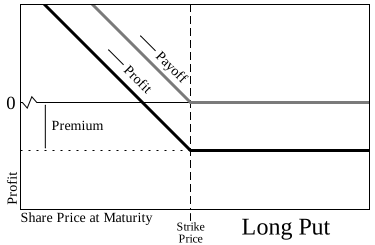
A put option gives the contract buyer the right to sell the underlying asset. You can think of a put like an insurance policy on a stock. If the stock's price collapses, the buyer can still "put" (force a sale of) the stock to the seller at the higher, agreed-upon price. Therefore, purchasing a put option is a bearish investment strategy.
On the other side of the trade, a put option imposes an obligation on the contract seller to purchase the underlying asset upon exercise. If the market crashes, the put writer is legally forced to buy the depreciated asset at the higher contract price.
Every option contract operates on three rigid, structural parameters: the strike price, the expiration date, and the premium.
1. The Strike Price
The strike price is the predetermined price at which the underlying asset is bought or sold upon exercise. Think of this as the "line in the sand." Regardless of extreme market volatility, the strike price remains rigidly fixed throughout the entire lifespan of a standard option contract.
2. The Expiration Date
Options are wasting assets; they do not live forever. The expiration date is the exact calendar date when an option contract becomes void and ceases to exist. Once the closing bell rings on that final day, the contract terminates. Consequently, an unexercised option contract has zero financial value after the expiration date passes.
3. The Premium
Nothing in finance is free. The option premium is the upfront price the buyer pays the seller to acquire the option contract. When looking at a financial terminal, you will notice that the option premium is quoted in the open market on a per-share basis. This means a quoted premium of $2.50 for a standard equity contract will actually cost the buyer $250, because standard contracts represent 100 shares.
To understand how premiums fluctuate in the open market, we must dissect what the premium actually represents. Mathematically, an option premium is the mathematical sum of intrinsic value and time value.
- Intrinsic Value: This is the immediate, tangible worth of the contract. Intrinsic value represents the exact dollar amount by which an option contract is currently in-the-money.
- Time Value: Markets are driven by probabilities. Time value represents the remaining portion of the option premium that exceeds the intrinsic value. It is the price the buyer pays for the amount of time remaining for the asset's price to move in their favor before expiration.
Understanding "In," "Out," and "At" the Money
Whether an option has intrinsic value depends entirely on the relationship between the asset's current market price and the contract's fixed strike price.
| Contract Type | In-the-Money (ITM) | Out-of-the-Money (OTM) |
|---|---|---|
| Call Option | Market price is above the strike price. | Market price is below the strike price. |
| Put Option | Market price is below the strike price. | Market price is above the strike price. |
Note: For both calls and puts, an option is considered at-the-money when the market price of the underlying asset exactly equals the strike price.
While the mechanics of options remain consistent, the rules of settlement change depending on what underlying asset the contract covers. On the FINRA SIE exam, you must sharply differentiate between equity options and index options.
Equity Options
Equity options use the shares of a specific publicly traded company as the underlying asset. (For example, an option on Apple or Tesla).
- Size: A standard equity option contract represents 100 shares of the underlying stock.
- Settlement: The exercise of an equity option requires the physical delivery of the underlying stock shares. If a call is exercised, actual shares move from the seller's account to the buyer's account.
- Expiration Timing: Standard monthly equity options expire on the third Friday of the designated expiration month.
Index Options
Index options use a designated stock market index as the underlying asset (such as the S&P 500 or the Dow Jones Industrial Average).
- Settlement: You cannot physically deliver "the S&P 500." Therefore, the exercise of an index option settles in cash rather than the physical delivery of individual securities.
- The Math of Settlement: Cash settlement of an index option requires the option seller to pay the buyer the cash difference between the strike price and the closing index value.
When can an option buyer actually exercise their right? The answer depends entirely on the "style" of the contract.
- American-style options can be exercised by the buyer on any business day prior to expiration. Because they require physical delivery of shares, standard equity options are typically issued as American-style options. This gives the buyer maximum flexibility.
- European-style options can only be exercised by the buyer on the exact expiration date. Because computing cash settlement mid-day on a massive index would be chaotic, broad-based index options are typically issued as European-style options.
To make this entire system function, traders must trust that the stranger on the other side of the trade will actually honor their obligations. This trust is institutionalized by the Options Clearing Corporation. The Options Clearing Corporation issues standard listed options contracts. More importantly, it acts as the ultimate counterparty to every trade; the Options Clearing Corporation guarantees the performance and settlement of standardized options contracts, effectively eliminating counterparty risk.
The Reality of Risk
As you step into the role of a financial professional, evaluating risk becomes your primary mandate. The asymmetry of rights and obligations in options trading creates a massive asymmetry in risk:
For the buyer, the risk is strictly capped. The maximum potential loss for an option buyer is strictly limited to the total premium paid for the contract. If the trade goes wrong, the option simply expires worthless, and the initial premium is gone.
However, the seller walks a tightrope. Selling an uncovered call option exposes the option writer to a theoretically unlimited maximum loss. An "uncovered" (or naked) call means the seller does not actually own the underlying stock. If the seller writes a call at a $50 strike price, and the stock rockets to $500, $5,000, or $50,000, the seller is legally obligated to buy shares at those astronomical market prices just to sell them back to the buyer at $50. There is no ceiling to how high a stock price can rise, meaning there is no ceiling to the seller's potential financial devastation.