Quadrilaterals and Other Polygons
Not sure you’re ready?
Take the ~3-minute readiness diagnostic and see where you stand.
Biologists classify life through a strict hierarchy of inherited traits, mapping the tree of life from kingdom down to species. Geometers classify polygons with the exact same rigor, organizing two-dimensional shapes into a rigid, logical hierarchy based on sides, angles, and symmetry. For a middle school mathematics teacher, mastering this taxonomy is not merely about memorizing formulas; it is about providing students with a structured way of seeing space. When a student understands that a square is just a highly specialized rectangle, they stop treating geometry as a list of arbitrary rules and start recognizing it as an interconnected logical system.
Before we dive into specific families of shapes, we must establish the baseline language of polygons. In middle school, your students will often conflate "shape" with "regular shape." It is your job to disaggregate those ideas.
A shape can be classified by its sides and angles independently:
- A polygon is classified as equilateral if all sides of the polygon are equal in length.
- A polygon is classified as equiangular if all interior angles of the polygon are equal in measure.
- A regular polygon is defined as a polygon that is simultaneously equilateral and equiangular.
We also classify polygons by their number of sides. The nomenclature you and your students must know fluently includes:
- Pentagon: A polygon with exactly five sides.
- Hexagon: A polygon with exactly six sides.
- Heptagon: A polygon with exactly seven sides.
- Octagon: A polygon with exactly eight sides.
- Nonagon: A polygon with exactly nine sides.
- Decagon: A polygon with exactly ten sides.
- Dodecagon: A polygon with exactly twelve sides.
Students frequently attempt to rote-memorize angle formulas, which inevitably leads to confusion under the pressure of an exam. Teach them the underlying physical mechanics of the shape instead.
Interior Angles
If you draw diagonals from a single vertex of an n-sided polygon to every non-adjacent vertex, you will divide the polygon into exactly n−2 triangles. Because every triangle contains 180∘, the sum of the interior angles of a polygon with n sides is mathematically defined as (n−2) multiplied by 180 degrees.
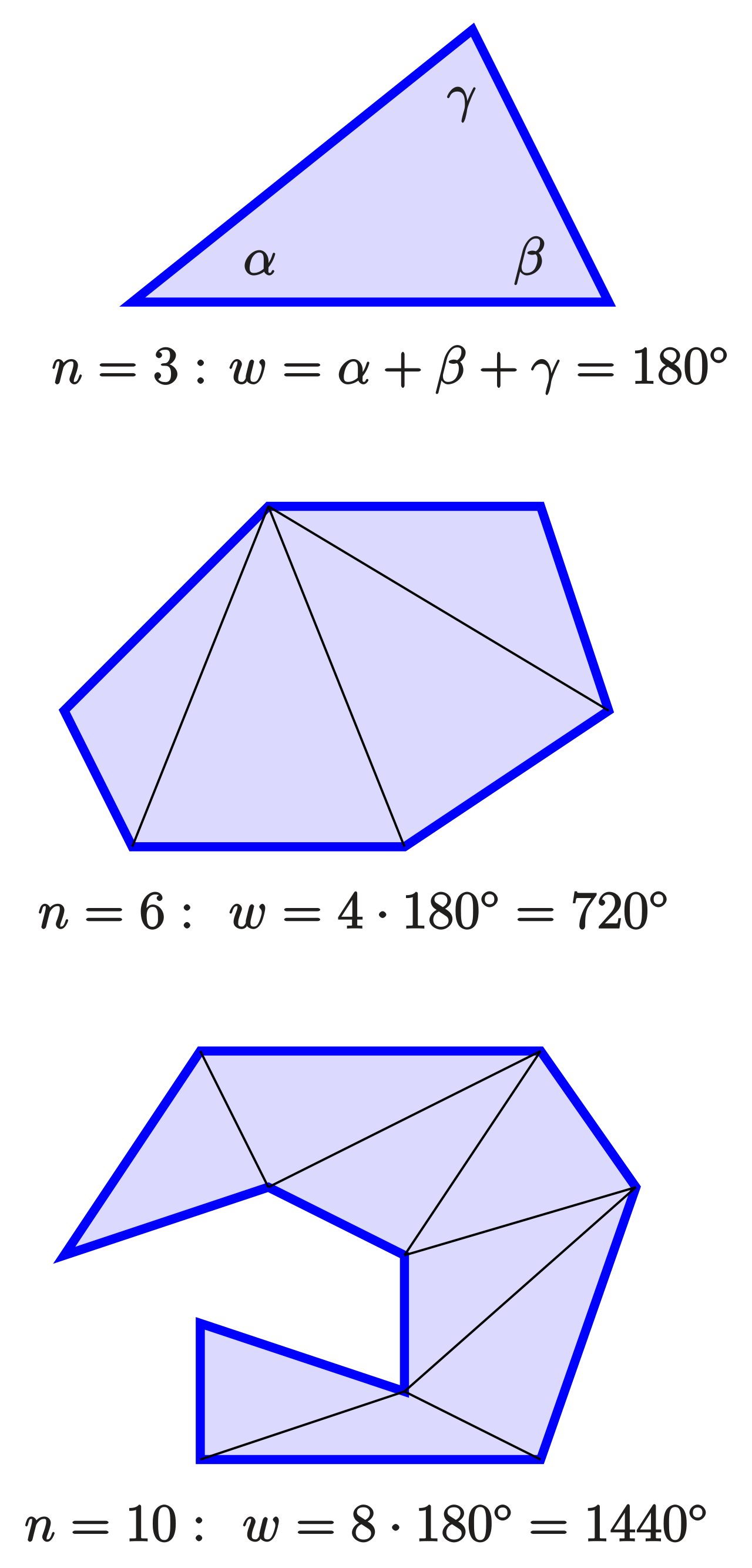
If the shape is perfectly symmetrical (a regular polygon), those total degrees are distributed evenly among the corners. Therefore, the measure of a single interior angle of an n-sided regular polygon is equal to (n−2) times 180 degrees, divided by n.
Exterior Angles
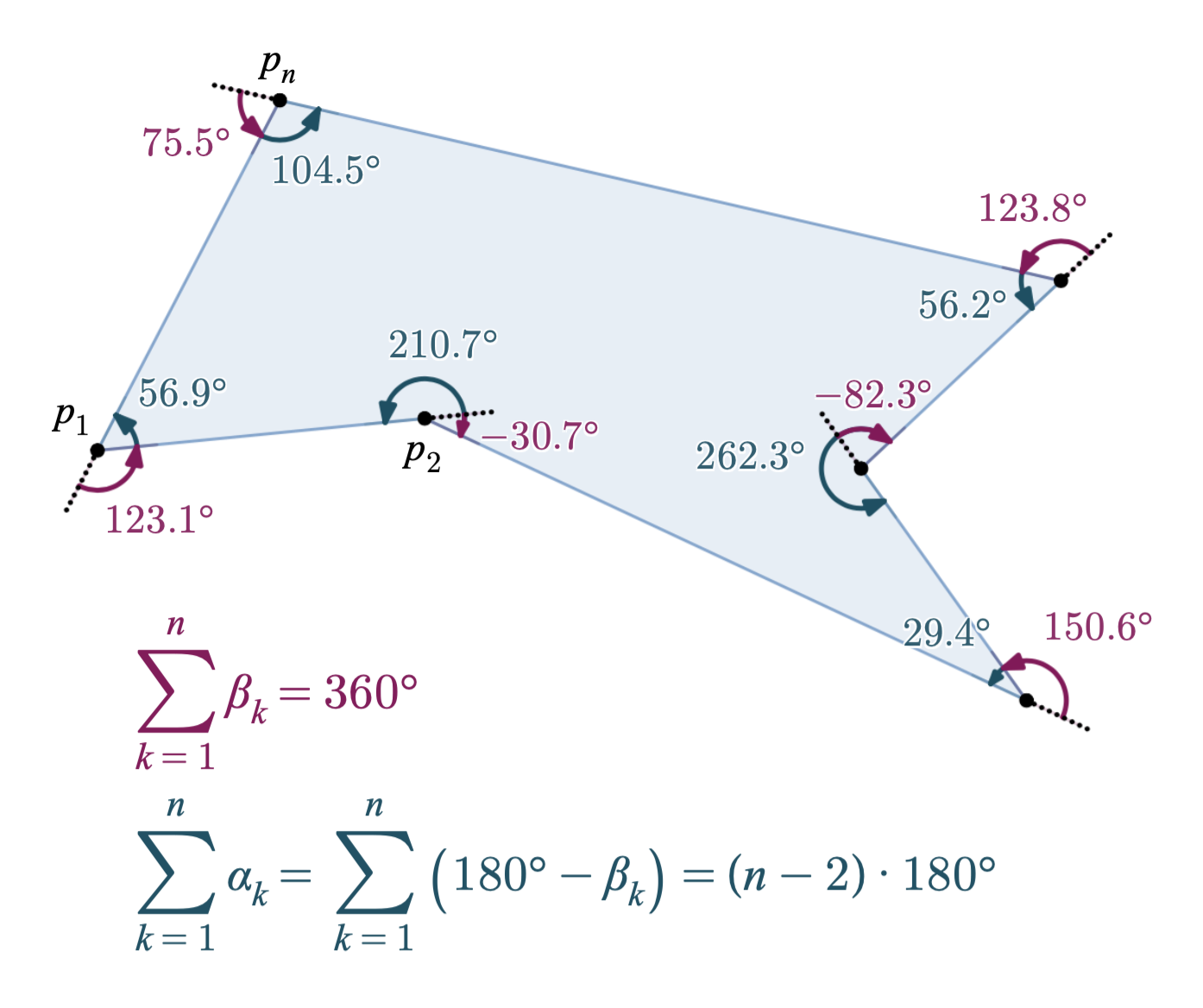
Imagine walking around the perimeter of a building. At each corner, you turn slightly. By the time you return to your starting point facing your original direction, you have completed one full rotation. Because of this physical reality, the sum of the exterior angles of any convex polygon is exactly 360 degrees regardless of the number of sides.
Consequently, for a perfectly symmetrical regular shape, the measure of a single exterior angle of a regular polygon with n sides is exactly 360 degrees divided by n.
Crucial Relationship: If you draw a straight line extending outward from a side, the interior angle and the exterior angle sit on that straight line. Therefore, an exterior angle and the adjacent interior angle of a convex polygon sum to exactly 180 degrees.
Diagonals
How many cross-beams (diagonals) can you build inside a shape? From any single corner of an n-sided polygon, you can draw a diagonal to every corner except yourself and the two immediate neighbors. That leaves (n−3) possible lines per vertex. Multiply that by n vertices, and divide by 2 so you don't double-count the line connecting Vertex A to Vertex B.
Thus, the number of diagonals that can be drawn in a polygon with n sides is determined by the formula 2n(n−3).
The foundational four-sided shape is the quadrilateral, a polygon with exactly four edges and four vertices. Because any quadrilateral can be split into exactly two triangles (4−2=2), the sum of the interior angles of any convex quadrilateral is exactly 360 degrees.
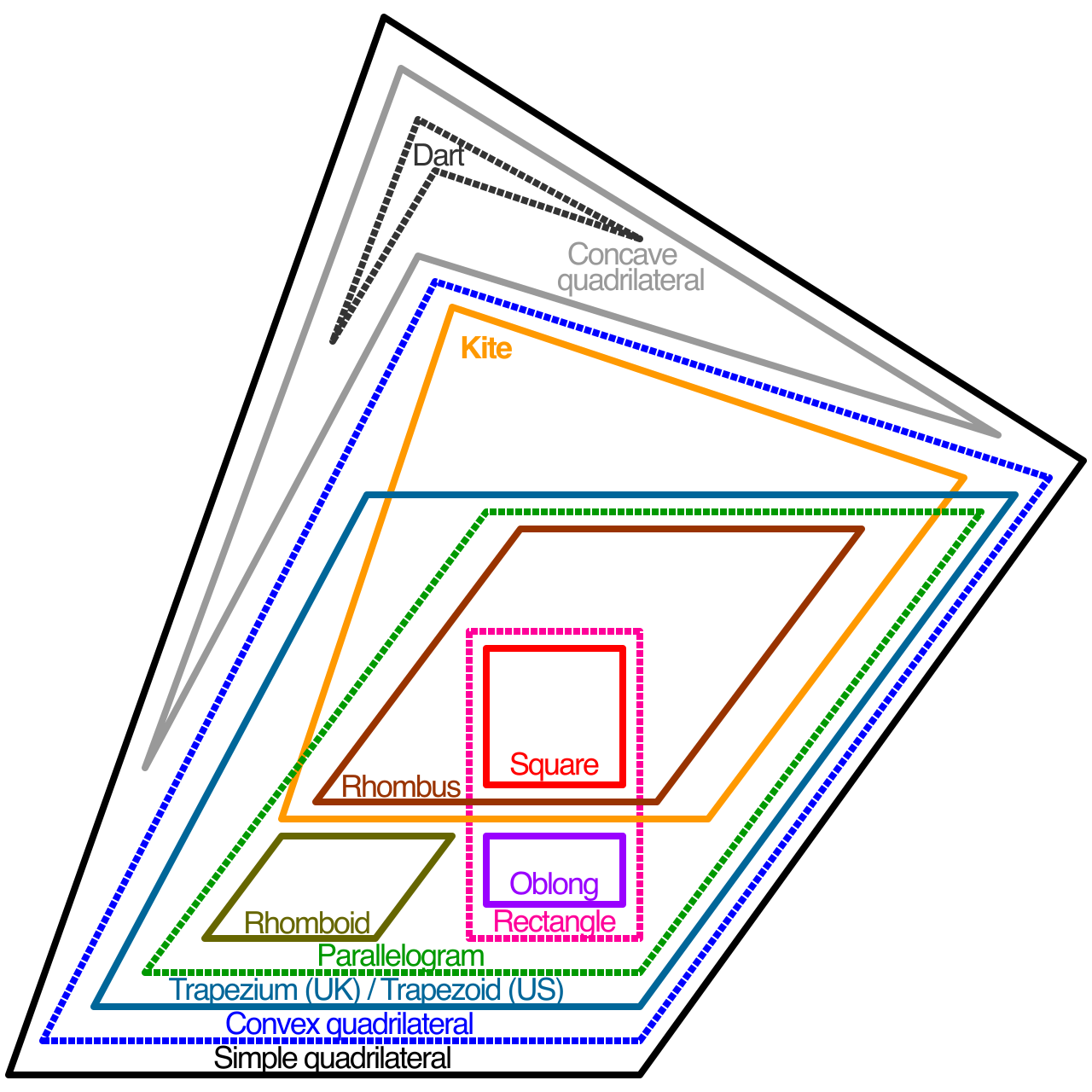
From this humble base, we apply increasingly strict geometric constraints to create a deeply interconnected family tree.
The Parent: The Parallelogram
A parallelogram is a quadrilateral with two pairs of parallel opposite sides. This single constraint of parallelism forces a cascade of structural inevitabilities:
- The opposite sides of a parallelogram are equal in length.
- The opposite interior angles of a parallelogram are equal in measure.
- Any two consecutive interior angles of a parallelogram are supplementary (they add to 180∘, which makes sense if you visualize them as consecutive interior angles cut by a transversal across parallel lines).
- The two diagonals of a parallelogram bisect each other, cutting one another perfectly in half.
To prove a shape is a parallelogram, you don't always need to check every rule. A quadrilateral is guaranteed to be a parallelogram if one pair of opposite sides is both parallel and equal in length.
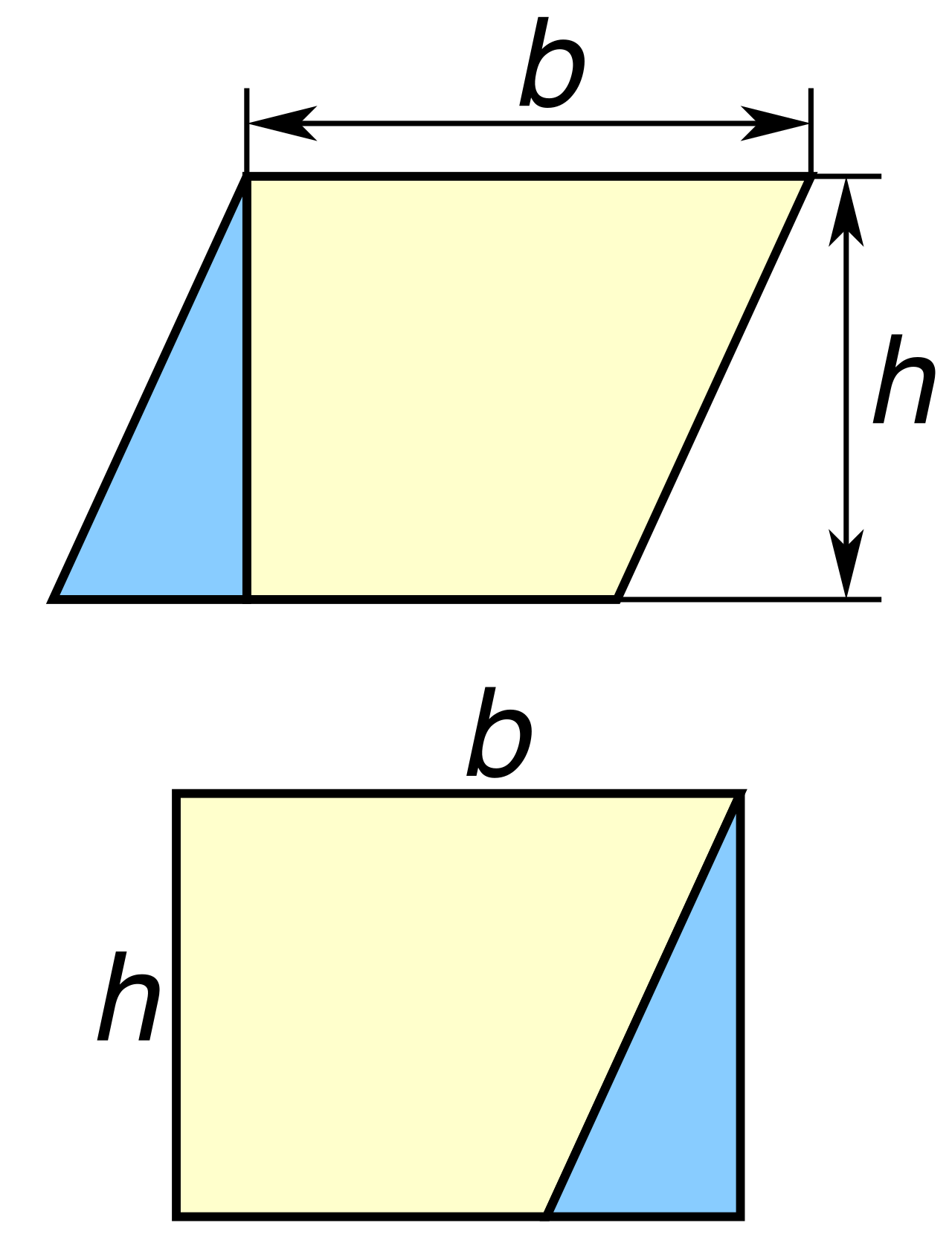
Area: If you snip off the triangular end of a parallelogram and move it to the other side, you form a neat rectangle. Therefore, the area of a parallelogram is the product of a base length and the corresponding perpendicular height.
The Specialists: Rectangles, Rhombuses, and Squares
If we take a parallelogram and add new constraints, we get highly specialized shapes.
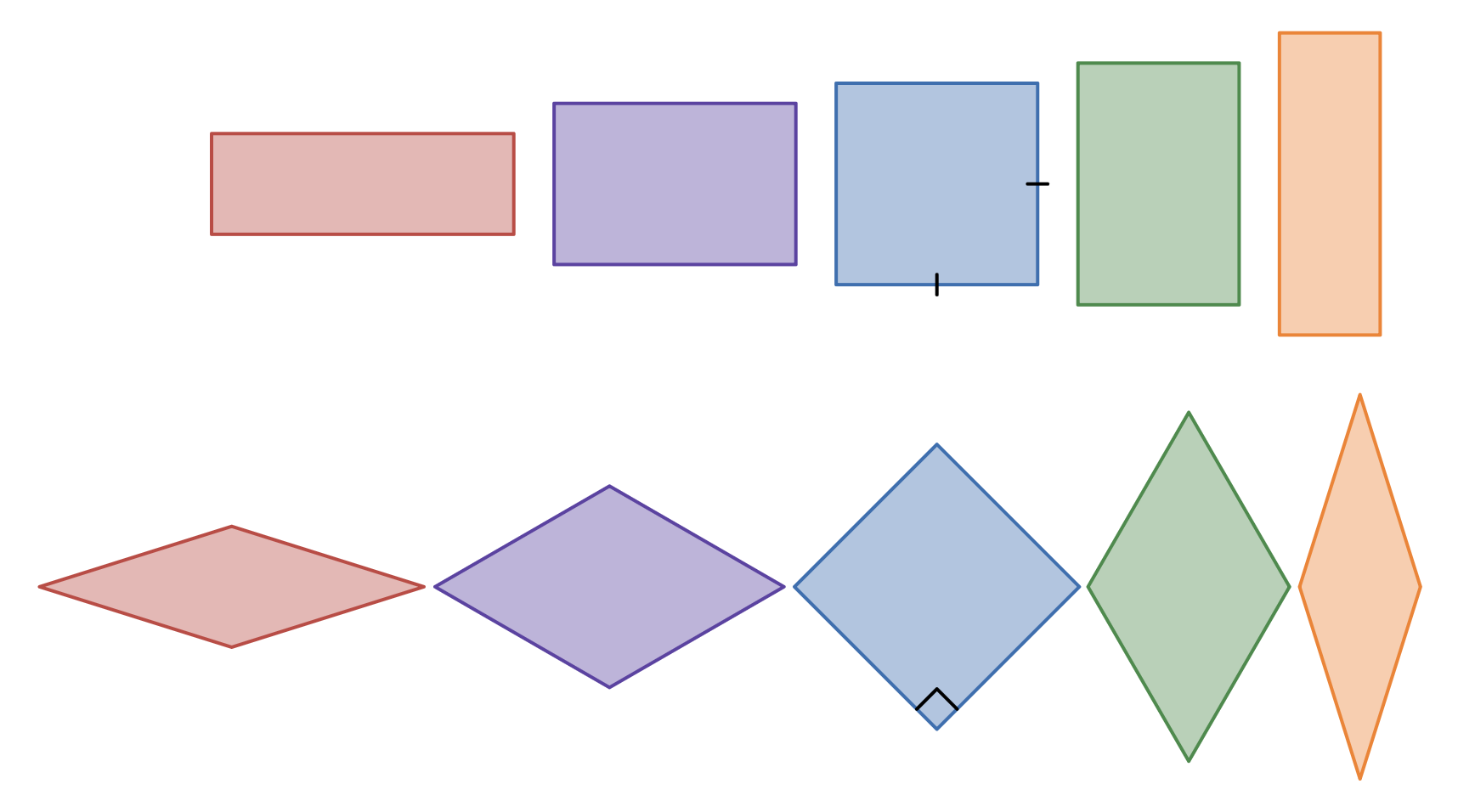
The Rectangle (The Angle Specialist) A rectangle is a quadrilateral containing four right angles. Because of its perfect opposite parallels, every rectangle satisfies all the geometric properties of a parallelogram. Furthermore, straightening the angles forces the cross-beams to match: the two diagonals of a rectangle are equal in length.
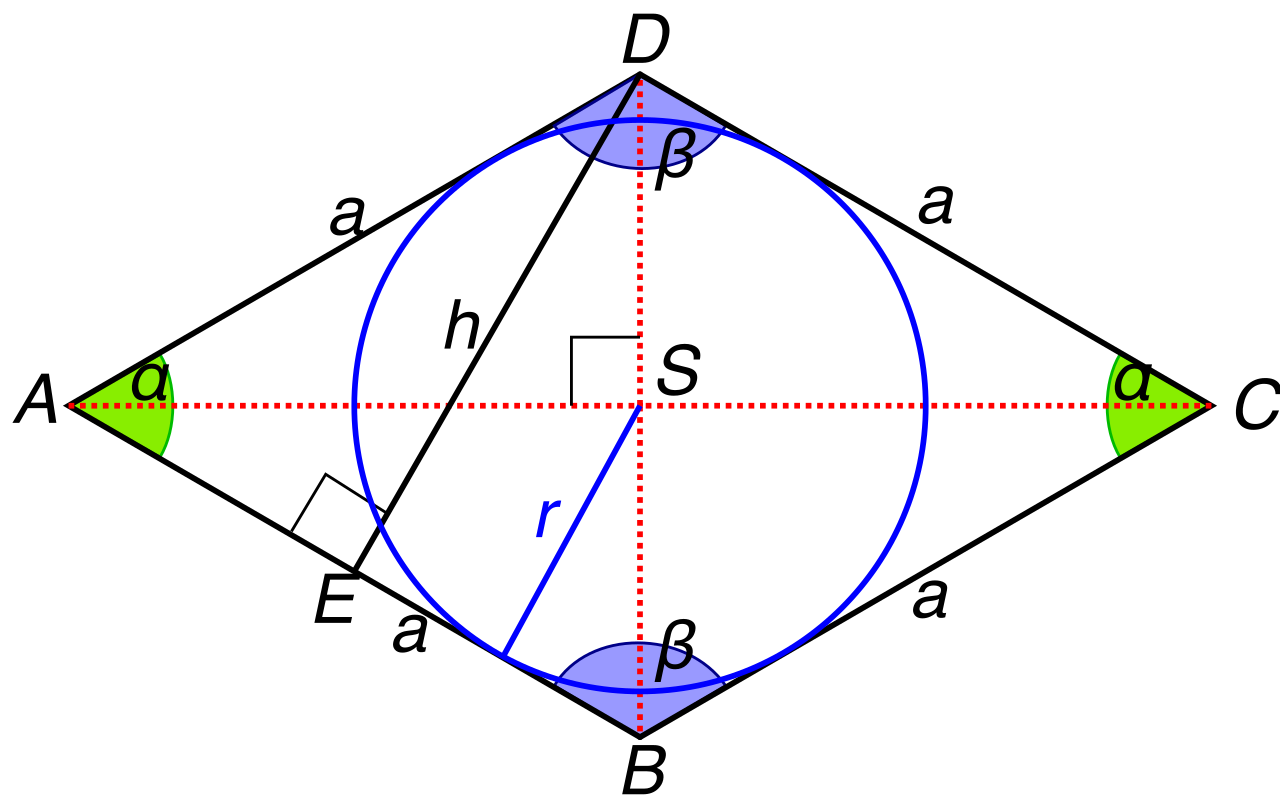
The Rhombus (The Side Specialist) A rhombus is a quadrilateral with four sides of equal length. Like the rectangle, every rhombus satisfies all the geometric properties of a parallelogram. But its equal sides do something fascinating to its internal cross-beams:
- The two diagonals of a rhombus intersect at an angle of exactly 90 degrees.
- Each diagonal of a rhombus bisects a pair of opposite interior angles.
- Area: Because the diagonals are perfectly perpendicular, the area of a rhombus is calculated as one-half the product of the lengths of the two diagonals.
The Square (The Perfect Child) A square is a quadrilateral with four equal-length sides and four right angles. Because it possesses both perfect angles and perfect sides, a square simultaneously satisfies all geometric properties of both a rectangle and a rhombus. This means its diagonals inherit everything: the two diagonals of a square are equal in length (inherited from the rectangle) and intersect at an angle of exactly 90 degrees (inherited from the rhombus).
Not all quadrilaterals fit neatly into the parallelogram family. Some operate under entirely different constraints.
The Trapezoid
Trapezoids are notorious in middle school education because of a longstanding debate in mathematical taxonomy. As a teacher, you must be aware of both frameworks:
- The Inclusive Definition: Defines a trapezoid as a quadrilateral with at least one pair of parallel sides. Under this modern definition (preferred in higher mathematics), parallelograms are technically a sub-type of trapezoids.
- The Exclusive Definition: Defines a trapezoid as a quadrilateral with exactly one pair of parallel sides. This is the traditional definition still prevalent in many state curricula.
Anatomy of a trapezoid:
- The parallel sides of a trapezoid are geometrically referred to as the bases.
- The non-parallel sides of a trapezoid are geometrically referred to as the legs.
If we enforce symmetry on those legs, we get an isosceles trapezoid, a trapezoid where the non-parallel legs are equal in length. This symmetry ensures that the base angles of an isosceles trapezoid are equal in measure and the two diagonals of an isosceles trapezoid are equal in length.
The Midsegment and Area: If you pinpoint the exact middle of the left leg and connect it to the middle of the right leg, you draw the midsegment, a line segment connecting the midpoints of the non-parallel legs.
- The midsegment of a trapezoid is parallel to the bases of the trapezoid.
- The length of the midsegment of a trapezoid is exactly half the sum of the lengths of the two parallel bases. (It is the literal geometric average of the bases).
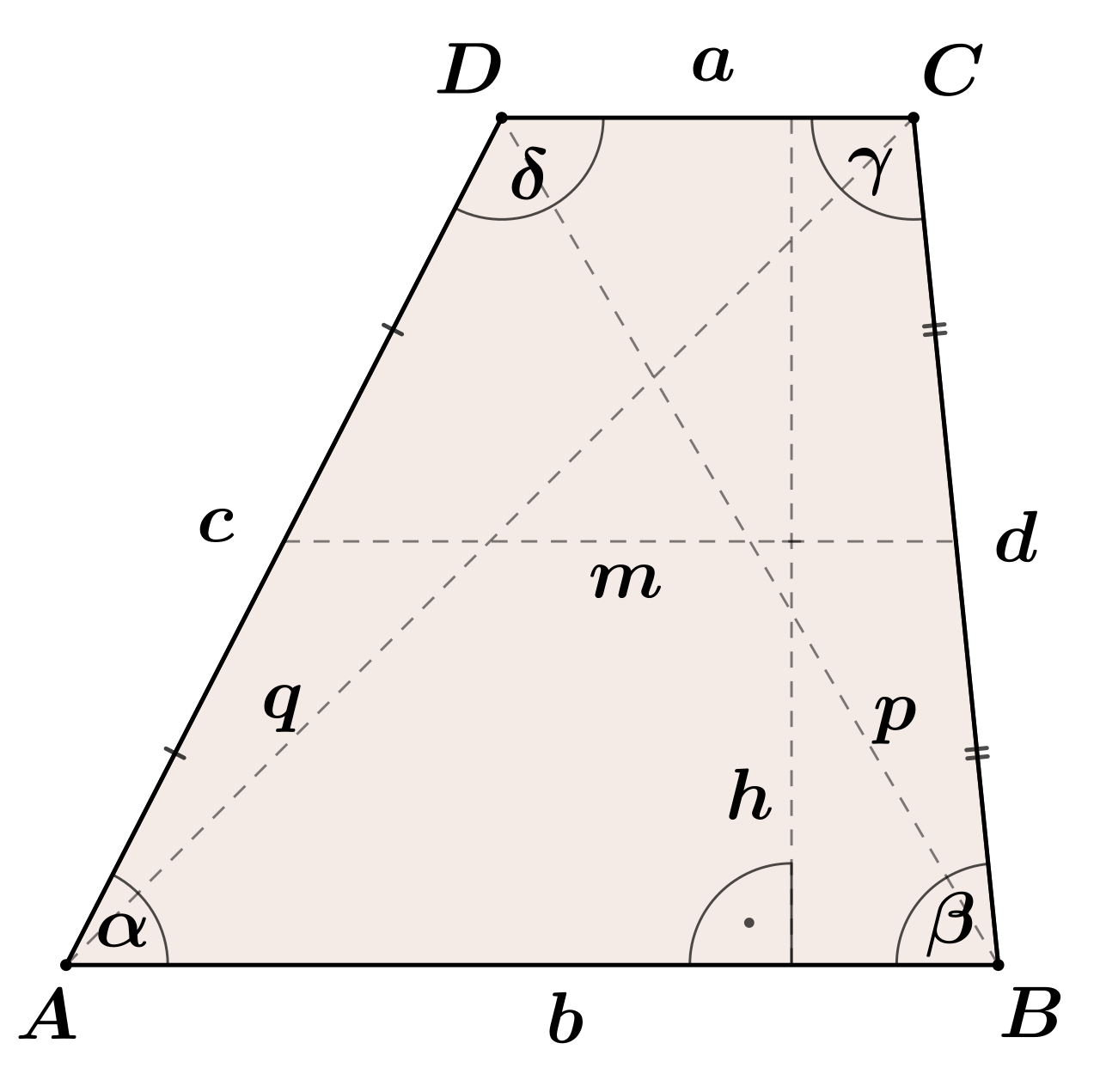
Area: Since the midsegment represents the average width of the shape, the area of a trapezoid is calculated by multiplying the average of the two base lengths by the perpendicular height.
The Kite
If you tape two different-sized isosceles triangles together at their bases, you build a kite. Strictly speaking, a kite is a quadrilateral with exactly two distinct pairs of equal-length adjacent sides. (Note the word distinct; this prevents the definition from collapsing into a rhombus).
Because of its unique, top-to-bottom symmetry:
- A kite contains exactly one pair of opposite angles that are equal in measure (the angles where the unequal sides meet).
- Exactly one diagonal of a kite bisects the other diagonal (the main symmetry line cuts the cross-beam in half).
- Like a rhombus, the two diagonals of a kite intersect at a right angle.
Area: Thanks to those perpendicular diagonals, the area of a kite is calculated as one-half the product of the lengths of the two diagonals.
We have established how to find the area of quadrilaterals, but how do we handle a regular nonagon or dodecagon? We use triangulation.
Imagine a regular octagon. If you mark its exact center, you can draw lines to every corner, splitting it into eight identical triangles. To find the area of the whole shape, we just need the area of one of those triangles, multiplied by eight.
The base of one of those triangles is simply the side length of the polygon. But what is the height? Geometers give this specific height a name: The apothem of a regular polygon is the perpendicular distance from the center of the polygon to the midpoint of any side.
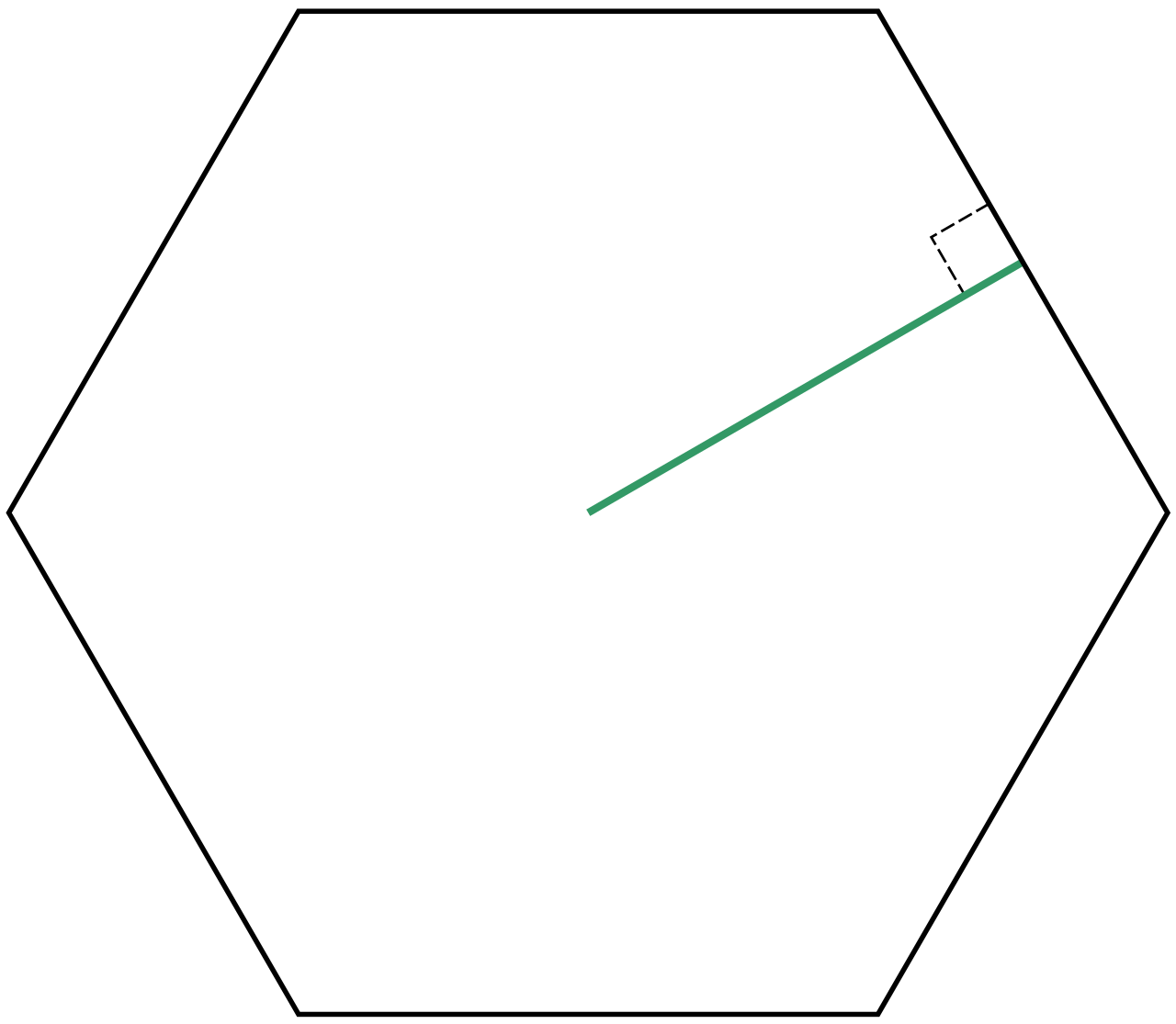
The area of one triangle is 21×base×apothem. If we multiply this by n triangles, we are multiplying the base by n, which gives us the perimeter of the entire shape!
Therefore, we arrive at the elegant, universal formula: The area of a regular polygon is one-half the product of the apothem length and the perimeter of the polygon.
As you prepare for your Praxis exam, and later for your classroom, view these properties not as isolated trivia, but as the interlocking gears of a vast, logical machine. By mastering the exact constraints of each shape, you equip yourself to teach geometry as it was meant to be taught: a beautiful, rational system of space.