Mendelian Genetics
Not sure you’re ready?
Take the ~3-minute readiness diagnostic and see where you stand.
A single garden pea seed contains the exact biological instructions required to construct an entire organism, dictating everything from the color of its flowers to the texture of its pod. Long before we could sequence DNA or image chromosomes, Gregor Mendel formulated the foundational laws of inheritance based on breeding experiments with the garden pea plant. By meticulously tracking mathematical patterns across generations of peas, he proved that heredity is not a nebulous blending of parental traits, but rather a rigid, quantifiable system of discrete information transfer. Understanding this system is the bedrock of modern biology.
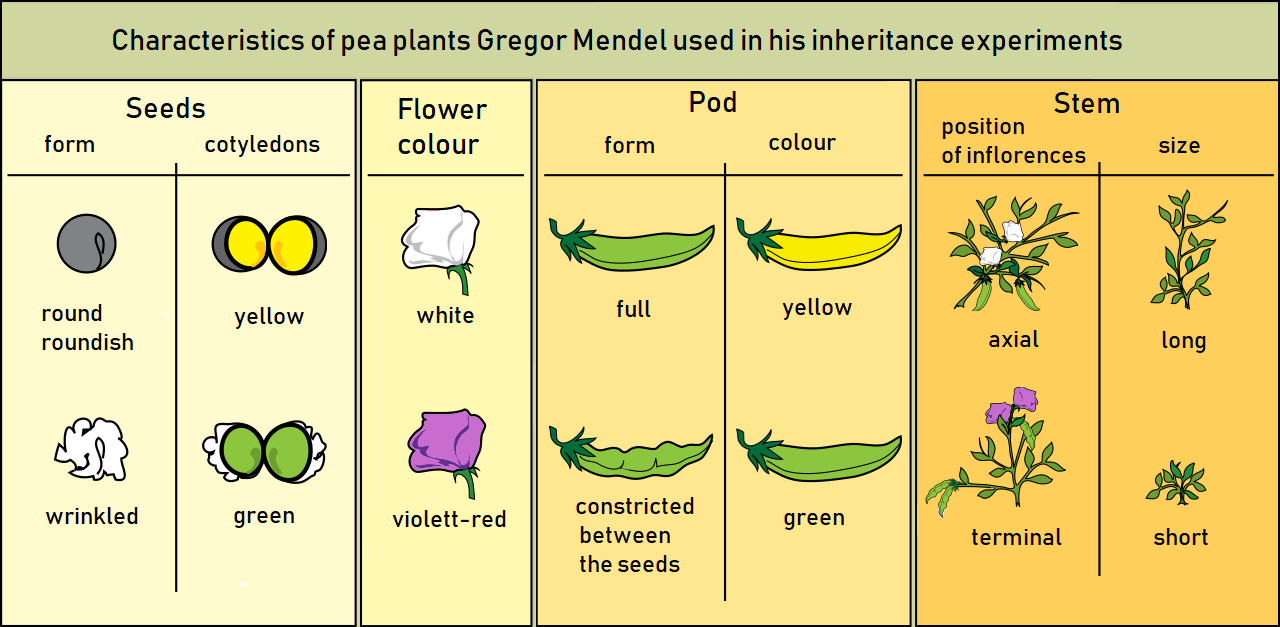
To teach genetics effectively, you must first clarify the difference between the physical reality of the organism and the hidden biological code that constructs it. Your future students will inevitably conflate what an organism looks like with what an organism is at a molecular level.
We begin with the gene, which is a discrete unit of heredity that determines a specific biological trait. But genes are not monolithic. An allele is a variant form of a gene located at a specific position on a specific chromosome. Think of a gene as a category (like "eye color") and an allele as the specific variation (like "brown" or "blue").
This distinction leads directly to the two most critical terms in genetics:
- Genotype refers to the exact genetic makeup of an organism for a particular trait. It is the hidden biochemical script.
- Phenotype refers to the observable physical or biochemical characteristics of an organism. It is the visible execution of that script.
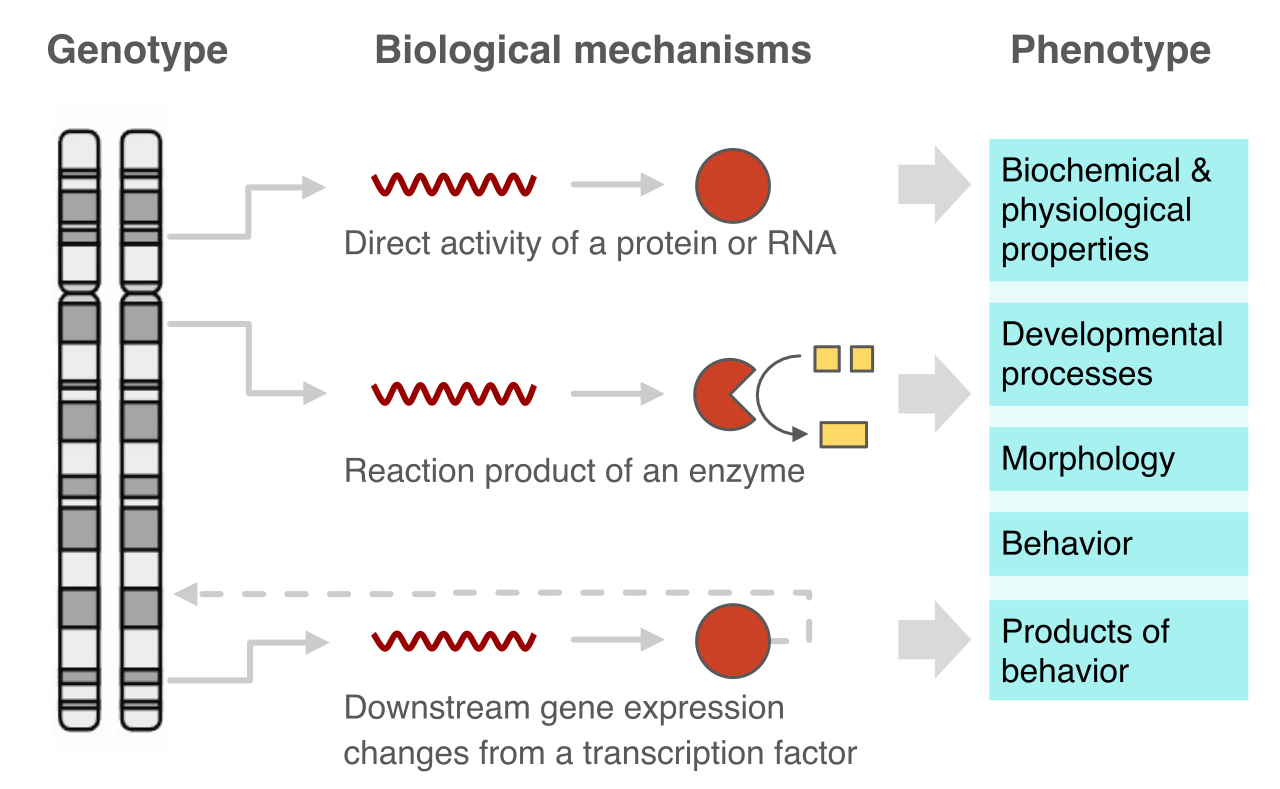
When you write a lesson plan, the written document is your genotype. What actually happens in your classroom on a Tuesday morning—the observable reality—is the phenotype.
Dominance and Zygosity
Because sexually reproducing organisms inherit one set of chromosomes from each parent, they possess two alleles for every somatic gene.
- A homozygous organism possesses two identical alleles for a specific gene.
- A heterozygous organism possesses two different alleles for a specific gene.
When an organism is heterozygous, a genetic conflict arises: which allele's instructions are actually carried out?
A dominant allele determines the observable phenotype in a heterozygous individual. Crucially, a dominant allele completely masks the expression of a recessive allele in a heterozygous individual. In contrast, a recessive allele only expresses a corresponding phenotype when an individual possesses two copies of that recessive allele.
Strict Mendelian inheritance assumes two key boundaries:
- Each trait is controlled by a single gene.
- Each gene has exactly two possible alleles. (As you will teach later in your curriculum, reality is often more complex—involving polygenic traits and multiple alleles—but Mendelian inheritance forms the foundational baseline from which all complexity diverges).
Mendel’s genius lay in his ability to infer invisible cellular mechanics purely through statistical observation. He derived three core laws that govern how alleles behave.
1. The Law of Dominance
The Law of Dominance states that in a heterozygote, the dominant allele will exclusively determine the phenotype. The recessive allele remains structurally intact and inheritable, but it is silent in the physical expression of that specific generation.
2. The Law of Segregation
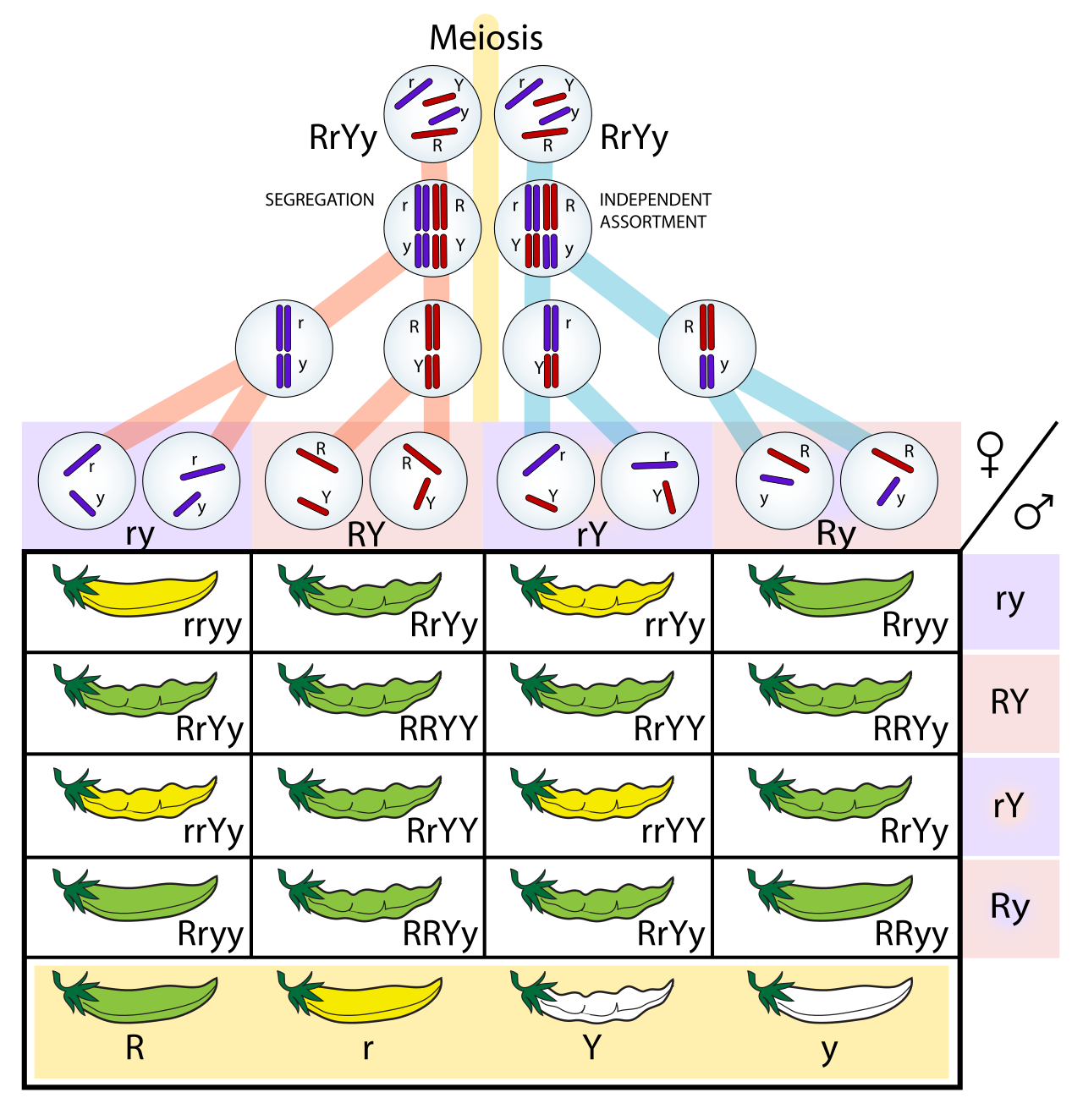
The Law of Segregation states that the two alleles for a heritable character separate during gamete formation.
Why is this conceptually vital for your students? Because the separation of alleles during gamete formation ensures that each gamete receives exactly one allele per gene. This is the macro-level consequence of Anaphase I in meiosis, where homologous chromosomes are pulled to opposite poles of the dividing cell. The law prevents the genetic code from doubling infinitely with each generation.
3. The Law of Independent Assortment
While segregation deals with the alleles of a single gene separating, The Law of Independent Assortment states that alleles of two or more different genes get sorted into gametes independently of one another. The inheritance of seed color has absolutely no mathematical bearing on the inheritance of plant height.
Important Caveat for the Exam: The Law of Independent Assortment applies specifically to genes located on different chromosomes or genes situated far apart on the same chromosome. If genes are located very close together on the same chromosome, they are "linked" and tend to travel together, violating this law.
Mendel discovered his laws by orchestrating precise breeding experiments. He relied on true-breeding organisms, which always pass down the same observable phenotypic traits to their offspring when self-fertilized. Biologically, a true-breeding organism is completely homozygous for the traits being studied.
This establishes our experimental timeline:
- The P generation in a Mendelian cross refers to the initial true-breeding parental individuals.
- The F1 generation refers to the first filial generation of offspring produced by crossing two individuals of the P generation.
- The F2 generation refers to the second filial generation produced by interbreeding individuals of the F1 generation.
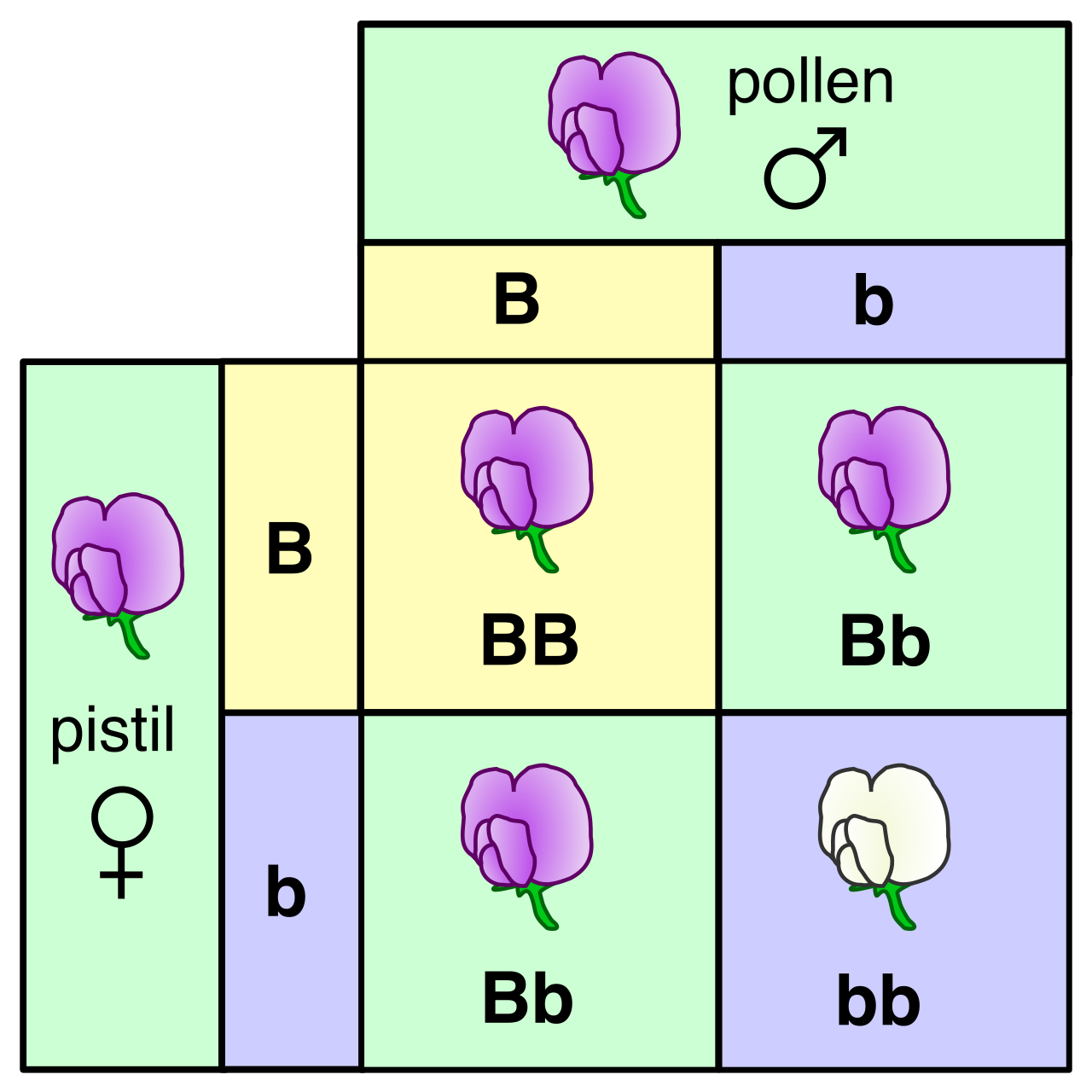
To calculate the outcomes of these crosses, geneticists use a Punnett square, a visual grid used to predict the genotypic and phenotypic frequencies of a particular breeding experiment. When teaching this, remind your students that the outside of the grid represents the separated alleles in the parents' gametes (Law of Segregation), while the inside boxes represent the fertilization events—the probabilistic recombination of those gametes.
The Monohybrid Cross
A monohybrid cross is a mating between two individuals that are heterozygous for a single specific gene. If you take an F1 generation plant (Aa) and cross it with another F1 generation plant (Aa), you are tracking a single trait.
- The expected genotypic ratio of offspring from a monohybrid cross between two heterozygous parents is 1:2:1 (one homozygous dominant, two heterozygous, one homozygous recessive).
- The expected phenotypic ratio of offspring from a monohybrid cross between two heterozygous parents is 3:1 (three expressing the dominant trait, one expressing the recessive trait).
The Dihybrid Cross
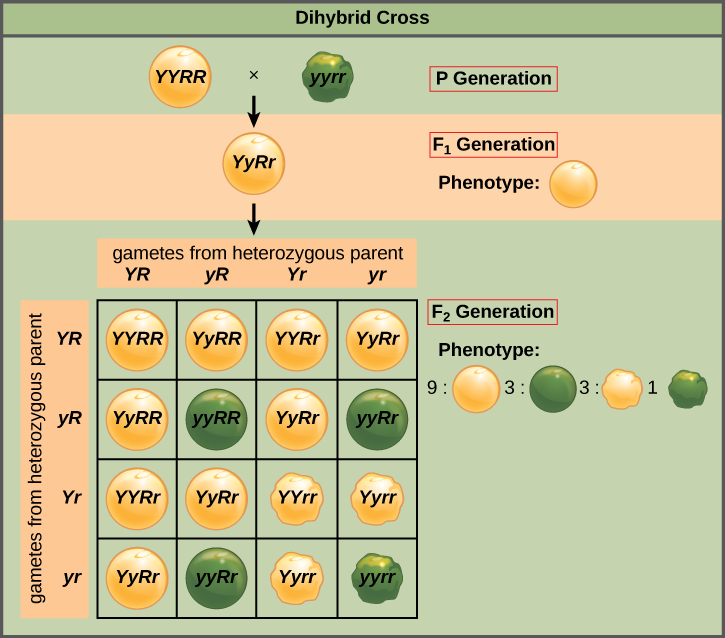
A dihybrid cross scales up the complexity; it is a mating between two individuals that are each heterozygous for two distinct genes (e.g., AaBb × AaBb).
Because the traits sort independently, the expected phenotypic ratio of offspring from a Mendelian dihybrid cross between two double-heterozygous parents is 9:3:3:1.
- 9 exhibit both dominant phenotypes.
- 3 exhibit the first dominant and second recessive phenotype.
- 3 exhibit the first recessive and second dominant phenotype.
- 1 exhibits both recessive phenotypes.
The Test Cross
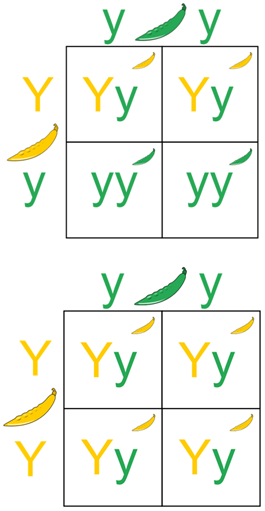
Imagine you find a pea plant with purple flowers (the dominant phenotype). Because of the Law of Dominance, its genotype is obscured; it could be homozygous dominant (PP) or heterozygous (Pp). How do you unveil the hidden genotype?
You perform a test cross. A test cross involves mating an individual showing a dominant phenotype with an individual showing a recessive phenotype. The purpose of a test cross is to determine whether an individual with a dominant phenotype has a homozygous dominant or heterozygous genotype.
- If any offspring display the recessive phenotype, the unknown parent must be heterozygous, because the recessive offspring required a recessive allele from both parents.
The Punnett square is just a visual representation of statistical probability. To analyze complex crosses without drawing massive grids, you must apply foundational probability rules.
| Rule | Definition | Application |
|---|---|---|
| Product Rule | Calculates the chance of two independent genetic events occurring together by multiplying their individual probabilities. | "What is the probability of an offspring inheriting allele A from the mother AND allele a from the father?" (21×21=41) |
| Sum Rule | Calculates the chance of either of two mutually exclusive genetic events occurring by adding their individual probabilities. | "What is the probability of an offspring being a heterozygote (inheriting A from mom and a from dad OR a from mom and A from dad)?" (41+41=21) |
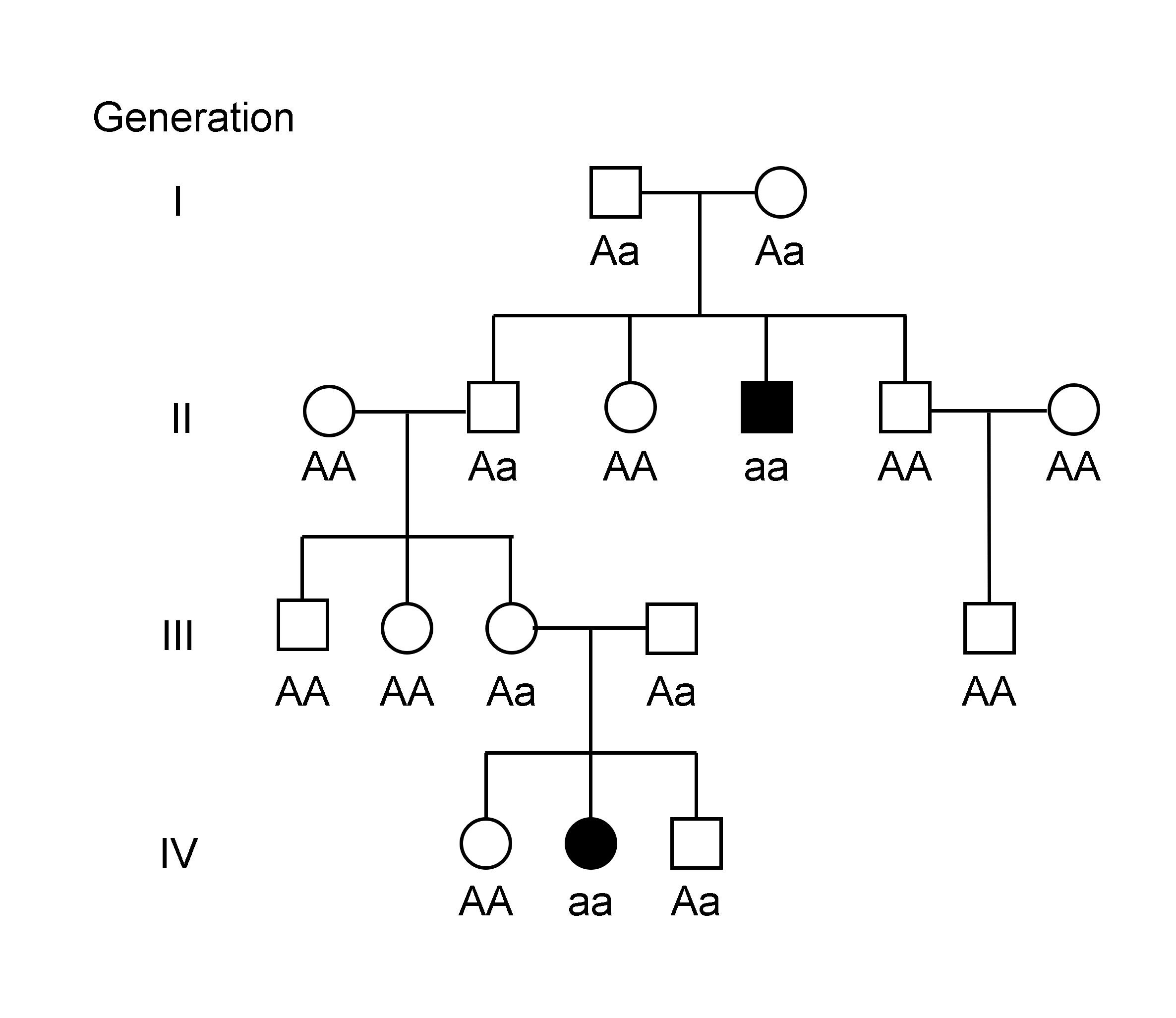
We cannot perform test crosses on humans. To trace genetic inheritance in our own species, we rely on retrospective mapping. A pedigree chart is the geneticist's family tree.
The Symbology of Pedigrees:
- In a genetic pedigree chart, squares conventionally represent biological males.
- In a genetic pedigree chart, circles conventionally represent biological females.
- In a genetic pedigree chart, fully shaded symbols represent individuals who express the specific trait being tracked.
- In a genetic pedigree chart, unshaded symbols represent individuals who do not express the specific trait being tracked.
Diagnosing Inheritance Patterns
When confronted with a pedigree on your Praxis exam, your immediate goal is to diagnose the mode of inheritance by hunting for tell-tale patterns.
- Autosomal dominant traits appear in every generation of a pedigree without skipping generations.
- Affected individuals with an autosomal dominant trait must have at least one affected parent.
- Heuristic: If you see an affected child with two unaffected parents, you can definitively rule out autosomal dominant inheritance.
- Autosomal recessive traits frequently skip generations in a genetic pedigree. They can remain hidden in heterozygous carriers for decades before revealing themselves.
- Two unaffected parents can produce an offspring affected by an autosomal recessive trait.
- When this happens, you know with absolute mathematical certainty that the unaffected parents of an offspring affected by an autosomal recessive trait are obligate heterozygous carriers of the recessive allele. They each carried the hidden script, and both passed the recessive allele to the offspring.
Mendelian genetics is not just a chapter in a textbook; it is the mathematical proof of biological continuity. When you teach your students that a monohybrid cross yields a 3:1 ratio, you are not just teaching them to multiply fractions. You are showing them the precise, predictable rhythm of life itself. The separation of chromosomes, the collision of gametes, the dominant suppression of recessive code—all of it plays out reliably in every field of corn, every litter of puppies, and every human family tree. Master these principles, and you equip yourself to translate the profound machinery of life for the next generation of scientists.