Using Venn Diagrams for Word Problems
Not sure you’re ready?
Take the ~3-minute readiness diagnostic and see where you stand.
Human beings possess an innate compulsion to categorize. When confronted with a chaotic universe of distinct objects—be they subatomic particles, biological species, or simply students enrolled in high school electives—we draw conceptual boundaries. In mathematics, this boundary-drawing yields a set, rigorously defined as a well-defined collection of distinct objects. Every individual item belonging to a set is known as an element. Yet, human reasoning is predominantly visual. To truly understand how different sets interact, overlap, or entirely avoid one another, we must map them geographically. We translate abstract logical relationships into physical spaces, creating a tool of profound analytical power.
In 1880, the British logician John Venn introduced the Venn diagram, revolutionizing how we handle complex categorical logic. Simply put, a Venn diagram is a visual representation of sets using geometric shapes. By translating word problems into these shapes, we bypass the cognitive overload of juggling abstract numbers and instead let geometry do the heavy logical lifting.
The architecture of this visual system is beautifully strict. The absolute boundary of our given reality is the universal set, which contains all elements under consideration in a specific problem. Visually, a surrounding rectangle in a Venn diagram represents the universal set. Nothing exists outside this box. Inside the rectangle, circles in a Venn diagram represent individual sets. By analyzing how these circles interact, we construct a precise map of the relationships between different groups of elements.
When we deal with multiple sets within the same universal boundary, they frequently share elements. This brings us to the two most fundamental operations in set theory: the intersection and the union.
The Intersection
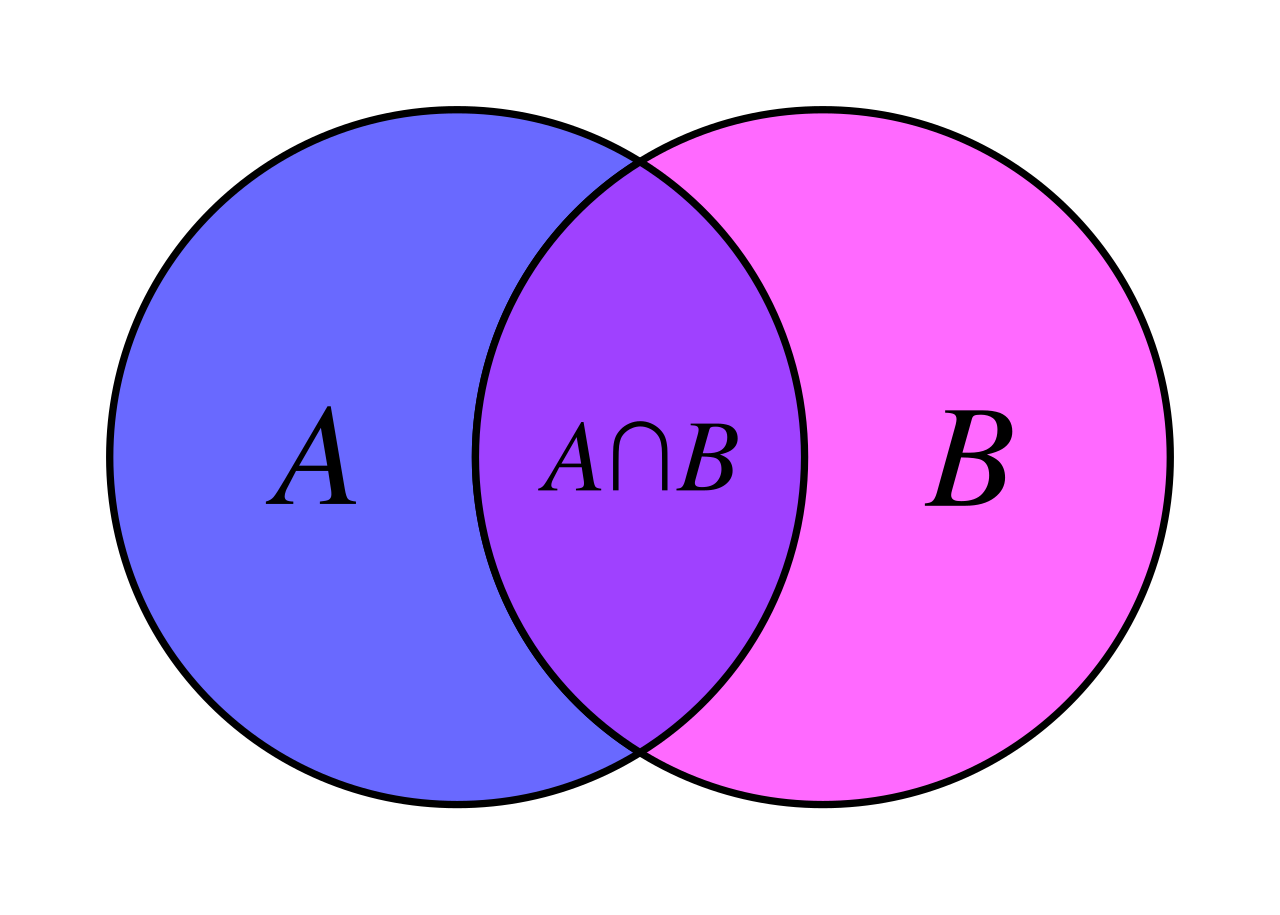
The intersection of two sets contains the elements shared by both sets.
If we are searching for students who participate in both Debate Club and the Robotics Team, we are looking exclusively at the space where the two sets cross. Visually, the overlapping region of two circles in a Venn diagram represents the intersection of two sets. In the language of mathematical word problems, the word 'and' in a set word problem indicates an intersection. The mathematical notation for this operation is concise: the symbol ∩ denotes the intersection of sets.
The Union
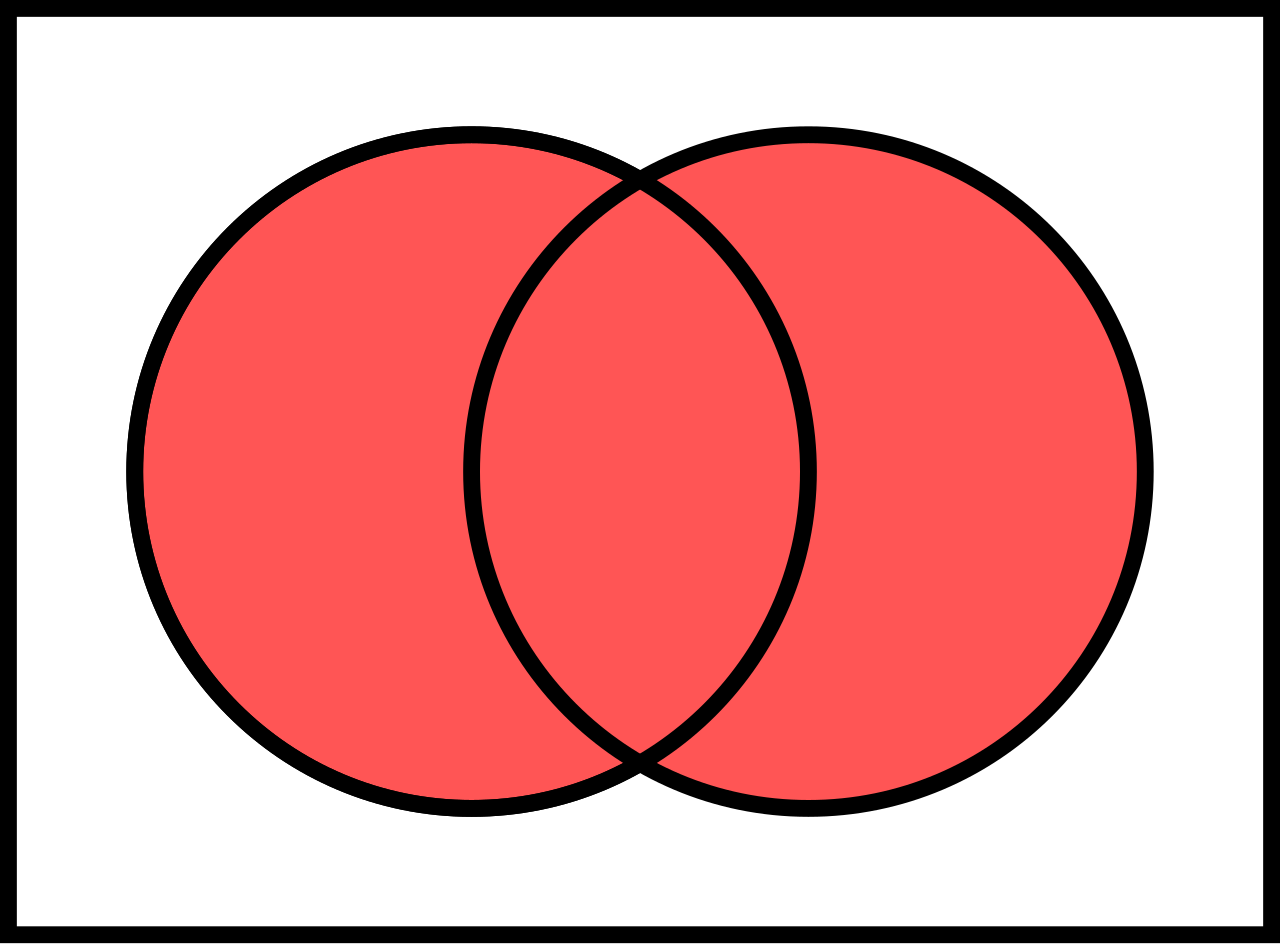
The union of two sets contains all elements present in either set or both sets.
Imagine pouring all the elements of Set A and all the elements of Set B into a single, massive container; the resulting pool is the union. Visually, the entire area covered by two circles in a Venn diagram represents the union of two sets. When reading a Praxis word problem, the word 'or' in a set word problem indicates a union. Note that in mathematics, "or" is inclusive—meaning one, the other, or both. Notationally, the symbol ∪ denotes the union of sets.
Occasionally, you will encounter distinct sets that have absolutely nothing in common. These are known as disjoint sets, which are simply sets sharing no common elements. Because they share nothing, disjoint sets appear in a Venn diagram as circles lacking overlap, standing as isolated islands within the universal rectangle.
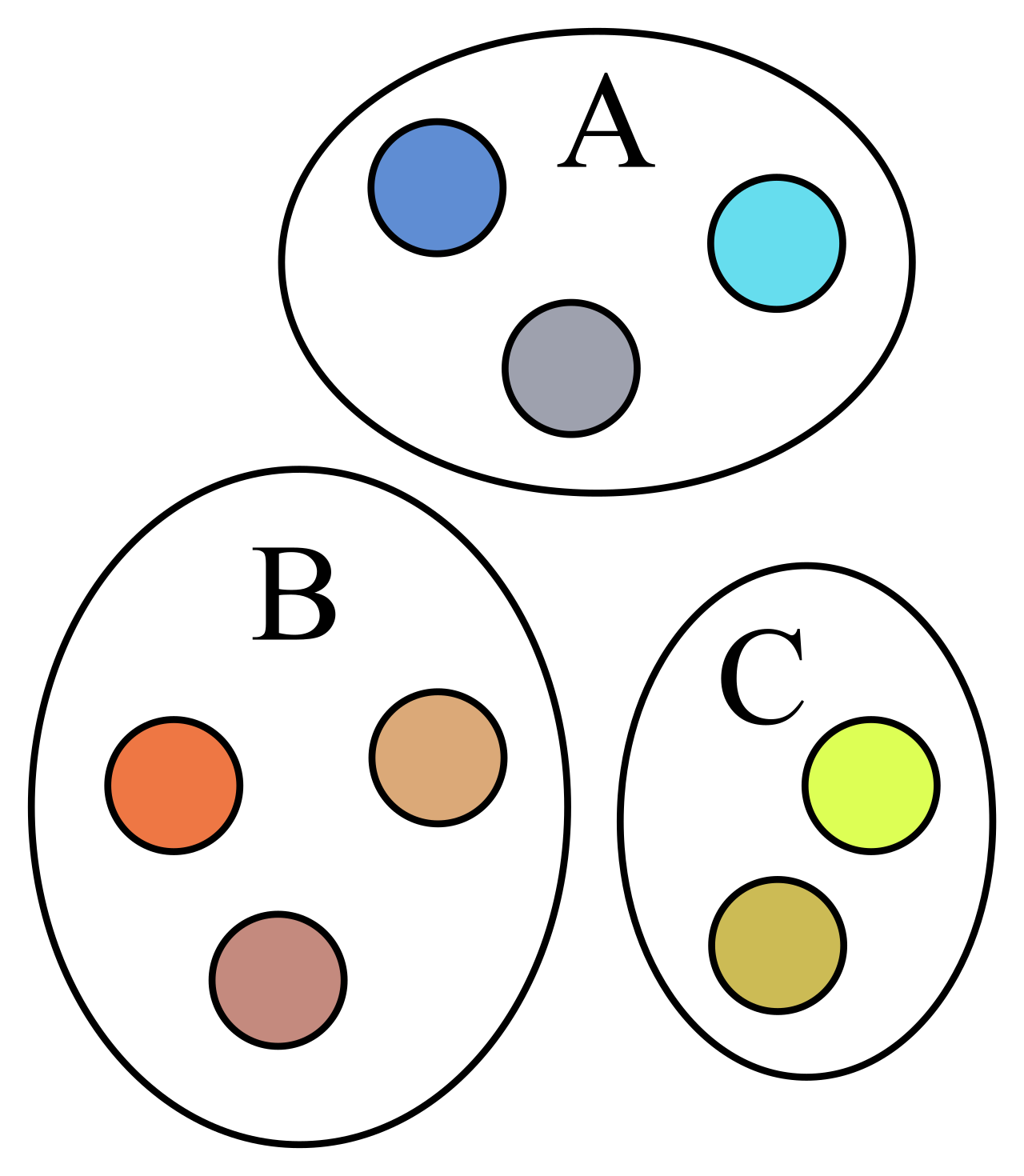
A robust mathematical system must account not only for what is in a set, but what is excluded from it.
The complement of a set contains all elements in the universal set absent from the given set.
If Set A represents all students enrolled in Chemistry, the complement is every student in the school not enrolled in Chemistry. In spatial terms, the area outside a set circle and inside the universal set rectangle represents the complement of the set. Linguistically, the word 'not' in a set word problem indicates a complement. In algebraic notation, a prime symbol (e.g., A′) or a superscript C (e.g., AC) denotes the complement of a set.
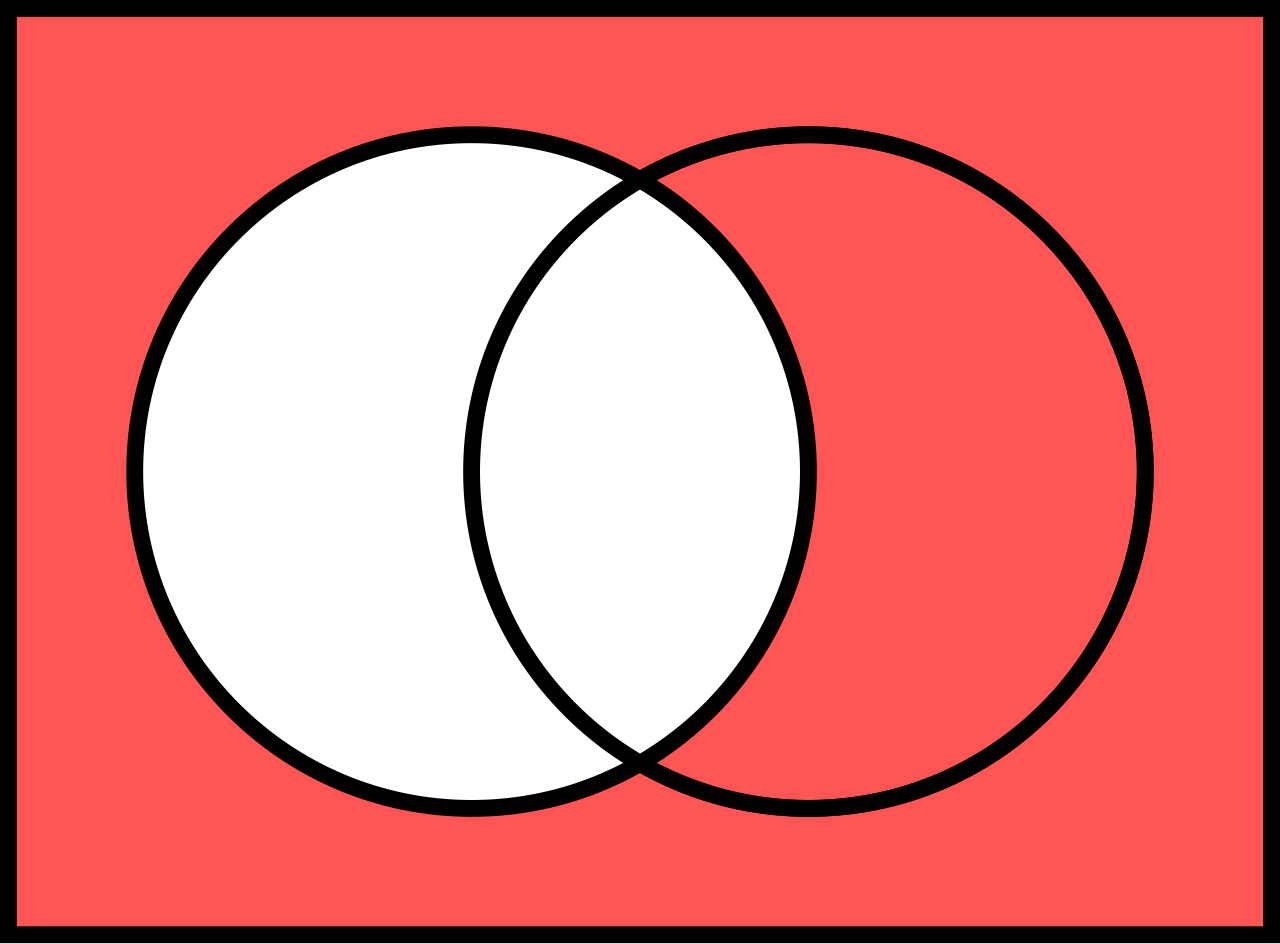
Furthermore, we often need to isolate a specific portion of a set while ignoring its overlapping regions. A set difference contains elements present in a first set and absent from a second set. When you encounter the word 'only' in a set word problem, it indicates a set difference. If a problem asks for students taking "only" Chemistry, you must find the elements inside the Chemistry circle but strictly outside the overlap with any other subject.
The Glossary of Set Logic
| Set Operation | Notation | Keyword | Visual Region in Venn Diagram |
|---|---|---|---|
| Intersection | ∩ | And | Overlapping region of two circles |
| Union | ∪ | Or | Entire area covered by two circles |
| Complement | A′ or AC | Not | Area outside a set circle, inside the universal rectangle |
| Set Difference | A−B | Only | Elements present in a first set, absent from a second |
The most common, catastrophic error students make on the Praxis Core exam is double-counting overlapping elements. Consider this scenario: out of a universal set of 50 students, 30 are in Band and 20 are in Chorus. You might instinctively assume there are 50 students total in the music program (30+20). But what if 10 students are in both Band and Chorus?
If you simply add the totals of the two sets, you will arrive at an incorrect conclusion. Why? Because adding the total element counts of two individual sets includes the intersection elements twice.
To correct this phantom double-count, we rely on a fundamental mathematical rule: the principle of inclusion-exclusion calculates the total number of elements in the union of two sets.
The Principle of Inclusion-Exclusion: The number of elements in the union of two sets equals the sum of elements in each individual set minus the elements in the intersection.
Mathematically: Total in Union=(Total in Set A)+(Total in Set B)−(Intersection).
By subtracting the intersection value once, we restore the correct count. Consequently, subtracting the intersection value from the total of a specific set yields the number of elements exclusive to the specific set. In our Band and Chorus example, subtracting the 10 overlapping students from the 30 total Band students reveals that exactly 20 students are in "only" Band.
Ultimately, the total number of elements in a Venn diagram equals the sum of all distinct non-overlapping regions. If you want to verify the grand total of the universal set, remember that the sum of all non-overlapping regions includes elements exclusive to each set plus the intersection plus the elements outside all sets.
When sitting for the Praxis Core, you will frequently be handed a paragraph of overlapping statistics and tasked with finding a missing variable. The secret to unraveling these problems is counter-intuitive: you do not read from left to right; you map from the inside out.
Solving a Venn diagram word problem begins by placing the innermost intersection value first.
Once the center is anchored, you can systematically work outward, subtracting that central value from the broader category totals to find the exclusive (set difference) regions, and finally computing the complement outside the circles.
Praxis Application Walkthrough
Let us apply this rule to a standard Praxis-level scenario: A survey of 100 educators (the universal set) finds that 60 use tablets in class, 55 use interactive whiteboards, and 20 use both. How many educators use neither?
- Map the Universe: The universal rectangle contains 100 educators.
- Anchor the Center: Place the 20 educators who use both in the overlapping intersection.
- Compute Set Differences (The "Only" Regions):
- Tablets total 60. Subtract the intersection: 60−20=40 educators use only tablets.
- Whiteboards total 55. Subtract the intersection: 55−20=35 educators use only whiteboards.
- Sum the Non-Overlapping Regions (The Union): Add the exclusive tablet users, the exclusive whiteboard users, and the intersection: 40+35+20=95. The union contains 95 educators.
- Compute the Complement: Subtract the union from the universal set: 100−95=5. There are 5 educators outside the circles who use neither.
Scaling the Logic: Three-Circle Diagrams
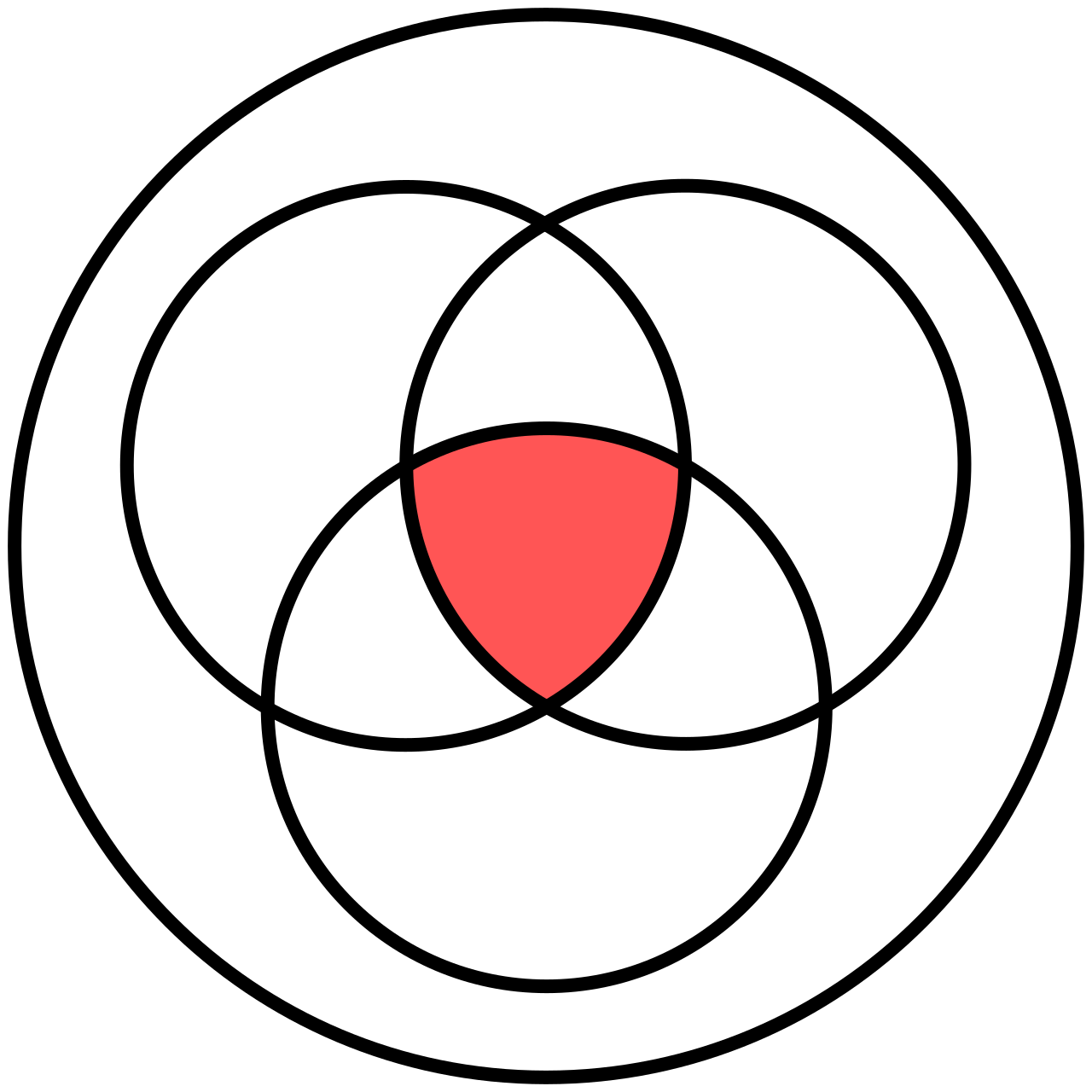
When variables escalate, you may encounter a three-circle Venn diagram, which represents the relationships among three different sets.
The fundamental principles remain identical, simply scaled in geometric complexity. You must navigate elements in exactly one set, exactly two sets, and elements shared by all. Where do you begin? By strictly following our cardinal rule: solving begins at the deepest core. The central overlapping region of a three-circle Venn diagram represents the intersection of all three sets. From this absolute center, you ripple outward—using subtraction to find the two-set overlaps, then the one-set exclusive regions, until the entire map is elegantly, logically complete.