A 10-Week CAPM Certification Study Plan That Fits a Real Schedule
In short
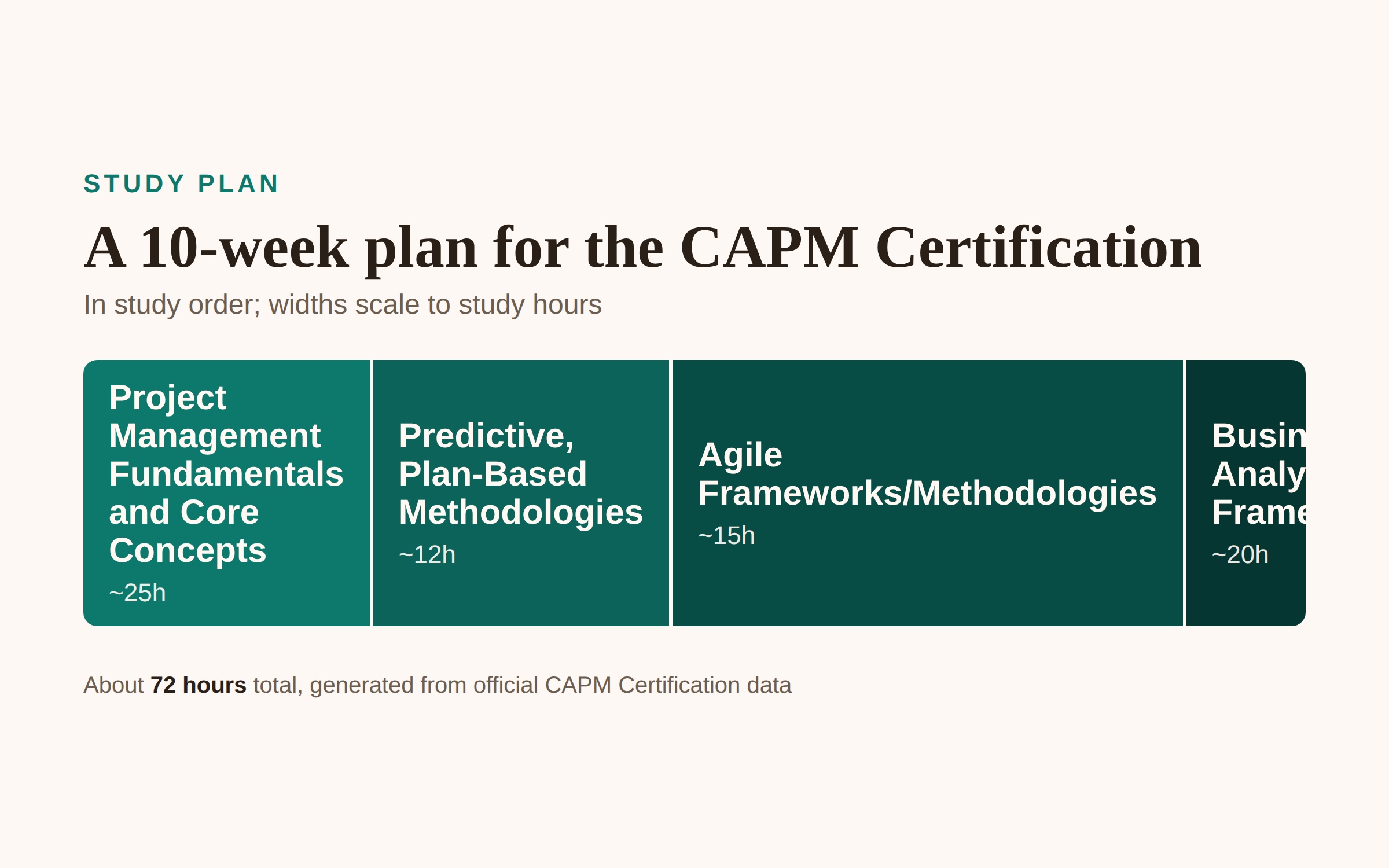
Budget 72 hours across 10 weeks, which is about 7 hours a week. The plan takes the four domains one at a time, in study order: 25 hours on Project Management Fundamentals and Core Concepts, then 12 on predictive methods, 15 on agile, and 20 on business analysis.
How long the prep takes
72 hours is the estimate for the CAPM Certification — the four domains added up. At 10 weeks that is 7.2 hours a week (72 ÷ 10).
| Domain | Weeks | Hours | Share of the exam | Topics |
|---|---|---|---|---|
| Project Management Fundamentals and Core Concepts | 1–3 | 25 | 36% | 10 |
| Predictive, Plan-Based Methodologies | 4–5 | 12 | 17% | 6 |
| Agile Frameworks/Methodologies | 6–7 | 15 | 20% | 6 |
| Business Analysis Frameworks | 8–10 | 20 | 27% | 7 |
The hours track the weights closely. Fundamentals takes 25 of the 72 hours, or 34.7% of your study time, against 36% of the exam. Business Analysis Frameworks is 27.8% of the hours against 27% of the questions. Agile is 20.8% against 20%, Predictive 16.7% against 17%. Nothing is funded more than about a point and a half away from its weight, so the hour budget can be followed as printed.
What varies is how a week feels, and topic count is what tells you. Predictive, Plan-Based Methodologies gives you 12 hours over 6 topics — 2 hours each, the thinnest per-topic budget in the plan. Business Analysis Frameworks sits at the other end: 7 topics, nearly 2.9 hours each, so those sittings run long. Fundamentals and Agile both land at 2.5 hours a topic. The four domains come to 29 topics.
The exam itself is 150 questions in 3 hours. Only 135 of them are scored; the other 15 are unscored pretest items, used to check whether a question is good enough for a future paper. They are scattered at random and never identified, so there is no way to tell them apart from the rest. Answer everything.
Apply each domain weight to those 135 scored questions and you can see what your hours are buying. Fundamentals is roughly 49 questions, Business Analysis Frameworks about 36, Agile 27, and Predictive about 23. Three hours across 150 questions is 1.2 minutes each.
There is no published pass mark to work back from. PMI sets one bar for everyone and keeps the number to itself. Scoring is scaled, and your result comes back as a performance category such as Above Target or Target. Readiness here is a question of recall: can you still explain a topic a month after you studied it?
Week by week
The order below keeps each domain's hours in one unbroken block, so no week straddles two subjects. Weekly load runs between 6 and 8.3 hours, against an average of 7.2 that no block in the plan hits.
| Weeks | Block | Hours per week |
|---|---|---|
| 1–3 | Project Management Fundamentals and Core Concepts | 8.3 |
| 4–5 | Predictive, Plan-Based Methodologies | 6 |
| 6–7 | Agile Frameworks/Methodologies | 7.5 |
| 8–10 | Business Analysis Frameworks | 6.7 |
Weeks 1 to 3 — Fundamentals, 25 hours
These are the heaviest weeks in the plan at 8.3 hours each, and they come first: the largest domain at 36%, and where the basic terminology sits. The ten topics are:
- how a project, a program and a portfolio differ
- life cycles and delivery approaches
- scope, ethics, and the constraints that bound a project
- planning basics
- milestones, task durations and resources
- the registers you keep, and how a project closes
- who does what on a project team
- leadership, management and emotional intelligence
- planned strategies and frameworks
- problem-solving tools and meetings
A lot of this domain is pairs of terms that sound alike and are tested on the difference: a project against an operation, leadership against management, a project manager's remit against a sponsor's. Flashcards earn their keep here. Build the deck in week 1 and keep it to the end of the plan.
Before you leave week 3, two checks. Can you lay out project, program and portfolio without hedging? And can you say what a project manager, a team member and a sponsor each own?
Weeks 4 and 5 — Predictive, 12 hours
The calculation weeks. Six topics in 12 hours:
- when a plan-driven approach suits the work
- the processes and activities that make it up
- schedule management and the critical path
- the work breakdown structure, and the work packages under it
- quality and integration management
- predictive project controls
Draw network diagrams by hand until you can trace a critical path through one without stopping to think. Practice schedule variance on figures you invent for yourself. The testing software has a digital calculator built in, and your own is not permitted. So carry the method in your head; the calculator on screen will handle the arithmetic.
Before you leave week 5, two checks. Can you find a critical path and work out a schedule variance unprompted? And can you describe what sits inside a work breakdown structure?
Weeks 6 and 7 — Agile, 15 hours
Fifteen hours, six topics:
- when an adaptive approach fits the organization
- how iterations get planned
- how adaptive scope and tracking work
- adaptive controls and artifacts
- the plan components and the named methodologies
- task management inside an iteration
The exam expects you to separate Scrum, Kanban, Extreme Programming and the Scaled Agile Framework by what each one does. It also expects you to read an artifact like a burndown chart and say what it is telling you.
Before you leave week 7, two checks. Can you state what distinguishes those four frameworks? And can you look at a burndown chart and explain what it tracks across an iteration?
Weeks 8 to 10 — Business Analysis, 20 hours
The second-largest block on the paper at 27%, and 20 hours over 7 topics:
- what a business analyst is responsible for
- how they communicate with stakeholders
- the tools and approaches for gathering requirements
- requirements traceability and the product backlog
- product roadmaps and releases
- how the chosen delivery method changes the business analysis work
- how requirements get validated as the work ships
The topic worth not rushing is how the chosen delivery method changes the business analysis work. It is what ties this domain back to the predictive and agile weeks behind it.
Week 10 is also where you rehearse the paper itself. The CAPM has a 10-minute break that arrives once you have answered and reviewed questions 1 through 75. The moment it starts, the first half is closed to you, so question 75 is a deadline. Half of 150 questions is 75 and half of 3 hours is 90 minutes: aim to be at question 75 by the 90-minute mark.
Spend part of week 10 on the question formats too. Alongside standard multiple-choice there is drag-and-drop matching, point-and-click hot spot items, and scenarios that arrive as animations or, if you are testing under online proctoring, as comic strips — which is how that format sidesteps audio problems.
Before you leave week 10, two checks. Can you define acceptance criteria and explain what a requirements traceability matrix is for? And can you match a requirements-gathering tool to the situation that calls for it, a survey against a use case?
Inside any week, the loop that holds up is short:
Read one topic and take notes on it →
answer practice questions on that topic in the same sitting →
write down the reason you missed each wrong answer →
re-read only those reasons before the next sitting.
The table hides the smallest block in the plan. Predictive, Plan-Based Methodologies is 17% of the questions and 12 of the 72 hours, while Agile Frameworks/Methodologies and Business Analysis Frameworks come to 47% between them. That is why five of the ten weeks sit after the predictive block.
If you have less time (or more)
The 72 hours do not shrink when the calendar does. Fewer weeks means heavier weeks.
| Weeks available | Hours per week |
|---|---|
| 6 | 12 |
| 8 | 9 |
| 10 | 7.2 |
| 14 | 5.1 |
| 16 | 4.5 |
Six weeks at 12 hours is a second job on top of your first. If your exam date leaves you that, protect the two largest blocks: Fundamentals at 25 hours and Business Analysis Frameworks at 20. That is 45 of the 72 hours, 62.5% of your study time, covering 63% of the questions. Predictive and Agile get one careful pass each.
At 12 hours, Predictive, Plan-Based Methodologies is the smallest block in the plan, which is why change lands there first in either direction. Twelve hours is the least you can free by dropping a whole block from the schedule, and the least it costs to extend one. It is also where the calculation sits — critical path and schedule variance — and at 1.2 minutes a question there is no room to rebuild a method from first principles on the day. Spare hours go there first.
Going longer than 10 weeks has its own cost. On a 16-week plan at 4.5 hours a week, the Fundamentals terminology you learned in week 2 is more than three months old by exam day. That is 36% of the paper. If you stretch the plan, put a short recall session on those flashcards into every week after you finish them, and re-answer the end-of-block checks in your final two weeks.
Common questions
How many hours should I plan for the CAPM? 72, which is what the four domains add up to. Ten weeks puts that at about 7 hours a week.
How many questions is the exam, and how long do I get? 150 questions in 3 hours, of which 135 are scored and 15 are unscored pretest items being trialled for future papers. That is 1.2 minutes a question. An optional tutorial and survey adds 5 to 15 minutes on top, and it does not eat into your 3 hours.
What is the passing score? PMI does not publish one. The bar is identical for everyone sitting the exam, but scoring is scaled and your result arrives as a performance category such as Above Target or Target, so there is no percentage to aim at.
Is the CAPM only a waterfall exam? No. Predictive, Plan-Based Methodologies is 17% of it. Agile Frameworks/Methodologies is 20% and Business Analysis Frameworks is 27%, so the adaptive and business analysis material outweighs the plan-driven material by almost three to one.
Can I bring my own calculator? No. The testing software has a digital calculator built in, and personal calculators are not permitted at a test center or under online proctoring.
What does the exam cost? 300 if you are not.
Which domain should I study first if I am compressing the plan? Project Management Fundamentals and Core Concepts. It is the largest at 36% and 25 hours, and it is where the basic terms and the distinctions between similar concepts are tested.
Only Ever's practice questions and study guides for this exam are free, including the AI-generated sets other providers put behind a paywall. Try the free practice questions, score yourself by domain, and let the weakest of the four pick your next study hour.