How to Pass the Praxis Core Math 5733 in 2026: A Realistic Plan
In short
The Praxis Core Math (5733) is 56 questions in 90 minutes — about 96 seconds each. Most states set the passing score at 150 on a 100–200 scale. Around 50 hours of study over seven weeks covers the content, which tops out at early high-school mathematics. The difficulty lives in the clock and the four-function calculator.
What the Praxis Core Math tests
This is a basic-skills gate, usually taken to enter a teacher-preparation program. The mathematics is middle-school and early high-school level: no calculus, no trigonometry, no proofs. What there is instead is 96 seconds to set up a proportion you may not have used since school.
ETS publishes three content categories with question counts and weights:
| Category | Questions | Weight |
|---|---|---|
| Number and Quantity | 20 | 36% |
| Data Interpretation and Representation, Statistics, and Probability | 18 | 32% |
| Algebra and Geometry | 18 | 32% |
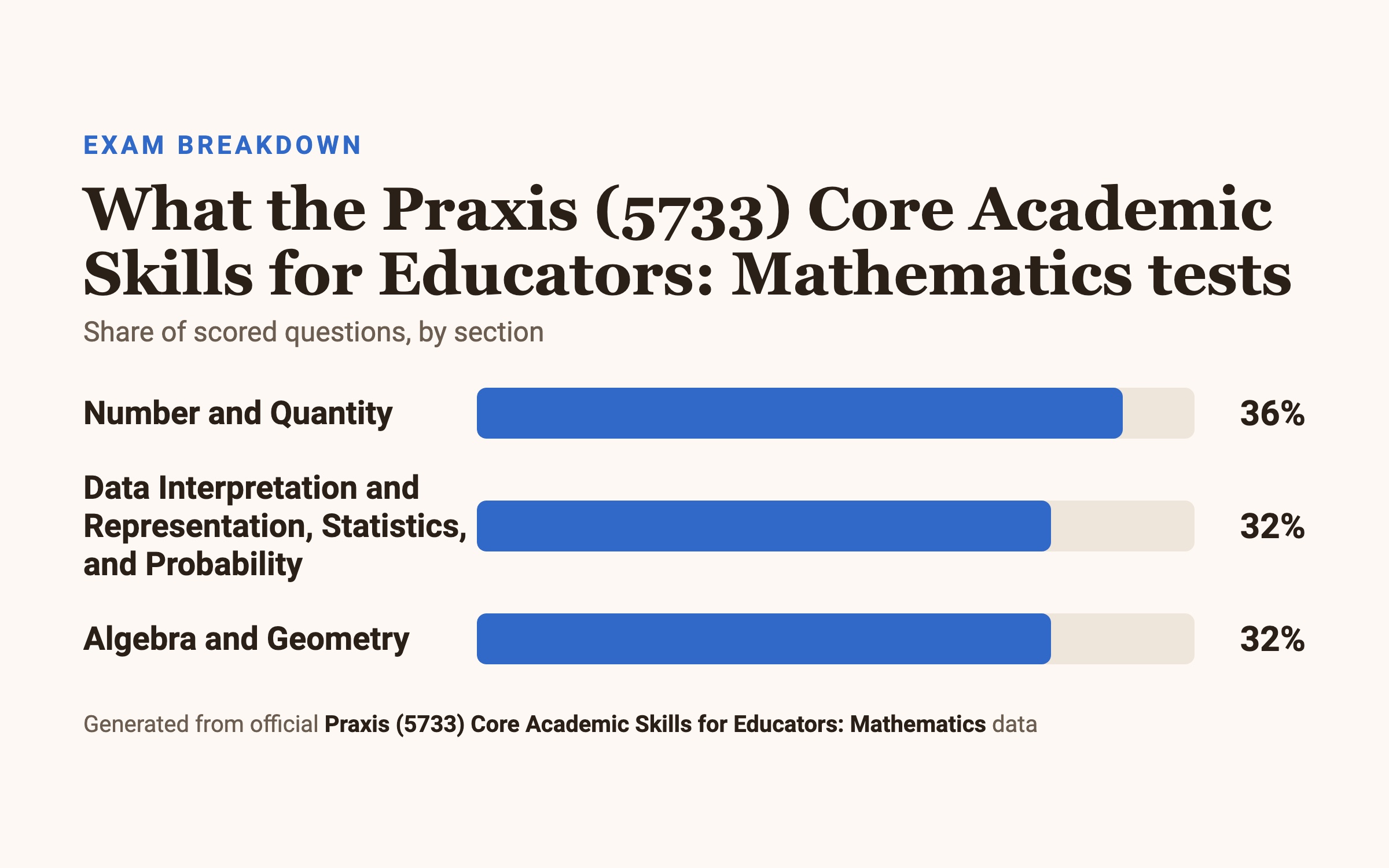
Number and Quantity is the largest single block at 36%, and it's also the most learnable — fractions, decimals, ratios, percentages, rates, factors and multiples, unit conversions. Twenty questions come from material an eighth-grader covers. That's where your first hours belong.
Three question formats appear. Standard multiple choice with one answer. Multiple-select questions where you pick every correct option, with no partial credit — a question with three correct answers is all-or-nothing. And numeric-entry questions, where you type an integer or decimal into a box, or a fraction across two separate boxes.
The calculator is on-screen and four-function only: add, subtract, multiply, divide. You cannot bring your own. It won't handle exponents, roots, or order of operations for you, so the arithmetic you can do in your head is time you get back.
ETS also provides a short list of formulas on screen — area and circumference of a circle, area of a rectangle, area of a triangle, and volume of a rectangular box. Everything else you need to know cold.
The plan, section by section
Fifty hours over seven weeks is a little over seven hours a week. The order matters as much as the total, because proportional reasoning underpins the other two categories: a rate question, a data-table question, and a percentage word problem are the same skill in different clothing. Build it first and the later blocks get faster.
Weeks 1–3, Number and Quantity, about 18 hours →
weeks 4–5, Algebra and Geometry, about 16 hours →
weeks 6–7, Data and Statistics, about 16 hours, alongside full-length timed practice.
Start with integers, decimals, and fractions, then ratios and proportions and percentages and percent change. Making these three second nature in week one is what makes the rest of the schedule work.
Constant rates and rates of change comes after that, then the number-theory topics: place value, factors and multiples, prime numbers and divisibility. Finish the block with units and conversions, which is pure procedure and worth drilling until it's mechanical.
Algebra and Geometry in the middle weeks. Translating a word problem into an equation is the highest-value skill here. Practice it more than anything else in this block — writing algebraic expressions, solving linear equations in one variable, then simple quadratics. On the geometry side, learn the angle relationships (especially parallel lines cut by a transversal), triangle properties, and the area and perimeter formulas that aren't on the provided sheet.
Data and Statistics last, paired with timed practice. Most of these questions are reading comprehension with numbers: pull the right figures off a bar graph, a circle graph, a boxplot, or a stem-and-leaf plot, then do one small calculation. Memorize mean, median, mode, and range, and know what a single outlier does to a mean. Correlation versus causation comes up too, along with basic probability and independent events.
Run at least three full 90-minute practice tests in the last two weeks, because pacing is the part you can't learn on test day.
Where candidates lose points
-
Spending three minutes on question 7. At 96 seconds a question, three minutes on one problem eats the budget for two others. Every question is worth the same. Build a hard rule in practice: if you don't have a path within 30 seconds, flag it and move.
-
Reaching for the calculator on arithmetic you already know. A four-function calculator is slower than your head for anything small, and every trip to it is time off the clock. Budget it for the ugly numbers only.
-
Half-answering multiple-select questions. Selecting two of the three correct options scores zero. When a question says select one or more, make a yes-or-no decision on every option before you move on.
-
Formatting numeric entry wrong. Fractions go into two separate boxes, numerator and denominator. Decimals and integers go into one. A correct value typed into the wrong box is marked wrong.
-
Assuming 150 is the number you need. Your state or agency sets the passing score. 150 is the score ETS's own standard-setting study recommends, and most states adopted it — but Mississippi requires 130 and Pennsylvania requires 142. Check yours before you register — your state's bar may be lower than the number you're aiming at.
-
Paying 150 would do. Each Core subtest costs 150. If you need all three, that's a $120 saving, with the trade-off that they all happen on the same day.
-
Missing the state alternatives. Several states let you satisfy the basic-skills requirement with an SAT, ACT, or GRE score instead of Praxis Core — Mississippi, for instance, accepts an ACT composite of 21. That's a state policy, so it varies by jurisdiction. Spend ten minutes on your state's requirements page before you pay for a test you may not need.
These state-set numbers do change. Treat any figure you read here or on a prep site as a prompt to check the ETS scores page for your own state.
Every topic here maps to a 15-minute study unit on the Praxis Core Math syllabus, and the practice questions are free, including the AI-generated question sets other prep tools charge for.
Common questions
How many questions are on the Praxis Core Math (5733)? 56, across Number and Quantity, Data and Statistics, and Algebra and Geometry. Some are unscored pretest items that ETS mixes in and doesn't identify, so answer every question — there's no penalty for guessing.
How much time do I get? 90 minutes for all 56 questions, which averages a little over a minute and a half each. There's no separately timed section, so the whole clock is yours to manage.
What score do I need to pass? It depends on your state. States and licensing agencies set the score; ETS doesn't. Most use 150 on the 100–200 scale, which is the score ETS's standard-setting study recommends, but Mississippi requires 130 and Pennsylvania requires 142. Verify your own requirement before you register.
Will I be allowed to use a calculator? Yes — an on-screen four-function calculator, built into the test. You can't bring your own. Practice under the same constraint and keep your mental arithmetic sharp, since the calculator costs you time on anything simple.
Are there any essay questions on this test? No. Praxis Core Math is entirely selected-response and numeric-entry. The essays are on the Writing subtest (5723).
How long should I study for the Praxis Core Math? Around 50 hours for most candidates, or about seven hours a week for seven weeks. If your arithmetic and proportional reasoning are already solid, the Algebra and Data blocks alone may need only 32 hours. Take a diagnostic first and spend your time where it's short.