How to Pass the Praxis Core Writing 5723 in 2026: A Realistic Plan
In short
The Praxis Core Writing (5723) is 40 selected-response questions and two essays in 100 minutes, split into three separately timed sections: 40 minutes for the multiple choice, then 30 minutes for each essay. Many states set the passing score at 162 on a 100–200 scale. This plan runs about 40 hours over six weeks, most of it timed essay practice.
What the Praxis Core Writing tests
The structural fact that shapes everything: the three sections are timed separately. Finishing the multiple-choice section in 28 minutes does not give you 42 minutes for your first essay. Leftover time on essay one does not roll into essay two. You get 40, then 30, then 30, and each clock stops on its own.
That changes the study plan more than any content decision. Writing two essays cold, 30 minutes each, is the skill this exam measures, and it's the part of the test that most rewards rehearsal.
ETS splits the content into two categories:
| Category | What's in it | Weight |
|---|---|---|
| Text Types, Purposes, and Production | Both essays, plus 6–12 selected-response questions | 60% |
| Language and Research Skills for Writing | 28–34 selected-response questions | 40% |
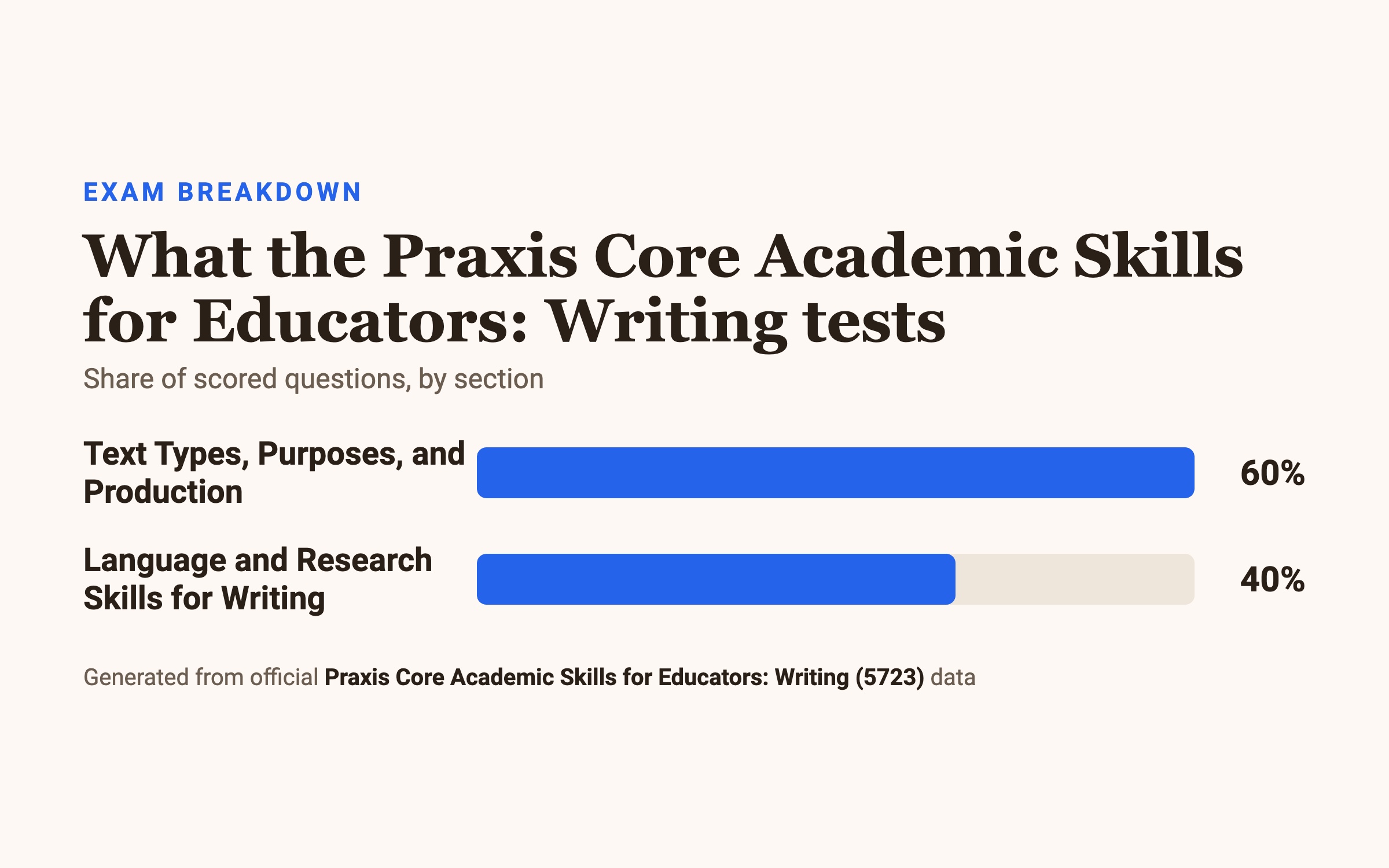
Read that table carefully. The 60% category contains the two essays and a handful of multiple-choice questions, so the essays carry less than 60% of your score on their own. ETS publishes no separate figure for them. The useful reading is where the multiple-choice questions live: 28 to 34 of the 40 come from the grammar and research half.
The two essays are different tasks. The argumentative essay gives you a position to take and asks you to support it from personal experience, observation, or reading. The informative/explanatory essay, which ETS also calls the source-based essay, gives you two sources and requires you to draw on both and cite them.
Scoring is worth knowing in detail, because it explains what to practice. Each essay is scored holistically from 1 to 6. Two scorers assess it: a trained human reader and e-rater, ETS's automated scoring engine. When the two agree, their scores are added together. A divergence beyond a set threshold sends the essay to a second human reader. Your selected-response and essay scores then combine into one scaled score.
The plan, section by section
Forty hours over six weeks, about seven a week. Grammar rules are finite, so that block comes first and pays off fast. Essays need repetition, which is why they take the bulk of the hours.
Weeks 1–2, grammar and mechanics, about 16 hours →
weeks 3–5, essay construction under a 30-minute timer, about 20 hours →
week 6, full 100-minute run-throughs, about 4 hours.
Begin with the grammatical relationships content, since 28 to 34 of the 40 multiple-choice questions live here. Cover subject-verb agreement, pronoun case and reference, and verb tense and form. Then the structural topics: misplaced and dangling modifiers, fragments and run-ons, parallel structure. Add capitalization and comma rules. At roughly a minute per multiple-choice question, these need to be recognition-speed.
Then essays, and this is where the hours belong. Work the argumentative essay first: a clear thesis in the opening paragraph, two or three developed reasons, a concrete example for each, a short close. Practice development and support specifically — development is one of the traits both the human reader and e-rater score, and thin support is what holds a competent essay back.
Move to the source-based essay, which has a stricter requirement. You must use both provided sources and acknowledge them. ETS's own scoring commentary attributes a low sample score partly to failing to acknowledge the source material, so citation is a scored expectation here. Practice synthesis and attribution as a single drill: read two short sources, write a thesis that accounts for both, reference each by name in the body.
A workable 30-minute shape for either essay:
Five minutes planning — thesis plus three supporting points →
twenty minutes drafting, one paragraph per point →
five minutes proofreading for agreement, tense, and punctuation.
Do this eight to ten times before test day, always against a timer.
Finish with two or three complete 100-minute run-throughs so the section transitions feel familiar.
Where candidates lose points
-
Planning to borrow time between sections. Three separate clocks mean a fast multiple-choice section buys you nothing, and an essay you're mid-sentence on at 30 minutes is submitted as it stands.
-
Writing one long paragraph. e-rater scores development, organization, and syntactic variety, and the human reader is working from a holistic 1–6 guide. Clear paragraph breaks and varied sentence lengths read better to both.
-
Ignoring the second source. The source-based essay asks you to draw on both provided sources, and ETS's scoring commentary treats failure to acknowledge source material as a real weakness. Reference both, by name, in the body.
-
Leaving mechanical errors in. Agreement, tense, and punctuation errors are exactly what an automated scorer detects reliably, so the proofreading pass at the end of each 30-minute block is worth protecting.
-
Treating 162 as the required score. Your state or agency sets it. 162 is also ETS's published median score for this test. South Carolina requires 158. Check your own state before you register, and note that scores move in 2-point increments, so 161 and 163 aren't possible results.
-
Forgetting the longer wait. Core Reading and Core Math scores come back within about seven days. Writing takes around 20 business days because of the essays. If you're testing against a program-admission deadline, count backwards from the 20-day figure.
-
Paying for three separate registrations. Each Core subtest is 150 — a $120 saving if you need all three, with the trade-off that they all happen on the same day.
Every topic here maps to a 15-minute study unit on the Praxis Core Writing syllabus, and the practice questions are free, including the AI-generated sets other prep tools charge for.
Common questions
How many questions are on the Praxis Core Writing (5723)? 40 selected-response questions and two essays. Between 28 and 34 of the multiple-choice questions come from the grammar, mechanics, and research category; the rest sit alongside the essays in the text-production category.
How much time is allowed? 100 minutes total, timed in three separate sections: 40 minutes for the 40 selected-response questions, then 30 minutes for each essay. Finishing multiple choice early doesn't buy you writing time, and unused time on the first essay doesn't carry to the second.
What is the passing score for the Praxis 5723? It depends on your state. ETS doesn't set passing scores; states and agencies do. Many use 162 on the 100–200 scale, but South Carolina requires 158. 162 is also ETS's published median for this test, which is part of why it gets repeated as though it were universal.
What types of essays are required? Two, 30 minutes each. The argumentative essay asks you to take a position and support it from experience, observation, or reading. The informative/explanatory essay — ETS also calls it the source-based essay — gives you two sources and requires you to draw on both and cite them. Each is scored holistically from 1 to 6 by a trained human reader and by e-rater, ETS's automated engine; when the two agree, their scores are added.
Are there unscored pretest questions on this exam? Yes, in the selected-response section. They're mixed in with the scored questions and aren't identified, so answer all 40 — there's no penalty for guessing.
How long should I study for the Praxis Core Writing? Around 40 hours over six weeks. Spend roughly 16 on grammar and mechanics, since that's where most of the multiple-choice questions come from, and the remaining 24 on timed essay practice. Eight to ten full essays written to the clock is a realistic target.