How to Pass the HESI A2 (2026): A Realistic Plan
In short
Passing the HESI A2 starts with one question your study guide can't answer: which score does your nursing program require, and which sections do you have to take? The bar is set by your school, often 75% or higher per section. A full eight-module sitting takes about 81 hours of prep; a common six-module program is closer to 67. Weight your hours toward the four core academic sections, which carry the most marks.
What the HESI A2 tests
The HESI A2 is an admissions exam, so it works differently from a licensure test. There is no single national passing score — each nursing program sets its own. Some want at least 75% on every section, others a 75% composite, and competitive programs ask for 80% or higher in areas like Anatomy & Physiology. So the first move, before any studying, is to confirm two things with your specific school: the required score, and which modules you have to take.
That second point changes your whole plan. The exam offers up to eight academic modules, and each is timed separately. Because of that, the question count isn't fixed — depending on how many modules your program requires, you'll answer roughly 150 to 326 questions across the sections you take. Most programs require the four core academic sections; many add Anatomy & Physiology and Biology. A full administration runs up to about 4 hours, and a basic on-screen calculator is available for the math. Some schools also include Learning Style and Personality Profile sections — these don't count toward your academic score.
Here is how the eight modules are weighted in a full sitting:
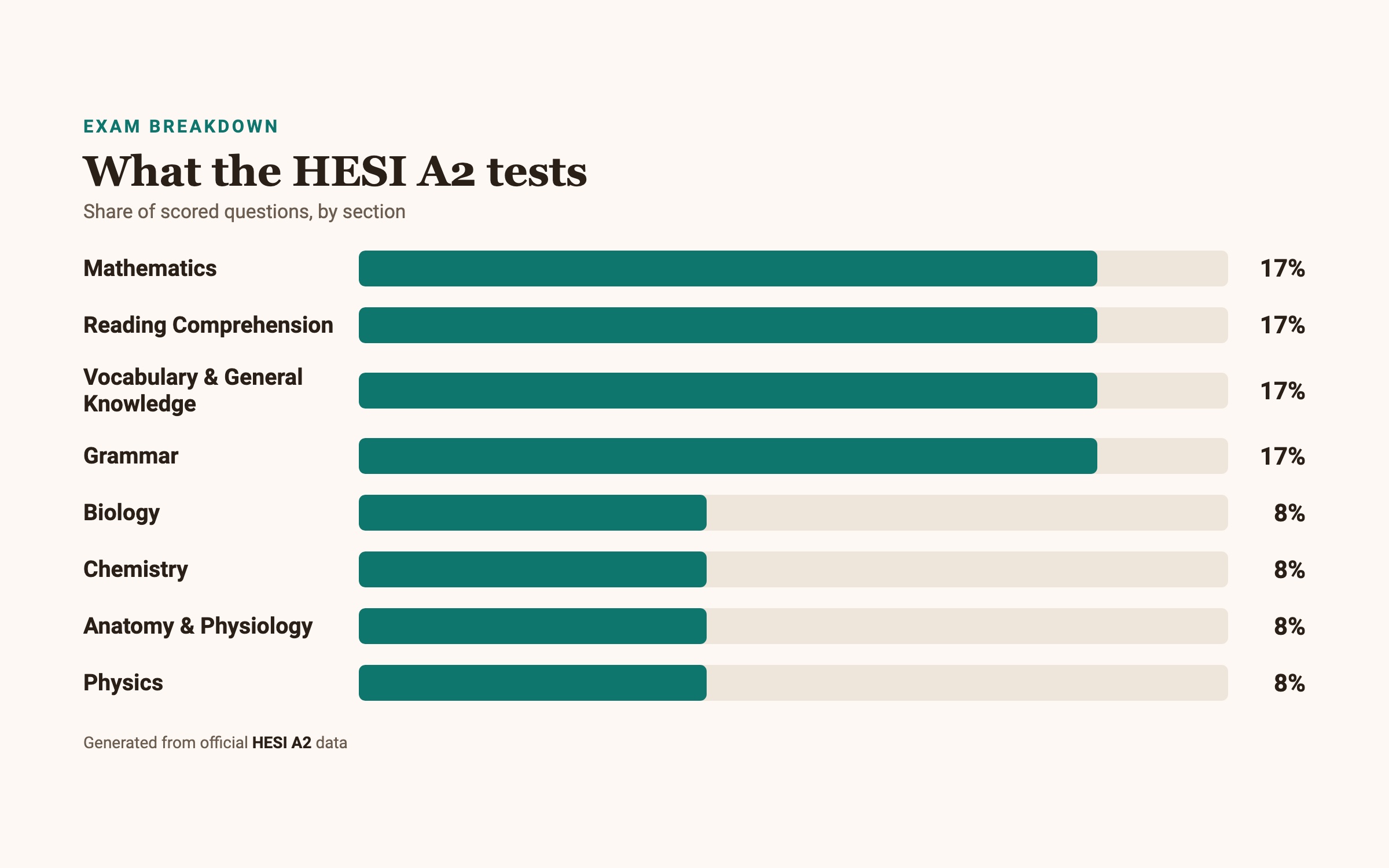
The four core academic modules — Mathematics, Reading Comprehension, Vocabulary & General Knowledge, and Grammar — each carry 17%. The four science modules carry 8% each. If your program only requires the core four, that's where all your hours should go.
The plan, section by section
Weight your hours to what your program requires, heaviest first — around 67 hours for a common six-module set, up to 81 for all eight:
Confirm your program's required modules and cut-score →
put your heaviest hours into Mathematics (~15h) — dosage-style arithmetic, fractions, ratios, conversions →
then Reading Comprehension (~12h) and Anatomy & Physiology (~12h) →
then Vocabulary (~10h) and Grammar (~10h) →
add only the science modules your program requires — Biology and Chemistry (~8h each), Physics (~6h).
That comes to about 67 hours for the common six-module set (the four core academic sections plus Anatomy & Physiology and Biology), and about 81 hours if your program requires all eight.
Math is where preparation pays back fastest, because the skills are learnable and repeatable — whole numbers, fractions, decimals, percentages, and conversions come up again and again. Drill them in short daily blocks and you'll walk in calm. Start with a free HESI A2 diagnostic so you see your weakest module before you spend an hour on the wrong one.
Where people lose marks
- Studying modules your program never tests wastes time your required sections need. If your school only wants the core four, skip Physics and Chemistry — confirm the module list before you build a plan.
- Vocabulary & General Knowledge is a full 17% and rewards a simple flashcard habit — health and science terms recur across HESI forms, so don't write it off as un-studiable.
- On the math, the calculator handles the arithmetic; the marks are lost in setting up the equation. Practice translating a word problem into the right operation.
- If your school uses a composite, a strong Math score can carry a softer section — but only if you know which rule your program applies. Check that before you plan.
Common questions
What is a passing score on the HESI A2? It depends entirely on your program. Many require at least 75% per section or a 75% composite; some set 80% or higher for specific sections. Verify the exact number with your school.
How long does the exam take? Up to about 4 hours for a full administration. Because it's modular and each section is separately timed, your actual time depends on how many modules your program requires.
Which subjects are tested? Up to eight: Mathematics, Reading Comprehension, Vocabulary & General Knowledge, Grammar, Biology, Chemistry, Anatomy & Physiology, and Physics. Most programs require the first four; many add Anatomy & Physiology and Biology.
Can I use a calculator on math? Yes — a basic on-screen calculator is provided for the Mathematics section.
How much should I study? Most successful candidates spend 60–90 hours, depending on their science background and how many modules they sit.
Confirm your program's required modules and cut-score first, then pour your hours into the sections that count. The full bank and study guide are free, where most providers charge for them. Try the free HESI A2 practice questions.