How to Pass the Praxis 5165 Mathematics in 2026: A Realistic Plan
In short
The Praxis 5165 is 66 questions in 180 minutes — roughly 2 minutes 45 seconds each. Most states want 159 on a 100–200 scale. Plan for around 90 hours of content work across 12 weeks, plus a final week of full-length practice. Roughly a quarter of the questions test how you would teach the mathematics.
What the Praxis 5165 tests
First, a naming point that saves people money. ETS now calls this test simply Mathematics (5165). The older "Mathematics: Content Knowledge" title belonged to test code 5161, which has been retired. If you find a study guide labeled 5161, it's for a test you can no longer take.
The blueprint runs deeper than the four headline categories, and the sub-splits are where study decisions get made:
| Category | Questions | Weight |
|---|---|---|
| I. Number and Quantity, and Algebra | 20 | 30% |
| — Number and Quantity | 7 | 10% |
| — Algebra | 13 | 20% |
| II. Functions and Calculus | 20 | 30% |
| — Functions | 13 | 20% |
| — Calculus | 7 | 10% |
| III. Geometry | 13 | 20% |
| IV. Statistics and Probability | 13 | 20% |
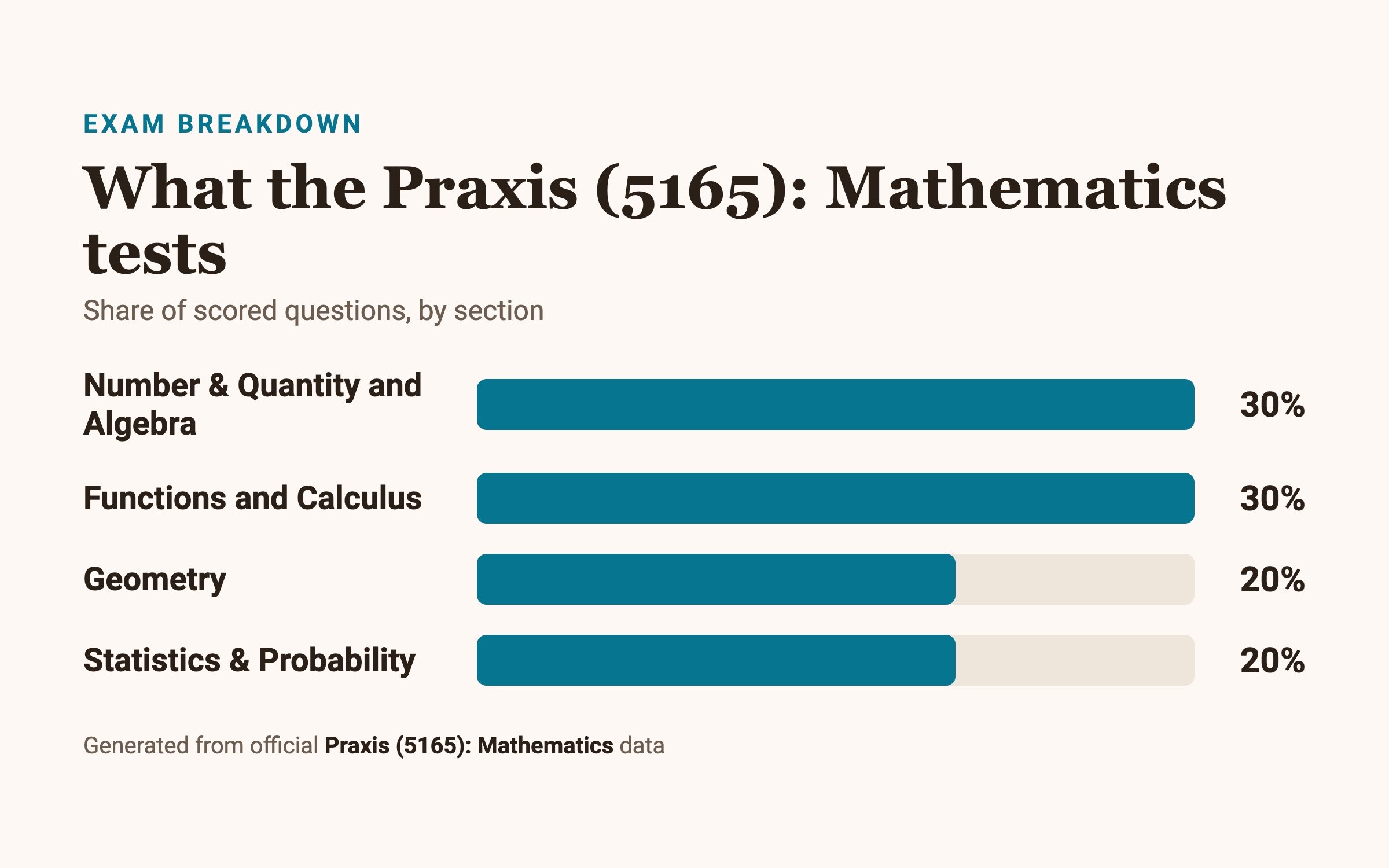
Algebra and Functions carry 20% each — together, 26 of the 66 questions. Calculus is 10%: seven questions. Number and Quantity is another seven.
Then there's the overlay. Roughly 25% of questions assess content applied to a Task of Teaching Mathematics. These aren't a fifth category; they cut across all four. You might be shown a student's incorrect work and asked to identify the misconception behind it. Or asked which of four representations would best introduce a concept.
Two practical facts. The calculator is an on-screen TI-84 Plus CE graphing calculator built into the test, and you may not bring your own.
And a Help screen provides notations, definitions, and formulas. What it gives you, and what it doesn't, should shape your memorization:
| Provided on screen | Not provided |
|---|---|
| Inverse-trigonometry ranges | Integration rules |
| Law of Sines, Law of Cosines | Most plane-geometry area formulas |
| Volumes: sphere, cone, cylinder, pyramid, prism | Statistics formulas |
| Surface areas: sphere, cone | |
| Product, quotient, and chain rules |
The plan, section by section
Ninety hours of content work over 12 weeks averages seven and a half hours a week, with week 13 reserved for full-length practice. The load isn't flat: weeks 9 and 10 run closer to nine hours. Sequence matters, because Functions sits on Algebra and Calculus sits on Functions.
Weeks 1–4, Number and Quantity plus Algebra, about 25 hours →
weeks 5–8, Functions then Calculus, about 30 hours →
weeks 9–10, Geometry, about 18 hours →
weeks 11–12, Statistics and Probability, about 17 hours →
week 13, full 180-minute timed practice.
Open with the real number system, ratios, rates, and percents, radicals and rational exponents, and the complex number system. Number and Quantity is only seven questions, so keep this block tight. Treat it as a warm-up on notation before the heavier algebra work.
Algebra is 13 questions and deserves proportionally more: expressions and equivalence, linear and quadratic equations, systems, inequalities, polynomial and rational expressions. Aim for fluency here, because the Functions block is built directly on it.
Functions is 13 questions, tied with Algebra, Geometry, and Statistics for the largest sub-block. Cover linear, quadratic, polynomial, rational, exponential, logarithmic, and trigonometric families. For each one, be able to move between equation, graph, table, and verbal description on sight. That translation skill is what most Functions questions probe, and the teaching-task items lean on it too.
Calculus is seven questions, so cap it. Limits, derivatives and their applications, basic integration, and the Fundamental Theorem.
Geometry next, 13 questions: congruence and similarity, right triangles and trigonometry, circles, coordinate geometry, transformations, and volume and surface area. The formula sheet covers only some of that. Check your memorization against the table above. Then Statistics and Probability, another 13: describing distributions, sampling and inference, conditional probability, and interpreting data displays. Neither block builds on the other, so start with whichever your diagnostic says is weaker.
Throughout, do the teaching-task practice alongside the content. When you finish a topic, ask what a student most commonly gets wrong in it and what you'd say next.
Reserve the final week for at least two full 180-minute sessions on the TI-84 Plus CE emulator. ETS provides an online tutorial for it, and the keystrokes differ enough from a physical handheld to cost real time if test day is your first encounter.
Where candidates lose points
-
Practicing on the wrong calculator. A physical TI-84 behaves differently from the browser emulator, and menu-hunting on test day is time you don't have.
-
Over-preparing calculus, under-preparing functions. Calculus is 10% of the test and Functions is 20%. Candidates routinely split their hours the other way round.
-
Solving when the question asked you to diagnose. On a teaching-task item, the correct answer is often about why a student did something, and the mathematically correct solution to the underlying problem may not appear among the options at all. Read the stem to the end before you start computing.
-
Memorizing the provided formulas. The Law of Sines, Law of Cosines, and the standard volume formulas are on the Help screen. Spend those hours on the integration and statistics formulas instead.
-
Aiming to scrape 159. The standard error of measurement on this test is 7.0 points, which means a 159 and a 165 aren't reliably different scores. If your state's cut is 159, prepare to land around 166 so ordinary test-day variance doesn't decide the outcome.
-
Assuming 159 is your number. ETS doesn't set passing scores. 35 of 42 jurisdictions chose 159, but Arkansas requires 143, Missouri 145, Delaware, Kentucky, Mississippi and Utah each require 152, and Wyoming 160. States revise these, so verify yours on ETS's own scores page before you register.
For context on difficulty: the median score is 168, and the middle 50% of test takers score between 150 and 185. That lower quartile sits below the common cut of 159, which means a substantial share of test takers don't clear it on a given attempt.
Every topic here maps to a 15-minute study unit on the Praxis 5165 syllabus, and the practice questions are free, including the AI-generated sets other prep tools charge for.
Common questions
How many questions are on the Praxis 5165? 66 questions in 180 minutes. ETS describes them as selected-response, which here covers standard multiple choice, multiple-select, and numeric-entry items. Some are unscored pretest questions that aren't identified, so answer everything.
What is the passing score for the Praxis 5165? There's no national one. Of the 42 jurisdictions using this test, 35 require 159 on the 100–200 scale, which makes 159 the sensible number to plan against. The outliers run both ways: Arkansas 143, Missouri 145, Delaware, Kentucky, Mississippi and Utah 152 apiece, and Wyoming 160. The median score is 168, with most test takers between 150 and 185.
Is a calculator allowed during the test? Yes, and it's built in: an on-screen TI-84 Plus CE graphing calculator. You can't bring your own. Practice on the emulator, because the keystrokes differ enough from a physical handheld to cost you real time under pressure.
How long do I have to complete the exam? 180 minutes for 66 questions, or roughly 2 minutes 45 seconds each. There are no separately timed sections, so you manage the whole clock yourself.
Do I need to memorize all the formulas? No. The Help screen provides inverse-trigonometry ranges, the Law of Sines and Law of Cosines, volume and surface-area formulas, and the product, quotient, and chain rules. Save your memorization for integration rules, most plane-geometry area formulas, and the statistics formulas.
How are teaching tasks incorporated into the exam? About 25% of questions assess content applied to a Task of Teaching Mathematics, spread across all four categories. They ask you to interpret student work, identify a misconception, or judge how well a representation supports understanding. Practice them alongside each content topic as you go.