How to Pass the Praxis Core Reading 5713 in 2026: A Realistic Plan
In short
The Praxis Core Reading (5713) is 56 questions in 85 minutes — about 91 seconds each. Most states set the passing score at 156 on a 100–200 scale, and ETS's published score tables put the median at 170, so the bar sits below typical performance. This plan runs about 42 hours over six weeks, training evidence-location under a clock.
What the Praxis Core Reading tests
Everything you need is in the passage. ETS states it plainly: every question can be answered using information contained in the text, and no question requires outside knowledge. Passages come from newspapers, magazines, journals, nonfiction books, novels, and online articles, spanning the humanities, social sciences, and general-interest topics. Some questions attach to charts, graphs, maps, or diagrams instead. You'll read about subjects you know nothing about, and that's by design.
The skill being measured is finding the line that proves the answer, fast.
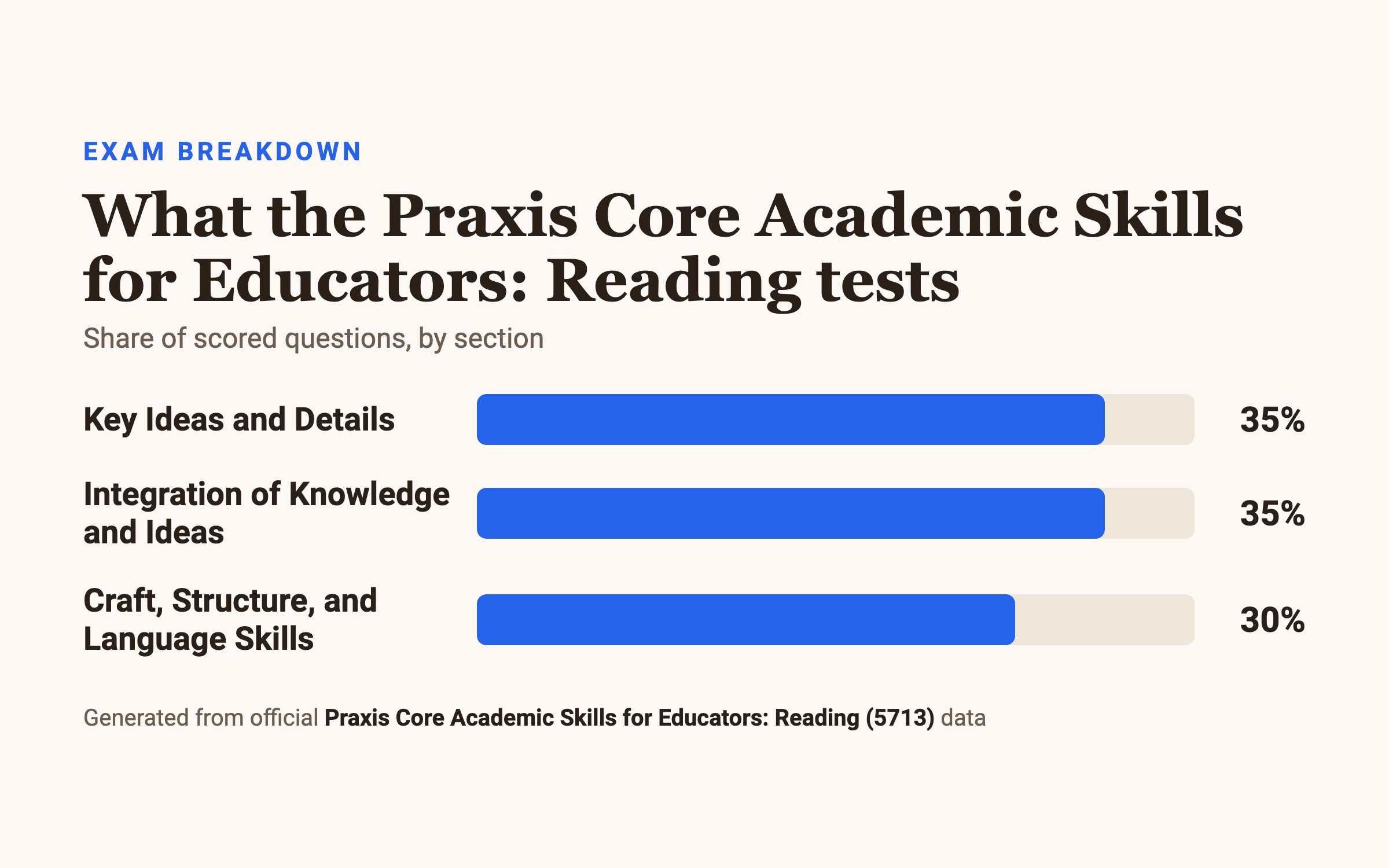
Three content categories:
| Category | Questions | Weight | Study hours |
|---|---|---|---|
| Key Ideas and Details | 17–22 | 35% | 15 |
| Craft, Structure, and Language Skills | 14–19 | 30% | 12 |
| Integration of Knowledge and Ideas | 17–22 | 35% | 15 |
The stimulus material comes in four shapes, and knowing them changes how you pace:
| Stimulus | Length | Questions |
|---|---|---|
| Paired passages (two texts, compared) | ~200 words combined | 4–7 |
| Long passage | ~200 words | 4–7 |
| Short passage | ~100 words | 2–3 |
| Brief statement | one or two sentences | 1 |
A brief statement with a single question can be answered in well under a minute, which is where you bank the time a paired-passage set needs.
One format detail catches people out. Most questions are standard five-option multiple choice, but the test also includes select-all-that-apply items, and there's no partial credit on them.
The plan, section by section
Forty-two hours over six weeks is about seven hours a week. The underlying skill is procedural, like sight-reading, so it responds to frequent short sessions with real passages. A 45-minute session on each weekday plus a longer timed run at the weekend gets you there.
Weeks 1–2, Key Ideas and Details, about 15 hours →
weeks 3–4, Craft, Structure, and Language Skills, about 12 hours →
weeks 5–6, Integration of Knowledge and Ideas, about 15 hours, with full timed sections throughout.
Start with identifying the main idea and determining the primary purpose. These two carry a large share of the 35% in Key Ideas and Details, and they share one habit. After each passage, say the author's point in your own words before you look at the options. Candidates who read the options first get pulled toward answers that are true statements about the passage but aren't its main idea — a wrong-answer design this test uses repeatedly.
Then summarizing and paraphrasing and finding supporting ideas and details. Train yourself to recognize the same idea expressed in unfamiliar words, since correct answers are almost always paraphrases. Finish the block with inference work: identifying inferences from stated content and understanding textual implications. The discipline for inference questions is narrow. The text has to force the answer; being consistent with the passage isn't enough.
Craft and Structure in the middle weeks, 12 hours. Vocabulary appears here as meaning in context. Nothing to memorize, and there are no analogies or antonym questions. Focus instead on author's attitude and tone, transition words that signal where an argument turns, organizational structure, and separating fact from opinion.
Integration of Knowledge and Ideas last, 15 hours, because it's the most demanding and it assumes the first two blocks. Here you evaluate the strength of evidence, identify unstated assumptions, read charts and graphs alongside text, and locate exactly where two authors agree and disagree. Paired passages reward a specific technique: read both, note each author's claim in three words, and only then read the questions.
Take at least three full 85-minute timed sections in the last two weeks. Pacing is the failure mode on this exam far more often than comprehension.
Where candidates lose points
-
Reading the whole passage twice. At 91 seconds per question, there is no clock left for a second full read of a 200-word passage. Read once, carefully, then go to the questions and return only to the specific lines you need.
-
Letting what you already know fill the gaps. When a passage covers a familiar subject, your background knowledge starts filling gaps the text left open. The wrong answers that sound right are usually true statements about the world that the passage never made. If you can't point at the line, it isn't the answer.
-
Picking an answer that's too strong. Options containing always, never, proves, or all are worth extra suspicion on inference questions, because a 200-word passage rarely supports an absolute.
-
Half-answering the select-all questions. There's no partial credit, so score each option true or false on its own terms.
-
Skipping the visual material. Charts, graphs, and maps carry questions in the Integration category, and the format itself slows you down if you have only trained on prose.
-
Treating 156 as universal. Your state or agency sets the passing score. Most use 156, but some accept a combined Core score across all three subtests instead of a per-subtest minimum. South Carolina, for example, accepts a 464 composite across the three, provided no single subtest falls more than four points under its own cut. Your state's rule may be more forgiving than a single number suggests.
Worth keeping in perspective: most test takers score between 158 and 184, comfortably clear of a 156 cut. If you're retaking after a near miss, remember that two scores a few points apart aren't reliably different, so aim several points clear of your state's cut.
Every topic here maps to a 15-minute study unit on the Praxis Core Reading syllabus, and the practice questions are free, including the AI-generated sets other prep tools charge for.
Common questions
How many questions are on the Praxis Core Reading (5713)? 56 questions in 85 minutes. Some are unscored pretest items mixed in with the scored ones and not identified, so answer everything — there's no penalty for guessing.
What is a passing score for the Praxis 5713? There's no single national score. ETS states outright that passing scores are set by states and agencies. Most use 156 on the 100–200 scale, and some accept a combined Core score instead of a per-subtest one. For context, the median score is 170 and most test takers score between 158 and 184.
Do I need outside knowledge about the passage topics? No. ETS states that every question can be answered using information contained in the passage. Familiarity with a topic may help you read faster, but leaning on it is a reliable way to pick a wrong answer.
What types of reading passages will I encounter? Four kinds: paired passages totaling about 200 words, long passages of about 200 words, short passages of about 100 words, and brief statements. The longer forms carry four to seven questions each; a brief statement carries one. Sources range across newspapers, magazines, journals, nonfiction, and novels, plus visual material like diagrams, charts, maps, and graphs.
Will there be vocabulary questions like analogies or antonyms? No. Vocabulary is tested as meaning in context — you work out what a word means from the sentence around it. There's no list to memorize.
How long should I study for the Praxis Core Reading? About 42 hours, or roughly seven hours a week over six weeks. Short frequent sessions with real passages suit this exam better than long ones, and the last two weeks should be mostly full-length timed practice.